Thank you for visiting SNEWPapers!
Sign up free
Editorial
December 24, 1822
The Portland Gazette
Portland, Cumberland County, Maine
What is this article about?
Editorial praises apprentices' libraries for fostering reading, moral and intellectual growth among young men, especially the middle class, to prevent vice and promote societal virtue, quoting the Portsmouth Journal and advocating widespread libraries, schools, and savings banks to empty jails and alms-houses.
Clipping
OCR Quality
95%
Excellent
Full Text
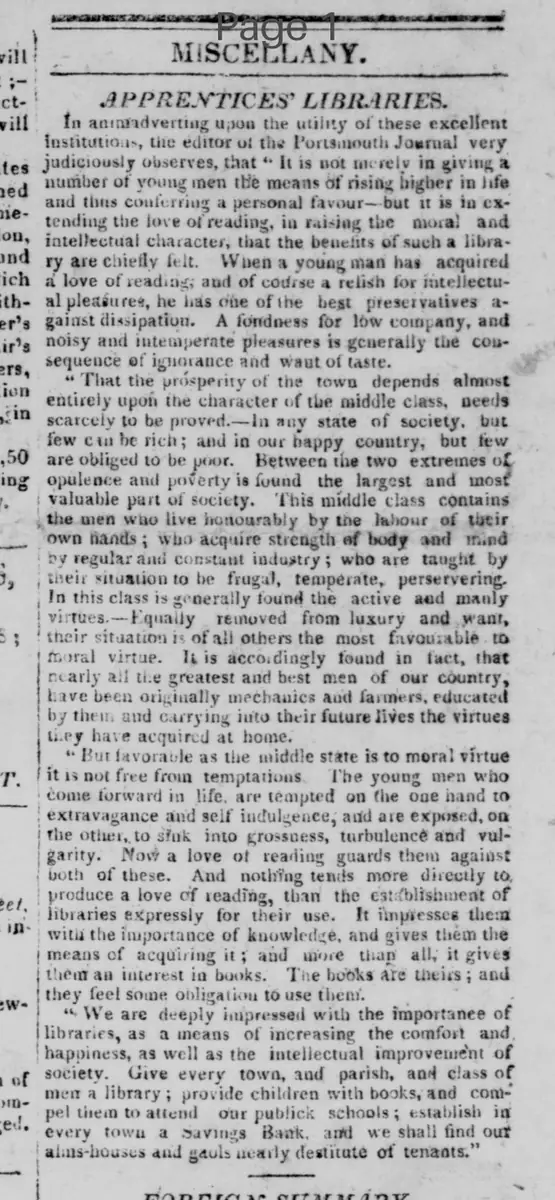
MISCELLANY.
APPRENTICES' LIBRARIES.
In animadverting upon the utility of these excellent institutions, the editor of the Portsmouth Journal very judiciously observes, that " It is not merely in giving a number of young men the means of rising higher in life and thus conferring a personal favour—but it is in extending the love of reading, in raising the moral and intellectual character, that the benefits of such a library are chiefly felt. When a young man has acquired a love of reading; and of course a relish for intellectual pleasures, he has one of the best preservatives against dissipation. A fondness for low company, and noisy and intemperate pleasures is generally the consequence of ignorance and want of taste.
"That the prosperity of the town depends almost entirely upon the character of the middle class, needs scarcely to be proved.—In any state of society, but few can be rich; and in our happy country, but few are obliged to be poor. Between the two extremes of opulence and poverty is found the largest and most valuable part of society. This middle class contains the men who live honourably by the labour of their own hands; who acquire strength of body and mind by regular and constant industry; who are taught by their situation to be frugal, temperate, persevering. In this class is generally found the active and manly virtues.—Equally removed from luxury and want, their situation is of all others the most favourable to moral virtue. It is accordingly found in fact, that nearly all the greatest and best men of our country, have been originally mechanics and farmers, educated by them, and carrying into their future lives the virtues they have acquired at home.
"But favourable as the middle state is to moral virtue it is not free from temptations The young men who come forward in life, are tempted on the one hand to extravagance and self indulgence, and are exposed, on the other, to sink into grossness, turbulence and vulgarity. Now a love of reading guards them against both of these. And nothing tends more directly to produce a love of reading, than the establishment of libraries expressly for their use. It impresses them with the importance of knowledge, and gives them the means of acquiring it; and more than all, it gives them an interest in books. The books are theirs; and they feel some obligation to use them.
We are deeply impressed with the importance of libraries, as a means of increasing the comfort and happiness, as well as the intellectual improvement of society. Give every town, and parish, and class of men a library; provide children with books, and compel them to attend our public schools; establish in every town a savings Bank, and we shall find our alms-houses and jails nearly destitute of tenants."
APPRENTICES' LIBRARIES.
In animadverting upon the utility of these excellent institutions, the editor of the Portsmouth Journal very judiciously observes, that " It is not merely in giving a number of young men the means of rising higher in life and thus conferring a personal favour—but it is in extending the love of reading, in raising the moral and intellectual character, that the benefits of such a library are chiefly felt. When a young man has acquired a love of reading; and of course a relish for intellectual pleasures, he has one of the best preservatives against dissipation. A fondness for low company, and noisy and intemperate pleasures is generally the consequence of ignorance and want of taste.
"That the prosperity of the town depends almost entirely upon the character of the middle class, needs scarcely to be proved.—In any state of society, but few can be rich; and in our happy country, but few are obliged to be poor. Between the two extremes of opulence and poverty is found the largest and most valuable part of society. This middle class contains the men who live honourably by the labour of their own hands; who acquire strength of body and mind by regular and constant industry; who are taught by their situation to be frugal, temperate, persevering. In this class is generally found the active and manly virtues.—Equally removed from luxury and want, their situation is of all others the most favourable to moral virtue. It is accordingly found in fact, that nearly all the greatest and best men of our country, have been originally mechanics and farmers, educated by them, and carrying into their future lives the virtues they have acquired at home.
"But favourable as the middle state is to moral virtue it is not free from temptations The young men who come forward in life, are tempted on the one hand to extravagance and self indulgence, and are exposed, on the other, to sink into grossness, turbulence and vulgarity. Now a love of reading guards them against both of these. And nothing tends more directly to produce a love of reading, than the establishment of libraries expressly for their use. It impresses them with the importance of knowledge, and gives them the means of acquiring it; and more than all, it gives them an interest in books. The books are theirs; and they feel some obligation to use them.
We are deeply impressed with the importance of libraries, as a means of increasing the comfort and happiness, as well as the intellectual improvement of society. Give every town, and parish, and class of men a library; provide children with books, and compel them to attend our public schools; establish in every town a savings Bank, and we shall find our alms-houses and jails nearly destitute of tenants."
What sub-type of article is it?
Education
Social Reform
Moral Or Religious
What keywords are associated?
Apprentices Libraries
Love Of Reading
Moral Character
Intellectual Improvement
Middle Class Virtues
Social Reform
What entities or persons were involved?
Portsmouth Journal
Middle Class
Mechanics And Farmers
Editorial Details
Primary Topic
Benefits Of Apprentices' Libraries
Stance / Tone
Strongly Supportive
Key Figures
Portsmouth Journal
Middle Class
Mechanics And Farmers
Key Arguments
Libraries Extend Love Of Reading And Raise Moral And Intellectual Character
Love Of Reading Preserves Against Dissipation And Low Company
Prosperity Depends On Middle Class Character
Middle Class Fosters Active And Manly Virtues
Libraries Guard Against Extravagance And Grossness
Establish Libraries, Schools, And Savings Banks To Reduce Alms Houses And Jails