Thank you for visiting SNEWPapers!
Sign up free
The National Intelligencer And Washington Advertiser
Washington, District Of Columbia
What is this article about?
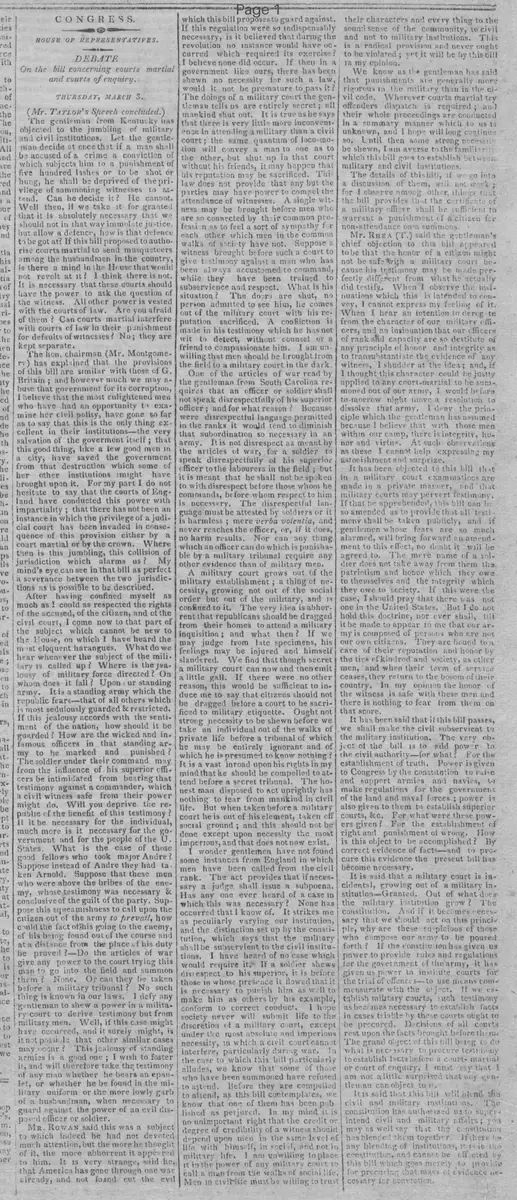
Transcript of U.S. House debate on March 3, 1808, over a bill empowering courts martial to compel civilian witness attendance, balancing military needs against civil rights; includes speeches by Taylor, Rowan, Rhea, and Lloyd; bill advances through readings by March 8.
Merged-components note: These two components are sequential in reading order and contain a continuous narrative report of the congressional debate on the bill concerning courts martial and courts of enquiry. The second component continues directly from the first, so they should be merged into a single story component.
Clippings
1 of 2
OCR Quality
Full Text
HOUSE OF REPRESENTATIVES,
DEBATE
On the bill concerning courts martial and courts of enquiry.
THURSDAY, MARCH 3.
(Mr. Taylor's Speech concluded.)
The gentleman from Kentucky has objected to the jumbling of military and civil institutions. Let the gentleman decide at once that if a man shall be accused of a crime a conviction of which subjects him to a punishment of five hundred lashes or to be shot or hung, he shall be deprived of the privilege of summoning witnesses to attend. Can he decide it? He cannot. Well then, if we take it for granted that it is absolutely necessary that we should not in that way immolate justice, but allow a defence, how is that defence to be got at? If this bill proposed to authorize courts martial to send musqueteers among the husbandmen in the country, is there a mind in the House that would not revolt at it? I think there is not. It is necessary that these courts should have the power to ask the question of the witness. All other power is vested with the courts of law. Are you afraid of them? Can courts martial interfere with courts of law in their punishment for defaults of witnesses? No; they are kept separate.
The hon. chairman (Mr. Montgomery) has explained that the provisions of this bill are similar with those of G. Britain: and however much we may abuse that government for its corruption, I believe that the most enlightened men who have had an opportunity to examine her civil polity, have gone so far as to say that this is the only thing excellent in their institutions—the very salvation of the government itself; that this good thing, like a few good men in a city, have saved the government from that destruction which some of her other institutions might have brought upon it. For my part I do not hesitate to say that the courts of England have conducted this power with impartiality; that there has not been an instance in which the privilege of a judicial court has been invaded in consequence of this provision either by a court martial or by the crown. Where then is this jumbling, this collision of jurisdiction which alarms us? My mind's eye can see in that bill as perfect a severance between the two jurisdictions as is possible to be described.
After having confined myself as much as I could as respected the rights of the accused, of the citizen, and of the civil court, I come now to that part of the subject which cannot be new to the House, on which I have heard the most eloquent harangues. What do we hear whenever the subject of the military is called up? Where is the jealousy of military force directed? On whom does it fall? Upon our standing army. It is a standing army which the republic fears—that of all others which is most sedulously guarded & restricted. If this jealousy accords with the sentiment of the nation, how should it be guarded? How are the wicked and infamous officers in that standing army to be marked and punished? The soldier under their command may from the influence of his superior officers be intimidated from bearing that testimony against a commander, which a civil witness safe from their power might do. Will you deprive the republic of the benefit of this testimony? If it be necessary for the individual, much more is it necessary for the government and for the people of the U. States. What is the case of those good fellows who took major Andre? Suppose instead of Andre they had taken Arnold. Suppose that these men who were above the bribes of the enemy, whose testimony was necessary & conclusive of the guilt of the party. Suppose this squeamishness to call upon the citizen out of the army to prevail, how could the fact of his going to the enemy, of his being found out of the course and at a distance from the place of his duty be proved?—Do the articles of war give any power to the court trying this man to go into the field and summon them? None. Or can they be taken before a military tribunal? No such thing is known in our laws. I defy any gentleman to shew a power in a military Court to derive testimony but from military men. Well, if this Case might have occurred, and it surely might, is it not possible that other similar cases may occur? This jealousy of standing armies is a good one; I wish to foster it, and will therefore take the testimony of any man whether he bears an epaulet, or whether he be found in the military uniform or the more lowly garb of a husbandman, when necessary to guard against the power of an evil disposed officer or soldier.
Mr. Rowan said this was a subject to which indeed he had not devoted much attention, but the more he thought of it, the more abhorrent it appeared to him. It is very strange, said he, that America has gone through one war already, and not found out the evil which this bill proposes to guard against. If this regulation were so indispensably necessary, is it believed that during the revolution no instance would have occurred which required its exercise? I believe none did occur. If then in a government like ours, there has been shewn no necessity for such a law, would it not be premature to pass it?
The doings of a military court the gentleman tells us are entirely secret; all mankind shut out. It is true as he says that there is very little more inconvenience in attending a military than a civil court; the same quantum of loco-motion will convey a man to one as to the other, but shut up in that court without his friends, it may happen that his reputation may be sacrificed. This law does not provide that any but the parties may have power to compel the attendance of witnesses. A single witness may be brought before men who are so connected by their common profession as to feel a sort of sympathy for each other which men in the common walks of society have not. Suppose a witness brought before such a court to give testimony against a man who has been always accustomed to command, while they have been trained to subservience and respect. What is his situation? The doors are shut, no person admitted to see him, he comes out of the military court with his reputation sacrificed. A contradiction is made in his testimony which he has not wit to detect, without counsel or a friend to compassionate him. I am unwilling that men should be brought from the field to a military court in the dark.
One of the articles of war read by the gentleman from South Carolina requires that an officer or soldier shall not speak disrespectfully of his superior officer; and for what reason? Because were disrespectful language permitted in the ranks it would tend to diminish that subordination so necessary in an army. It is not disrespect as meant by the articles of war, for a soldier to speak disrespectfully of his superior officer to the labourers in the field; but it is meant that he shall not be spoken to with disrespect before those whom he commands, before whom respect to him is necessary. The disrespectful language must be attested by soldiers or it is harmless; mere verba volantia, and never reaches the officer, or, if it does, no harm results. Nor can any thing which an officer can do which is punishable by a military tribunal require any other evidence than of military men.
A military court grows out of the military establishment; a thing of necessity, growing not out of the social order but out of the military, and is confined to it. The very idea is abhorrent that republicans should be dragged from their homes to attend a military inquisition; and what then? If we may judge from late specimens, his feelings may be injured and himself slandered. We find that though secret a military court can now and then emit a little gall. If there were no other reason, this would be sufficient to induce me to say that citizens should not be dragged before a court to be sacrificed to military etiquette. Ought not strong necessity to be shewn before we take an individual out of the walks of private life before a tribunal of which he may be entirely ignorant and of which he is presumed to know nothing? It is a vast inroad upon his rights in my mind that he should be compelled to attend before a secret tribunal. The honest man disposed to act uprightly has nothing to fear from mankind in civil life. But when taken before a military court he is out of his element, taken off social ground; and this should not be done except upon necessity the most imperious, and that does not now exist.
I wonder gentlemen have not found some instances from England in which men have been called from the civil rank. The act provides that if necessary a judge shall issue a subpoena. Has any one ever heard of a case in which this was necessary? None has occurred that I know of. It strikes me as peculiarly varying our institution, and the distinction set up by the constitution, which says that the military shall be subservient to the civil institutions. I have heard of no case which would require it. If a soldier shews disrespect to his superior, it is before those in whose presence it flowed that it is necessary to punish him as well to make him as others by his example, conform to correct conduct. I hope society never will submit life to the discretion of a military court, except under the most absolute and imperious necessity, in which a civil court cannot interfere, particularly during war. In the case to which this bill particularly alludes, we know that some of those who have been summoned have refused to attend. Before they are compelled to attend, as this bill contemplates, we know that one of them has been published as perjured. In my mind it is no unimportant right that the credit or degree of credibility of a witness should depend upon men in the same level of life with himself, in social, and not in military life. I am unwilling to place it in the power of any military court to call a man from the walks of social life. Men in civil life must be willing to trust their characters and every thing to the sound sense of the community, to civil and not to military institutions. This is a radical provision and never ought to be violated; yet it will be by this bill in my opinion.
We know as the gentleman has said that punishments are generally more rigorous in the military than in the civil code. Wherever courts martial try offenders dispatch is required; and their whole proceedings are conducted in a summary manner which to us is unknown, and I hope will long continue so. Until then some strong necessity be shewn, I am averse to the familiarity which this bill goes to establish between military and civil institutions.
The details of this bill, if we go into a discussion of them, will not work; for I observe among other things that the bill provides that the certificate of a military officer shall be sufficient to warrant a punishment of a citizen for non-attendance on a summons.
Mr. Rhea (T.) said the gentleman's chief objection to this bill appeared to be that the honor of a citizen might not be safe with a military court because his testimony may be made perfectly different from what he actually did testify. When I observe the insinuations which this is intended to convey, I cannot express my feeling of it. When I hear an intention to derogate from the character of our military officers, and an insinuation that our officers of rank and capacity are so destitute of any principle of honor and integrity as to transubstantiate the evidence of any witness, I shudder at the idea; and, if I thought this character could be justly applied to any court-martial to be summoned out of our army, I would before to-morrow night move a resolution to dissolve that army. I deny the principle which the gentleman has assumed because I believe that with those men within our camp, there is integrity, honor and virtue. At such observations as these I cannot help expressing my astonishment and surprize.
It has been objected to this bill that in a military court examinations are made in a private manner, and that military courts may pervert testimony. If that be apprehended, this bill can be so amended as to provide that all testimony shall be taken publicly, and if gentlemen whose fears are so much alarmed, will bring forward an amendment to this effect, no doubt it will be agreed to. The mere name of a soldier does not take away from them the patriotism and honor which they owe to themselves and the integrity which they owe to society. If this were the case, I should pray that there was not one in the United States. But I do not hold this doctrine, nor ever shall, till it be made to appear to me that our army is composed of persons who are not our own citizens. They are bound to care of their reputation and honor by the ties of kindred and society, as other men, and when their term of service ceases, they return to the bosom of their country. In my opinion the honor of the witness is safe with these men and there is nothing to fear from them on that score.
It has been said that if this bill passes, we shall make the civil subservient to the military institution. The very object of the bill is to add power to the civil authority—for what? For the establishment of truth. Power is given to Congress by the constitution to raise and support armies and navies, to make regulations for the government of the land and naval forces; power is also given to them to establish superior courts, &c. For what were these powers given? For the establishment of right and punishment of wrong. How is this object to be accomplished? By correct evidence of facts—and to procure this evidence the present bill has become necessary.
It is said that a military court is incidental, growing out of a military institution—Granted. Out of what does the military institution grow? The constitution. And if it becomes necessary that we should act on this principle, why are these suspicions of those who compose our army to be poured forth? If the constitution has given us power to provide rules and regulations for the government of the army, it has given us power to institute courts for the trial of offences—to use means commensurate with the object. If we establish military courts, such testimony as becomes necessary to establish facts in cases triable by those courts ought to be procured. Decisions of all Courts rest upon the facts brought before them. The grand object of this bill being to do what is necessary to procure testimony to establish facts before a court-martial or Court of enquiry, I must say that I am not a little surprised that any gentleman can object to it.
It is said that this bill will blend the civil and military institutions. The constitution has authorized us to superintend civil and military affairs; you may as well say that the constitution has blended them together. If there is any blending of institutions, it is in the constitution, and cannot be acted by this bill which goes merely to provide for procuring that mass of evidence necessary for conviction.
MR. Lloyd said he would state the reasons that would induce him to vote in favor of the motion for striking out the first section, and also his reasons for voting against the bill. That the principles and details of this bill were so abhorrent to his mind, so little according with the political principles which had always actuated his conduct, that he could not reconcile it with his duty to his constituents, or to his own feelings to give a silent vote. He wished also to be understood, that in any observations he should make, he meant not to impeach the principles or motives of those gentlemen who advocated the bill, nor in any thing he might say in regard to courts of inquiry, or courts martial, did he mean to reflect on any officer of our army.
He said he should consider the nature of the court to whom we were about to give the power by law, of dragging our citizens from their families and their homes, how far the details of this bill accorded with the principles of justice or the spirit of the constitution, and what necessity did there exist for the increasing of the jurisdiction of military courts to this alarming extent. The reason which has been urged by my colleague (Mr. Montgomery) and on which he declares this bill to be founded, is, that at present a soldier or officer of the United States may be tried and deprived of his life when deprived of the power of summoning witnesses that may be necessary for his defence. This might be an argument of some weight, if an officer or soldier was amenable only to a military court; but the act is that military courts are clearly intended by the articles of war for the punishment of offences committed in quarters, garrisons or on march, or acts most generally committed in the view of the army, and which are made offences by military law. Those offences then, sir, being committed before military men, courts martial or courts of inquiry have already the power of summoning those witnesses that may be material either to criminate or acquit the accused. But what, sir, is the situation of the officer or soldier who commits an offence against the persons or property of a citizen, such as are punishable by the known laws of the land. If the gentleman will turn to the 33d article of war, he will find that they are to be delivered over to a civil magistrate that he may bring them to trial. Mr. L. then read the following clause:
"When any commissioned officer or soldier shall be accused of a capital crime, or of having used violence or committed any offence against the persons or property of any citizen of any of the United States, such as is punishable by the known laws of the land, the commanding officer, and officers, &c. are required, upon application, &c. to use their utmost endeavors to deliver over the person or persons so accused, &c. in order to bring them to trial, &c."
In what situation then I will ask, is it probable that an officer or soldier should commit an offence, on the trial for which he would not have it in his power to summon evidence? If an offence is committed for which he is amenable to a court martial, it results from his situation, and the effects of military discipline that it must take place in the presence of those who may be summoned by a military court. I mean, sir, his brother officers or soldiers. If on the other hand an offence is committed, not known in the articles of war, and for which he is amenable to the civil authorities of your country, a military court has nothing to do with it, and the civil court has already the power of summoning any witness either military or civil.
This then, sir, being a correct position, I shall contend that there is not the most distant probability that any offence should be committed, when it will be impossible to procure or compel the attendance of evidence, if any evidence should exist, and it must be admitted that if none should exist, no law we can pass can conjure it up either for the purpose of condemnation or acquittal, and what must give force to this opinion, that no necessity does exist or this law, is, that not a case has occurred in which testimony could not be had before a proper tribunal. I would, sir, then ask if no such case has existed, if your laws heretofore have been effective, why anticipate an improbable evil, for the purpose of applying the remedy of this law, the effects of which, in my opinion, would be mischievous and oppressive. Sir, I trust the House will not do it. The gentleman from South Carolina has to be sure expressed great sympathy for those persons who are subject to military rule. Sir, I feel as much as that gentleman for the sufferings of those who are subject to military and arbitrary power. But we find from the experience of every country that policy has dictated the subordination imposed by the articles of war, and from habit and custom it is now thought necessary and proper. But however pleasing and soothing the gentleman's representation of the situation of the soldier may be to the feelings of humanity, it certainly as an argument can have no bearing on the present question. If you mean to grant privileges to the military, which heretofore have been granted only to citizens, you destroy that subordination and distinction which from experience and necessity has existed between the two orders, and which distinction has been recognized in the constitution, and therefore until it is found necessary from experience to make this regulation the House will not surely agree to it. The gentleman from S. C. tells us that trials before military courts are not public. I profess myself to be very little acquainted with the modes of proceeding in these courts, and will therefore take the gentleman on his own shewing, and ask this House if they will sanction a law by which their fellow citizens shall be dragged into an inquisition--that in defiance of those principles which have heretofore actuated the republican party in violation of the people's rights, that you will drag them before a court of enquiry, or court martial, as the case may be, there to be shut up and questioned, on the most delicate subjects to themselves, and perhaps irrelevant to the cause, at the caprice and discretion of the commanding officer. Can this be justified? Can this be reconciled to their own feelings or to the people? If it can, gentlemen must differ very widely from me; indeed viewing it as I do, they never could support it. The gentleman from S. C. has also observed, that whenever any thing was said in the House with respect to the liberty of the country, standing armies were introduced, and that the House were favored by an eloquent strain of declamation. Is this strange? Sir, the very articles of war which we are about to amend, or rather to make worse, is a strong argument why men subject to them ought not to be depended on in times of peace. Can any man suppose that a soldier who can be tied up and flogged at the discretion of a petty court martial, can feel that ardor for liberty with one who is living in the unrestrained enjoyment of all its blessings? Can they be expected to step forward in defence of rights they do not enjoy? Can they feel much attachment to the principles of a constitution, when they are deprived of sacred rights which are extended to others, and which rights would alone attach your citizens to your government? No Sir, no such zeal can be expected from them. You might as well expect from the slave of an Eastern nabob, that attachment to your constitution which you find in your own citizens. The gentleman from Tennessee has observed that courts martial or courts of enquiry cannot pervert the truth of evidence. They certainly have a right to determine as they please on evidence; and by whom I would ask are these courts appointed? Generally it may be said by the officers of high rank, but sometimes by officers of inferior rank, sometimes for one purpose, sometimes for another. But no one will contend, sir, who knows any thing of human nature, that in as much as men holding commissions, and filling high offices in the government have the appointment of courts martial, that the time may not arrive when those courts may be created for the worst of purposes; that they may be created for the purpose of advancing the views and interest of the person who creates them. Will the gentleman contend that a court appointed in this way, can or will decide properly on the evidence that comes before them? Certainly not, sir; and I would ask to whom are these courts responsible? Responsible only to the person who appoints them. Sir, permit me to say that I consider these military courts as little calculated from the very nature of their creation to decide the fate of an American citizen as the inquisition itself. But, sir, another consideration has great weight with me. Before I would compel a citizen to appear as an evidence in any court, I must have some pledge that he would be protected, and that the persons composing the court, were competent to decide on the rules of evidence, and that he might not be called on to answer questions tending to criminate himself. I will readily and willingly admit that the persons composing a court martial or court of enquiry may possess all the honor and valor characteristic of the soldier, but it does not follow that they are acquainted with our common and statute laws. A man may possess all the qualifications that may entitle him to mount the cockade in his hat: he may be bold, ardent and adventurous, but not a profound lawyer. In fact, sir, without saying any thing to the disparagement of our officers, and which I assure you I have no disposition to do, I may say that from the nature of their education they are not qualified to compose a court, such as American citizens are accustomed to. I will ask what may be the result of this law if passed: a soldier or officer is on his trial at Michilimackinac, and for the purpose of delay he subpoenas a witness from a distant part of the Union, you must by the provisions of this law, leave your home, and give your attendance, when in fact you know nothing relevant to the cause, This, sir, is giving a privilege unknown, I believe, in our civil courts, for when a witness does not attend, you must file an affidavit, or your cause goes on; but this regulation for ought I know, may vary in the different states.
Let us now examine the provisions of the first section, and see how far it comports with the dignity which ought to be preserved in the judiciary of our country, and how far it respects the private and delicate communications which frequently take place amongst your citizens, and with which the public interest and welfare have no connexion.
Let us refer to the bill. "That in every case where the attendance of any person, not in the military or naval service of the United States, shall be necessary as a witness before a military or naval court martial, a summons may be issued out of any court of the United States, and the clerk of any such court shall be, and he is hereby authorized and required, upon due application in writing by the judge advocate, or party officiating as such, or by the party accused, to issue such summons, requiring such witness to appear, and give evidence before such court martial or court of enquiry, and upon good & sufficient cause shewn"--What is meant by the words good and sufficient cause shewn? I ask the framers of the bill, if they mean by good and sufficient cause shewn, that a military court shall determine when it is necessary; and that a judge of a civil court shall, in compliance with their command, issue a summons? Is this, Sir, to be the power given to a court of enquiry by this bill? If it is, you make the civil institutions of your country instruments in the hands of a military court. for you call upon a judge to do a judicial act without knowing whether it is correct or not. This sir, is a principle which I never can sanction with my vote. But perhaps this is not the intention, but it is intended that the judge shall determine the necessity and propriety of summoning the witness. Then I will ask how is it possible that a judge can decide when the case is not judicially before him? How can the judge of this district for instance decide upon the case depending in the court of Inquiry, to which he has not attended in the character of a judge? If they have not all the circumstances before them it is impossible they can decide any question with propriety in the capacity of a judge. But sir, it seems that they are to have power by this law, to compel a witness to produce any paper, document or record in his possession, power, or control—[Mr. Lloyd then read the following.-"The said witness in such summons may be further directed and required to exhibit in evidence before such court martial or court of inquiry, any paper document or record in his possession, power or control."] Is there, I will ask, a judge presiding in any civil court in the United States who would suffer a party to examine a witness to this alarming, unjust and indelicate extent? Was there ever such a thing heard of in a country possessed of civil liberty, that a summons should issue compelling a citizen to produce every document or paper in their possession or control? It is true when any paper is decided by a Judge in a court of common law to be relevant, and important in a case, the party may be compelled to produce it, but to say that every paper & document, even of the most delicate, and irrelevant nature is to be produced, that the communications which have been made in the generous glow of friendship; that letters which have been intrusted to the care and honor of a friend, involving the secret and private transactions of a man's life and having no bearing on the cause at issue, are to be indiscriminately revealed to a military court, is a measure, sir, that I am sure this House never will sanction.
What sir, will be the consequence of this law if it pass? You prostrate the rules of evidence which have heretofore existed, and in your great zeal to convict the accused, you compel an American citizen in violation of justice and the principles of liberty to become his own accuser. It may be said, sir, that a court of inquiry or court martial would not suffer a disclosure of facts irrelevant to the cause. to be made. In the first place, sir, I may answer that they may be (without reflecting on them as men of honor or courage) ignorant of statute and common law and ignorant of the rules of evidence, and in the second place I never would trust to the discretion of any court, much less to a court having as little responsibility to the nation as a military court.
From the proviso at the end of the second section, it appears that sickness or some other inevitable impediment is the only plea that can be made in justification of a default, and if a paper is not produced "That in case such witness shall satisfy the court before whom such proceeding against such witness shall be had as aforesaid, that the default imputed to him was produced by sickness or other inevitable impediment, and was not an act of contempt or wilful disobedience, such witness shall be forthwith discharged from any farther proceedings thereupon in said court." I will ask this House if summoned to produce a letter I could satisfy the judge that it had no relation to the cause depending ought it not to be on the principles of justice and commonsense a sufficient cause for withholding it, ought I to be compelled to gratify the whim and caprice of the accuser or the accused, to produce a letter of a delicate and private nature having no bearing on the subject, or to produce one that might criminate myself. Sir, this doctrine cannot be supported. As something has been said sir, with respect to the court of inquiry now sitting in this city perhaps it may be said that this law should pass to enable the court to progress in their Inquiry-against this it may be urged that the offence into which they are enquiring, is not an offence known to the articles of war; but in my opinion it would be better that ten thousand offenders covered with suspicion and guilt should escape unpunished, than to violate the principles of your constitution, on the inviolate observance of which depends the liberty and happiness of yourselves and your children. Better would it be that General Wilkinson should remain (what has he proved by his own declaration) the victim of suspicion for 13 years longer without establishing his innocence, and let the responsibility for his future good conduct rest with those who hereafter may retain him in office. Sir, as this individual case may be introduced as a reason for the adoption of this law, permit me to digress, and call the attention of the House and the nation to one fact; that in this country which possesses every institution calculated to protect the property, to defend the liberty, and to preserve from malignity and slander, the character of the citizen; that an individual should be found professing all the punctilious honor and courage of the soldier, who for thirteen years has been the victim of suspicion. This is an enigma I will not pretend to unravel, but will leave it to those more skilled in necromancy than myself.
It has been said, sir, that the President of the U. S. intimated a necessity for this law. He certainly in his message, noticed that military courts had not the power of compelling the attendance of witnesses; but I cannot from this suppose that he meant to recommend a thing like this; fraught with mischiefs incalculable; but for the sake of argument, I will admit that the President has recommended this extraordinary bill, does it follow that this circumstance is to induce me to sacrifice the pledge I have given to my constituents to protect their rights, as far as I am able, or to violate the oath I have taken in the face of this House, and in the face of the nation to support the constitution of the U. States-But this argument of confidence so often introduced into this House, is one I do not understand or approve. We are responsible to the people for our conduct-so is the Executive. And to say that we must advocate this or that measure because the Executive recommends it, is in my opinion degrading to the dignity of the Representatives of the people. To the new-born political creed of unsuspecting confidence, of implicit obedience to Executive will, I never can, I never will subscribe. If I cannot retain my popularity by a strict adherence to the principles of the constitution, by supporting all measures calculated to advance the happiness of the people & the good of my country, & by a decided opposition to all those measures calculated to have a contrary effect, no matter by whom recommended, I am ready and willing to retire into private life, there to lament the political fanaticism of my countrymen. It is, sir, from the people themselves I wish to hold my popularity, and on the ground that by my political conduct I show myself attached to their rights and independence. I have trespassed a considerable time on the patience of the Committee, and am conscious of their indulgence.
Mr. RHEA rose to explain that he had not used the expression that military courts could not pervert testimony.
Mr. Taylor rose to observe that he had when up before expressed himself inaccurately; and the gentlemen who had replied to him had taken ample advantage of it. Military courts, he said, took testimony in public, but deliberated on it in private. He had before stated that the trial was private, which was an error proceeding from his considering the practice in this country to be the same as in England.
(For a continuation of Proceedings on this subject, see the detail of the business of yesterday and to-day in our next.)
MONDAY, MARCH 7.
On this day the bill concerning courts martial and courts of enquiry went through the committee of the whole, and was ordered to a third reading to-morrow.
TUESDAY, MARCH 8.
The bill concerning courts martial being on its third reading, was on this day on motion of Mr. Basset, recommitted to a committee of the whole.
The engrossed bill authorising the sale of certain arms passed its third reading by Yeas and Nays-86 to 21.
The bill in addition to the embargo act was returned from the Senate with amendments-which were concurred in.
The bill for the purchase of an additional number of arms, was returned from the Senate with an amendment for appropriating 150,000 dollars for the purchase of SULPHUR and SALT-PETRE; which was concurred in without a division.
Details of this and the preceding day's proceedings are from press of matter postponed till our next.
What sub-type of article is it?
What themes does it cover?
What keywords are associated?
What entities or persons were involved?
Where did it happen?
Story Details
Key Persons
Location
House Of Representatives
Event Date
Thursday, March 3.
Story Details
Debate in the House on a bill to allow courts martial and courts of enquiry to summon civilian witnesses, with speeches arguing for military necessity and against infringement on civil rights and liberties.