Thank you for visiting SNEWPapers!
Sign up free
Story
February 15, 1891
The Cheyenne Daily Leader
Cheyenne, Laramie County, Wyoming
What is this article about?
Demonstration of whist card game's inferential power, where player A deduces partners' and opponents' hands through card plays across rounds, showcasing strategic thinking.
Clipping
OCR Quality
95%
Excellent
Full Text
Davis Deacons.
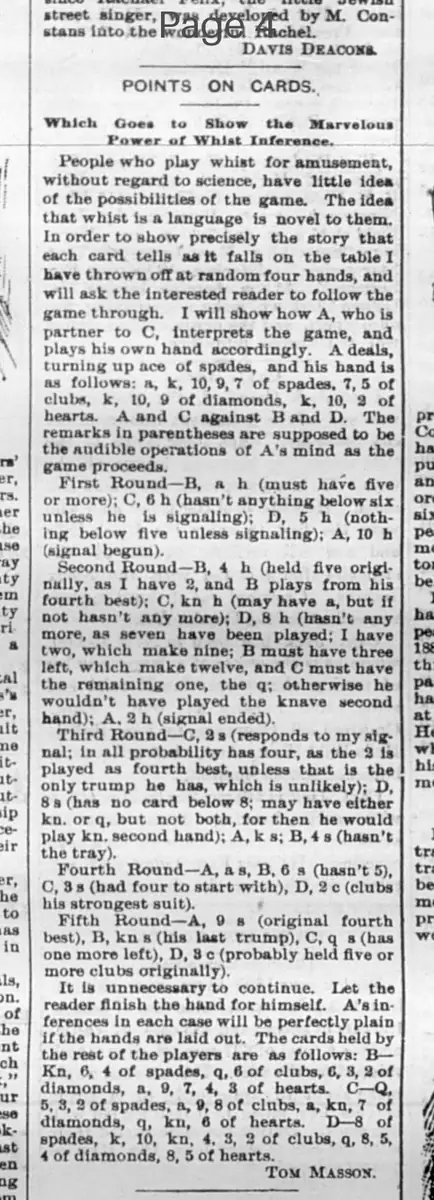
POINTS ON CARDS.
Which Goes to Show the Marvelous Power of Whist Inference.
People who play whist for amusement, without regard to science, have little idea of the possibilities of the game. The idea that whist is a language is novel to them. In order to show precisely the story that each card tells as it falls on the table I have thrown off at random four hands, and will ask the interested reader to follow the game through. I will show how A, who is partner to C, interprets the game, and plays his own hand accordingly. A deals, turning up ace of spades, and his hand is as follows: a, k, 10, 9, 7 of spades, 7, 5 of clubs, k, 10, 9 of diamonds, k, 10, 2 of hearts. A and C against B and D. The remarks in parentheses are supposed to be the audible operations of A's mind as the game proceeds.
First Round—B, a h (must have five or more); C, 6 h (hasn't anything below six unless he is signaling); D, 5 h (nothing below five unless signaling); A, 10 h (signal begun).
Second Round—B, 4 h (held five originally, as I have 2, and B plays from his fourth best); C, kn h (may have a, but if not hasn't any more); D, 8 h (hasn't any more, as seven have been played; I have two, which make nine; B must have three left, which make twelve, and C must have the remaining one, the a; otherwise he wouldn't have played the knave second hand); A, 2 h (signal ended).
Third Round—C, 3 s (responds to my signal; in all probability has four, as the 2 is played as fourth best, unless that is the only trump he has, which is unlikely); D, 8 s (has no card below 8; may have either kn, or q, but not both, for then he would play kn. second hand); A, k s; B, 4 s (hasn't the tray).
Fourth Round—A, as, B, 6 s (hasn't 5), C, 3 s (had four to start with), D, 2 c (clubs his strongest suit).
Fifth Round—A, 9 s (original fourth best), B, kn s (his last trump), C, q s (has one more left), D, 3 c (probably held five or more clubs originally).
It is unnecessary to continue. Let the reader finish the hand for himself. A's inferences in each case will be perfectly plain if the hands are laid out. The cards held by the rest of the players are as follows: B—Kn, 6, 4 of spades, q, 6 of clubs, 6, 3, 2 of diamonds, a, 9, 7, 4, 3 of hearts. C—Q, 5, 3, 2 of spades, a, 9, 8 of clubs, a, kn, 7 of diamonds, q, kn, 6 of hearts. D—8 of spades, k, 10, kn, 4, 3, 2 of clubs, q, 8, 5, 4 of diamonds, 8, 5 of hearts.
TOM MASSON.
POINTS ON CARDS.
Which Goes to Show the Marvelous Power of Whist Inference.
People who play whist for amusement, without regard to science, have little idea of the possibilities of the game. The idea that whist is a language is novel to them. In order to show precisely the story that each card tells as it falls on the table I have thrown off at random four hands, and will ask the interested reader to follow the game through. I will show how A, who is partner to C, interprets the game, and plays his own hand accordingly. A deals, turning up ace of spades, and his hand is as follows: a, k, 10, 9, 7 of spades, 7, 5 of clubs, k, 10, 9 of diamonds, k, 10, 2 of hearts. A and C against B and D. The remarks in parentheses are supposed to be the audible operations of A's mind as the game proceeds.
First Round—B, a h (must have five or more); C, 6 h (hasn't anything below six unless he is signaling); D, 5 h (nothing below five unless signaling); A, 10 h (signal begun).
Second Round—B, 4 h (held five originally, as I have 2, and B plays from his fourth best); C, kn h (may have a, but if not hasn't any more); D, 8 h (hasn't any more, as seven have been played; I have two, which make nine; B must have three left, which make twelve, and C must have the remaining one, the a; otherwise he wouldn't have played the knave second hand); A, 2 h (signal ended).
Third Round—C, 3 s (responds to my signal; in all probability has four, as the 2 is played as fourth best, unless that is the only trump he has, which is unlikely); D, 8 s (has no card below 8; may have either kn, or q, but not both, for then he would play kn. second hand); A, k s; B, 4 s (hasn't the tray).
Fourth Round—A, as, B, 6 s (hasn't 5), C, 3 s (had four to start with), D, 2 c (clubs his strongest suit).
Fifth Round—A, 9 s (original fourth best), B, kn s (his last trump), C, q s (has one more left), D, 3 c (probably held five or more clubs originally).
It is unnecessary to continue. Let the reader finish the hand for himself. A's inferences in each case will be perfectly plain if the hands are laid out. The cards held by the rest of the players are as follows: B—Kn, 6, 4 of spades, q, 6 of clubs, 6, 3, 2 of diamonds, a, 9, 7, 4, 3 of hearts. C—Q, 5, 3, 2 of spades, a, 9, 8 of clubs, a, kn, 7 of diamonds, q, kn, 6 of hearts. D—8 of spades, k, 10, kn, 4, 3, 2 of clubs, q, 8, 5, 4 of diamonds, 8, 5 of hearts.
TOM MASSON.
What sub-type of article is it?
Curiosity
What themes does it cover?
Moral Virtue
What keywords are associated?
Whist
Card Inference
Game Strategy
Trump Signals
Hand Deduction
What entities or persons were involved?
A
C
B
D
Tom Masson
Story Details
Key Persons
A
C
B
D
Tom Masson
Story Details
Player A demonstrates whist inference by deducing hands from card plays in five rounds, revealing the strategic 'language' of the game.