Thank you for visiting SNEWPapers!
Sign up free
The Daily Cincinnati Republican, And Commercial Register
Cincinnati, Hamilton County, Ohio
What is this article about?
US Senate debates and passes Mr. King's resolution postponing legislation on French treaty affairs due to early calling of French Chambers, overruling Mr. Clay's proposal that would invite French non-compliance with the 1831 treaty indemnity.
Clipping
OCR Quality
Full Text
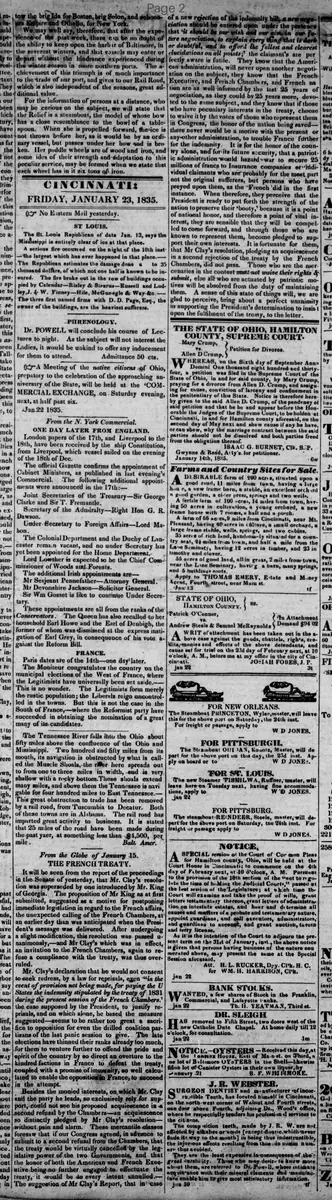
THE FRENCH TREATY.
It will be seen from the report of the proceedings in the Senate of yesterday, that Mr. Clay's resolution was superseded by one introduced by Mr. King of Georgia. The proposition of Mr. King as at first submitted, suggested as a motive for postponing immediate legislation in regard to the French affairs, the unexpected calling of the French Chambers, at an earlier day than was anticipated when the President's message was delivered. After undergoing a slight modification, this resolution was passed unanimously, and Mr. Clay's which was in effect, an invitation to the French Chambers, again to refuse a compliance with the treaty, was thus overruled.
Mr. Clay's declaration that he would not consent to seek redress, by a law for reprisals, even "in the event of provision not being made, for paying the United States the indemnity stipulated by the treaty of 1831 during the present session of the French Chambers," the case supposed by the President, to justify reprisals, and on which alone, he based the measure suggested—seems to be rather too great a sacrifice to opposition for even the drilled coalition partisans of the last panic session to give. The late elections have thinned their ranks already too much, for them to venture further to offend the pride and spirit of the country by so direct an overture to the kindred factions in France to defeat the treaty, coupled with a promise of impunity, so well calculated to enable the opposition in France, to succeed in the attempt.
Besides the monied interests, on which Mr. Clay and the party he leads, so exclusively rely for support, could not see his proposed acquiescence in a second refusal by the Chambers—an acquiescence so distinctly pledged by Mr. Clay's resolution—without pain and alarm. These mercantile classes foresaw that if our Congress agreed, in advance to submit to a second refusal from the Chambers, that the treaty would be virtually cancelled by the legislative power of the two Governments, and that the honor of both the American and French Executive being no further engaged to effectuate the treaty, it would be to every intent annulled.
The suggestion of Mr. Clay's Report, that in case of a new rejection of the indemnity bill; a new negotiation should be entered upon under the pretence that 'it should be our wish and our aim in our future negociation, to explain every thing that is dark or doubtful, and to afford the fullest and clearest elucidations on all points; the claimant's are perfectly aware is futile. They know that the American administration, will never open another negotiation on the subject, they know that the French Executive, and French Chambers, and French nation are as well informed by the last 25 years of negotiation, as they could by 25 years more, devoted to the same subject, and they know that if those who have pecuniary interests in the treaty, choose to waive it by the votes of those who represent them in Congress, the honor of the nation being saved—there never would be a motive with the present or any other administration, to trouble France further for the indemnity. It is for the honor of the country alone, and for its future security, that a patriotic administration would hazard "war to secure 25 millions of francs to Insurance companies or individual claimants who are probably for the most part not the original sufferers, but persons who have preyed upon them, as the French did in the first instance. When therefore, they perceive that the President is ready to put forth the strength of the nation to preserve their 'booty,' because it is a point of national honor, and therefore a point of vital interest, they are sensible that they will be compelled to come forward, and through those who are known to represent them, become pledged to support their own interests. It is fortunate for them, that Mr. Clay's resolution, pledging an acquiescence in a second rejection of the treaty by the French Chambers, did not pass. Those who are the mercenaries in the contest must not waive their rights submit, else all who are actuated by patriotic motives will be absolved from the duty of maintaining them. A sense of this state of things will, we are glad to perceive, bring about a perfect unanimity in supporting the President's determination to insist upon the fulfilment of the treaty, to the letter.
What sub-type of article is it?
What keywords are associated?
What entities or persons were involved?
Where did it happen?
Foreign News Details
Primary Location
France
Event Date
January 15
Key Persons
Outcome
mr. king's resolution passed unanimously, superseding and overruling mr. clay's resolution
Event Details
US Senate proceedings on January 14 superseded Mr. Clay's resolution with Mr. King's, postponing legislation on French treaty due to early calling of French Chambers; Clay's proposal seen as inviting French non-compliance with 1831 treaty indemnity, while King's passed unanimously; commentary criticizes Clay's stance against reprisals and suggests it would annul the treaty, emphasizing national honor and support for President's insistence on fulfillment.