Thank you for visiting SNEWPapers!
Sign up free
Editorial
April 14, 1820
Kentucky Gazette
Lexington, Fayette County, Kentucky
What is this article about?
This editorial from the National Intelligencer criticizes the Hartford Convention, highlighting premature motions in the Massachusetts legislature in October 1814 to confront President Madison, assume control of federal taxes, and raise a state army of 10,000 men primarily to support secessionist convention efforts rather than defend against British invasion during the War of 1812.
Clipping
OCR Quality
95%
Excellent
Full Text
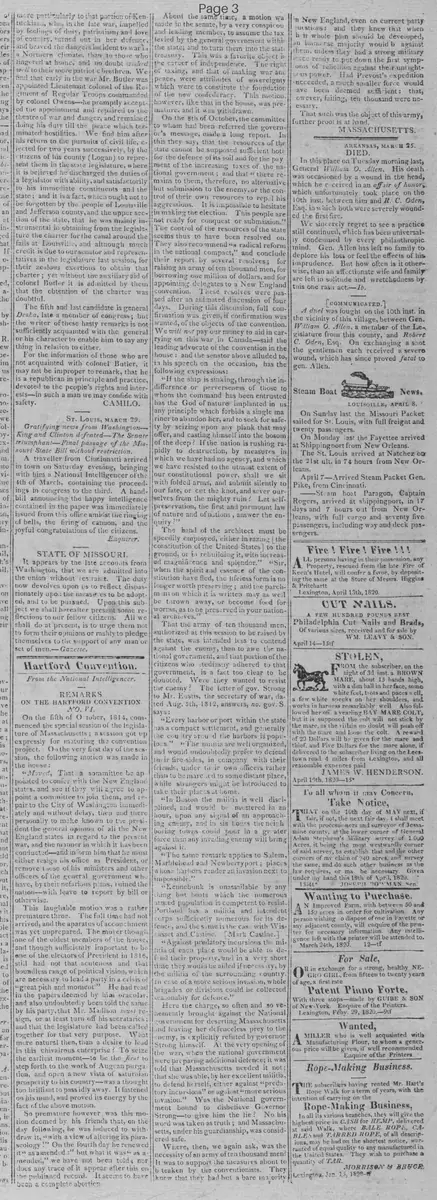
Hartford Convention.
From the National Intelligencer.
REMARKS ON THE HARTFORD CONVENTION NO. VI.
On the fifth of October, 1814, commenced the special session of the legislature of Massachusetts; a session got up expressly for maturing the convention project. On the very first day of the session, the following motion was made in the house:
"Resolved, That a committee be appointed to confer with the New England states, and see if they will agree to appoint a committee to join them, and repair to the City of Washington immediately and without delay, then and there personally to make known to the president the general opinion of all the New England states in regard to the present war, and the manner in which it has been conducted—and inform him that he must either resign his office as President, or remove those of his ministers and other officers of the general government who have, by their nefarious plans, ruined the nation—with leave to report by bill or otherwise."
This laughable motion was a rather premature throe. The full time had not arrived, and the apparatus of accouchement was yet unprepared. The mover though one of the oldest members of the house, and though sufficiently important to be one of the electors of President in 1816, still had not that acuteness and that boundless range of political vision, which are necessary to lead a party in a crisis of "great pith and moment." He had read in the papers deemed by him oracular, and also undoubtedly been told the same by his party, that Mr. Madison must resign, or at least turn off his secretaries; and that the legislature had been called together for that very purpose. What more natural then, than a desire to lead in this chivalrous enterprise? To seize the earliest moment—to be the first to step forth to the work of Augcan purgation, and open a new vista of saturnian prosperity to his country—was a thought too brilliant to pass idly away. It fastened on his mind, and proved its energy by the fact of the above motion.
So premature however was this motion deemed by his friends that, on the day following, he was induced to withdraw it, "with a view of altering its phraseology!" On the fourth day he renewed it "as amended:" but what it was "as amended," we have not been told, nor does any trace of it appear after this on the published record. It seems to have been a complete abortion.
About the same time, a motion was made in the senate, by a very conspicuous and leading member, to assume the tax levied by the general government within the state; and to turn them into the state treasury. This was a favorite object in the career of independence. The right of taxing, and that of making war and peace, were attributes of sovereignty which were to constitute the foundation of the new confederacy. This motion, however, like that in the house, was premature, and it was withdrawn.
On the 8th of October, the committee to whom had been referred the governor's message, made a long report. In this they say, that the resources of the state cannot be supposed sufficient both for the defence of its soil and for the payment of the increasing taxes of the national government; and that "there remains to them, therefore, no alternative but submission to the enemy, or the control of their own resources to repel his aggressions. It is impossible to hesitate in making the election. This people are not ready for conquest or submission."
The control of the resources of the state seems thus to have been resolved on. They also recommend "a radical reform in the national compact," and conclude their report by several resolves; for raising an army of ten thousand men, for borrowing one million of dollars, and for appointing delegates to a New England convention. These resolves were passed after an animated discussion of four days. During this discussion, full confirmation was given, if confirmation was wanted, of the objects of the convention. We will not pay our money to aid in carrying on this war in Canada—said the leading advocate of the convention in the house: and the senator above alluded to, in his speech on the occasion, has the following expressions:
"If the ship is sinking, through the indifference or perverseness of those to whom the command has been entrusted has the God of nature implanted in us any principle which forbids a single mariner to abandon her, and to seek for safety by seizing upon any plank that may offer, and casting himself into the bosom of the deep? If the nation is rushing rapidly to destruction, by measures in which we have had no agency, and which we have resisted to the utmost extent of our constitutional power, shall we sit with folded arms, and submit silently to our fate, or cut the knot, and sever ourselves from the mighty ruin? Let self-preservation, the first and paramount law of nature and of nations, answer the enquiry?"
The hand of the architect must be speedily employed, either in razing [the constitution of the United States] to the ground, or in rebuilding it, with increased magnificence and splendor." "Sir, when the spirit and essence of the constitution have fled, the lifeless form is no longer worth preserving; and the parchment which it is written may as well be thrown away, or become food for worms, as to be preserved in your national archives."
That the army of ten thousand men, authorized at this session to be raised by the state, was intended less to contend against the enemy, than to awe the national government, and that portion of the citizens who steadfastly adhered to that government, is a fact too clear to be doubted. Were they wanted to resist the enemy? The letter of gov. Strong to Mr. Eustis, the secretary of war, dated Aug. 5th, 1812, answers, no. Gov. S. says:
"Every harbor or port within the state has a compact settlement, and generally the country around the harbors is populous." "The militia are well organized, and would undoubtedly prefer to defend their fire-sides, in company with their friends, under their own officers rather than to be marched to some distant place, while strangers must be introduced to take their places at home.
"In Boston the militia is well disciplined, and would be mustered in an hour, upon any signal of an approaching enemy, and in six hours the neighboring towns could pour in a greater force than any invading enemy will bring against it.
"The same remark applies to Salem, Marblehead and Newburyport; places whose harbors render an invasion next to impossible."
"Kennebunk is unassailable by any thing but boats which the numerous armed population is competent to resist. Portland has a militia and independent corps sufficiently numerous for its defence, and the same is the case with Wiscasset and Castine.
"Against predatory incursions the militia of each place would be able to defend their property, and in a very short time they would be aided if necessary, by the militia of the surrounding country. In case of a more serious invasion, whole brigades or divisions could be collected seasonably for defence."
Here the charge, so often and so vehemently brought against the National Government for deserting Massachusetts and leaving her defenceless prey to the enemy, is explicitly refuted by governor Strong himself. At the very opening of the war, when the national government were preparing additional defence; it was told that Massachusetts needed it not: that she was able, by her excellent militia, to defend herself, either against "predatory incursions" or against "more serious invasion." Was the National government bound to disbelieve Governor Strong—to give him the lie? No; his word was taken as truth; and Massachusetts, under his guardianship, was considered safe.
Where, then, we again ask, was the necessity of an army of ten thousand men? It was to support the measures about to be taken by the conventionists. They knew that they had but a bare majority in New England, even on current party questions: and they knew that when their whole plan should be developed, an immense majority would be against them, unless they had a strong military force ready to put down the first symptoms of rebellion against their upright-n ous power. Had Prevost's expedition succeeded, a much smaller force would have been deemed sufficient: that, however, failing, ten thousand were necessary.
That such was the object of this army, further proof is at hand.
From the National Intelligencer.
REMARKS ON THE HARTFORD CONVENTION NO. VI.
On the fifth of October, 1814, commenced the special session of the legislature of Massachusetts; a session got up expressly for maturing the convention project. On the very first day of the session, the following motion was made in the house:
"Resolved, That a committee be appointed to confer with the New England states, and see if they will agree to appoint a committee to join them, and repair to the City of Washington immediately and without delay, then and there personally to make known to the president the general opinion of all the New England states in regard to the present war, and the manner in which it has been conducted—and inform him that he must either resign his office as President, or remove those of his ministers and other officers of the general government who have, by their nefarious plans, ruined the nation—with leave to report by bill or otherwise."
This laughable motion was a rather premature throe. The full time had not arrived, and the apparatus of accouchement was yet unprepared. The mover though one of the oldest members of the house, and though sufficiently important to be one of the electors of President in 1816, still had not that acuteness and that boundless range of political vision, which are necessary to lead a party in a crisis of "great pith and moment." He had read in the papers deemed by him oracular, and also undoubtedly been told the same by his party, that Mr. Madison must resign, or at least turn off his secretaries; and that the legislature had been called together for that very purpose. What more natural then, than a desire to lead in this chivalrous enterprise? To seize the earliest moment—to be the first to step forth to the work of Augcan purgation, and open a new vista of saturnian prosperity to his country—was a thought too brilliant to pass idly away. It fastened on his mind, and proved its energy by the fact of the above motion.
So premature however was this motion deemed by his friends that, on the day following, he was induced to withdraw it, "with a view of altering its phraseology!" On the fourth day he renewed it "as amended:" but what it was "as amended," we have not been told, nor does any trace of it appear after this on the published record. It seems to have been a complete abortion.
About the same time, a motion was made in the senate, by a very conspicuous and leading member, to assume the tax levied by the general government within the state; and to turn them into the state treasury. This was a favorite object in the career of independence. The right of taxing, and that of making war and peace, were attributes of sovereignty which were to constitute the foundation of the new confederacy. This motion, however, like that in the house, was premature, and it was withdrawn.
On the 8th of October, the committee to whom had been referred the governor's message, made a long report. In this they say, that the resources of the state cannot be supposed sufficient both for the defence of its soil and for the payment of the increasing taxes of the national government; and that "there remains to them, therefore, no alternative but submission to the enemy, or the control of their own resources to repel his aggressions. It is impossible to hesitate in making the election. This people are not ready for conquest or submission."
The control of the resources of the state seems thus to have been resolved on. They also recommend "a radical reform in the national compact," and conclude their report by several resolves; for raising an army of ten thousand men, for borrowing one million of dollars, and for appointing delegates to a New England convention. These resolves were passed after an animated discussion of four days. During this discussion, full confirmation was given, if confirmation was wanted, of the objects of the convention. We will not pay our money to aid in carrying on this war in Canada—said the leading advocate of the convention in the house: and the senator above alluded to, in his speech on the occasion, has the following expressions:
"If the ship is sinking, through the indifference or perverseness of those to whom the command has been entrusted has the God of nature implanted in us any principle which forbids a single mariner to abandon her, and to seek for safety by seizing upon any plank that may offer, and casting himself into the bosom of the deep? If the nation is rushing rapidly to destruction, by measures in which we have had no agency, and which we have resisted to the utmost extent of our constitutional power, shall we sit with folded arms, and submit silently to our fate, or cut the knot, and sever ourselves from the mighty ruin? Let self-preservation, the first and paramount law of nature and of nations, answer the enquiry?"
The hand of the architect must be speedily employed, either in razing [the constitution of the United States] to the ground, or in rebuilding it, with increased magnificence and splendor." "Sir, when the spirit and essence of the constitution have fled, the lifeless form is no longer worth preserving; and the parchment which it is written may as well be thrown away, or become food for worms, as to be preserved in your national archives."
That the army of ten thousand men, authorized at this session to be raised by the state, was intended less to contend against the enemy, than to awe the national government, and that portion of the citizens who steadfastly adhered to that government, is a fact too clear to be doubted. Were they wanted to resist the enemy? The letter of gov. Strong to Mr. Eustis, the secretary of war, dated Aug. 5th, 1812, answers, no. Gov. S. says:
"Every harbor or port within the state has a compact settlement, and generally the country around the harbors is populous." "The militia are well organized, and would undoubtedly prefer to defend their fire-sides, in company with their friends, under their own officers rather than to be marched to some distant place, while strangers must be introduced to take their places at home.
"In Boston the militia is well disciplined, and would be mustered in an hour, upon any signal of an approaching enemy, and in six hours the neighboring towns could pour in a greater force than any invading enemy will bring against it.
"The same remark applies to Salem, Marblehead and Newburyport; places whose harbors render an invasion next to impossible."
"Kennebunk is unassailable by any thing but boats which the numerous armed population is competent to resist. Portland has a militia and independent corps sufficiently numerous for its defence, and the same is the case with Wiscasset and Castine.
"Against predatory incursions the militia of each place would be able to defend their property, and in a very short time they would be aided if necessary, by the militia of the surrounding country. In case of a more serious invasion, whole brigades or divisions could be collected seasonably for defence."
Here the charge, so often and so vehemently brought against the National Government for deserting Massachusetts and leaving her defenceless prey to the enemy, is explicitly refuted by governor Strong himself. At the very opening of the war, when the national government were preparing additional defence; it was told that Massachusetts needed it not: that she was able, by her excellent militia, to defend herself, either against "predatory incursions" or against "more serious invasion." Was the National government bound to disbelieve Governor Strong—to give him the lie? No; his word was taken as truth; and Massachusetts, under his guardianship, was considered safe.
Where, then, we again ask, was the necessity of an army of ten thousand men? It was to support the measures about to be taken by the conventionists. They knew that they had but a bare majority in New England, even on current party questions: and they knew that when their whole plan should be developed, an immense majority would be against them, unless they had a strong military force ready to put down the first symptoms of rebellion against their upright-n ous power. Had Prevost's expedition succeeded, a much smaller force would have been deemed sufficient: that, however, failing, ten thousand were necessary.
That such was the object of this army, further proof is at hand.
What sub-type of article is it?
Partisan Politics
War Or Peace
Constitutional
What keywords are associated?
Hartford Convention
Massachusetts Legislature
War Of 1812
Secession Threats
State Army
National Government
Governor Strong
What entities or persons were involved?
Hartford Convention
Massachusetts Legislature
Governor Strong
President Madison
Secretary Of War Eustis
New England States
Editorial Details
Primary Topic
Criticism Of Hartford Convention And Massachusetts Secessionist Actions
Stance / Tone
Strongly Critical Of Conventionists And Supportive Of National Government
Key Figures
Hartford Convention
Massachusetts Legislature
Governor Strong
President Madison
Secretary Of War Eustis
New England States
Key Arguments
Premature Motion To Demand Madison's Resignation Or Removal Of Officials Was Withdrawn
Senate Motion To Seize Federal Taxes For State Treasury Was Premature And Withdrawn
Committee Report Recommends Controlling State Resources, Radical Reform Of National Compact, And New England Convention
State Army Of 10,000 Men Intended To Awe National Government Rather Than Defend Against Enemy
Governor Strong's 1812 Letter Refutes Need For Additional Defense, Claiming Massachusetts Militia Sufficient
Conventionists Seek Military Force To Suppress Opposition To Their Plans