Thank you for visiting SNEWPapers!
Sign up free
Southern Christian Advocate
Charleston, Charleston County, South Carolina
What is this article about?
An editor recounts joining Secretary Cauthen and Dr. Elliot on a promotional trip for the Methodist Centenary campaign in Upper South Carolina, visiting churches in Clinton, Chester, and Rock Hill to urge pledge payments, emphasizing the inspiring story of post-WWI global rebuilding through church funds.
Clipping
OCR Quality
Full Text
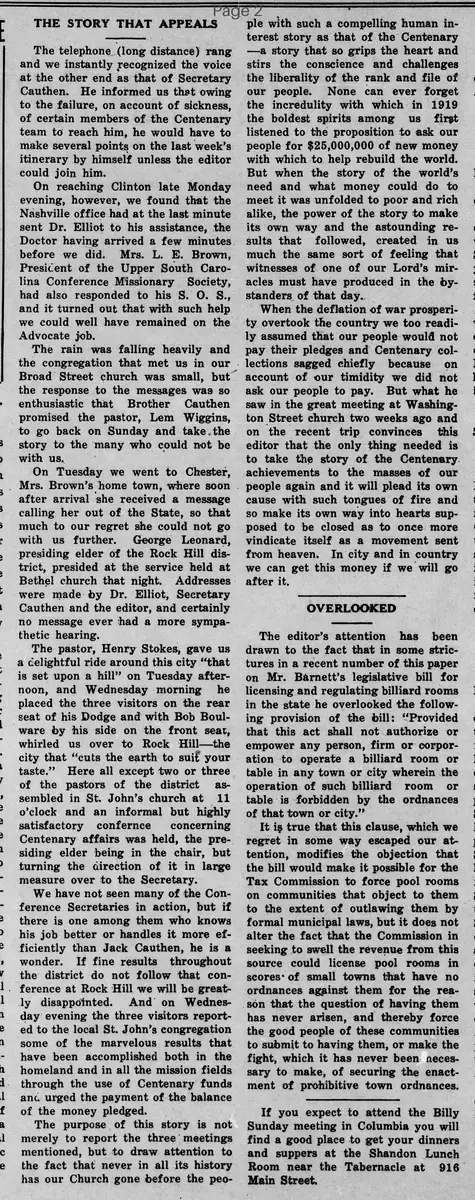
The telephone (long distance) rang and we instantly recognized the voice at the other end as that of Secretary Cauthen. He informed us that owing to the failure, on account of sickness, of certain members of the Centenary team to reach him, he would have to make several points on the last week's itinerary by himself unless the editor could join him.
On reaching Clinton late Monday evening, however, we found that the Nashville office had at the last minute sent Dr. Elliot to his assistance, the Doctor having arrived a few minutes before we did. Mrs. L. E. Brown, President of the Upper South Carolina Conference Missionary Society, had also responded to his S. O. S., and it turned out that with such help we could well have remained on the Advocate job.
The rain was falling heavily and the congregation that met us in our Broad Street church was small, but the response to the messages was so enthusiastic that Brother Cauthen promised the pastor, Lem Wiggins, to go back on Sunday and take the story to the many who could not be with us.
On Tuesday we went to Chester, Mrs. Brown's home town, where soon after arrival she received a message calling her out of the State, so that much to our regret she could not go with us further. George Leonard, presiding elder of the Rock Hill district, presided at the service held at Bethel church that night. Addresses were made by Dr. Elliot, Secretary Cauthen and the editor, and certainly no message ever had a more sympathetic hearing.
The pastor, Henry Stokes, gave us a delightful ride around this city "that is set upon a hill" on Tuesday afternoon, and Wednesday morning he placed the three visitors on the rear seat of his Dodge and with Bob Boulware by his side on the front seat, whirled us over to Rock Hill—the city that "cuts the earth to suit your taste." Here all except two or three of the pastors of the district assembled in St. John's church at 11 o'clock and an informal but highly satisfactory conference concerning Centenary affairs was held, the presiding elder being in the chair, but turning the direction of it in large measure over to the Secretary.
We have not seen many of the Conference Secretaries in action, but if there is one among them who knows his job better or handles it more efficiently than Jack Cauthen, he is a wonder. If fine results throughout the district do not follow that conference at Rock Hill we will be greatly disappointed. And on Wednesday evening the three visitors reported to the local St. John's congregation some of the marvelous results that have been accomplished both in the homeland and in all the mission fields through the use of Centenary funds and urged the payment of the balance of the money pledged.
The purpose of this story is not merely to report the three meetings mentioned, but to draw attention to the fact that never in all its history has our Church gone before the people with such a compelling human interest story as that of the Centenary—a story that so grips the heart and stirs the conscience and challenges the liberality of the rank and file of our people. None can ever forget the incredulity with which in 1919 the boldest spirits among us first listened to the proposition to ask our people for $25,000,000 of new money with which to help rebuild the world.
But when the story of the world's need and what money could do to meet it was unfolded to poor and rich alike, the power of the story to make its own way and the astounding results that followed, created in us much the same sort of feeling that witnesses of one of our Lord's miracles must have produced in the bystanders of that day.
When the deflation of war prosperity overtook the country we too readily assumed that our people would not pay their pledges and Centenary collections sagged chiefly because on account of our timidity we did not ask our people to pay. But what he saw in the great meeting at Washington Street church two weeks ago and on the recent trip convinces this editor that the only thing needed is to take the story of the Centenary achievements to the masses of our people again and it will plead its own cause with such tongues of fire and so make its own way into hearts supposed to be closed as to once more vindicate itself as a movement sent from heaven. In city and in country we can get this money if we will go after it.
What sub-type of article is it?
What themes does it cover?
What keywords are associated?
What entities or persons were involved?
Where did it happen?
Story Details
Key Persons
Location
Upper South Carolina, Clinton, Chester, Rock Hill
Event Date
Late Monday Evening To Wednesday, Post 1919
Story Details
Editor joins Secretary Cauthen and Dr. Elliot on a trip to promote Centenary campaign payments through meetings in Clinton, Chester, and Rock Hill churches, highlighting the compelling human interest story of the church's $25,000,000 effort to rebuild the world after WWI, urging renewed collection efforts despite economic challenges.