Thank you for visiting SNEWPapers!
Sign up free
New Orleans Republican
New Orleans, Orleans County, Louisiana
What is this article about?
The New York Tribune reports on General Banks' letter to the Lynn committee endorsing the Liberal movement, aligning with Mr. Sumner's stance. It highlights Banks' political background from Democracy to Republicanism and his influence on Massachusetts voters for unity across parties in support of war results.
Clipping
OCR Quality
Full Text
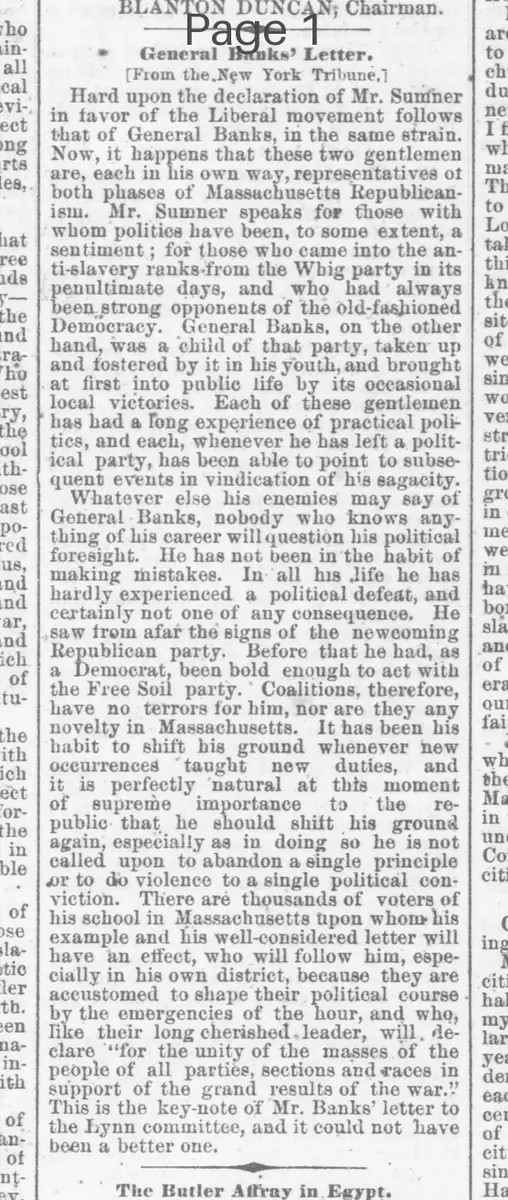
[From the New York Tribune.]
Hard upon the declaration of Mr. Sumner in favor of the Liberal movement follows that of General Banks, in the same strain. Now, it happens that these two gentlemen are, each in his own way, representatives of both phases of Massachusetts Republicanism. Mr. Sumner speaks for those with whom politics have been, to some extent, a sentiment: for those who came into the anti-slavery ranks—from the Whig party in its penultimate days, and who had always been strong opponents of the old-fashioned Democracy. General Banks, on the other hand, was a child of that party, taken up and fostered by it in his youth, and brought at first into public life by its occasional local victories. Each of these gentlemen has had a long experience of practical politics, and each, whenever he has left a political party, has been able to point to subsequent events in vindication of his sagacity. Whatever else his enemies may say of General Banks, nobody who knows anything of his career will question his political foresight. He has not been in the habit of making mistakes. In all his life he has hardly experienced a political defeat, and certainly not one of any consequence. He saw from afar the signs of the new-coming Republican party. Before that he had, as a Democrat, been bold enough to act with the Free Soil party. Coalitions, therefore, have no terrors for him, nor are they any novelty in Massachusetts. It has been his habit to shift his ground whenever new occurrences taught new duties, and it is perfectly natural at this moment of supreme importance to the republic that he should shift his ground again, especially as in doing so he is not called upon to abandon a single principle or to do violence to a single political conviction. There are thousands of voters of his school in Massachusetts upon whom his example and his well-considered letter will have an effect, who will follow him, especially in his own district, because they are accustomed to shape their political course by the emergencies of the hour, and who, like their long cherished leader, will declare for the unity of the masses of the people of all parties, sections and races in support of the grand results of the war."
This is the key-note of Mr. Banks' letter to the Lynn committee, and it could not have been a better one.
What sub-type of article is it?
What keywords are associated?
What entities or persons were involved?
Where did it happen?
Domestic News Details
Primary Location
Massachusetts
Key Persons
Event Details
General Banks' letter to the Lynn committee endorses the Liberal movement, following Mr. Sumner's declaration, emphasizing unity across parties, sections, and races in support of the war's results. The article discusses Banks' and Sumner's political backgrounds and influences in Massachusetts Republicanism.