Thank you for visiting SNEWPapers!
Sign up free
Story
November 20, 1835
Richmond Enquirer
Richmond, Richmond County, Virginia
What is this article about?
Political commentary on Whig party chaos in 1840 election, focusing on debates over Harrison vs. Webster in Pennsylvania and Virginia, with calls for Clay and criticisms of internal hypocrisy and disunity.
Clipping
OCR Quality
95%
Excellent
Full Text
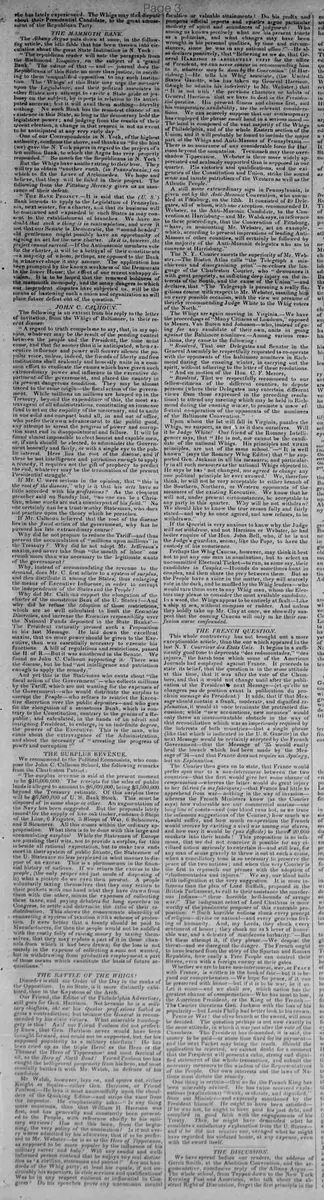
THE BATTLE OF THE WHIGS!
Disorder is still the Order of the Day in the ranks of the Opposition. In no State, is it more distinctly exhibited, than in the Keystone of the Arch
Our Friend, the Editor of the Philadelphia Advertiser still goes for Gen. Harrison. Not because he is a military chieftain, oh! no! his Quaker professions forbid so gross a contradiction; but because the General is recommended by his civic virtues. What miserable humbuggery is this! As if our Friend Poulson did not perfectly know, that Gen. Harrison never would have been brought 'forward, and could not be supported, but for his supposed popularity as a military chieftain! He has been cried up as the triple Hero! as the Hero of the Thames! the Hero of Tippecanoe! and most farcical of all, as the Hero of North Bend! Friend Poulson too has caught the belligerent propensity from his hero, and most manfully battles it with Mr. Walsh, in defence of his candidate.
Mr. Walsh, however, lays on, and spares not, either Knight or Squire-either Gen. Harrison, or Friend Poulson —He lays it most unmercifully upon the shoulders of the Quaking Editor and strips the visor from the impostor. He emphatically asks-"Is any thing more notorious, than that William H. Harrison was first, and has generally and constantly been presented to the People, with reference chiefly to his military services? Has not this been, from the beginning, the very policy of the nomination? is it not everywhere admitted by his advocates, that if to be preferred to Mr. Webster—he is so as the Hero of Tippecanoe, as supposed to be more popular by the influence of his military career and halo? Will any candid and well-informed person contend that he enjoys any real distinction as 'a civilian, statesman and patriot?' Are not hundreds of the Whig party, at least his equals, if not undeniably his superiors, in civil services and qualifications?
Was he in any respect eminent or influential in Congress? Do his speeches prove any uncommon mental faculties or valuable attainments? Do his prolix and pompous official reports and epistles argue particular modesty of spirit and soundness of judgment? Who among us knows precisely what are his present tenets as a politician, and what changes may have been wrought in his personal qualities, by time and circumstances, since he was in any national office?"-He also declares positively, that "Believing as we do, that GENERAL HARRISON IS ABSOLUTELY UNFIT FOR THE OFFICE of President, we can never concur in recommending him to it, whatever may be done by the Convention" (at Harrisburg.)-He tells his Whig associate. (the United States Gazette, who has taken up General Harrison, though he admits his inferiority to Mr. Webster.) that "It is not with the previous character or habits of General Harrison' that we have to deal in the Presidential question. His present fitness and claims first, and his comparative availability, are the relevant considerations. We can scarcely suppose that our contemporary has employed the phrase small band in a serious mood. The band is composed of the vast majority of the Whigs of Philadelphia, and of the whole Eastern section of the Union; and it will probably be found to include the major part of the Whigs and Anti-Masons of Pennsylvania.— There is no assurance of any considerable force for Harrison beyond the mountains. Tecumseh may there over-shadow Tippecanoe. Webster is there more widely appreciated and zealously supported than is supposed in our quarter. His victories and qualifications, and the exigencies of the Constitution and Union, strike the sound sense and innate patriotism of the Western as well as the Atlantic People.'
A still more extraordinary sign in Pennsylvania, is given out by the Anti-Masonic Convention, who assembled at Pittsburgh, on the 12th. It consisted of 49 Delegates, all of whom, with one exception. recommended D. Webster, as the Anti-Masonic Candidate, to the Convention at Harrisburg-and Mr. Walsh says, in reference to these proceedings, that the Convention of Pittsburgh, "have, in nominating Mr. Webster, set an example, which, according to present impressions of leading Anti-Masons of other counties, will certainly be followed by the majority of the Anti-Masonic delegates who are to convene at Harrisburg.
The N. Y. Courier asserts the superiority of Mr. Webster.-The Boston Atlas calls "the Telegraph a mischievous and disorganising print"-re-echoes the language of the Charleston Courier, who "denounces it with great propriety, as inflicting deep injury on the interests of the South, and the cause of the Union"—and declares, that "The Telegraph is pursuing a really flagitious course with respect to Mr. Webster, assailing him on every possible occasion, with the view we presume of thereby recommending Judge White to the Whig voters of the North."
The Whigs are again moving in Virginia. We have the proceedings of "Many Citizens of Loudoun," opposed to Messrs. Van Buren and Johnson-who, instead of going for any candidate of their own, unite in going against the Baltimore nominees.-Among various resolutions, they came to the following :
"Resolved, That our Delegates and Senator in the General Assembly be respectfully requested to co-operate with the opponents of the Baltimore nominees in Richmond during the ensuing winter, in carrying out the spirit, without adhering to the letter of these resolutions.
"And on motion of the Hon. C. F. Mercer,
"Resolved. That we respectfully recommend to our fellow-citizens of the different counties, to depute persons (where their Delegates may entertain different views from those expressed in the preceding resolutions) to attend any meeting which may be held in Richmond during the ensuing winter, to promote a more effectual co-operation of the opponents of the nominees of the Baltimore Convention.
Upon whom the lot will fall in Virginia, puzzles the Whigs, we suspect, as much as it does ourselves. Will it be Judge White? Our friend of the Romney Intelligencer says, that "He is not, nor cannot be the candidate of the national Whigs. His principles and their principles, are not of the same school." It is well known" says the Romney Whig Editor) that "he supported Gen. Jackson in all his measures; and particularly in all such measures as the national Whigs objected to. He says he has 'not changed, nor agreed to change any one political principle he ever avowed.' We, therefore think, he will not be very acceptable to either branch of the Southern, Northern, or Western opponents of the measures of the existing Executive. We know that he will not, under present circumstances, be acceptable to any party in this quarter. Why will he not withdraw? We should like to know the true reason fully and fairly stated—and why he once agreed, and now refuses, to be withdrawn.'
If the Querist is very anxious to know why the Judge will not withdraw, and not Harrison or Webster, he had better enquire of the Hon. John Bell, who, if he is not the Judge's guardian, seems, like the Pope, to have the custody of his conscience.
Perhaps the Whig Caucus, however, may think it best not to put any one man in nomination, but to select an uncommitted Electoral Ticket--to run, as some say, their candidates in Couples.-Hounds do sometimes hunt in couples, and then share the prey between them. But as the People have a voice in the matter, they will scarcely vote in the dark, and be muffled by the Whig leaders—who would turn them over to any Whig man, whom the Electors may please to consider the most available candidate.
In a word, the Whigs appear to be entirely at fault-Like a ship at sea, without compass or rudder. And unless they boldly take up Mr. Clay at once, we shrewdly suspect that the coming Caucus will only make their confusion worse confounded.
Disorder is still the Order of the Day in the ranks of the Opposition. In no State, is it more distinctly exhibited, than in the Keystone of the Arch
Our Friend, the Editor of the Philadelphia Advertiser still goes for Gen. Harrison. Not because he is a military chieftain, oh! no! his Quaker professions forbid so gross a contradiction; but because the General is recommended by his civic virtues. What miserable humbuggery is this! As if our Friend Poulson did not perfectly know, that Gen. Harrison never would have been brought 'forward, and could not be supported, but for his supposed popularity as a military chieftain! He has been cried up as the triple Hero! as the Hero of the Thames! the Hero of Tippecanoe! and most farcical of all, as the Hero of North Bend! Friend Poulson too has caught the belligerent propensity from his hero, and most manfully battles it with Mr. Walsh, in defence of his candidate.
Mr. Walsh, however, lays on, and spares not, either Knight or Squire-either Gen. Harrison, or Friend Poulson —He lays it most unmercifully upon the shoulders of the Quaking Editor and strips the visor from the impostor. He emphatically asks-"Is any thing more notorious, than that William H. Harrison was first, and has generally and constantly been presented to the People, with reference chiefly to his military services? Has not this been, from the beginning, the very policy of the nomination? is it not everywhere admitted by his advocates, that if to be preferred to Mr. Webster—he is so as the Hero of Tippecanoe, as supposed to be more popular by the influence of his military career and halo? Will any candid and well-informed person contend that he enjoys any real distinction as 'a civilian, statesman and patriot?' Are not hundreds of the Whig party, at least his equals, if not undeniably his superiors, in civil services and qualifications?
Was he in any respect eminent or influential in Congress? Do his speeches prove any uncommon mental faculties or valuable attainments? Do his prolix and pompous official reports and epistles argue particular modesty of spirit and soundness of judgment? Who among us knows precisely what are his present tenets as a politician, and what changes may have been wrought in his personal qualities, by time and circumstances, since he was in any national office?"-He also declares positively, that "Believing as we do, that GENERAL HARRISON IS ABSOLUTELY UNFIT FOR THE OFFICE of President, we can never concur in recommending him to it, whatever may be done by the Convention" (at Harrisburg.)-He tells his Whig associate. (the United States Gazette, who has taken up General Harrison, though he admits his inferiority to Mr. Webster.) that "It is not with the previous character or habits of General Harrison' that we have to deal in the Presidential question. His present fitness and claims first, and his comparative availability, are the relevant considerations. We can scarcely suppose that our contemporary has employed the phrase small band in a serious mood. The band is composed of the vast majority of the Whigs of Philadelphia, and of the whole Eastern section of the Union; and it will probably be found to include the major part of the Whigs and Anti-Masons of Pennsylvania.— There is no assurance of any considerable force for Harrison beyond the mountains. Tecumseh may there over-shadow Tippecanoe. Webster is there more widely appreciated and zealously supported than is supposed in our quarter. His victories and qualifications, and the exigencies of the Constitution and Union, strike the sound sense and innate patriotism of the Western as well as the Atlantic People.'
A still more extraordinary sign in Pennsylvania, is given out by the Anti-Masonic Convention, who assembled at Pittsburgh, on the 12th. It consisted of 49 Delegates, all of whom, with one exception. recommended D. Webster, as the Anti-Masonic Candidate, to the Convention at Harrisburg-and Mr. Walsh says, in reference to these proceedings, that the Convention of Pittsburgh, "have, in nominating Mr. Webster, set an example, which, according to present impressions of leading Anti-Masons of other counties, will certainly be followed by the majority of the Anti-Masonic delegates who are to convene at Harrisburg.
The N. Y. Courier asserts the superiority of Mr. Webster.-The Boston Atlas calls "the Telegraph a mischievous and disorganising print"-re-echoes the language of the Charleston Courier, who "denounces it with great propriety, as inflicting deep injury on the interests of the South, and the cause of the Union"—and declares, that "The Telegraph is pursuing a really flagitious course with respect to Mr. Webster, assailing him on every possible occasion, with the view we presume of thereby recommending Judge White to the Whig voters of the North."
The Whigs are again moving in Virginia. We have the proceedings of "Many Citizens of Loudoun," opposed to Messrs. Van Buren and Johnson-who, instead of going for any candidate of their own, unite in going against the Baltimore nominees.-Among various resolutions, they came to the following :
"Resolved, That our Delegates and Senator in the General Assembly be respectfully requested to co-operate with the opponents of the Baltimore nominees in Richmond during the ensuing winter, in carrying out the spirit, without adhering to the letter of these resolutions.
"And on motion of the Hon. C. F. Mercer,
"Resolved. That we respectfully recommend to our fellow-citizens of the different counties, to depute persons (where their Delegates may entertain different views from those expressed in the preceding resolutions) to attend any meeting which may be held in Richmond during the ensuing winter, to promote a more effectual co-operation of the opponents of the nominees of the Baltimore Convention.
Upon whom the lot will fall in Virginia, puzzles the Whigs, we suspect, as much as it does ourselves. Will it be Judge White? Our friend of the Romney Intelligencer says, that "He is not, nor cannot be the candidate of the national Whigs. His principles and their principles, are not of the same school." It is well known" says the Romney Whig Editor) that "he supported Gen. Jackson in all his measures; and particularly in all such measures as the national Whigs objected to. He says he has 'not changed, nor agreed to change any one political principle he ever avowed.' We, therefore think, he will not be very acceptable to either branch of the Southern, Northern, or Western opponents of the measures of the existing Executive. We know that he will not, under present circumstances, be acceptable to any party in this quarter. Why will he not withdraw? We should like to know the true reason fully and fairly stated—and why he once agreed, and now refuses, to be withdrawn.'
If the Querist is very anxious to know why the Judge will not withdraw, and not Harrison or Webster, he had better enquire of the Hon. John Bell, who, if he is not the Judge's guardian, seems, like the Pope, to have the custody of his conscience.
Perhaps the Whig Caucus, however, may think it best not to put any one man in nomination, but to select an uncommitted Electoral Ticket--to run, as some say, their candidates in Couples.-Hounds do sometimes hunt in couples, and then share the prey between them. But as the People have a voice in the matter, they will scarcely vote in the dark, and be muffled by the Whig leaders—who would turn them over to any Whig man, whom the Electors may please to consider the most available candidate.
In a word, the Whigs appear to be entirely at fault-Like a ship at sea, without compass or rudder. And unless they boldly take up Mr. Clay at once, we shrewdly suspect that the coming Caucus will only make their confusion worse confounded.
What sub-type of article is it?
Political Commentary
Election Infighting
What keywords are associated?
Whig Disorder
Harrison Criticism
Webster Support
Political Conventions
Election 1840
What entities or persons were involved?
Gen. Harrison
Mr. Walsh
Friend Poulson
Mr. Webster
Mr. Clay
Judge White
Hon. C. F. Mercer
Hon. John Bell
Where did it happen?
Pennsylvania, Philadelphia, Virginia, Pittsburgh, Harrisburg, Richmond
Story Details
Key Persons
Gen. Harrison
Mr. Walsh
Friend Poulson
Mr. Webster
Mr. Clay
Judge White
Hon. C. F. Mercer
Hon. John Bell
Location
Pennsylvania, Philadelphia, Virginia, Pittsburgh, Harrisburg, Richmond
Event Date
Circa 1840
Story Details
The article satirizes the Whig party's internal divisions over presidential nominees, criticizing support for Harrison as hypocritical, praising Walsh's attacks, noting Anti-Masonic preference for Webster, and highlighting confusion in Virginia, predicting further disarray without nominating Clay.