Thank you for visiting SNEWPapers!
Sign up free
Norfolk Gazette And Publick Ledger
Norfolk, Virginia
What is this article about?
In a letter to the Brattleborough Reporter, James Elliot of Brattleborough, Vermont, on June 29, 1805, clarifies a misreported statement accusing a private 'junto' (not legislators) of plotting to destroy the U.S. Constitution. He criticizes a Washington caucus's proposed amendments as ruinous but affirms their integrity, requesting republication for accuracy.
Clipping
OCR Quality
Full Text
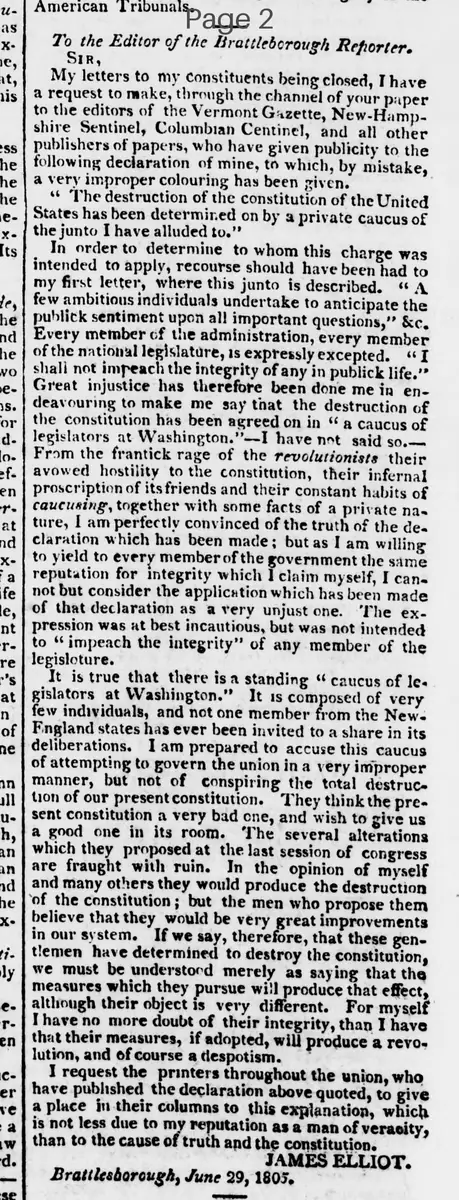
SIR,
My letters to my constituents being closed, I have a request to make, through the channel of your paper to the editors of the Vermont Gazette, New-Hampshire Sentinel, Columbian Centinel, and all other publishers of papers, who have given publicity to the following declaration of mine, to which, by mistake, a very improper colouring has been given.
"The destruction of the constitution of the United States has been determined on by a private caucus of the junto I have alluded to."
In order to determine to whom this charge was intended to apply, recourse should have been had to my first letter, where this junto is described. "A few ambitious individuals undertake to anticipate the publick sentiment upon all important questions," &c. Every member of the administration, every member of the national legislature, is expressly excepted. "I shall not impeach the integrity of any in publick life."
Great injustice has therefore been done me in endeavouring to make me say that the destruction of the constitution has been agreed on in "a caucus of legislators at Washington."—I have not said so.—From the frantick rage of the revolutionists their avowed hostility to the constitution, their infernal proscription of its friends and their constant habits of caucusing, together with some facts of a private nature, I am perfectly convinced of the truth of the declaration which has been made; but as I am willing to yield to every member of the government the same reputation for integrity which I claim myself, I cannot but consider the application which has been made of that declaration as a very unjust one. The expression was at best incautious, but was not intended to "impeach the integrity" of any member of the legislature.
It is true that there is a standing "caucus of legislators at Washington." It is composed of very few individuals, and not one member from the New-England states has ever been invited to a share in its deliberations. I am prepared to accuse this caucus of attempting to govern the union in a very improper manner, but not of conspiring the total destruction of our present constitution. They think the present constitution a very bad one, and wish to give us a good one in its room. The several alterations which they proposed at the last session of congress are fraught with ruin. In the opinion of myself and many others they would produce the destruction of the constitution; but the men who propose them believe that they would be very great improvements in our system. If we say, therefore, that these gentlemen have determined to destroy the constitution, we must be understood merely as saying that the measures which they pursue will produce that effect, although their object is very different. For myself I have no more doubt of their integrity, than I have that their measures, if adopted, will produce a revolution, and of course a despotism.
I request the printers throughout the union, who have published the declaration above quoted, to give a place in their columns to this explanation, which is not less due to my reputation as a man of veracity, than to the cause of truth and the constitution.
JAMES ELLIOT.
Brattlesborough, June 29, 1805.
What sub-type of article is it?
What themes does it cover?
What keywords are associated?
What entities or persons were involved?
Letter to Editor Details
Author
James Elliot
Recipient
To The Editor Of The Brattleborough Reporter
Main Argument
james elliot clarifies that his statement about a 'junto' determining the destruction of the u.s. constitution was not aimed at legislators or the administration, but at ambitious individuals outside government; he criticizes a caucus of legislators for proposing ruinous amendments while affirming their integrity.
Notable Details