Thank you for visiting SNEWPapers!
Sign up free
Daily National Intelligencer
Washington, District Of Columbia
What is this article about?
A letter to the editors defends the concept of perpetual motion against skeptics, arguing that friction and resistance are common obstacles overcome by external powers, and that theoretical reasonings should not discourage inventive genius. It clarifies that a perpetual machine renews its operations until parts wear out. Dated Tennessee, September 10, 1816.
Clipping
OCR Quality
Full Text
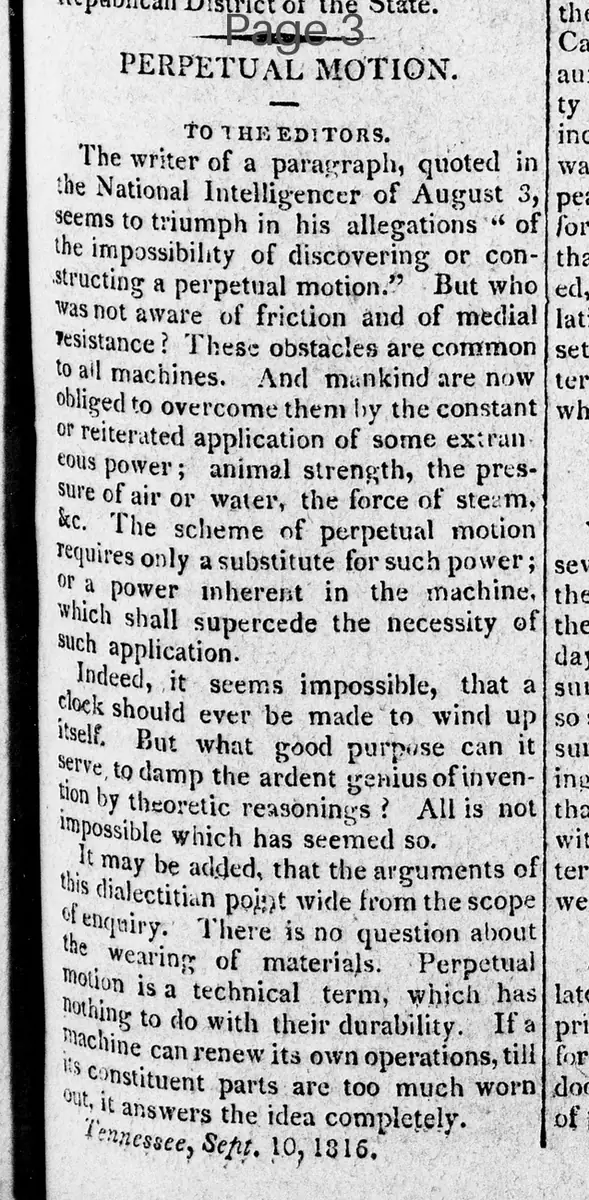
TO THE EDITORS.
The writer of a paragraph, quoted in the National Intelligencer of August 3, seems to triumph in his allegations "of the impossibility of discovering or constructing a perpetual motion." But who was not aware of friction and of medial resistance? These obstacles are common to all machines. And mankind are now obliged to overcome them by the constant or reiterated application of some extraneous power; animal strength, the pressure of air or water, the force of steam; &c. The scheme of perpetual motion requires only a substitute for such power; or a power inherent in the machine, which shall supercede the necessity of such application."
Indeed, it seems impossible, that a clock should ever be made to wind up itself. But what good purpose can it serve, to damp the ardent genius of invention by theoretic reasonings? All is not impossible which has seemed so.
It may be added, that the arguments of this dialectitian point wide from the scope of enquiry. There is no question about the wearing motion is a technical term, which has nothing to do with materials. Perpetual machine can renew its own operations, till its constituent parts are too much worn out, it answers the idea completely.
Tennessee, Sept. 10, 1816
What sub-type of article is it?
What themes does it cover?
What keywords are associated?
What entities or persons were involved?
Letter to Editor Details
Recipient
The Editors
Main Argument
the pursuit of perpetual motion should not be dismissed as impossible due to friction and resistance, which are common to all machines; it requires only an inherent power to replace external ones, and theoretical skepticism dampens invention without serving any good purpose.
Notable Details