Thank you for visiting SNEWPapers!
Sign up free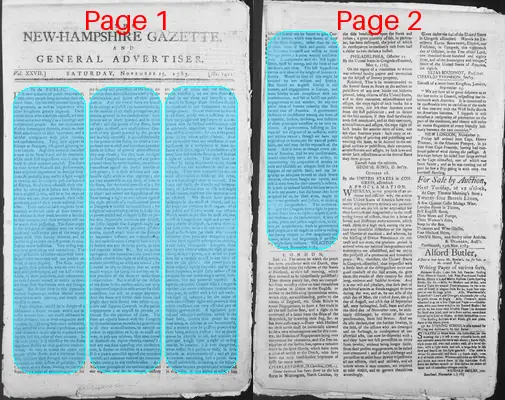
The New Hampshire Gazette And General Advertiser
Portsmouth, Exeter, Rockingham County, New Hampshire
What is this article about?
This 1783 editorial exhorts the newly independent United States to uphold national faith by adhering strictly to the Treaty of Peace with Britain and the Articles of Confederation. It warns that deviations could erode sovereignty, international reputation, and union, while defending Congress's powers to raise funds and compensate soldiers, emphasizing public virtue and fidelity.
Merged-components note: This is a single continuous editorial piece split across pages 1 and 2, as the text flows directly from the end of the first component to the start of the second.
Clippings
1 of 2
OCR Quality
Full Text
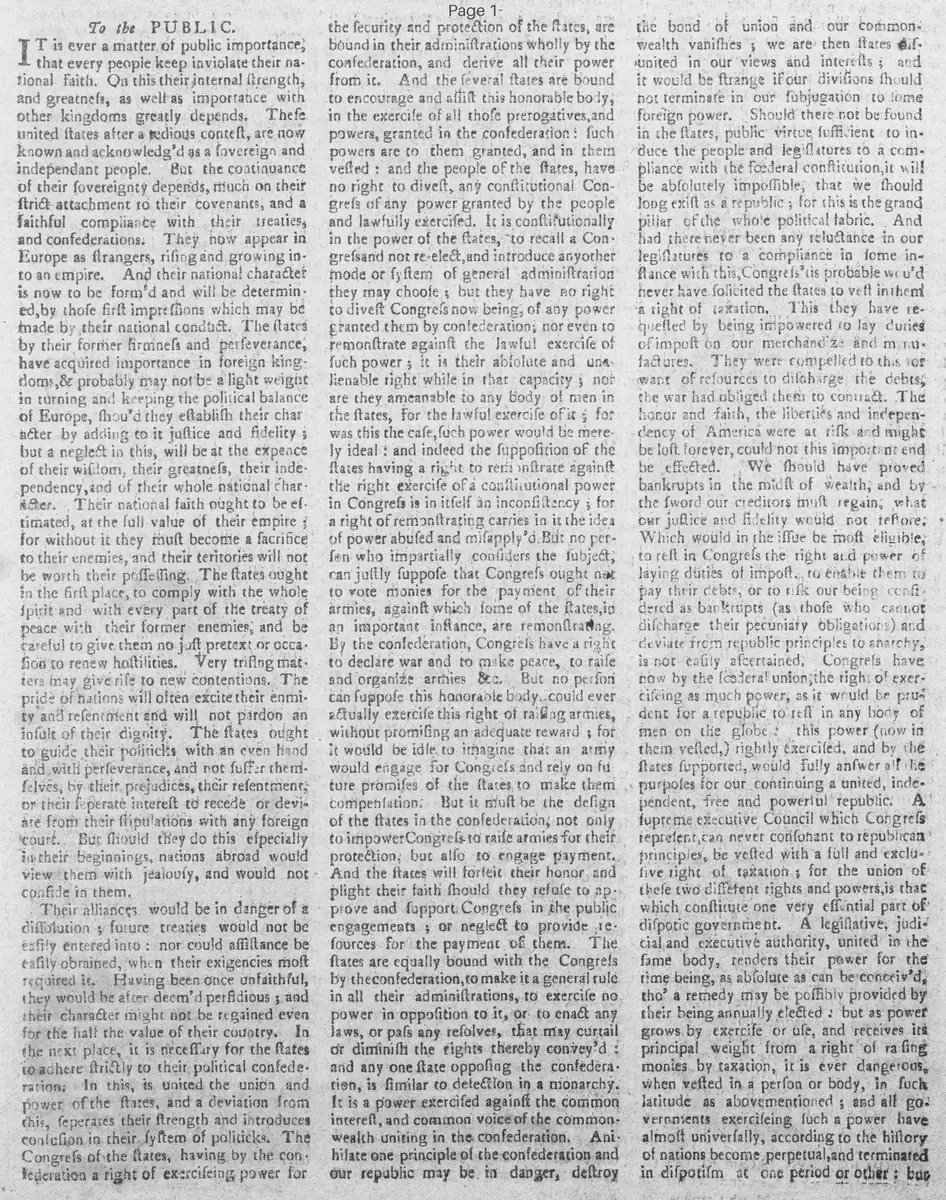
It is ever a matter of public importance, that every people keep inviolate their national faith. On this their internal strength and greatness, as well as importance with other kingdoms greatly depends. These united states after a tedious contest, are now known and acknowledged as a sovereign and independent people. But the continuance of their sovereignty depends, much on their strict attachment to their covenants, and a faithful compliance with their treaties, and confederations: They now appear in Europe as strangers, rising and growing into an empire. And their national character is now to be formed and will be determined, by those first impressions which may be made by their national conduct. The states by their former firmness and perseverance, have acquired importance in foreign kingdoms, & probably may not be a light weight in turning and keeping the political balance of Europe, should they establish their character by adding to it justice and fidelity; but a neglect in this, will be at the expense of their wisdom, their greatness, their independence, and of their whole national character. Their national faith ought to be estimated at the full value of their empire: for without it they must become a sacrifice to their enemies, and their territories will not be worth their possessing. The states ought in the first place, to comply with the whole spirit and with every part of the treaty of peace with their former enemies, and be careful to give them no just pretext or occasion to renew hostilities. Very trifling matters may give rise to new contentions. The pride of nations will often excite their enmity and resentment and will not pardon an insult of their dignity. The states ought to guide their politics with an even hand and with perseverance. and not suffer themselves, by their prejudices, their resentments, or their separate interest to recede or deviate from their stipulations with any foreign court. But should they do this especially in their beginnings, nations abroad would view them with jealousy, and would not confide in them. Their alliances would be in danger of a dissolution ; future treaties would not be easily entered into : nor could assistance be easily obtained, when their exigencies most required it. Having been once unfaithful, they would be after deemed perfidious ; and their character might not be regained even for the half the value of their country. In the next place, it is necessary for the states to adhere strictly to their political confederation; In this, is united the union and power of the states, and a deviation from this, separates their strength and introduces confusion in their system of politics. The Congress of the states, having by the confederation a right of exercising power for the security and protection of the states, are bound in their administrations wholly by the confederation. and derive all their power from it. And the several states are bound to encourage and assist this honorable body: in the exercise of all those prerogatives,and powers, granted in the confederation : such powers are to them granted, and in them vested : and the people of the states, have no right to divest, any constitutional Congress of any power granted by the people and lawfully exercised. It is constitutionally in the power of the states, to recall a Congress and not re-elect,and introduce any other mode or system of general administration they may choose ; but they have no right to divest Congress now being, of any power granted them by confederation; nor even to remonstrate against the lawful exercise of such power ; it is their absolute and inalienable right while in that capacity ; nor are they amenable to any body of men in the states. for the lawful exercise of it ; for was this the case.such power would be merely ideal : and indeed the supposition of the states having a right to remonstrate against the right exercise of a constitutional power in Congress is in itself an inconsistency ; for a right of remonstrating carries in it the idea of power abused and misapplied.But no person who impartially considers the subject; can justly suppose that Congress ought not to vote monies for the payment of their armies. against which some of the states.in an important instance, are remonstrating. By the confederation. Congress have a right to declare war and to make peace, to raise and organize armies &c. But no person can suppose this honorable body. could ever actually exercise this right of raising armies; without promising an adequate reward ; for it would be idle. to imagine that an army would engage for Congress and rely on future promises of the states to make them compensation. But it must be the design of the states in the confederation; not only to empower Congress to raise armies for their protection; but also to engage payment. And the states will forfeit their honor and plight their faith should they refuse to approve and support Congress in the public engagements ; or neglect to provide resources for the payment of them. The states are equally bound with the Congress by the confederation, to make it a general rule in all their administrations, to exercise no power in opposition to it, or to enact any laws, or pass any resolves, that may curtail or diminish the rights thereby conveyed and any one state opposing the confederation, is similar to defection in a monarchy. It is a power exercised against the common interest, and common voice of the commonwealth uniting in the confederation. And annihilate one principle of the confederation and our republic may be, in danger, destroy the bond of union and our common wealth vanishes ; we are then states disunited in our views and interests ; and it would be strange if our divisions should not terminate in our subjugation to some foreign power. Should there not be found in the states. public virtue sufficient to induce the people and legislatures to a compliance with the federal constitution.it will be absolutely impossible; that we should long exist as a republic ; for this is the grand pillar of the whole political fabric. And had there never been any reluctance in our legislatures to a compliance in some instance with this,Congress 'tis probable we would never have solicited the states to vest in them a right of taxation. This they have requested by being empowered to lay duties of impost on our merchandize: and manufactures. They were compelled to this for want of resources to discharge the debts. the war had obliged them to contract. The honor and faith, the liberties and independence of America were at risk and might be lost forever. could not this important end be effected. We should have proved bankrupts in the midst of wealth; and by the sword our creditors must regain: what our justice and fidelity would not restore: Which would in the issue be most eligible: to vest in Congress the right and power of laying duties of impost.. to enable them to pay their debts, or to risk our being considered as bankrupts (as those who cannot discharge their pecuniary Obligations) and deviate from republic principles to anarchy, is not easily ascertained. Congress have now by the federal union,the right of exercising as much power, as it would be prudent for a republic to vest in any body of men on the globe : this power (now in them vested.) rightly exercised. and by the states supported, would fully answer all the purposes for our continuing a united, independent, free and powerful republic. A supreme executive Council which Congress represent, can never consonant to republican principles. be vested with a full and exclusive right of taxation ; for the union of these two different rights and powers, is that which constitute one very essential part of despotic government. A legislative, judicial and executive authority, united in the same body, renders their power for the time being, as absolute as can be conceived. tho' a remedy may be possibly provided by their being annually elected : but as power grows by exercise or use, and receives its principal weight from a right of raising monies by taxation, it is ever dangerous. when vested in a person or body, in such latitude as abovementioned ; and all governments exercising such a power have almost universally, according to the history of nations become perpetual, and terminated in despotism at one period or other : but
whether it may not be better to give Congress a power, which may sooner or later render them defective, rather than by our division, want of faith and public virtue to become a conquest and vassals to some foreign power, is a point worthy consideration. A compliance with the first supposition, must be wrong, and the birth of our weakness and vices. The last supposition carries in it ideas of the height of human calamity. Would to God all this might be avoided by our wisdom and fidelity. But should we neglect fidelity in our treaties, and engagements in Europe, and want fidelity in our compliance with our confederation, and fail to fulfill our public engagements to one another, let any one paint ideas of human calamity that shall exceed that of America. A government destitute of consistency having the form of a republic, broken, declining, and destitute of those principles necessary to its very existence. A government, suffering in Europe all the disgrace of an unstable, crafty and vicious nation; though we have our beginnings in honor, yet for want of public faith, our end may be the reproach of the earth. And it seems as though every citizen of America, had he any consideration, would cheerfully exert all his ability, in contributing his proportion of monies to raise and establish an adequate fund for the support of our public faith, and not begrudge an adequate reward to those brave citizens, who have fought our battles, and risked their lives for their country's defence. It is base to defraud faithful soldiers because it is in our power; but the honor they have acquired for us, by their arms, ought to excite our gratitude and justice, in making them a due compensation. The commutation pay the Congress have a right to grant: but the states have no right to oppose it, without violence to the confederation. A love of union, peace and justice ought then to dictate an acquiescence, both in government and people, and all ought to unite in raising our young empire to that magnitude and honor, which our beginnings, if persisted in, might fairly indicate.
SOLICITOR.
Exeter, November 1783.
What sub-type of article is it?
What keywords are associated?
What entities or persons were involved?
Editorial Details
Primary Topic
Adherence To Treaties And Confederation For National Faith And Union
Stance / Tone
Exhortative Defense Of Fidelity To International And Domestic Obligations
Key Figures
Key Arguments