Thank you for visiting SNEWPapers!
Sign up free
Daily National Intelligencer
Washington, District Of Columbia
What is this article about?
US President submits documents to Congress on South American independence, including a July 5, 1820 letter from Secretary John Quincy Adams appointing John M. Forbes as commercial agent for Buenos Ayres or Chile, instructing him on commerce, seamen protection, privateering abuses, and neutral political observation amid revolutions.
Clipping
OCR Quality
Full Text
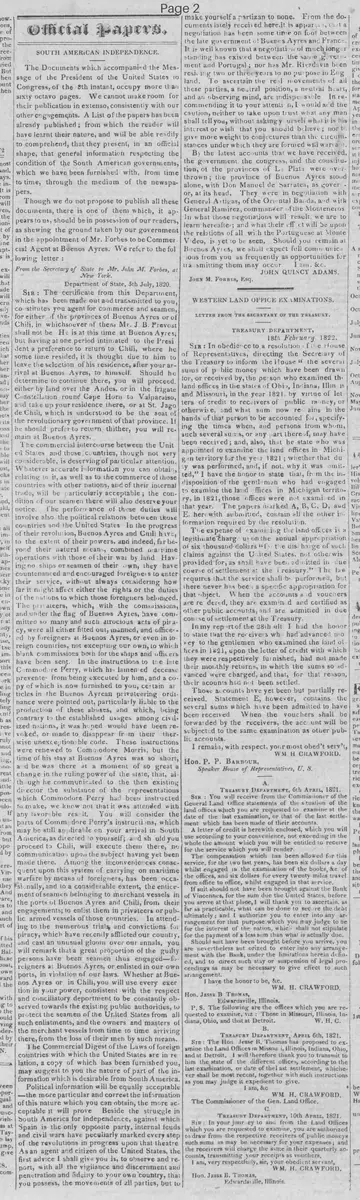
SOUTH AMERICAN INDEPENDENCE.
The Documents which accompanied the Message of the President of the United States to Congress, of the 8th instant, occupy more than sixty octavo pages. We cannot make room for their publication in extenso, consistently with our other engagements. A List of the papers has been already published; from which the reader will have learnt their nature, and will be able readily to comprehend, that they present, in an official shape, that general information respecting the condition of the South American governments, which we have been furnished with, from time to time, through the medium of the newspapers.
Though we do not propose to publish all these documents, there is one of them which, it appears to us, should be in possession of our readers, as shewing the ground taken by our government in the appointment of Mr. Forbes to be Commercial Agent at Buenos Ayres. We refer to the following letter:
From the Secretary of State to Mr. John M. Forbes, at New York.
Department of State, 5th July, 1820.
Sir: The certificate from this Department, which has been made out and transmitted to you, constitutes you agent for commerce and seamen, for either of the provinces of Buenos Ayres or of Chili, in whichsoever of them Mr. J. B. Prevost shall not be. He is at this time at Buenos Ayres; but having at one period intimated to the President a preference to return to Chili, where he some time resided, it is thought due to him to leave the selection of his residence, after your arrival at Buenos Ayres, to himself. Should he determine to continue there, you will proceed, either by land over the Andes, or in the frigate Constellation round Cape Horn to Valparaiso, and take up your residence there, or at St. Jago de Chili, which is understood to be the seat of the revolutionary government of that province. If he should prefer to return thither, you will remain at Buenos Ayres.
The commercial intercourse between the United States and those countries, though not very considerable, is deserving of particular attention. Whatever accurate information you can obtain, relating to it, as well as to the commerce of those countries with other nations, and of their internal trade, will be particularly acceptable; the condition of our seamen there will also deserve your notice. The performance of these duties will involve also the political relations between those countries and the United States. In the progress of their revolution, Buenos Ayres and Chili have, to the extent of their powers, and indeed, far beyond their natural means, combined naval operations with those of their war by land. Having no ships or seamen of their own, they have countenanced and encouraged foreigners to enter their service, without always considering how far it might affect either the rights or the duties of the nations to which those foreigners belonged. The privateers, which, with the commissions, and under the flag of Buenos Ayres, have committed so many and such atrocious acts of piracy, were all either fitted out, manned, and officered by foreigners at Buenos Ayres, or even in foreign countries, not excepting our own, to which blank commissions both for the ships and officers have been sent. In the instructions to the late Commodore Perry, which his lamented decease prevented from being executed by him, and a copy of which is now furnished to you, certain articles in the Buenos Ayrean privateering ordinance were pointed out, particularly liable to the production of these abuses, and which, being contrary to the established usages among civilized nations, it was hoped would have been revoked, or made to disappear from their otherwise unexceptionable code. These instructions were renewed to Commodore Morris, but the time of his stay at Buenos Ayres was so short, and he was there at a moment of so great a change in the ruling power of the state, that, although he communicated to the then existing director the substance of the representations which Commodore Perry had been instructed to make, we know not that it was attended with any favorable result. You will consider the parts of Commodore Perry's instructions, which may be still applicable on your arrival in South America, as directed to yourself; and should you proceed to Chili, will execute them there, no communication upon the subject having yet been made there. Among the inconveniences consequent upon this system of carrying on maritime warfare by means of foreigners, has been occasionally, and to a considerable extent, the enticement of seamen belonging to merchant vessels in the ports of Buenos Ayres and Chili, from their engagements; to enlist them in privateers or public armed vessels of those countries. In attending to the numerous trials and convictions for piracy, which have recently afflicted our country, and cast an unusual gloom over our annals, you will remark that a great proportion of the guilty persons have been seamen thus engaged--foreigners at Buenos Ayres, or enlisted in our own ports, in violation of our laws. Whether at Buenos Ayres or in Chili, you will use every exertion in your power, consistent with the respect and conciliatory deportment to be constantly observed towards the existing public authorities, to protect the seamen of the United States from all such enlistments, and the owners and masters of the merchant vessels from time to time arriving there, from the loss of their men by such means.
The Commercial Digest of the Laws of foreign countries with which the United States are in relation, a copy of which has been furnished you, may suggest to you the nature of part of the information which is desirable from South America. Political information will be equally acceptable--the more particular and correct the information of this nature which you can obtain, the more acceptable it will prove. Beside the struggle in South America for independence, against which Spain is the only opposite party, internal feuds and civil wars have peculiarly marked every step of the revolutions in progress upon that theatre. As an agent and citizen of the United States, the first advice I shall give you is, to observe and report, with all the vigilance and discernment and penetration and fidelity to your own country, that you possess, the movements of all parties, but to make yourself a partizan to none. From the documents lately received here it is apparent, that a negotiation has been some time on foot between the late government of Buenos Ayres and France. It is well known that a negotiation of much longer standing has existed between the same government and Portugal; nor has Mr. Rivadavia been residing two or three years to no purpose in England. To ascertain the real movements of all these parties, a neutral position, a neutral heart, and an observing mind, are indispensable. In recommending it to your attention, I would add the caution, neither to take upon trust what any man shall tell you, without asking yourself what it is his interest or wish that you should believe; nor to give more weight to conjectures than the circumstances under which they are formed will warrant.
By the latest accounts that we have received, the government the congress, and the constitution, of the provinces of La Plata were overthrown; the province of Buenos Ayres stood alone, with Don Manuel de Sarratea, as governor, at its head. They were in negotiation with General Artigas, of the Oriental Banda, and with General Ramirez, commander of the Monteneros. In what those negotiations will result. we are to learn hereafter; and what their effect will be upon the relations of all with the Portuguese at Montevideo, is yet to be seen. Should you remain at Buenos Ayres, we shall expect full communications from you as frequently as opportunities for transmitting them may occur.
I am, &c.
JOHN QUINCY ADAMS.
JOHN M. Forbes, Esq.
What sub-type of article is it?
What themes does it cover?
What keywords are associated?
What entities or persons were involved?
Where did it happen?
Story Details
Key Persons
Location
Buenos Ayres, Chili, Valparaiso, St. Jago De Chili, South America, La Plata, Oriental Banda, Montevideo
Event Date
5th July, 1820
Story Details
Secretary of State John Quincy Adams appoints John M. Forbes as commercial agent and protector of seamen for Buenos Ayres or Chile, depending on J.B. Prevost's location. Instructions cover gathering commercial and political intelligence, addressing privateering abuses and piracy by foreign-manned vessels, protecting US seamen from enlistment, and maintaining neutrality amid South American revolutions and internal conflicts.