Thank you for visiting SNEWPapers!
Sign up free
Imperial Valley Press
El Centro, Imperial County, California
What is this article about?
Analysis of diplomatic timing in US-Japan relations: FDR's 'no' to Pacific war reassures Tokyo, but $898M appropriation for Pacific bases signals preparation, amid Japanese fleet scares and new ambassador Nomura's arrival. Critiques historical US directness vs. European cunning.
Clipping
OCR Quality
Full Text
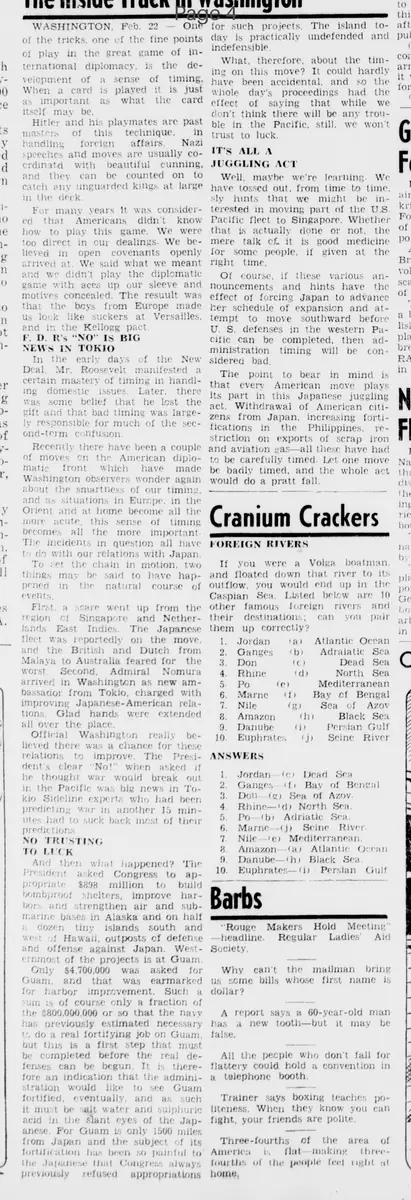
When a card is played it is just as important as what the card itself may be.
Hitler and his playmates are past masters of this technique, in handling foreign affairs. Nazi speeches and moves are usually coordinated with beautiful cunning, and they can be counted on to catch any unguarded kings at large in the deck.
For many years it was considered that Americans didn't know how to play this game. We were too direct in our dealings. We believed in open covenants openly arrived at. We said what we meant and we didn't play the diplomatic game with aces up our sleeve and motives concealed. The result was that the boys from Europe made us look like suckers at Versailles, and in the Kellogg pact.
F. D. R's "NO" IS BIG NEWS IN TOKIO
In the early days of the New Deal, Mr. Roosevelt manifested a certain mastery of timing in handling domestic issues. Later, there was some belief that he lost the gift and that bad timing was largely responsible for much of the second-term confusion.
Recently there have been a couple of moves on the American diplomatic front which have made Washington observers wonder again about the smartness of our timing, and as situations in Europe, in the Orient and at home become all the more acute, this sense of timing becomes all the more important.
The incidents in question all have to do with our relations with Japan.
To get the chain in motion, two things may be said to have happened in the natural course of events.
First, a scare went up from the region of Singapore and Netherlands East Indies. The Japanese fleet was reportedly on the move, and the British and Dutch from Malaya to Australia feared for the worst. Second, Admiral Nomura arrived in Washington as new ambassador from Tokio, charged with improving Japanese-American relations. Glad hands were extended all over the place.
Official Washington really believed there was a chance for these relations to improve. The President's clear "No!" when asked if he thought war would break out in the Pacific was big news in Tokio. Sideline experts who had been predicting war in another 15 minutes had to suck back most of their predictions.
NO TRUSTING TO LUCK
And then what happened? The President asked Congress to appropriate $898 million to build bombproof shelters, improve harbors and strengthen air and submarine bases in Alaska and on half a dozen tiny islands south and west of Hawaii, outposts of defense and offense against Japan. Westernmost of the projects is at Guam. Only $4,700,000 was asked for Guam, and that was earmarked for harbor improvement. Such a sum is of course only a fraction of the $800,000,000 or so that the navy has previously estimated necessary to do a real fortifying job on Guam, but this is a first step that must be completed before the real defenses can be begun. It is therefore an indication that the administration would like to see Guam fortified, eventually, and as such it must be salt water and sulphuric acid in the slant eyes of the Japanese. For Guam is only 1500 miles from Japan and the subject of its fortification has been so painful to the Japanese that Congress always previously refused appropriations for such projects. The island today is practically undefended and indefensible.
What, therefore, about the timing on this move? It could hardly have been accidental, and so the whole day's proceedings had the effect of saying, that while we don't think there will be any trouble in the Pacific, still, we won't trust to luck.
IT'S ALL A JUGGLING ACT
Well, maybe we're learning. We have tossed out, from time to time, sly hints that we might be interested in moving part of the U.S Pacific fleet to Singapore. Whether that is actually done or not, the mere talk of it is good medicine for some people, if given at the right time.
Of course, if these various announcements and hints have the effect of forcing Japan to advance her schedule of expansion and attempt to move southward before U. S. defenses in the western Pacific can be completed, then administration timing will be considered bad.
The point to bear in mind is that every American move plays its part in this Japanese juggling act. Withdrawal of American citizens from Japan, increasing fortifications in the Philippines, restriction on exports of scrap iron and aviation gas—all these have had to be carefully timed. Let one move be badly timed, and the whole act would do a pratfall.
What sub-type of article is it?
What themes does it cover?
What keywords are associated?
What entities or persons were involved?
Where did it happen?
Story Details
Key Persons
Location
Washington, Pacific Region, Guam
Event Date
February 1941
Story Details
The article discusses the importance of timing in international diplomacy, critiquing past US naivety and recent American moves toward Japan, including FDR's reassurance of no Pacific war followed by requests for military fortifications in Alaska, Hawaii, and Guam, amid Japanese fleet movements and new ambassador arrival.