Thank you for visiting SNEWPapers!
Sign up free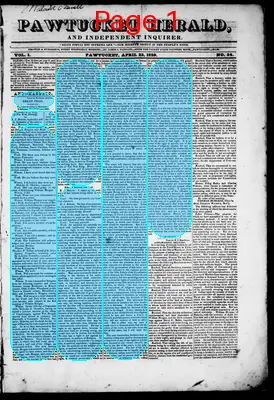
Pawtucket Herald, And Independent Inquirer
Pawtucket, Providence County, Rhode Island
What is this article about?
Anti-Masonic mock trial in Rochester Enquirer prosecutes Freemasons for kidnapping William Morgan in 1826 over his exposé book. Witnesses detail the abduction plot from Batavia to Fort Niagara and argue against excluding testimony based on religious beliefs.
Clipping
OCR Quality
Full Text
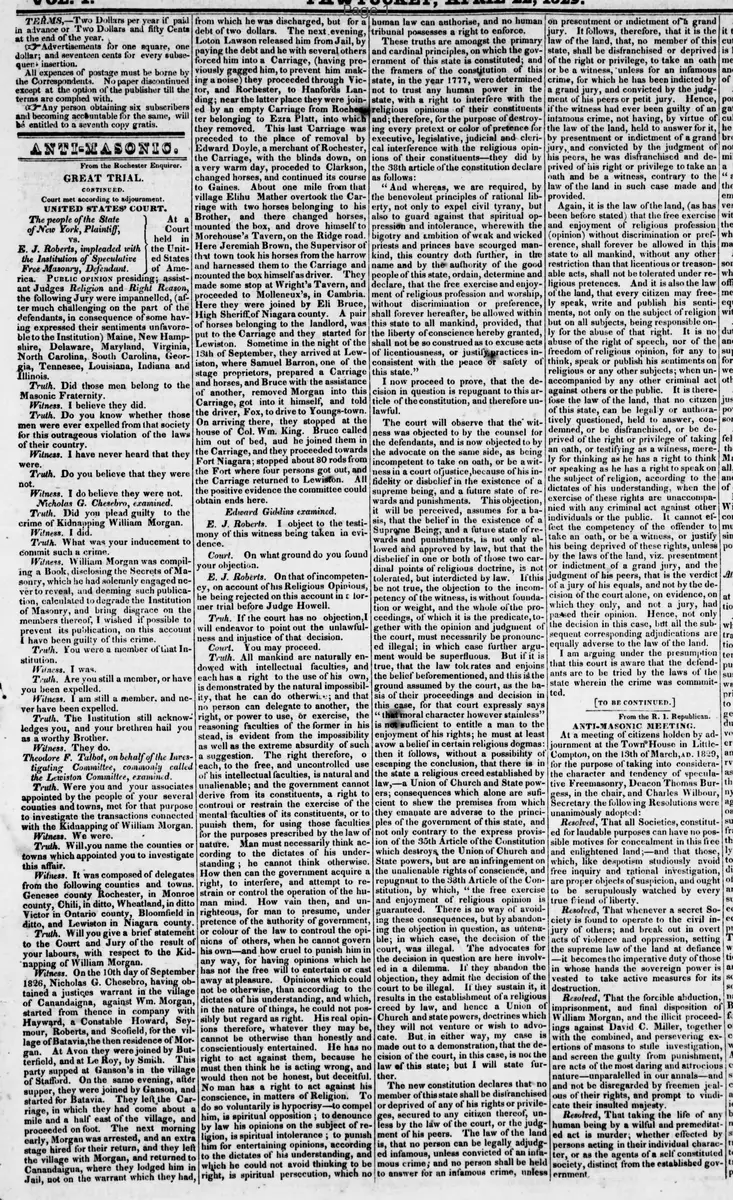
From the Rochester Enquirer.
GREAT TRIAL.
CONTINUED.
Court met according to adjournment.
UNITED STATES' COURT
The people of the State of New York, Plaintiff,
vs.
R. J. Roberts, impleaded with the Institution of Speculative Free Masonry, Defendant
of America. Public opinion presiding; assistant Judges Religion and Right Reason, the following Jury were impannelled, (after much challenging on the part of the defendants, in consequence of some having expressed their sentiments unfavorable to the Institution) Maine, New Hampshire, Delaware, Maryland, Virginia, North Carolina, South Carolina, Georgia, Tennessee, Louisiana, Indiana and Illinois.
Truth. Did those men belong to the Masonic Fraternity.
Witness. I believe they did.
Truth. Do you know whether those men were ever expelled from that society for this outrageous violation of the laws of their country.
Witness. I have never heard that they were.
Truth. Do you believe that they were not.
Witness. I do believe they were not.
Nicholas G. Chesebro, examined.
Truth. Did you plead guilty to the crime of Kidnapping William Morgan.
Witness. I did.
Truth. What was your inducement to commit such a crime.
Witness. William Morgan was compiling a Book, disclosing the Secrets of Masonry, which he had solemnly engaged never to reveal, and deeming such publication, calculated to degrade the Institution of Masonry, and bring disgrace on the members thereof, I wished if possible to prevent its publication, on this account I have been guilty of this crime.
Truth. You were a member of that Institution.
Witness. I was.
Truth. Are you still a member, or have you been expelled.
Witness. I am still a member. and never have been expelled.
Truth. The Institution still acknowledges you, and your brethren hail you as a worthy Brother.
Witness. They do.
Theodore F. Talbot, on behalf of the Investigating Committee, commonly called the Lewiston Committee, examined.
Truth. Were you and your associates appointed by the people of your several counties and towns, met for that purpose to investigate the transactions connected with the Kidnapping of William Morgan.
Witness. We were.
Truth. Will you name the counties or towns which appointed you to investigate this affair.
Witness. It was composed of delegates from the following counties and towns. Genesee county Rochester, in Monroe county, Chili, in ditto, Wheatland, in ditto Victor in Ontario county, Bloomfield in ditto, and Lewiston in Niagara county.
Truth. Will you give a brief statement to the Court and Jury of the result of your labours, with respect to the Kidnapping of William Morgan.
Witness. On the 10th day of September 1826, Nicholas G. Chesebro, having obtained a justice's warrant in the village of Canandaigua, against Wm. Morgan, started from thence in company with Hayward, a Constable Howard, Seymour, Roberts, and Scofield, for the village of Batavia, the then residence of Morgan. At Avon they were joined by Butterfield, and at Le Roy, by Smith. This party supped at Ganson's in the village of Stafford. On the same evening, after supper, they were joined by Ganson, and started for Batavia. They left the Carriage, in which they had come about a mile and a half east of the village, and proceeded on foot. The next morning early, Morgan was arrested, and an extra stage hired for their return, and they left the village with Morgan, and returned to Canandaigua, where they lodged him in Jail, not on the warrant which they had, from which he was discharged, but for a debt of two dollars. The next evening, Loton Lawson released him from Jail, by paying the debt and he with several others forced him into a Carriage, (having previously gagged him, to prevent him making a noise) they proceeded through Victor, and Rochester, to Hanfords Landing; near the latter place they were joined by an empty Carriage from Rochester belonging to Ezra Platt, into which they removed. This last Carriage was preceded to the place of removal by Edward Doyle, a merchant of Rochester, the Carriage, with the blinds down, on a very warm day, proceeded to Clarkson, changed horses, and continued its course to Gaines. About one mile from that village Elihu Mather overtook the Carriage with two horses belonging to his Brother, and there changed horses, mounted the box, and drove himself to Morehouse's Tavern, on the Ridge road. Here Jeremiah Brown, the Supervisor of that town took his horses from the harrow and harnessed them to the Carriage and mounted the box himself as driver. They made some stop at Wright's Tavern, and proceeded to Mellenex's, in Cambria. Here they were joined by Eli Bruce, High Sheriff of Niagara county. A pair of horses belonging to the landlord, was put to the Carriage and they started for Lewiston. Sometime in the night of the 13th of September, they arrived at Lewiston, where Samuel Barron, one of the stage proprietors, prepared a Carriage and horses, and Bruce with the assistance of another, removed Morgan into this Carriage, got into it himself, and told the driver, Fox, to drive to Youngstown. On arriving there, they stopped at the house of Col. Wm. King. Bruce called him out of bed, and he joined them in the Carriage, and they proceeded towards Fort Niagara; stopped about 80 rods from the Fort where four persons got out, and the Carriage returned to Lewiston. All the positive evidence the committee could obtain ends here.
Edward Giddins examined.
E. J. Roberts.
I object to the testimony of this witness being taken in evidence.
Court.
On what ground do you found your objection.
E. J. Roberts. On that of incompetency, on account of his Religious Opinions, he being rejected on this account in a former trial before Judge Howell.
Truth. If the court has no objection, I will endeavor to point out the unlawfulness and injustice of that decision.
Court. You may proceed.
Truth. All mankind are naturally endowed with intellectual faculties, and each has a right to the use of his own, is demonstrated by the natural impossibility, that he can do otherwise; and that no person can delegate to another, the right, or power to use, or exercise, the reasoning faculties of the former in his stead, is evident from the impossibility as well as the extreme absurdity of such a suggestion. The right therefore, of each, to the free, and uncontrolled use of his intellectual faculties, is natural and unalienable; and the government cannot derive from its constituents, a right to controul or restrain the exercise of the mental faculties of its constituents, or to punish them, for using those faculties for the purposes prescribed by the law of nature.
Man must necessarily think according to the dictates of his understanding; he cannot think otherwise. How then can the government acquire a right, to interfere, and attempt to restrain or control the operation of the human mind. How vain then, and unrighteous, for man to presume, under pretence of the authority of government, or colour of the law to controul the opinions of others, when he cannot govern his own-and how cruel to punish him in any way, for having opinions which he has not the free will to entertain or cast away at pleasure. Opinions which could not be otherwise, than according to the dictates of his understanding, and which, in the nature of things, he could not possibly but regard as right. His real opinions therefore, whatever they may be, cannot be otherwise than honestly and conscientiously entertained. He has no right to act against them, because he must then think he is acting wrong, and would then not be honest, but deceitful.
No man has a right to act against his conscience, in matters of Religion. To do so voluntarily is hypocrisy-to compel him, is spiritual oppression; to denounce by law his opinions on the subject of religion, is spiritual intolerance; to punish him for entertaining opinions, according to the dictates of his understanding, and which he could not avoid thinking to be right, is spiritual persecution, which no human law can authorise, and no human tribunal possesses a right to enforce.
These truths are amongst the primary and cardinal principles, on which the government of this state is constituted; and the framers of the constitution of this state, in the year 1777, were determined not to trust any human power in the state, with a right to interfere with the religious opinions of their constituents and; therefore, for the purpose of destroying every pretext or color of pretence for executive, legislative, judicial and clerical interference with the religious opinions of their constituents--they did by the 38th article of the constitution declare as follows:
"And whereas, we are required, by the benevolent principles of rational liberty, not only to expel civil tyrany, but also to guard against that spiritual oppression and intolerance, wherewith the bigotry and ambition of weak and wicked priests and princes have scourged mankind, this country doth further, in the name and by the authority of the good people of this state, ordain, determine and declare, that the free exercise and enjoyment of religious profession and worship, without discrimination or preference, shall forever hereafter, be allowed within this state to all mankind, provided, that the liberty of conscience hereby granted, shall not be so construed as to excuse acts of licentiousness, or justify practices inconsistent with the peace or safety of this state."
I now proceed to prove, that the decision in question is repugnant to this article of the constitution, and therefore unlawful.
The court will observe that the witness was objected to by the counsel for the defendants, and is now objected to by the advocate on the same side, as being incompetent to take on oath, or be a witness in a court of justice, because of his infidelity or disbelief in the existence of a supreme being, and a future state of rewards and punishments. This objection, it will be perceived, assumes for a basis, that the belief in the existence of a Supreme Being, and a future state of rewards and punishments, is not only allowed and approved by law, but that the disbelief in one or both of those two cardinal points of religious doctrine, is not tolerated, but interdicted by law. If this be not true, the objection to the incompetency of the witness, is without foundation or weight, and the whole of the proceedings, of which it is the predicate, together with the opinion and judgment of the court, must necessarily be pronounced illegal; in which case further argument would be superfluous. But if it is true, that the law tolerates and enjoins the belief before mentioned, and this is the ground assumed by the court, as the basis of their proceedings and decision in this case, for that court expressly says "that moral character however stainless" is not sufficient to entitle a man to the enjoyment of his rights; he must at least avow a belief in certain religious dogmas: then it follows, without a possibility of escaping the conclusion, that there is in the state a religious creed established by law,—a Union of Church and State powers; consequences which alone are sufficient to shew the premises from which they emanate are adverse to the principles of the government of this state, and not only contrary to the express provision of the 38th Article of the Constitution which destroys the Union of Church and State powers, but are an infringement on the unalienable rights of conscience, and repugnant to the 38th Article of the Constitution, by which, "the free exercise and enjoyment of religious opinion is guaranteed. There is no way of avoiding these consequences, but by abandoning the objection in question, as untenable; in which case, the decision of the court, was illegal. The advocates for the decision in question are hereinvolved in a dilemma. If they abandon the objection, they admit the decision of the court to be illegal. If they sustain it, it results in the establishment of a religious creed by law, and hence a Union of Church and state powers, doctrines which they will not venture or wish to advocate. But in either way, my case is made out to a demonstration, that the decision of the court, in this case, is not the law of this state; but I will state further.
The new constitution declares that no member of this state shall be disfranchised or deprived of any of his rights or privileges, secured to any citizen thereof, unless by the law of the land, or the judgment of his peers. The law of the land is, that no person can be legally adjudged infamous, unless convicted of an infamous crime; and no person shall be held to answer for an infamous crime, unless on presentment or indictment of a grand jury. It follows, therefore, that it is the law of the land, that no member of this state, shall be disfranchised or deprived of the right or privilege, to take an oath or be a witness, unless for an infamous crime, for which he has been indicted by a grand jury, and convicted by the judgment of his peers or petit jury. Hence, if the witness had ever been guilty of an infamous crime, not having, by virtue of the law of the land, held to answer for it, by presentment or indictment of a grand jury, and convicted by the judgment of his peers, he was disfranchised and deprived of his right or privilege to take an oath and be a witness, contrary to the law of the land in such case made and provided.
Again, it is the law of the land, (as has been before stated) that the free exercise and enjoyment of religious profession (opinion) without discrimination or preference, shall forever be allowed in this state to all mankind, without any other restriction than that licentious or treasonable acts, shall not be tolerated under religious pretences. And it is also the law of the land, that every citizen may freely speak, write and publish his sentiments, not only on the subject of religion but on all subjects, being responsible only for the abuse of that right. It is no abuse of the right of speech, nor of the freedom of religious opinion, for any to think, speak or publish his sentiments on religious or any other subjects; when unaccompanied by any other criminal act against others or the public. It is therefore the law of the land, that no citizen of this state, can be legally or authoritatively questioned, held to answer, condemned, or be disfranchised, or be deprived of the right or privilege of taking an oath, or testifying as a witness, merely for thinking as he has a right to think or speaking as he has a right to speak on the subject of religion, according to the dictates of his understanding, when the exercise of these rights are unaccompanied with any criminal act against other individuals or the public. It cannot effect the competency of the offender to take an oath, or be a witness, or justify his being deprived of these rights, unless by the laws of the land, viz. presentment or indictment of a grand jury, and the judgment of his peers, that is the verdict of a jury of his equals, and not by the decision of the court alone, on evidence, on which they only, and not a jury, had passed their opinion. Hence, not only the decision in this case, but all the subsequent corresponding adjudications are equally adverse to the law of the land.
I am arguing under the presumption that this court is aware that the defendants are to be tried by the laws of the state wherein the crime was committed.
[TO BE CONTINUED.]
What sub-type of article is it?
What themes does it cover?
What keywords are associated?
What entities or persons were involved?
Where did it happen?
Story Details
Key Persons
Location
New York State (Canandaigua, Batavia, Rochester, Lewiston, Fort Niagara)
Event Date
September 10 13, 1826
Story Details
Mock trial against Freemasonry for kidnapping William Morgan to prevent publication of Masonic secrets. Witnesses Chesebro admits guilt but remains member; Talbot details abduction route from Batavia to Fort Niagara; argument defends witness Giddins' competency despite religious disbelief, citing constitutional protections.