Thank you for visiting SNEWPapers!
Sign up free
Editorial
November 25, 1829
Pawtucket Herald, And Independent Inquirer
Pawtucket, Providence County, Rhode Island
What is this article about?
An anti-Masonic editorial defends seceders from Freemasonry against perjury charges, arguing that Masonic oaths are invalid as they support deceit. It references biblical examples and the William Morgan affair, blaming perjury on conspirators in Morgan's case.
Clipping
OCR Quality
95%
Excellent
Full Text
From the Philanthropist and Investigator.
FREEMASONRY INVESTIGATED
NUMBER XI
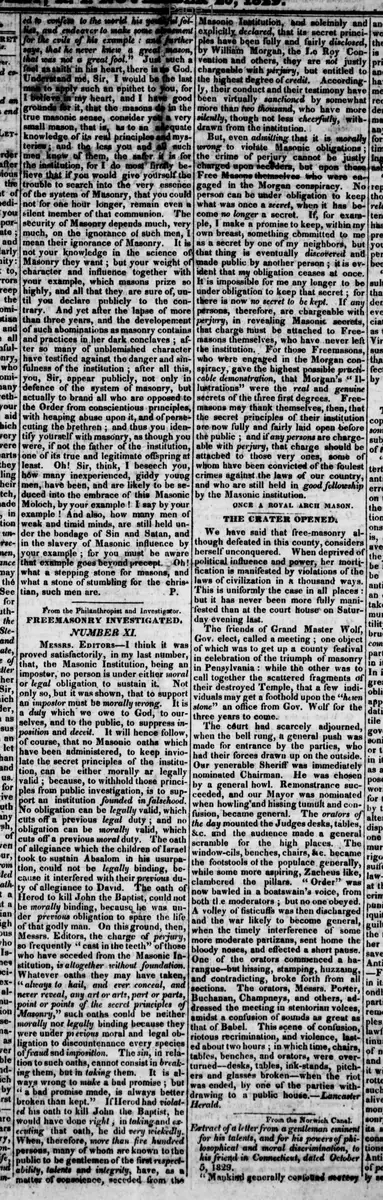
Messrs. Editors—I think it was proved satisfactorily, in my last number, that, the Masonic Institution, being an impostor, no person is under either moral or legal obligation to sustain it. Not only so, but it was shown, that to support an impostor must be morally wrong. It is a duty which we owe to God, to ourselves, and to the public, to suppress imposition and deceit. It will hence follow, of course, that no Masonic oaths which have been administered, to keep inviolate the secret principles of the institution, can be either morally or legally valid ; because, to withhold those principles from public investigation, is to support an institution founded in falsehood. No obligation can be legally valid, which cuts off a previous legal duty ; and no obligation can be morally valid, which cuts off a previous moral duty. The oath of allegiance which the children of Israel took to sustain Absalom in his usurpation, could not be legally binding, because it interfered with their previous duty of allegiance to David. The oath of Herod to kill John the Baptist, could not be morally binding, because he was under previous obligation to spare the life of that godly man. On this ground, then, Messrs. Editors, the charge of perjury, so frequently "cast in the teeth" of those who have seceded from the Masonic Institution, is altogether without foundation. Whatever oaths they may have taken, "always to hail, and ever conceal, and never reveal, any art or arts, part or parts, point or points of the secret principles of Masonry," such oaths could be neither morally nor legally binding because they were under previous moral and legal obligation to discountenance every species of fraud and imposition. The sin, in relation to such oaths, cannot consist in breaking them, but in taking them. It is always wrong to make a bad promise ; but "a bad promise made, is always better broken than kept." If Herod had violated his oath to kill John the Baptist, he would have done right ; in taking and executing that oath, he did very wickedly. When, therefore, more than five hundred persons, many of whom are known to the public to be gentlemen of the first respectability, talents and integrity, have, as a matter of conscience, seceded from the Masonic Institution, and solemnly and explicitly declared, that its secret principles have been fully and fairly disclosed, by William Morgan, the Le Roy Convention and others, they are not justly chargeable with perjury, but entitled to the highest degree of credit. Accordingly, their conduct and their testimony have been virtually sanctioned by somewhat more than two thousand, who have more silently, though not less cheerfully, withdrawn from the institution.
But, even admitting that it is morally wrong to violate Masonic obligations ; the crime of perjury cannot be justly charged upon seceders, but upon those Free Masons themselves—who were engaged in the Morgan conspiracy. No person can be under obligation to keep what was once a secret, when it has become no longer a secret. If, for example, I make a promise to keep, within my own breast, something committed to me as a secret by one of my neighbors, but that thing is eventually discovered and made public by another person ; it is evident that my obligation ceases at once. It is impossible for me any longer to be under obligation to keep that secret ; for there is now no secret to be kept. If any persons, therefore, are chargeable with perjury, in revealing Masonic secrets, that charge must be attached to Free-masons themselves, who have never left the institution. For those Freemasons, who were engaged in the Morgan conspiracy, gave the highest possible practical demonstration, that Morgan's "Illustrations" were the real and genuine secrets of the three first degrees. Free-masons may thank themselves, then, that the secret principles of their institution are now fully and fairly laid open before the public ; and if any persons are chargeable with perjury, that charge should be attached to those very ones, some of whom have been convicted of the foulest crimes against the laws of our country, and who are still held in good fellowship by the Masonic institution.
FREEMASONRY INVESTIGATED
NUMBER XI
Messrs. Editors—I think it was proved satisfactorily, in my last number, that, the Masonic Institution, being an impostor, no person is under either moral or legal obligation to sustain it. Not only so, but it was shown, that to support an impostor must be morally wrong. It is a duty which we owe to God, to ourselves, and to the public, to suppress imposition and deceit. It will hence follow, of course, that no Masonic oaths which have been administered, to keep inviolate the secret principles of the institution, can be either morally or legally valid ; because, to withhold those principles from public investigation, is to support an institution founded in falsehood. No obligation can be legally valid, which cuts off a previous legal duty ; and no obligation can be morally valid, which cuts off a previous moral duty. The oath of allegiance which the children of Israel took to sustain Absalom in his usurpation, could not be legally binding, because it interfered with their previous duty of allegiance to David. The oath of Herod to kill John the Baptist, could not be morally binding, because he was under previous obligation to spare the life of that godly man. On this ground, then, Messrs. Editors, the charge of perjury, so frequently "cast in the teeth" of those who have seceded from the Masonic Institution, is altogether without foundation. Whatever oaths they may have taken, "always to hail, and ever conceal, and never reveal, any art or arts, part or parts, point or points of the secret principles of Masonry," such oaths could be neither morally nor legally binding because they were under previous moral and legal obligation to discountenance every species of fraud and imposition. The sin, in relation to such oaths, cannot consist in breaking them, but in taking them. It is always wrong to make a bad promise ; but "a bad promise made, is always better broken than kept." If Herod had violated his oath to kill John the Baptist, he would have done right ; in taking and executing that oath, he did very wickedly. When, therefore, more than five hundred persons, many of whom are known to the public to be gentlemen of the first respectability, talents and integrity, have, as a matter of conscience, seceded from the Masonic Institution, and solemnly and explicitly declared, that its secret principles have been fully and fairly disclosed, by William Morgan, the Le Roy Convention and others, they are not justly chargeable with perjury, but entitled to the highest degree of credit. Accordingly, their conduct and their testimony have been virtually sanctioned by somewhat more than two thousand, who have more silently, though not less cheerfully, withdrawn from the institution.
But, even admitting that it is morally wrong to violate Masonic obligations ; the crime of perjury cannot be justly charged upon seceders, but upon those Free Masons themselves—who were engaged in the Morgan conspiracy. No person can be under obligation to keep what was once a secret, when it has become no longer a secret. If, for example, I make a promise to keep, within my own breast, something committed to me as a secret by one of my neighbors, but that thing is eventually discovered and made public by another person ; it is evident that my obligation ceases at once. It is impossible for me any longer to be under obligation to keep that secret ; for there is now no secret to be kept. If any persons, therefore, are chargeable with perjury, in revealing Masonic secrets, that charge must be attached to Free-masons themselves, who have never left the institution. For those Freemasons, who were engaged in the Morgan conspiracy, gave the highest possible practical demonstration, that Morgan's "Illustrations" were the real and genuine secrets of the three first degrees. Free-masons may thank themselves, then, that the secret principles of their institution are now fully and fairly laid open before the public ; and if any persons are chargeable with perjury, that charge should be attached to those very ones, some of whom have been convicted of the foulest crimes against the laws of our country, and who are still held in good fellowship by the Masonic institution.
What sub-type of article is it?
Moral Or Religious
Crime Or Punishment
Legal Reform
What keywords are associated?
Freemasonry
Masonic Oaths
Perjury
William Morgan
Morgan Conspiracy
Seceders
Imposture
Moral Duty
What entities or persons were involved?
Freemasons
William Morgan
Le Roy Convention
Absalom
David
Herod
John The Baptist
Morgan Conspiracy Participants
Editorial Details
Primary Topic
Invalidity Of Masonic Oaths And Defense Against Perjury Charges For Seceders
Stance / Tone
Strongly Anti Masonic, Defending Seceders
Key Figures
Freemasons
William Morgan
Le Roy Convention
Absalom
David
Herod
John The Baptist
Morgan Conspiracy Participants
Key Arguments
Masonic Institution Is An Impostor, So No Moral Or Legal Obligation To Sustain It
Supporting Imposture Is Morally Wrong; Duty To Suppress Deceit
Masonic Oaths Invalid As They Withhold Principles From Investigation, Supporting Falsehood
No Obligation Valid If It Cuts Off Prior Legal Or Moral Duty
Biblical Examples: Oaths To Absalom And Herod Invalid
Perjury Charge Against Seceders Unfounded; Sin In Taking, Not Breaking Bad Oaths
Over 500 Seceders Credibly Disclosed Secrets Via Morgan And Others
Perjury Belongs To Freemasons In Morgan Conspiracy Who Revealed Secrets
Once Secret Is Public, Obligation To Keep It Ceases