Thank you for visiting SNEWPapers!
Sign up free
The Arkansas Advocate
Little Rock, Pulaski County, Arkansas
What is this article about?
In Philadelphia, a duel involving U.S. Navy officers Edmund Byrne, Hampton Westcott, Charles H. Duryee, and Charles G. Hunter resulted in the death of civilian William Miller Jr. The officers were promptly removed from Navy rolls by the Secretary and President Jackson. Pennsylvania's legislature passed resolutions condemning dueling and approving the action, establishing a precedent against such acts by military personnel.
Clipping
OCR Quality
Full Text
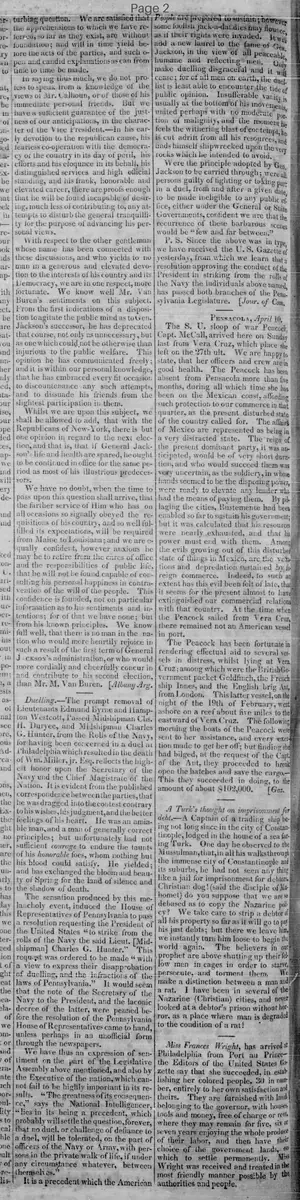
The sensation produced by this melancholy event, induced the House of Representatives of Pennsylvania to pass a resolution requesting the President of the United States "to strike from the rolls of the Navy the said Lieut. [Midshipman] Charles G. Hunter." This request was ordered to be made "with a view to express their disapprobation of duelling, and the infractions of the laws of Pennsylvania." It would seem that the note of the Secretary of the Navy to the President, and the laconic decree of the latter, were penned before the resolution of the Pennsylvania House of Representatives came to hand, unless perhaps in an unofficial form through the newspapers.
We have thus an expression of sentiment on the part of the Legislative Assembly above mentioned, and also by the Executive of the nation, which cannot fail to be highly important in its results. "The greatness of its consequence," says the National Intelligencer, "lies in its being a precedent, which probably will settle the question, forever, that no duel, or challenge of defiance to a duel, will be tolerated, on the part of officers of the Navy or Army, with persons in the private walk of life, if under any circumstance whatever, between themselves."
It is a precedent which the American people are prepared to sustain; however some foolish jack-a-dandies may flounce, as if their rights were invaded. It will add a new laurel to the fame of Gen. Jackson, in the view of all peaceable, humane and reflecting men. Only make duelling disgraceful and it will cease; for of all men on earth, the duellist is least able to encounter the tide of public opinion. Insufferable vanity is usually at the bottom of his movements, united perhaps with no moderate portion of malignity, and the moment he feels the withering blast of contempt, he is cut adrift from all his resources, and finds himself shipwrecked upon the very rocks which he intended to avoid.
Were the principle adopted by Gen. Jackson to be carried through; were all persons guilty of fighting or taking part in a duel, from and after a given date, to be made ineligible to any public office, either under the General or State Governments, confident we are that the recurrence of these barbarous scenes would be "few and far between."
P. S. Since the above was in type, we have received the U. S. Gazette of yesterday, from which we learn that a resolution approving the conduct of the President in striking from the rolls of the Navy the individuals above named has passed both branches of the Pennsylvania Legislature.
What sub-type of article is it?
What keywords are associated?
What entities or persons were involved?
Where did it happen?
Domestic News Details
Primary Location
Philadelphia
Key Persons
Outcome
death of wm. miller, jr. esq.; removal of lieutenants edmund byrne and hampton westcott, passed midshipman chas. h. duryee, and midshipman charles g. hunter from navy rolls; resolutions passed by pennsylvania legislature approving the president's action.
Event Details
Lieutenants Edmund Byrne and Hampton Westcott, Passed Midshipman Chas. H. Duryee, and Midshipman Charles G. Hunter were involved in a duel at Philadelphia resulting in the death of Wm. Miller, jr. Esq., who was reluctant to participate. The Secretary of the Navy and President ordered their removal from the Navy rolls. The Pennsylvania House of Representatives passed a resolution requesting the removal of Midshipman Charles G. Hunter to express disapprobation of duelling. The event sets a precedent against duelling involving military officers.