Thank you for visiting SNEWPapers!
Sign up free
The Virginia Gazette
Williamsburg, Virginia
What is this article about?
Junius writes to the tutor of the Prince of Wales, outlining duties in educating the heir: instill equality, virtue, love of country, caution in power, mercy, and exemplary conduct to ensure good kingship and public welfare.
Clipping
OCR Quality
Full Text
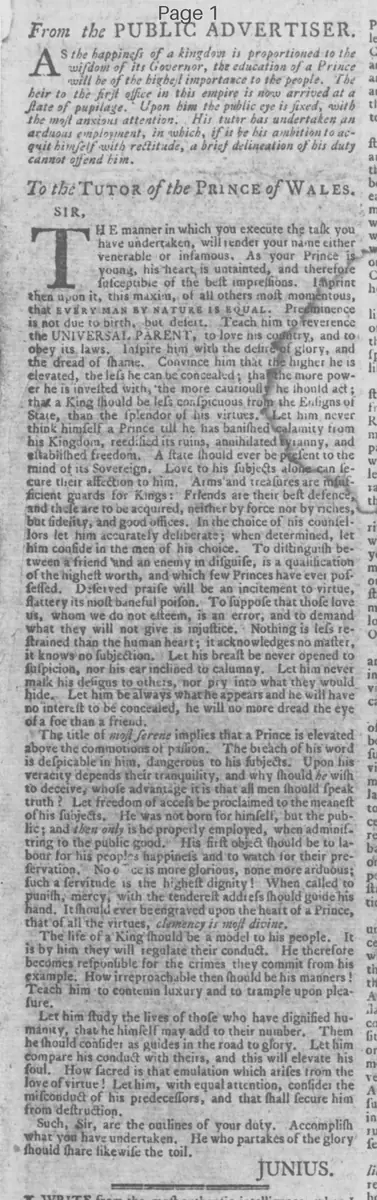
If the happiness of a kingdom is proportioned to the wisdom of its Governor, the education of a Prince will be of the highest importance to the people. The heir to the first office in this empire is now arrived at an age of pupilage. Upon him the public eye is fixed, with the most anxious attention. His tutor has undertaken an arduous employment, in which, if it be his ambition to acquit himself with rectitude, a brief delineation of his duty cannot offend him.
To the Tutor of the Prince of Wales.
SIR,
The manner in which you execute the task you have undertaken, will render your name either venerable or infamous. As your Prince is young, his heart is untainted, and therefore susceptible of the best impressions. Imprint then upon it, this maxim, of all others most momentous, That EVERY MAN BY NATURE IS EQUAL. Pre-eminence is not due to birth, but desert. Teach him to reverence the UNIVERSAL PARENT, to love his country, and to obey its laws. Inspire him with the desire of glory, and the dread of shame. Convince him that the higher he is elevated, the less he can be concealed; that the more power he is invested with, the more cautiously he should act; that a King should be less conspicuous from the trappings of State, than the splendour of his virtues. Let him never think himself a Prince till he has banished calamity from his Kingdom, redressed its ruins, annihilated tyranny, and established freedom. A state should ever be present to the mind of its Sovereign. Love to his subjects alone can secure their affection to him. Arms and treasures are insufficient guards for Kings: Friends are their best defence, and these are to be acquired, neither by force nor by riches, but fidelity, and good offices. In the choice of his counsellors let him accurately deliberate: when determined, let him confide in the men of his choice. To distinguish between a friend and an enemy in disguise, is a qualification of the highest worth, and which few Princes have ever possessed. Deserved praise will be an incitement to virtue, flattery its most baneful poison. To suppose that those love us, whom we do not esteem, is an error, and to demand what they will not give is injustice. Nothing is less restrained than the human heart; it acknowledges no master, it knows no subjection. Let his breast be never opened to suspicion, nor his ear inclined to calumny. Let him never mark his designs to others, nor pry into what they would hide. Let him be always what he appears and he will have no interest to be concealed, he will no more dread the eye of a foe than a friend.
The title of most serene implies that a Prince is elevated above the commotions of passion. The breach of his word is despicable in him, dangerous to his subjects. Upon his veracity depends their tranquility, and why should he wish to deceive, whose advantage it is that all men should speak truth? Let freedom of access be proclaimed to the meanest of his subjects. He was not born for himself, but the public; and then only is he properly employed, when administering to the public good. His first object should be to labour for his people's happiness and to watch for their preservation. No office is more glorious, none more arduous; such a servitude is the highest dignity! When called to punish, mercy, with the tenderest address should guide his hand. It should ever be engraved upon the heart of a Prince, that of all the virtues, clemency is most divine.
The life of a King should be a model to his people. It is by him they will regulate their conduct. He therefore becomes responsible for the crimes they commit from his example. How irreproachable then should be his manners! Teach him to contemn luxury and to trample upon pleasure.
Let him study the lives of those who have dignified humanity, that he himself may add to their number. Them he should consider as guides in the road to glory. Let him compare his conduct with theirs, and this will elevate his soul. How sacred is that emulation which arises from the love of virtue! Let him, with equal attention, consider the misconduct of his predecessors, and that shall secure him from destruction.
Such, Sir, are the outlines of your duty. Accomplish what you have undertaken. He who partakes of the glory should share likewise the toil.
JUNIUS.
What sub-type of article is it?
What keywords are associated?
What entities or persons were involved?
Where did it happen?
Foreign News Details
Primary Location
England
Key Persons
Event Details
A letter addressed to the tutor of the Prince of Wales provides detailed advice on educating the young prince, emphasizing principles of equality, reverence for the universal parent, love of country, obedience to laws, pursuit of glory, dread of shame, cautious exercise of power, establishment of freedom, acquisition of friends through fidelity and good offices, discernment of true counselors, avoidance of flattery and suspicion, maintenance of veracity, freedom of access to subjects, prioritization of public good and mercy, exemplary conduct, study of virtuous predecessors, and emulation of their lives.