Thank you for visiting SNEWPapers!
Sign up free
Editorial
April 20, 1840
Republican Herald
Providence, Providence County, Rhode Island
What is this article about?
Editorial in the Burning Herald argues that the North Eastern Boundary dispute with Britain involves US national honor and rights under treaty. It asserts the US must firmly maintain its position to avoid war, but believes Britain, preoccupied elsewhere, will not pursue conflict.
Clipping
OCR Quality
95%
Excellent
Full Text
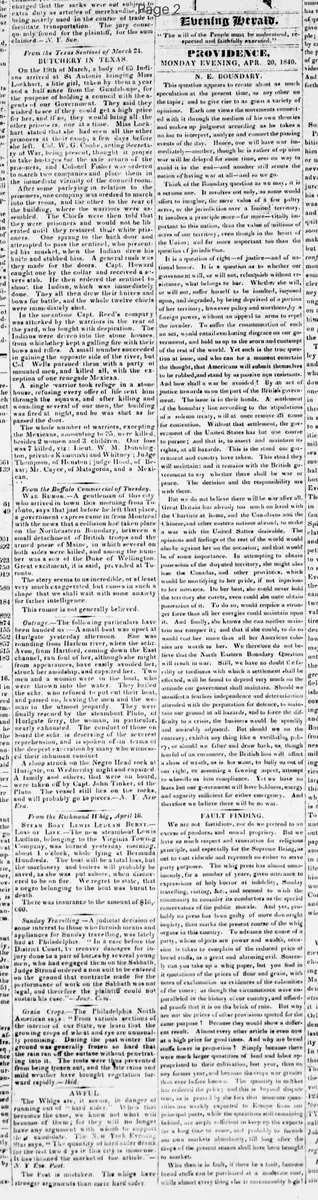
Burning Herald.
"The will of the People must be understood, respected and faithfully executed."
PROVIDENCE,
MONDAY EVENING, APR. 20, 1840.
N. E. BOUNDARY.
This question appears to create about as much speculation at the present time, as any other on the tapis; and to give rise to as great a variety of opinions. Each one views the movements connected with it through the medium of his own theories and makes up judgment according as he takes a notion to interpret, analyze and connect the passing events of the day. Hence, one will have war immediately—another, though he is rather of opinion war will be delayed for some time, sees no way to avoid it in the end—and another still scouts the notion of having war at all—and so we go.
Think of the Boundary question as we may, it is a serious one. It involves not only, as some would affect to imagine, the mere value of a few paltry acres, or the jurisdiction over a limited territory. It involves a principle more—far more—vitally important to this nation, than the value of millions of acres of our territory, even though in the heart of the Union; and far more important too than the question of jurisdiction.
It is a question of right—of justice—and of national honor. It is a question as to whether our government will, or will not, relinquish without resistance, what belongs to her. Whether she will, or will not, suffer herself to be insulted, imposed upon, and degraded, by being deprived of a portion of her territory, however paltry and worthless, by a foreign power, without an appeal to arms to repel the invader. To suffer the consummation of such an act, would entail everlasting disgrace on our government, and hold us up to the scorn and contempt of the rest of the world. Yet such is the true question at issue, and who can for a moment entertain the thought, that Americans will submit themselves to be robbed, and stand by as passive non resistants.
And how shall a war be avoided? By an act of justice towards us on the part of the British government. The issue is in their hands. A settlement of the boundary line according to the stipulations of a solemn treaty, will at once remove all cause for contention. Without that settlement, the government of the United States has but one course to pursue; and that is, to assert and maintain its rights, at all hazards. This is the stand our government and country have taken. This stand they will maintain: and it remains with the British government to say whether there shall be war or peace. The decision and the responsibility are with them.
But we do not believe there will be war after all. Great Britain has already too much on hand with the Chartists at home, and the Canadians and the Chinese, and other eastern nations abroad, to make a war with the United States desirable. The opinions and feelings of the rest of the world would also be against her on the occasion; and that would be of some importance. In attempting to obtain possession of the disputed territory, she might also lose the Canadas, and other provinces, which would be mortifying to her pride, if not injurious to her interests. Do her best, she could never hold the territory she covets, even could she once obtain possession of it. To do so, would require a stronger force than all her energies could maintain upon it. And finally, she knows she can neither maintain nor conquer it; and that if she could, to do so would cost her more than all her American colonies are worth to her. We therefore do not believe that the North Eastern Boundary Question will result in war. Still, we have no doubt the facility or tardiness with which a settlement shall be effected, will be found to depend very much on the attitude our government shall maintain. Should we manifest a fearless independence and determination attended with the preparation for defence, to maintain our ground at all hazards, and to force the difficulty to a crisis, the business would be speedily and amicably adjusted. But should we on the contrary, exhibit any thing like a vacillating policy, or should we falter and draw back, as though fearful of an encounter, the British lion will affect a show of wrath, as is his wont, to bully us out of our right, or assuming a fawning aspect, attempt to wheedle us into compliance. Yet we have no fears but our government will have boldness, energy and sagacity sufficient for either emergency.
And therefore we believe there will be no war.
"The will of the People must be understood, respected and faithfully executed."
PROVIDENCE,
MONDAY EVENING, APR. 20, 1840.
N. E. BOUNDARY.
This question appears to create about as much speculation at the present time, as any other on the tapis; and to give rise to as great a variety of opinions. Each one views the movements connected with it through the medium of his own theories and makes up judgment according as he takes a notion to interpret, analyze and connect the passing events of the day. Hence, one will have war immediately—another, though he is rather of opinion war will be delayed for some time, sees no way to avoid it in the end—and another still scouts the notion of having war at all—and so we go.
Think of the Boundary question as we may, it is a serious one. It involves not only, as some would affect to imagine, the mere value of a few paltry acres, or the jurisdiction over a limited territory. It involves a principle more—far more—vitally important to this nation, than the value of millions of acres of our territory, even though in the heart of the Union; and far more important too than the question of jurisdiction.
It is a question of right—of justice—and of national honor. It is a question as to whether our government will, or will not, relinquish without resistance, what belongs to her. Whether she will, or will not, suffer herself to be insulted, imposed upon, and degraded, by being deprived of a portion of her territory, however paltry and worthless, by a foreign power, without an appeal to arms to repel the invader. To suffer the consummation of such an act, would entail everlasting disgrace on our government, and hold us up to the scorn and contempt of the rest of the world. Yet such is the true question at issue, and who can for a moment entertain the thought, that Americans will submit themselves to be robbed, and stand by as passive non resistants.
And how shall a war be avoided? By an act of justice towards us on the part of the British government. The issue is in their hands. A settlement of the boundary line according to the stipulations of a solemn treaty, will at once remove all cause for contention. Without that settlement, the government of the United States has but one course to pursue; and that is, to assert and maintain its rights, at all hazards. This is the stand our government and country have taken. This stand they will maintain: and it remains with the British government to say whether there shall be war or peace. The decision and the responsibility are with them.
But we do not believe there will be war after all. Great Britain has already too much on hand with the Chartists at home, and the Canadians and the Chinese, and other eastern nations abroad, to make a war with the United States desirable. The opinions and feelings of the rest of the world would also be against her on the occasion; and that would be of some importance. In attempting to obtain possession of the disputed territory, she might also lose the Canadas, and other provinces, which would be mortifying to her pride, if not injurious to her interests. Do her best, she could never hold the territory she covets, even could she once obtain possession of it. To do so, would require a stronger force than all her energies could maintain upon it. And finally, she knows she can neither maintain nor conquer it; and that if she could, to do so would cost her more than all her American colonies are worth to her. We therefore do not believe that the North Eastern Boundary Question will result in war. Still, we have no doubt the facility or tardiness with which a settlement shall be effected, will be found to depend very much on the attitude our government shall maintain. Should we manifest a fearless independence and determination attended with the preparation for defence, to maintain our ground at all hazards, and to force the difficulty to a crisis, the business would be speedily and amicably adjusted. But should we on the contrary, exhibit any thing like a vacillating policy, or should we falter and draw back, as though fearful of an encounter, the British lion will affect a show of wrath, as is his wont, to bully us out of our right, or assuming a fawning aspect, attempt to wheedle us into compliance. Yet we have no fears but our government will have boldness, energy and sagacity sufficient for either emergency.
And therefore we believe there will be no war.
What sub-type of article is it?
Foreign Affairs
War Or Peace
What keywords are associated?
Northeast Boundary
National Honor
British Treaty
Potential War
Us Rights
Diplomatic Settlement
What entities or persons were involved?
British Government
United States Government
Chartists
Canadians
Chinese
Editorial Details
Primary Topic
North Eastern Boundary Dispute With Britain
Stance / Tone
Firm Defense Of Us Rights, Optimistic Avoidance Of War
Key Figures
British Government
United States Government
Chartists
Canadians
Chinese
Key Arguments
Boundary Dispute Involves National Honor And Justice Beyond Mere Territory
Us Must Assert Rights Without Resistance To Avoid Disgrace
War Avoidable By British Adherence To Treaty
Britain Unlikely To Seek War Due To Domestic And Foreign Commitments
Firm Us Stance Will Expedite Amicable Settlement