Thank you for visiting SNEWPapers!
Sign up free
Editorial
May 10, 1792
National Gazette
Philadelphia, Philadelphia County, Pennsylvania
What is this article about?
Post-Revolutionary War editorial from Boston criticizes army officers' Society of the Cincinnati for claiming superiority and seeking special financial rewards, arguing instead for equal justice without favoritism, at public expense or restitution from wartime profiteers. References Madison's failed congressional motion.
Clipping
OCR Quality
98%
Excellent
Full Text
BOSTON, April 26.
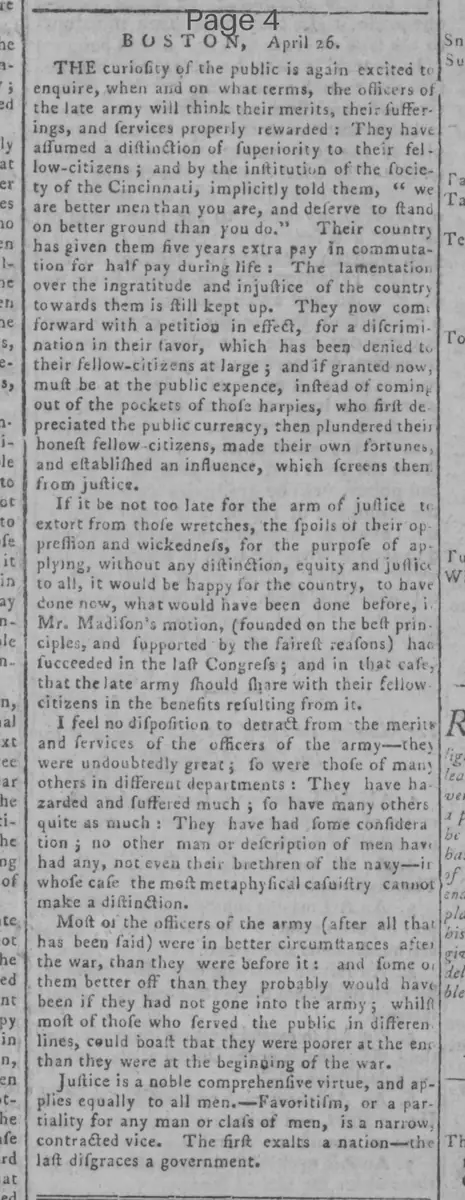
THE curiosity of the public is again excited to enquire, when and on what terms, the officers of the late army will think their merits, their sufferings, and services properly rewarded: They have assumed a distinction of superiority to their fellow-citizens; and by the institution of the society of the Cincinnati, implicitly told them, "we are better men than you are, and deserve to stand on better ground than you do." Their country has given them five years extra pay in commutation for half pay during life: The lamentation over the ingratitude and injustice of the country towards them is still kept up. They now come forward with a petition in effect, for a discrimination in their favor, which has been denied to their fellow-citizens at large; and if granted now, must be at the public expence, instead of coming out of the pockets of those harpies, who first depreciated the public currency, then plundered their honest fellow citizens, made their own fortunes and established an influence, which screens them from justice.
If it be not too late for the arm of justice to extort from those wretches, the spoils of their oppression and wickedness, for the purpose of applying, without any distinction, equity and justice to all, it would be happy for the country, to have come now, what would have been done before, if Mr. Madison's motion, (founded on the best principles, and supported by the fairest reasons) had succeeded in the last Congress; and in that case, that the late army should share with their fellow citizens in the benefits resulting from it.
I feel no disposition to detract from the merits and services of the officers of the army—they were undoubtedly great; so were those of many others in different departments: They have hazarded and suffered much; so have many others quite as much: They have had some consideration; no other man or description of men have had any, not even their brethren of the navy—in whose case the most metaphysical casuistry cannot make a distinction.
Most of the officers of the army (after all that has been said) were in better circumstances after the war, than they were before it: and some of them better off than they probably would have been if they had not gone into the army; whilst most of those who served the public in different lines, could boast that they were poorer at the end than they were at the beginning of the war.
Justice is a noble comprehensive virtue, and applies equally to all men.—Favoritism, or a partiality for any man or class of men, is a narrow, contracted vice. The first exalts a nation—the last disgraces a government.
THE curiosity of the public is again excited to enquire, when and on what terms, the officers of the late army will think their merits, their sufferings, and services properly rewarded: They have assumed a distinction of superiority to their fellow-citizens; and by the institution of the society of the Cincinnati, implicitly told them, "we are better men than you are, and deserve to stand on better ground than you do." Their country has given them five years extra pay in commutation for half pay during life: The lamentation over the ingratitude and injustice of the country towards them is still kept up. They now come forward with a petition in effect, for a discrimination in their favor, which has been denied to their fellow-citizens at large; and if granted now, must be at the public expence, instead of coming out of the pockets of those harpies, who first depreciated the public currency, then plundered their honest fellow citizens, made their own fortunes and established an influence, which screens them from justice.
If it be not too late for the arm of justice to extort from those wretches, the spoils of their oppression and wickedness, for the purpose of applying, without any distinction, equity and justice to all, it would be happy for the country, to have come now, what would have been done before, if Mr. Madison's motion, (founded on the best principles, and supported by the fairest reasons) had succeeded in the last Congress; and in that case, that the late army should share with their fellow citizens in the benefits resulting from it.
I feel no disposition to detract from the merits and services of the officers of the army—they were undoubtedly great; so were those of many others in different departments: They have hazarded and suffered much; so have many others quite as much: They have had some consideration; no other man or description of men have had any, not even their brethren of the navy—in whose case the most metaphysical casuistry cannot make a distinction.
Most of the officers of the army (after all that has been said) were in better circumstances after the war, than they were before it: and some of them better off than they probably would have been if they had not gone into the army; whilst most of those who served the public in different lines, could boast that they were poorer at the end than they were at the beginning of the war.
Justice is a noble comprehensive virtue, and applies equally to all men.—Favoritism, or a partiality for any man or class of men, is a narrow, contracted vice. The first exalts a nation—the last disgraces a government.
What sub-type of article is it?
Military Affairs
Social Reform
Moral Or Religious
What keywords are associated?
Society Of The Cincinnati
Army Officers Rewards
Equal Justice
Post War Compensation
Favoritism Criticism
Madison Motion
Wartime Profiteers
What entities or persons were involved?
Society Of The Cincinnati
Officers Of The Late Army
Mr. Madison
Congress
Navy Brethren
Editorial Details
Primary Topic
Criticism Of Special Rewards For Revolutionary Army Officers
Stance / Tone
Critical Of Favoritism And Advocacy For Equal Justice
Key Figures
Society Of The Cincinnati
Officers Of The Late Army
Mr. Madison
Congress
Navy Brethren
Key Arguments
Officers Claim Superiority Through Society Of The Cincinnati
Country Already Provided Five Years Extra Pay
Petition Seeks Discrimination Denied To Other Citizens At Public Expense
Justice Requires Restitution From Wartime Profiteers For Equal Benefits
Officers' Merits Great But Not Unique; Many Others Suffered Equally Without Reward
Most Officers Better Off Post War Than Before
Favoritism Disgraces Government; Equal Justice Exalts Nation