Thank you for visiting SNEWPapers!
Sign up free
Editorial
August 28, 1872
Clearfield Republican
Clearfield, Clearfield County, Pennsylvania
What is this article about?
Speech by Hon. Wm. A. Wallace at Greensburg, PA, on August 19, 1872, advocating Democratic support for Horace Greeley and unity with liberal Republicans to restore constitutional principles, states' rights, and end corruption under Grant's administration, critiquing Southern federal interference and state officials like Hartranft.
Clipping
OCR Quality
98%
Excellent
Full Text
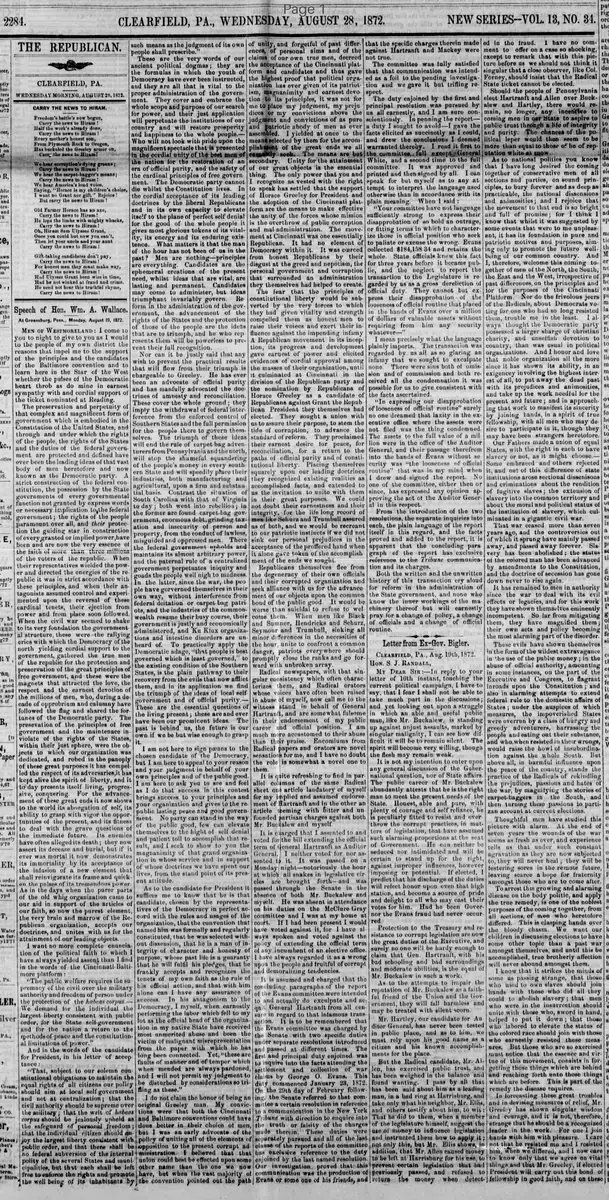
Speech of Hon. Wm. A. Wallace.
At Greensburg, Penn., Monday, August 19, 1872.
Men of Westmoreland: I come to you tonight to give to you as I would to the people of my own district the reasons that impel me to the support of the principles and the candidates of the Baltimore convention and to learn here in the Star of the West whether the pulses of the Democratic heart throb as do mine in earnest sympathy with and cordial support of the ticket nominated at Reading.
The preservation and perpetuity of that complex and magnificent form of government which is embodied in the Constitution of the United States, and through and under which the rights of the people, the rights of the States and the duties of the federal government are protected and defined have ever been the leading ideas of that vast body of men heretofore and now known as the Democratic party. A strict construction of the federal constitution, the possession by the State governments of every governmental function not granted by express words or necessary implication to the federal government; the rights of the people paramount over all, and their protection the guiding star in construction of every granted or implied power, have been and are now the very essence of the faith of more than three millions of the voters of the republic. When their representatives wielded the power and directed the energies of the republic it was in strict accordance with these principles, and when their antagonists assumed control and experimented upon the reversal of these cardinal tenets, their ejection from power and from place soon followed. When the civil war seemed to shake to its very foundation the governmental structure, these were the rallying cries with which the Democracy of the north yielding cordial support to the government, gathered the true men of the republic for the protection and preservation of the great principles of free government, and these were the magnets that attracted the love, the respect and the earnest devotion of the millions of men, who, during a decade of opprobrium and calumny have followed the flag and shared the fortunes of the Democratic party. The preservation of the principles of free government and the maintenance inviolate of the rights of the States within their just sphere, were the objects to which our organization was dedicated, and robed in the panoply of these great purposes it has compelled the respect of its adversaries, it has kept alive the spirit of liberty, and it today presents itself living, progressive, conquering. For the advancement of these great ends it now shows to the world its abnegation of self, its ability to grasp with vigor the opportunities of the present, and its fitness to deal with the grave questions of the immediate future. Its enemies have often alleged its death; they now assert its decease and burial, but if it ever was mortal it now demonstrates its immortality by its acceptance of the infusion of a new element that shall reinvigorate its frame and quicken the pulses of its tremendous power. As in the days when the purer parts of the old whig organization came to our aid in support of the articles of our faith, so now the purest element, the very brain and marrow of the Republican organization, accepts our doctrines, and unites with us for the attainment of our leading objects.
I want no more complete enunciation of the political faith to which I have always yielded assent than I find in the words of the Cincinnati-Baltimore platform:
"The public welfare requires the supremacy of the civil over the military authority and freedom of person under the protection of the habeas corpus. We demand for the individual the largest liberty consistent with public order, for the State self-government and for the nation a return to the methods of peace and the constitutional limitations of power."
And in the words of the candidate for President, in his letter of acceptance:
"That, subject to our solemn constitutional obligations to maintain the equal rights of all citizens our policy should aim at local self government and not at centralization; that the civil authority should be supreme over the military; that the writ of habeas corpus should be jealously upheld as the safeguard of personal freedom; that the individual citizen should enjoy the largest liberty consistent with public order, and that there shall be no federal subversion of the internal polity of the several States and municipalities, but that each shall be left free to enforce the rights and promote the well being of its inhabitants by such means as the judgment of its own people shall prescribe."
These are the very words of our ancient political dogmas; they are the formulas in which the youth of Democracy have ever been instructed, and they are all that is vital to the proper administration of the government. They cover and embrace the whole scope and purpose of our search for power, and their just application will perpetuate the institutions of our country and will restore prosperity and happiness to the whole people.
Who will not look with pride upon the magnificent spectacle that is presented in the cordial unity of the best men of the nation for the restoration of an era of official purity, and the safety of the cardinal principles of free government. The Democratic party cannot die whilst the Constitution lives. In the cordial acceptance of its leading doctrines by the liberal Republicans and in its own capacity to elevate itself to the plane of perfect self denial for the good of the whole people it gives most glorious tokens of its vitality, its energy and its enduring existence. What matters it that the man of the hour has not been of us in the past? Men are nothing—principles are everything. Candidates are the ephemeral creations of the present need, whilst ideas that are vital, are lasting and permanent. Candidates may come to administer, but ideas triumphant invariably govern. Reform in the administration of the government, the advancement of the rights of the States and the protection of those of the people are the ideas that are to triumph, and he who represents them will be powerless to prevent their full recognition.
Nor can it be justly said that any wish to prevent the practical results that will flow from their triumph is chargeable to Greeley. He has ever been an advocate of official purity and has manfully advocated the doctrines of amnesty and reconciliation. These cover the whole ground; they imply the withdrawal of federal interference from the enforced control of Southern States and the full permission for the people there to govern themselves. The triumph of these ideas will end the rule of carpet-bag adventurers from Pennsylvania and the north, will stop the shameful squandering of the people's money in every southern State and will speedily place their industries, both manufacturing and agricultural, upon a firm and substantial basis. Contrast the situation of South Carolina with that of Virginia today; both went into rebellion; in the former are found carpet-bag government, enormous debt, grinding taxation and insecurity of person and property, from the conduct of lawless, misguided and oppressed men. There the federal government upholds and maintains its almost arbitrary power, and the paternal rule of a centralized government perpetuates iniquity and goads the people well nigh to madness. In the latter, since the war, the people have governed themselves in their own way, without interference from federal deputation or carpet bag patriots, and the industries of the commonwealth resume their busy course, their government is justly and economically administered, and Ku Klux organizations and intestine disorders are unheard of. To practically apply the Democratic adage, "that people is best governed which is least governed," to the existing condition of the Southern States, is the plain pathway to their recovery from the evils that now afflict them, and in its application we find the triumph of the ideas of local self government and of official purity.
These are the essential questions of the living present; these are and over have been our prominent ideas. The past is behind us, the future is our own if we be but wise enough to grasp it.
I am not here to sing paeans to the chosen candidate of the Democracy, but I am here to appeal to your reason and your judgment in behalf of your own principles and of the public good. I am here to ask you to see and feel as I do that success in this contest brings success to your principles and your organization and gives to the republic lasting peace and good government. No party can stand in the way of the public good, few can elevate themselves to the height of self denial and patient toil to accomplish that result, and I seek to show to you the magnanimity of that grand organization in whose service and in support of whose doctrines we have spent our lives, from the stand point of its present attitude.
As to the candidate for President it suffices me to know that he is that candidate, chosen by the representatives of the Democracy in perfect accord with the rules and usages of the organization, that the convention that named him was formally and regularly constituted, that he was selected without dissension, that he is a man of integrity of character and honesty of purpose, whose past life is a guaranty that he will fulfil his pledges, that he frankly accepts and recognizes the tenets of my own faith as the rule of his official action, and that with him alone can I have any assurance of success. In his antagonism to the Democracy, I myself, when earnestly performing the labor which fell to my lot as the official head of the organization in my native State have received most unmerited abuse and been the victim of malignant misrepresentation from the paper with which he has long been connected. Yet, "these are faults of manner and of temper which when mended are always pardoned and I will not permit my judgment to be disturbed by considerations so trifling as these."
I do not claim the honor of being an original Greeley man. My convictions were that both the Cincinnati and Baltimore conventions could have done better in their choice of men, but I was an early advocate of the policy of uniting all of the elements of opposition to the present corrupt administration. I believed that that union could best be effected upon some other name than the one we now have, but when the vast majority of the convention pointed out the path of unity, and forgetful of past differences, of personal aims and of the claims of our own true men, decreed the acceptance of the Cincinnati platform and candidates and thus gave the highest proof that political organization has ever given of its patriotism, magnanimity and earnest devotion to its principles, it was not for me to place my judgment, my prejudices or my convictions above the judgment and convictions of as pure and patriotic a body of men as ever assembled. I yielded at once to the means selected by them for the accomplishment of the great ends we all earnestly seek. The means are but secondary. Unity for the attainment of our great objects is the essential thing. The only power that you and I recognize as vested with the right to speak has settled that the support of Horace Greeley for President and the adoption of the Cincinnati platform are the means to make effective the unity of the forces whose mission is the overthrow of public corruption and mal-administration. The movement at Cincinnati was one essentially Republican. It had no element of Democracy within it. It was coerced from honest Republicans by their disgust at the greed and nepotism, the personal government and corruption that surrounded an administration they themselves had helped to create. The fear that the principles of constitutional liberty would be subverted by the very forces to which they had given vitality and strength compelled them as honest men to raise their voices and exert their influence against the impending infamy. A Republican movement in its inception, its progress and development gave earnest of power and elicited evidences of cordial approval among the masses of their organization, until it culminated at Cincinnati in the division of the Republican party and the nomination by Republicans of Horace Greeley as a candidate of Republicans against Grant the Republican President they themselves had elected. They sought a union with us to assure their purpose, to stem the tide of corruption, to advance the standard of reform. They proclaimed their earnest desire for peace, for reconciliation, for a return to the paths of official purity and of constitutional liberty. Placing themselves squarely upon our leading doctrines they recognized existing realities as accomplished facts, and extended to us the invitation to unite with them in their great purposes. We could not doubt their earnestness and their integrity, for the life long record of men like Schurz and Trumbull assured us of both, and we would be recreant to our patriotic instincts if we did not sink our personal prejudices in the acceptance of the proffered hand when it alone gave token of the accomplishment of the ends we sought. Republicans themselves flee from the degeneracy of their own officials and their corrupted organization and seek alliance with us for the advancement of our objects upon the common bond of the public good. It would be worse than suicidal to refuse to welcome them. When men like Black and Sumner, Hendricks and Schurz, Seymour and Trumbull, sinking all minor differences in the necessities of the hour, unite to confront a common danger, patriots everywhere should promptly close the ranks and go forward with unbroken array.
Radical newspapers, with that singular consistency which often characterizes them, and Radical orators whose voices have often been raised in abuse of myself, now call me to the witness stand in behalf of General Hartranft, and are somewhat fulsome in their endorsement of my public career and official position. I am much more accustomed to their abuse than their praise. Encomiums from Radical papers and orators are novel sensations for me, and I have no doubt the role is somewhat a novel one to them.
It is quite refreshing to find in parallel columns of the same Radical sheet one article laudatory of myself for my implied and assumed endorsement of Hartranft and in the other an article teeming with bitter and unfounded partisan charges against both Mr. Buckalew and myself. It is charged that I assented to and voted for the bill extending the official term of General Hartranft as Auditor General. I neither voted for nor assented to it. It was passed on a Monday night—notoriously the hour at which all snakes in legislative circles are brought forth—and was passed through the Senate in the absence of both Mr. Buckalew and myself. He was absent in attendance on his duties on the McClure Gray committee and I was at my home at court. If I had been present I would have voted against it, for I have always spoken and voted against the policy of extending the official term of any incumbent of an elective office. I have always regarded it as a wrong upon the people and fruitful of corrupt and demoralizing tendencies.
The committee was fully satisfied that that communication was intended as a foil to the pending investigation and we gave it but trifling respect.
The duty enjoined by the first and principal resolution was pursued by us all earnestly, and I am sure conscientiously. In penning the report—a duty I sought to avoid—I gave the facts elicited as succinctly as I could, and drew the conclusions I deemed warranted thereby. I read it first to the committee, full except General White, and a second time to the full committee. It was approved and printed and then signed by all. I can speak for but myself as to any attempt to interpret the language used otherwise than in accordance with its plain meaning. When I said:
"Your committee have not language sufficiently strong to express their disapprobation of so bold an outrage, or fitting terms in which to characterize those in official position who seek to palliate or excuse the wrong. Evans collected $184,158 34 and retains the whole. State officials knew this fact for three years before it became public, and the neglect to report the transaction to the Legislature is regarded by us as a gross dereliction of official duty. They cannot but express their disapprobation of the looseness of official routine that placed in the hands of Evans over a million of dollars of valuable assets without requiring from him any security whatever—"
I mean precisely what the language plainly imports. The transaction was regarded by us all as so glaring an infamy that we sought to exculpate none. There were sins both of omission and of commission and both received all the condemnation it was possible for us to give consistent with the facts ascertained.
"In expressing our disapprobation of looseness of official routine" surely no one dreamed that laxity in the executive office where the assets were not filed was the thing condemned. The assets to the full value of a million were in the office of the Auditor General, and their passage therefrom into the hands of Evans without security was "the looseness of official routine" that was in my mind when I drew and signed the report. No one of the committee, either then or since, has expressed any opinion approving the act of the Auditor General in this respect.
From the introduction of the two resolutions, the separate inquiries into each, the plain language of the report itself in this regard, and the facts proved and added to the report, it is apparent that the concluding paragraph of the report has exclusive reference to the Tribune communication and its charges.
Both the written and the unwritten history of this transaction cry aloud for reform in the administration of the State government, and none who know the inner workings of the machinery thereof but will earnestly pray for a change of policy, a change of officials and a change of official routine.
At Greensburg, Penn., Monday, August 19, 1872.
Men of Westmoreland: I come to you tonight to give to you as I would to the people of my own district the reasons that impel me to the support of the principles and the candidates of the Baltimore convention and to learn here in the Star of the West whether the pulses of the Democratic heart throb as do mine in earnest sympathy with and cordial support of the ticket nominated at Reading.
The preservation and perpetuity of that complex and magnificent form of government which is embodied in the Constitution of the United States, and through and under which the rights of the people, the rights of the States and the duties of the federal government are protected and defined have ever been the leading ideas of that vast body of men heretofore and now known as the Democratic party. A strict construction of the federal constitution, the possession by the State governments of every governmental function not granted by express words or necessary implication to the federal government; the rights of the people paramount over all, and their protection the guiding star in construction of every granted or implied power, have been and are now the very essence of the faith of more than three millions of the voters of the republic. When their representatives wielded the power and directed the energies of the republic it was in strict accordance with these principles, and when their antagonists assumed control and experimented upon the reversal of these cardinal tenets, their ejection from power and from place soon followed. When the civil war seemed to shake to its very foundation the governmental structure, these were the rallying cries with which the Democracy of the north yielding cordial support to the government, gathered the true men of the republic for the protection and preservation of the great principles of free government, and these were the magnets that attracted the love, the respect and the earnest devotion of the millions of men, who, during a decade of opprobrium and calumny have followed the flag and shared the fortunes of the Democratic party. The preservation of the principles of free government and the maintenance inviolate of the rights of the States within their just sphere, were the objects to which our organization was dedicated, and robed in the panoply of these great purposes it has compelled the respect of its adversaries, it has kept alive the spirit of liberty, and it today presents itself living, progressive, conquering. For the advancement of these great ends it now shows to the world its abnegation of self, its ability to grasp with vigor the opportunities of the present, and its fitness to deal with the grave questions of the immediate future. Its enemies have often alleged its death; they now assert its decease and burial, but if it ever was mortal it now demonstrates its immortality by its acceptance of the infusion of a new element that shall reinvigorate its frame and quicken the pulses of its tremendous power. As in the days when the purer parts of the old whig organization came to our aid in support of the articles of our faith, so now the purest element, the very brain and marrow of the Republican organization, accepts our doctrines, and unites with us for the attainment of our leading objects.
I want no more complete enunciation of the political faith to which I have always yielded assent than I find in the words of the Cincinnati-Baltimore platform:
"The public welfare requires the supremacy of the civil over the military authority and freedom of person under the protection of the habeas corpus. We demand for the individual the largest liberty consistent with public order, for the State self-government and for the nation a return to the methods of peace and the constitutional limitations of power."
And in the words of the candidate for President, in his letter of acceptance:
"That, subject to our solemn constitutional obligations to maintain the equal rights of all citizens our policy should aim at local self government and not at centralization; that the civil authority should be supreme over the military; that the writ of habeas corpus should be jealously upheld as the safeguard of personal freedom; that the individual citizen should enjoy the largest liberty consistent with public order, and that there shall be no federal subversion of the internal polity of the several States and municipalities, but that each shall be left free to enforce the rights and promote the well being of its inhabitants by such means as the judgment of its own people shall prescribe."
These are the very words of our ancient political dogmas; they are the formulas in which the youth of Democracy have ever been instructed, and they are all that is vital to the proper administration of the government. They cover and embrace the whole scope and purpose of our search for power, and their just application will perpetuate the institutions of our country and will restore prosperity and happiness to the whole people.
Who will not look with pride upon the magnificent spectacle that is presented in the cordial unity of the best men of the nation for the restoration of an era of official purity, and the safety of the cardinal principles of free government. The Democratic party cannot die whilst the Constitution lives. In the cordial acceptance of its leading doctrines by the liberal Republicans and in its own capacity to elevate itself to the plane of perfect self denial for the good of the whole people it gives most glorious tokens of its vitality, its energy and its enduring existence. What matters it that the man of the hour has not been of us in the past? Men are nothing—principles are everything. Candidates are the ephemeral creations of the present need, whilst ideas that are vital, are lasting and permanent. Candidates may come to administer, but ideas triumphant invariably govern. Reform in the administration of the government, the advancement of the rights of the States and the protection of those of the people are the ideas that are to triumph, and he who represents them will be powerless to prevent their full recognition.
Nor can it be justly said that any wish to prevent the practical results that will flow from their triumph is chargeable to Greeley. He has ever been an advocate of official purity and has manfully advocated the doctrines of amnesty and reconciliation. These cover the whole ground; they imply the withdrawal of federal interference from the enforced control of Southern States and the full permission for the people there to govern themselves. The triumph of these ideas will end the rule of carpet-bag adventurers from Pennsylvania and the north, will stop the shameful squandering of the people's money in every southern State and will speedily place their industries, both manufacturing and agricultural, upon a firm and substantial basis. Contrast the situation of South Carolina with that of Virginia today; both went into rebellion; in the former are found carpet-bag government, enormous debt, grinding taxation and insecurity of person and property, from the conduct of lawless, misguided and oppressed men. There the federal government upholds and maintains its almost arbitrary power, and the paternal rule of a centralized government perpetuates iniquity and goads the people well nigh to madness. In the latter, since the war, the people have governed themselves in their own way, without interference from federal deputation or carpet bag patriots, and the industries of the commonwealth resume their busy course, their government is justly and economically administered, and Ku Klux organizations and intestine disorders are unheard of. To practically apply the Democratic adage, "that people is best governed which is least governed," to the existing condition of the Southern States, is the plain pathway to their recovery from the evils that now afflict them, and in its application we find the triumph of the ideas of local self government and of official purity.
These are the essential questions of the living present; these are and over have been our prominent ideas. The past is behind us, the future is our own if we be but wise enough to grasp it.
I am not here to sing paeans to the chosen candidate of the Democracy, but I am here to appeal to your reason and your judgment in behalf of your own principles and of the public good. I am here to ask you to see and feel as I do that success in this contest brings success to your principles and your organization and gives to the republic lasting peace and good government. No party can stand in the way of the public good, few can elevate themselves to the height of self denial and patient toil to accomplish that result, and I seek to show to you the magnanimity of that grand organization in whose service and in support of whose doctrines we have spent our lives, from the stand point of its present attitude.
As to the candidate for President it suffices me to know that he is that candidate, chosen by the representatives of the Democracy in perfect accord with the rules and usages of the organization, that the convention that named him was formally and regularly constituted, that he was selected without dissension, that he is a man of integrity of character and honesty of purpose, whose past life is a guaranty that he will fulfil his pledges, that he frankly accepts and recognizes the tenets of my own faith as the rule of his official action, and that with him alone can I have any assurance of success. In his antagonism to the Democracy, I myself, when earnestly performing the labor which fell to my lot as the official head of the organization in my native State have received most unmerited abuse and been the victim of malignant misrepresentation from the paper with which he has long been connected. Yet, "these are faults of manner and of temper which when mended are always pardoned and I will not permit my judgment to be disturbed by considerations so trifling as these."
I do not claim the honor of being an original Greeley man. My convictions were that both the Cincinnati and Baltimore conventions could have done better in their choice of men, but I was an early advocate of the policy of uniting all of the elements of opposition to the present corrupt administration. I believed that that union could best be effected upon some other name than the one we now have, but when the vast majority of the convention pointed out the path of unity, and forgetful of past differences, of personal aims and of the claims of our own true men, decreed the acceptance of the Cincinnati platform and candidates and thus gave the highest proof that political organization has ever given of its patriotism, magnanimity and earnest devotion to its principles, it was not for me to place my judgment, my prejudices or my convictions above the judgment and convictions of as pure and patriotic a body of men as ever assembled. I yielded at once to the means selected by them for the accomplishment of the great ends we all earnestly seek. The means are but secondary. Unity for the attainment of our great objects is the essential thing. The only power that you and I recognize as vested with the right to speak has settled that the support of Horace Greeley for President and the adoption of the Cincinnati platform are the means to make effective the unity of the forces whose mission is the overthrow of public corruption and mal-administration. The movement at Cincinnati was one essentially Republican. It had no element of Democracy within it. It was coerced from honest Republicans by their disgust at the greed and nepotism, the personal government and corruption that surrounded an administration they themselves had helped to create. The fear that the principles of constitutional liberty would be subverted by the very forces to which they had given vitality and strength compelled them as honest men to raise their voices and exert their influence against the impending infamy. A Republican movement in its inception, its progress and development gave earnest of power and elicited evidences of cordial approval among the masses of their organization, until it culminated at Cincinnati in the division of the Republican party and the nomination by Republicans of Horace Greeley as a candidate of Republicans against Grant the Republican President they themselves had elected. They sought a union with us to assure their purpose, to stem the tide of corruption, to advance the standard of reform. They proclaimed their earnest desire for peace, for reconciliation, for a return to the paths of official purity and of constitutional liberty. Placing themselves squarely upon our leading doctrines they recognized existing realities as accomplished facts, and extended to us the invitation to unite with them in their great purposes. We could not doubt their earnestness and their integrity, for the life long record of men like Schurz and Trumbull assured us of both, and we would be recreant to our patriotic instincts if we did not sink our personal prejudices in the acceptance of the proffered hand when it alone gave token of the accomplishment of the ends we sought. Republicans themselves flee from the degeneracy of their own officials and their corrupted organization and seek alliance with us for the advancement of our objects upon the common bond of the public good. It would be worse than suicidal to refuse to welcome them. When men like Black and Sumner, Hendricks and Schurz, Seymour and Trumbull, sinking all minor differences in the necessities of the hour, unite to confront a common danger, patriots everywhere should promptly close the ranks and go forward with unbroken array.
Radical newspapers, with that singular consistency which often characterizes them, and Radical orators whose voices have often been raised in abuse of myself, now call me to the witness stand in behalf of General Hartranft, and are somewhat fulsome in their endorsement of my public career and official position. I am much more accustomed to their abuse than their praise. Encomiums from Radical papers and orators are novel sensations for me, and I have no doubt the role is somewhat a novel one to them.
It is quite refreshing to find in parallel columns of the same Radical sheet one article laudatory of myself for my implied and assumed endorsement of Hartranft and in the other an article teeming with bitter and unfounded partisan charges against both Mr. Buckalew and myself. It is charged that I assented to and voted for the bill extending the official term of General Hartranft as Auditor General. I neither voted for nor assented to it. It was passed on a Monday night—notoriously the hour at which all snakes in legislative circles are brought forth—and was passed through the Senate in the absence of both Mr. Buckalew and myself. He was absent in attendance on his duties on the McClure Gray committee and I was at my home at court. If I had been present I would have voted against it, for I have always spoken and voted against the policy of extending the official term of any incumbent of an elective office. I have always regarded it as a wrong upon the people and fruitful of corrupt and demoralizing tendencies.
The committee was fully satisfied that that communication was intended as a foil to the pending investigation and we gave it but trifling respect.
The duty enjoined by the first and principal resolution was pursued by us all earnestly, and I am sure conscientiously. In penning the report—a duty I sought to avoid—I gave the facts elicited as succinctly as I could, and drew the conclusions I deemed warranted thereby. I read it first to the committee, full except General White, and a second time to the full committee. It was approved and printed and then signed by all. I can speak for but myself as to any attempt to interpret the language used otherwise than in accordance with its plain meaning. When I said:
"Your committee have not language sufficiently strong to express their disapprobation of so bold an outrage, or fitting terms in which to characterize those in official position who seek to palliate or excuse the wrong. Evans collected $184,158 34 and retains the whole. State officials knew this fact for three years before it became public, and the neglect to report the transaction to the Legislature is regarded by us as a gross dereliction of official duty. They cannot but express their disapprobation of the looseness of official routine that placed in the hands of Evans over a million of dollars of valuable assets without requiring from him any security whatever—"
I mean precisely what the language plainly imports. The transaction was regarded by us all as so glaring an infamy that we sought to exculpate none. There were sins both of omission and of commission and both received all the condemnation it was possible for us to give consistent with the facts ascertained.
"In expressing our disapprobation of looseness of official routine" surely no one dreamed that laxity in the executive office where the assets were not filed was the thing condemned. The assets to the full value of a million were in the office of the Auditor General, and their passage therefrom into the hands of Evans without security was "the looseness of official routine" that was in my mind when I drew and signed the report. No one of the committee, either then or since, has expressed any opinion approving the act of the Auditor General in this respect.
From the introduction of the two resolutions, the separate inquiries into each, the plain language of the report itself in this regard, and the facts proved and added to the report, it is apparent that the concluding paragraph of the report has exclusive reference to the Tribune communication and its charges.
Both the written and the unwritten history of this transaction cry aloud for reform in the administration of the State government, and none who know the inner workings of the machinery thereof but will earnestly pray for a change of policy, a change of officials and a change of official routine.
What sub-type of article is it?
Partisan Politics
Constitutional
Legal Reform
What keywords are associated?
Democratic Unity
Horace Greeley
Party Reform
Constitutional Principles
States Rights
Political Corruption
Southern Reconstruction
Grant Administration
Liberal Republicans
Official Purity
What entities or persons were involved?
Wm. A. Wallace
Horace Greeley
Baltimore Convention
Cincinnati Convention
Ulysses S. Grant
John Hartranft
Carl Schurz
Lyman Trumbull
Democratic Party
Republican Party
Liberal Republicans
Editorial Details
Primary Topic
Support For Democratic Republican Unity And Horace Greeley Against Grant Administration Corruption
Stance / Tone
Strongly Supportive Of Democratic Principles, Party Unity, And Reform
Key Figures
Wm. A. Wallace
Horace Greeley
Baltimore Convention
Cincinnati Convention
Ulysses S. Grant
John Hartranft
Carl Schurz
Lyman Trumbull
Democratic Party
Republican Party
Liberal Republicans
Key Arguments
Democratic Party Upholds Strict Construction Of Constitution, States' Rights, And Individual Liberties
Unity With Liberal Republicans Reinvigorates Democratic Principles Against Corruption
Cincinnati Baltimore Platform Demands Civil Supremacy, Habeas Corpus, Local Self Government
Greeley's Acceptance Letter Aligns With Democratic Dogmas
Southern States Suffer Under Federal Interference And Carpetbag Rule; Self Government Needed
Critique Of Hartranft's Administration For Financial Irregularities And Lack Of Security In Asset Handling
Reform Requires Change In Officials And Policy To End Corruption