Thank you for visiting SNEWPapers!
Sign up free
The National Intelligencer And Washington Advertiser
Washington, District Of Columbia
What is this article about?
British recapture of Goree island reported; detailed description of its geography and vulnerabilities. French captured it on January 17 via privateers after desperate action, killing 20 British and losing 47-120 men; garrison surrendered due to outnumbered forces and water shortage.
Clipping
OCR Quality
Full Text
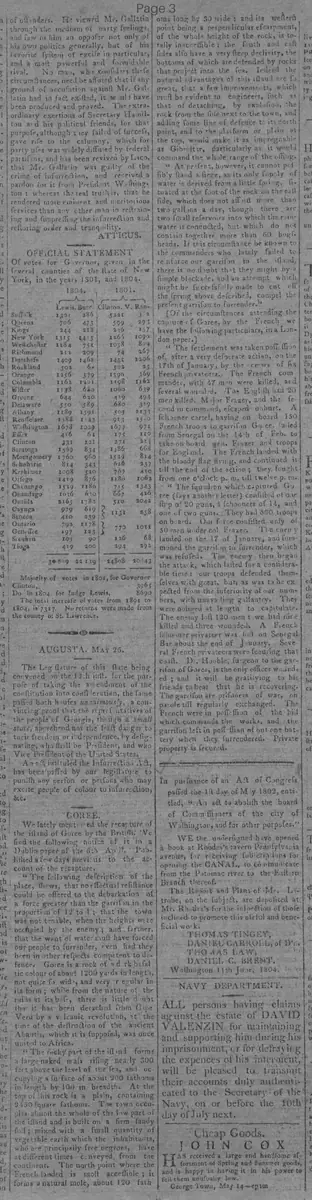
We lately mentioned the recapture of the island of Goree by the British; we find the following notice of it in a Dublin paper of the 6th April, published a few days previous to the account of the recapture.
The following description of the place, shews, that no effectual resistance could be offered to the debarkation of a force greater than the garrison in the proportion of 12 to 1: that the town was not tenable, when the heights were occupied by the enemy; and farther, that the want of water must have forced our people to surrender, even had they been in other respects competent to defence. Goree is a rock of a dark basaltic colour of about 1200 yards in length, not quite so wide, and very regular in its form: while from the nature of the ruins at its base, there is little doubt that it has been detached from Cape Verd by a volcanic revolution, at the time of the destruction of the ancient Atlantis, which it is supposed, was once united to Africa.
The rocky part of the island forms a large naked mass rising nearly 300 feet above the level of the sea, and occupying a surface of about 200 fathoms in length by 100 in breadth. At the top of this rock is a plain, containing 9450 square fathoms. The town occupies almost the whole of the low part of the island and is built on a firm sandy soil; mixed with a small quantity of vegetable earth which the inhabitants, who are principally free negroes, have at different times conveyed from the continent. The north point where the French landed is most accessible; it forms a natural mole, about 120 fathoms long by 50 wide: and its western point being a perpendicular scarpment, of the whole height of the rock, is totally inaccessible: the south and east sides also have a very steep declivity, the bottoms of which are defended by rocks that project into the sea. Indeed the natural advantages of this island are so great, that a few improvements, which must be evident to engineers, such as that of detaching, by explosion, the rock from the side next to the town, and adding some line of defence to its north point, and to the platform or plain at the top, would make it as impregnable as Gibraltar, particularly as it would command the whole range of the offing.
At present, however, it cannot possibly stand a siege, as its only supply of water is derived from a little spring, situated at the foot of the rock on the east side, which does not afford more than two gallons a day, though there are two small reservoirs into which the rain-water is conducted, but which do not contain together more than 60 hogsheads. If this circumstance be known to the commanders who lately sailed to reinforce our garrison in the island, there is no doubt that they might by a simple blockade, and an attempt which might be successfully made to cut off the spring above described, compel the present garrison to surrender.
[Of the circumstances attending the capture of Goree, by the French we have the following particulars, in a London paper.]
The settlement was taken possession of, after a very desperate action, on the 17th of January, by the crews of six French privateers. The French commander, with 47 men were killed, and several wounded. The English had 20 men killed. Major Frazer, and the second in command, escaped unhurt. A schooner cartel, having on board 150 French troops to garrison Goree, sailed from Senegal on the 14th of Feb. to take on board gen. Frazer and troops for England. The French landed with the bloody flag flying, and continued it till the end of the action; they fought from one o'clock p. m. till twelve p. m.
The squadron which captured Goree (says another letter) consisted of one ship of 20 guns, 4 schooners of 14, and one of two guns. They had 500 troops on board. Our force consisted only of 50 men under col. Frazer. The enemy landed on the 17 of January, and summoned the garrison to surrender, which was refused. The enemy then began the attack, which lasted for a considerable time: our troops defended themselves with great, but, as was to be expected from the inferiority of our numbers, with unavailing gallantry. They were obliged at length to capitulate. The enemy lost 120 men: we had nine killed and three wounded. A French Schooner privateer was lost on Senegal Bar about the end of January. Several French privateers were cruising that coast. Dr. Hooble, surgeon to the garrison of Goree, is the only officer wounded: and it will be gratifying to his friends to hear that he is recovering. The garrison are prisoners of war, on parole till regularly exchanged. The French were in possession of the hill which commands the works, and the garrison left in possession of but one battery when they surrendered. Private property is secured.
What sub-type of article is it?
What keywords are associated?
What entities or persons were involved?
Where did it happen?
Foreign News Details
Primary Location
Goree
Event Date
17th Of January
Key Persons
Outcome
french: 47-120 killed, several wounded; british: 9-20 killed, 3 wounded; garrison surrendered as prisoners of war on parole; private property secured.
Event Details
French privateers captured Goree on January 17 after landing 500 troops against 50 British under Col. Frazer; desperate action from 1pm to midnight; British refused surrender initially but capitulated due to outnumbered forces and loss of commanding hill; recent British recapture mentioned.