Thank you for visiting SNEWPapers!
Sign up free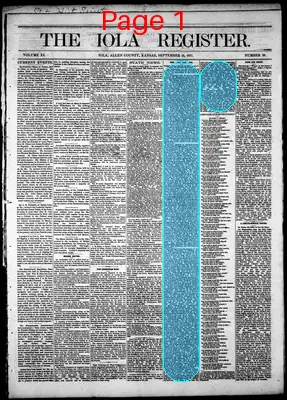
Editorial
September 15, 1877
The Iola Register
Iola, Allen County, Kansas
What is this article about?
Extracts from a speech by Hon. James F. Wilson at Altoona, Iowa, on September 5, defending the Republican Party of Iowa's unity at the Des Moines Convention, supporting Southern pacification via justice and civil rights protection, and warning of resurgent Southern Democrats' threats to Reconstruction gains and national unity.
Merged-components note: Merged continuation of 'THE IOWA CAMPAIGN' editorial.
Clipping
OCR Quality
95%
Excellent
Full Text
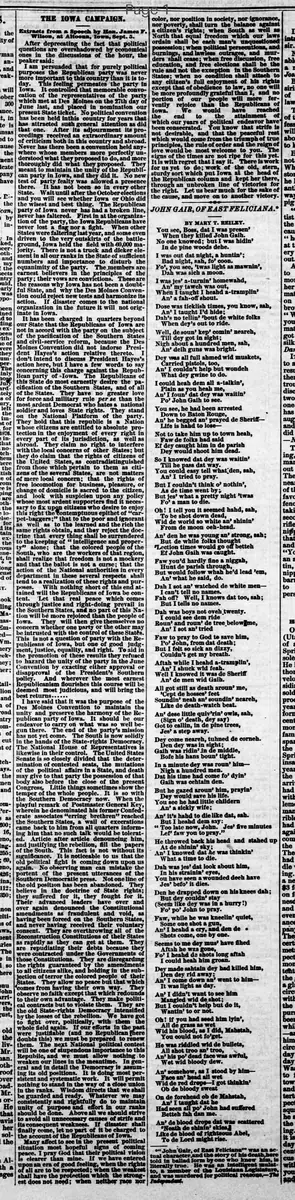
THE IOWA CAMPAIGN.
Extracts from a Speech by Hon. James F. Wilson, at Altoona, Iowa, Sept. 5.
After deprecating the fact that political questions are overshadowed by economical ones in the discussions of the hour, the speaker said:
I am persuaded that for purely political purposes the Republican party was never more important to this country than it is to-day. This feeling permeates the party in Iowa. It controlled that memorable convention of the representatives of the party which met at Des Moines on the 27th day of June last, and placed in nomination our present State ticket. No political convention has been held in this country for years that has attracted such general attention as did that one. After its adjournment its proceedings received an extraordinary amount of criticism both in this country and abroad. Never has there been a convention held anywhere whose members more perfectly understood what they proposed to do, and more thoroughly did what they proposed. They meant to maintain the unity of the Republican party in Iowa, and they did it. No new test of party fealty was allowed a presence there. It has not been so in every other State. Wait until after the October elections and you will see whether Iowa or Ohio did the wisest and best thing. The Republican party of Iowa never has had a broken line, never has faltered. First in at the organization of the party, the Iowa Republicans have never lost a flag nor a fight. When other States were faltering last year, and some even driven to the very outskirts of the battle-ground, Iowa held the field with 60,000 majority. There is not a truck and dicker element in all our ranks in the State of sufficient numbers and importance to disturb the equanimity of the party. The members are earnest believers in the principles of the party; their vows are convictions. These are the reasons why Iowa has not been a doubtful State, and why the Des Moines Convention could reject new tests and harmonize its action. If disaster comes to the national organization in the future it will not originate in Iowa.
It has been charged in quarters beyond our State that the Republicans of Iowa are not in accord with the party on the subject of the pacification of the Southern States and civil-service reform, because the Des Moines Convention did not indorse President Hayes's action relative thereto. I don't intend to discuss President Hayes's action here, but I have a few words to say concerning this charge against the Republican party of Iowa. The Republicans of this State do most earnestly desire the pacification of the Southern States, and of all of the States. They have no greater love for force and military rule per se than the most ardent Democrat who hates a national soldier and loves State rights. They stand on the National Platform of the party. They hold that this republic is a Nation whose citizens are entitled to absolute protection in the enjoyment of every right in every part of its jurisdiction, as well as abroad. They claim no right to interfere with the local concerns of other States; but they do claim that the rights of citizens of the United States, as contradistinguished from those which pertain to them as citizens of the several States, are not matters of mere local concern: that the rights of free locomotion for business, pleasure, or change of domicile is sacred to the citizen, and look with suspicion upon any policy whose most ardent supporters find it necessary to fix upon citizens who desire to enjoy this right the contemptuous epithet of "carpet-baggers;" that to the poor and ignorant as well as to the learned and the rich the same rights obtain, and they reject the doctrine that every thing shall be surrendered to the keeping of "intelligence and property" alone; that the colored people of the South, who are the workers of that region, shall realize that freedom is not a mockery and that the ballot is not a curse; that the action of the National authorities in every department in these several respects shall tend to a realization of these rights and purposes. With nothing short of this end attained will the Republicans of Iowa be content. Let that real peace which comes through justice and right-doing prevail in the Southern States, and no part of this Nation will be more rejoiced than the people of Iowa. They will then give themselves no concern whether one party or the other may be intrusted with the control of these States. This is not a question of party with the Republicans of Iowa, but one of good judgment, justice, equality, and right. To aid in the promotion of these results they refused to hazard the unity of the party in the June Convention by exacting either approval or disapproval of the President's Southern policy. And wherever the most earnest Republicanism flourishes this course will be deemed most judicious, and will bring the best returns.
I have said that it was the purpose of the Des Moines Convention to maintain the unity and preserve the harmony of the Republican party of Iowa. It should be our endeavor to carry on what was so well begun there. The end of the party's mission has not yet come. The South is now solidly in the hands of the State-rights Democracy. The National House of Representatives is likewise in their control. The United States Senate is so closely divided that the determination of contested seats, the mutations of the political affairs in a State, and death may give to that party the possession of that body also before the close of the present Congress. Little things sometimes show the temper of the whole people. It is so with the Southern Democracy now. When the playful remark of Postmaster General Key, wherein he denominated his former Confederate associates "erring brethren" reached the Southern States, a wail of execrations came back to him from all quarters informing him that no such talk would be tolerated. Article after article denouncing him, and justifying the rebellion, fill the papers of the South. This fact is not without its significance. It is noticeable to us that the old political fight is coming down upon us again. No observing man can mistake the portent of the present utterances of the Southern Democratic press. Not one line of the old position has been abandoned. They believe in the doctrine of State rights; they suffered for it, they fought for it. Their advanced leaders have over and over again denounced the Constitutional amendments as fraudulent and void, as having been forced on the Southern States, and never having received their voluntary consent. They are overthrowing all of the Reconstruction Constitutions of their States as rapidly as they can get at them. They are repudiating their debts because they were contracted under the Governments of those Constitutions. They are disregarding the rights guaranteed by the amendments to all citizens alike, and holding in the subjection of terror the colored people of their States. They allow no peace but that which comes from having their own way. They observe no faith except that which redounds to their own advantage. They make political contracts but to violate them. They are the old State-rights Democracy intensified by the losses of the rebellion. We have got to fight over, politically with them the whole field again. If our efforts in the past were justifiable (and no Republican here doubts this) we must be prepared to renew them. The next National political contest will be one of stupendous importance to this Republic, and we must allow nothing to weaken our lines in the meantime. In general and in detail the Democracy is assuming its old positions. It is doing most persistent and systematic work. It will permit nothing to stand in the way of a close union in the ranks. Wisdom directs that we shall be guarded and ready. Whatever we may consistently and rightfully do to maintain unity of purpose and effort in our ranks should be done. Above all we should strive to avoid all unnecessary causes of strife and its consequent weakness. If disaster shall finally come, let no part of it be charged to the account of the Republicans of Iowa.
Many affect to see in the present political situation most hopeful signs of coming peace. I pray God that their political vision is clearer than mine. If we have entered upon an era of good feeling, when the rights of all are to be respected; when the weakest shall have the protection which the strongest does not need; when neither race nor color, nor position in society, nor ignorance, nor poverty, shall turn the balance against a citizen's rights; when South as well as North that equal freedom which our laws ordain shall be each man's unquestioned possession; when political persecutions, and burnings, and lawless outrages, and murders shall cease; when free discussion, free education, and free elections shall be the rule and not the exception in the Southern States; when no condition shall attach to any citizen's full enjoyment of his rights except that of obedience to law, no one will be more profoundly grateful than I, and no portion of our people will more fervently rejoice than the Republicans of Iowa.
We would have reached the end to the attainment of which our years of political endeavor have been consecrated. You know that strife is not desirable, and that the peaceful rest which would come from the triumph of true principles, the rule of order and the reign of love would be most welcome to you. The signs of the times are not ripe for this yet. It is with regret that I say it. There is work for us yet to do; work of the old, stern, sturdy sort which put Iowa at the head of the Republican column and kept her there, through an unbroken line of victories for the right. Let us bear much for the sake of the cause, and move on to another victory.
Extracts from a Speech by Hon. James F. Wilson, at Altoona, Iowa, Sept. 5.
After deprecating the fact that political questions are overshadowed by economical ones in the discussions of the hour, the speaker said:
I am persuaded that for purely political purposes the Republican party was never more important to this country than it is to-day. This feeling permeates the party in Iowa. It controlled that memorable convention of the representatives of the party which met at Des Moines on the 27th day of June last, and placed in nomination our present State ticket. No political convention has been held in this country for years that has attracted such general attention as did that one. After its adjournment its proceedings received an extraordinary amount of criticism both in this country and abroad. Never has there been a convention held anywhere whose members more perfectly understood what they proposed to do, and more thoroughly did what they proposed. They meant to maintain the unity of the Republican party in Iowa, and they did it. No new test of party fealty was allowed a presence there. It has not been so in every other State. Wait until after the October elections and you will see whether Iowa or Ohio did the wisest and best thing. The Republican party of Iowa never has had a broken line, never has faltered. First in at the organization of the party, the Iowa Republicans have never lost a flag nor a fight. When other States were faltering last year, and some even driven to the very outskirts of the battle-ground, Iowa held the field with 60,000 majority. There is not a truck and dicker element in all our ranks in the State of sufficient numbers and importance to disturb the equanimity of the party. The members are earnest believers in the principles of the party; their vows are convictions. These are the reasons why Iowa has not been a doubtful State, and why the Des Moines Convention could reject new tests and harmonize its action. If disaster comes to the national organization in the future it will not originate in Iowa.
It has been charged in quarters beyond our State that the Republicans of Iowa are not in accord with the party on the subject of the pacification of the Southern States and civil-service reform, because the Des Moines Convention did not indorse President Hayes's action relative thereto. I don't intend to discuss President Hayes's action here, but I have a few words to say concerning this charge against the Republican party of Iowa. The Republicans of this State do most earnestly desire the pacification of the Southern States, and of all of the States. They have no greater love for force and military rule per se than the most ardent Democrat who hates a national soldier and loves State rights. They stand on the National Platform of the party. They hold that this republic is a Nation whose citizens are entitled to absolute protection in the enjoyment of every right in every part of its jurisdiction, as well as abroad. They claim no right to interfere with the local concerns of other States; but they do claim that the rights of citizens of the United States, as contradistinguished from those which pertain to them as citizens of the several States, are not matters of mere local concern: that the rights of free locomotion for business, pleasure, or change of domicile is sacred to the citizen, and look with suspicion upon any policy whose most ardent supporters find it necessary to fix upon citizens who desire to enjoy this right the contemptuous epithet of "carpet-baggers;" that to the poor and ignorant as well as to the learned and the rich the same rights obtain, and they reject the doctrine that every thing shall be surrendered to the keeping of "intelligence and property" alone; that the colored people of the South, who are the workers of that region, shall realize that freedom is not a mockery and that the ballot is not a curse; that the action of the National authorities in every department in these several respects shall tend to a realization of these rights and purposes. With nothing short of this end attained will the Republicans of Iowa be content. Let that real peace which comes through justice and right-doing prevail in the Southern States, and no part of this Nation will be more rejoiced than the people of Iowa. They will then give themselves no concern whether one party or the other may be intrusted with the control of these States. This is not a question of party with the Republicans of Iowa, but one of good judgment, justice, equality, and right. To aid in the promotion of these results they refused to hazard the unity of the party in the June Convention by exacting either approval or disapproval of the President's Southern policy. And wherever the most earnest Republicanism flourishes this course will be deemed most judicious, and will bring the best returns.
I have said that it was the purpose of the Des Moines Convention to maintain the unity and preserve the harmony of the Republican party of Iowa. It should be our endeavor to carry on what was so well begun there. The end of the party's mission has not yet come. The South is now solidly in the hands of the State-rights Democracy. The National House of Representatives is likewise in their control. The United States Senate is so closely divided that the determination of contested seats, the mutations of the political affairs in a State, and death may give to that party the possession of that body also before the close of the present Congress. Little things sometimes show the temper of the whole people. It is so with the Southern Democracy now. When the playful remark of Postmaster General Key, wherein he denominated his former Confederate associates "erring brethren" reached the Southern States, a wail of execrations came back to him from all quarters informing him that no such talk would be tolerated. Article after article denouncing him, and justifying the rebellion, fill the papers of the South. This fact is not without its significance. It is noticeable to us that the old political fight is coming down upon us again. No observing man can mistake the portent of the present utterances of the Southern Democratic press. Not one line of the old position has been abandoned. They believe in the doctrine of State rights; they suffered for it, they fought for it. Their advanced leaders have over and over again denounced the Constitutional amendments as fraudulent and void, as having been forced on the Southern States, and never having received their voluntary consent. They are overthrowing all of the Reconstruction Constitutions of their States as rapidly as they can get at them. They are repudiating their debts because they were contracted under the Governments of those Constitutions. They are disregarding the rights guaranteed by the amendments to all citizens alike, and holding in the subjection of terror the colored people of their States. They allow no peace but that which comes from having their own way. They observe no faith except that which redounds to their own advantage. They make political contracts but to violate them. They are the old State-rights Democracy intensified by the losses of the rebellion. We have got to fight over, politically with them the whole field again. If our efforts in the past were justifiable (and no Republican here doubts this) we must be prepared to renew them. The next National political contest will be one of stupendous importance to this Republic, and we must allow nothing to weaken our lines in the meantime. In general and in detail the Democracy is assuming its old positions. It is doing most persistent and systematic work. It will permit nothing to stand in the way of a close union in the ranks. Wisdom directs that we shall be guarded and ready. Whatever we may consistently and rightfully do to maintain unity of purpose and effort in our ranks should be done. Above all we should strive to avoid all unnecessary causes of strife and its consequent weakness. If disaster shall finally come, let no part of it be charged to the account of the Republicans of Iowa.
Many affect to see in the present political situation most hopeful signs of coming peace. I pray God that their political vision is clearer than mine. If we have entered upon an era of good feeling, when the rights of all are to be respected; when the weakest shall have the protection which the strongest does not need; when neither race nor color, nor position in society, nor ignorance, nor poverty, shall turn the balance against a citizen's rights; when South as well as North that equal freedom which our laws ordain shall be each man's unquestioned possession; when political persecutions, and burnings, and lawless outrages, and murders shall cease; when free discussion, free education, and free elections shall be the rule and not the exception in the Southern States; when no condition shall attach to any citizen's full enjoyment of his rights except that of obedience to law, no one will be more profoundly grateful than I, and no portion of our people will more fervently rejoice than the Republicans of Iowa.
We would have reached the end to the attainment of which our years of political endeavor have been consecrated. You know that strife is not desirable, and that the peaceful rest which would come from the triumph of true principles, the rule of order and the reign of love would be most welcome to you. The signs of the times are not ripe for this yet. It is with regret that I say it. There is work for us yet to do; work of the old, stern, sturdy sort which put Iowa at the head of the Republican column and kept her there, through an unbroken line of victories for the right. Let us bear much for the sake of the cause, and move on to another victory.
What sub-type of article is it?
Partisan Politics
Constitutional
Social Reform
What keywords are associated?
Republican Unity
Iowa Convention
Southern Pacification
Civil Rights
State Rights
Reconstruction
Democratic Resurgence
Party Harmony
What entities or persons were involved?
Hon. James F. Wilson
Republican Party Of Iowa
Des Moines Convention
President Hayes
Southern Democrats
Postmaster General Key
Editorial Details
Primary Topic
Republican Party Unity In Iowa And Vigilance Against Southern Democratic Resurgence
Stance / Tone
Strongly Pro Republican, Urging Party Unity And Defense Of Civil Rights
Key Figures
Hon. James F. Wilson
Republican Party Of Iowa
Des Moines Convention
President Hayes
Southern Democrats
Postmaster General Key
Key Arguments
Republican Party In Iowa Is Vital For National Unity And Has Never Faltered
Des Moines Convention Maintained Party Harmony By Rejecting New Tests Of Fealty
Iowa Republicans Support Pacification Of Southern States Through Justice And Protection Of Citizens' Rights
Opposition To Southern Democrats' State Rights Doctrine And Repudiation Of Reconstruction
Urgent Need To Renew Political Fight To Protect Constitutional Amendments And Civil Rights For All, Especially Colored People
Vigilance Required As Democrats Seek Control Of Government Branches
Hope For Era Of Good Feeling With Equal Rights, But Signs Indicate Continued Strife