Thank you for visiting SNEWPapers!
Sign up free
The Virginia Gazette
Williamsburg, Virginia
What is this article about?
Hoadleianus writes to Robert Carter Nicholas, Treasurer of Virginia, defending his letter on religious toleration against accusations of indecency and heresy. He argues for the separation of civil and religious authority, citing Locke and Warburton, and asserts that the civil magistrate should not prohibit speculative opinions not contradicting God, providence, or morality.
Clipping
OCR Quality
Full Text
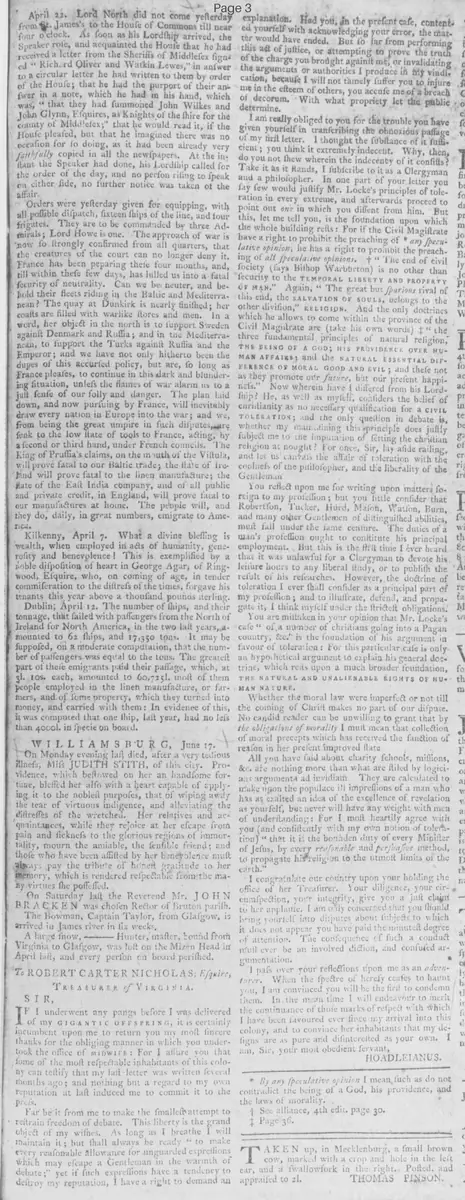
TREASURER of VIRGINIA.
SIR,
If I underwent any pangs before I was delivered of my GIGANTIC OFFSPRING, it is certainly incumbent upon me to return you my most sincere thanks for the obliging manner in which you undertook the office of Midwife: For I assure you that some of the most respectable inhabitants of this colony can testify that my last letter was written several months ago; and nothing but a regard to my own reputation at last induced me to commit it to the press.
Far be it from me to make the smallest attempt to restrain freedom of debate. This liberty is the grand object of my wishes. As long as I breathe I will maintain it; but shall always be ready "to make every reasonable allowance for unguarded expressions which may escape a Gentleman in the warmth of debate;" yet if such expressions have a tendency to destroy my reputation, I have a right to demand an explanation. Had you, in the present case, contented yourself with acknowledging your error, the matter would have ended. But so far from performing this act of justice, or attempting to prove the truth of the charge you brought against me, or invalidating the arguments or authorities I produce in my vindication, because I will not tamely suffer you to injure me in the esteem of others, you accuse me of a breach of decorum. With what propriety let the public determine.
I am really obliged to you for the trouble you have given yourself in transcribing the obnoxious passage of my first letter. I thought the substance of it sufficient; you think it extremely indecent. Why, then, do you not shew wherein the indecency of it consists? Take it as it stands, I subscribe to it as a Clergyman and a philosopher. In one part of your letter you say few would justify Mr. Locke's principles of toleration in every extreme, and afterwards proceed to point out one in which you dissent from him. But this, let me tell you, is the foundation upon which the whole building rests: For if the Civil Magistrate have a right to prohibit the preaching of any speculative opinion, he has a right to prohibit the preaching of all speculative opinions. "The end of civil society (says Bishop Warburton) is no other than security to the TEMPORAL LIBERTY AND PROPERTY of Man." Again, "The great but spurious rival of this end, the SALVATION OF SOULS, belongs to the other division, RELIGION. And the only doctrines which he allows to come within the province of the Civil Magistrate are (take his own words) "the three fundamental principles of natural religion, THE BEING OF A GOD; HIS PROVIDENCE OVER HUMAN AFFAIRS; AND THE NATURAL ESSENTIAL DIFFERENCE OF MORAL GOOD AND EVIL; and THESE NOT as they promote our future, but our present happiness." Now wherein have I differed from his Lordship? He, as well as myself, considers the belief of christianity as no necessary qualification for a civil TOLERation; and the only question in debate is, whether my maintaining this principle does justly subject me to the imputation of setting the christian religion at nought? For once, Sir, lay aside railing, and let us canvass the affair of toleration with the coolness of the philosopher, and the liberality of the Gentleman.
You reflect upon me for writing upon matters so foreign to my profession; but you little consider that Robertson, Tucker, Hurd, Mason, Watson, Burke, and many other Gentlemen of distinguished abilities, must fall under the same censure. The duties of a man's profession ought to constitute his principal employment. But this is the first time I ever heard that it was unlawful for a Clergyman to devote his leisure hours to any liberal study, or to publish the result of his researches. However, the doctrine of toleration I ever shall consider as a principal part of my profession; and to illustrate, defend, and propagate it, I think myself under the strictest obligations.
You are mistaken in your opinion that Mr. Locke's case "of a number of christians going into a Pagan country, &c." is the foundation of his argument in favour of toleration: For this particular case is only an hypothetical argument to explain his general doctrine, which rests upon a much broader foundation, THE NATURAL AND UNALIENABLE RIGHTS OF HUMAN NATURE.
Whether the moral law were imperfect or not till the coming of Christ makes no part of our dispute. No candid reader can be unwilling to grant that by the obligations of morality I must mean that collection of moral precepts which has received the sanction of reason in her present improved state.
All you have said about charity schools, missions, &c. are nothing more than what are styled by logicians argumenta ad invidiam. They are calculated to make upon the populace ill impressions of a man who has as exalted an idea of the excellence of revelation as yourself, but never will have any weight with men of understanding: For I most heartily agree with you (and consistently with my own notion of toleration) "that it is the bounden duty of every Minister of Jesus, by every reasonable and persuasive method, to propagate his religion to the utmost limits of the earth."
I congratulate our country upon your holding the office of her Treasurer. Your diligence, your circumspection, your integrity, give you a just claim to her applause. I am only concerned that you should be lying yourself into disputes about subjects to which it does not appear you have paid the minutest degree of attention. The consequence of such a conduct must ever be an involved diction, and confused argumentation.
I pass over your reflections upon me as an adventurer. When the spectre of heresy ceases to haunt you, I am convinced you will be the first to condemn them. In the mean time I will endeavour to merit the continuance of those marks of respect with which I have been favoured ever since my arrival into this colony, and to convince her inhabitants that my designs are as pure and disinterested as your own. I am, Sir, your most obedient servant,
HOADLEIANUS.
By any speculative opinion I mean such as do not contradict the being of a God, his providence, and the laws of morality.
* See Alliance, 4th edit. page 30.
‡ Page 36.
What sub-type of article is it?
What themes does it cover?
What keywords are associated?
What entities or persons were involved?
Letter to Editor Details
Author
Hoadleianus
Recipient
Robert Carter Nicholas, Esquire, Treasurer Of Virginia
Main Argument
the writer defends his advocacy for religious toleration, arguing that the civil magistrate should not prohibit speculative opinions that do not contradict the being of god, his providence, or moral laws, drawing on locke and warburton to separate civil society from religious salvation.
Notable Details