Thank you for visiting SNEWPapers!
Sign up free
Gazette Of The United States, & Philadelphia Daily Advertiser
Philadelphia, Philadelphia County, Pennsylvania
What is this article about?
Publication of the new French Republic constitution dated December 13, 1799, detailing citizenship, government structure with three consuls (Buonaparte as chief), legislative bodies, and rights. Followed by Paris updates on consul appointments, troop oaths, and public acceptance through December 20.
Clipping
OCR Quality
Full Text
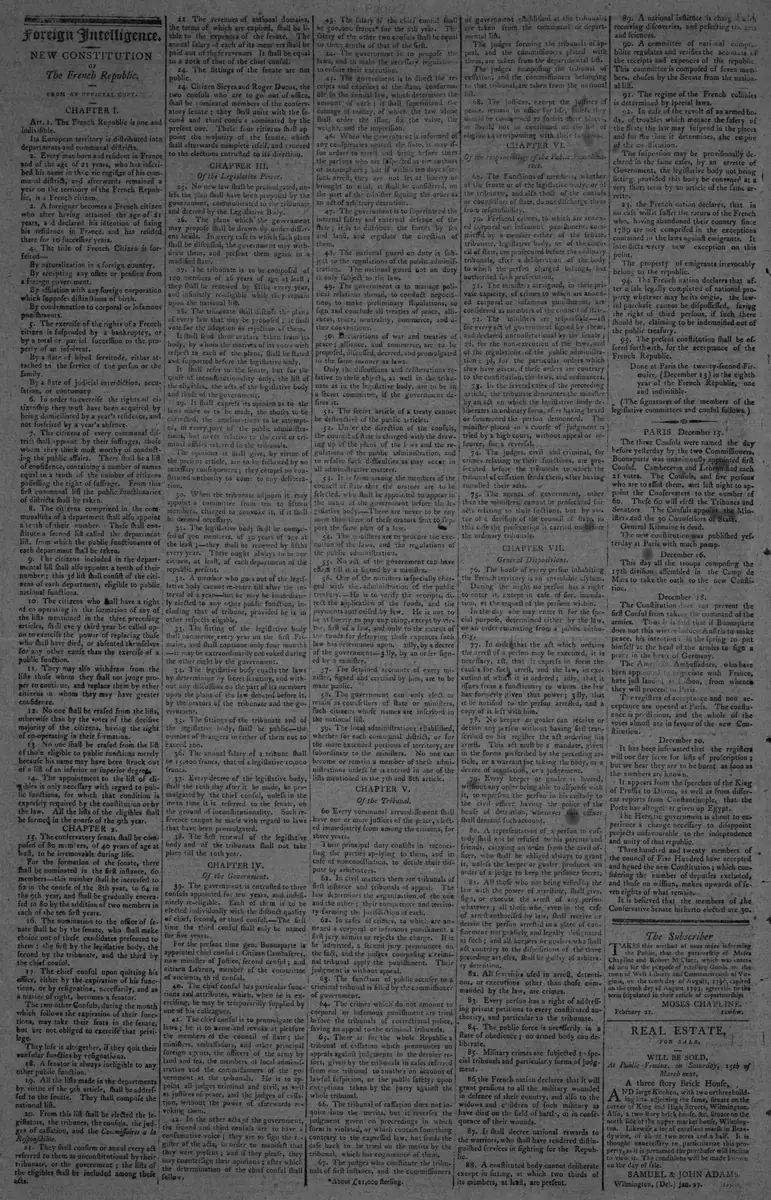
NEW CONSTITUTION
OF
The French Republic.
FROM AN OFFICIAL COPY.
CHAPTER I.
Art. I. The French Republic is one and indivisible.
Its European territory is distributed into departments and communal districts.
2. Every man born and resident in France and of the age of 21 years, who has inscribed his name in the civil register of his communal district, and afterwards remained a year on the territory of the French Republic, is a French citizen.
3. A foreigner becomes a French citizen who after having attained the age of 21 years, has declared his intention of fixing his residence in France, and has resided there for 10 successive years.
4. The title of French Citizen is forfeited—
By naturalization in a foreign country.
By accepting any office or pension from a foreign government,
By affiliation with any foreign corporation which opposes distinctions of birth.
By condemnation to corporal or infamous punishments.
5. The exercise of the rights of a French citizen is suspended by a bankruptcy, or by a total or partial succession to the property of an insolvent.
By a state of hired servitude, either attached to the service of the person or the family.
By a state of judicial interdiction, accusation, or contumacy.
6. In order to exercise the rights of citizenship they must have been acquired by being domiciliated by a year's residence, and not forfeited by a year's absence.
7. The citizens of every communal district shall appoint by their suffrages, those whom they think most worthy of conducting the public affairs. There shall be a list of confidence, containing a number of names equal to a tenth of the number of citizens possessing the right of suffrage. From this first communal list the public functionaries of districts shall be taken.
8. The citizens comprised in the communal lists of a department shall also appoint a tenth of their number. These shall constitute a second list called the departmental list, from which the public functionaries of each department shall be taken.
9. The citizens included in the departmental list shall also appoint a tenth of their number; this 3d list shall consist of the citizens of each department, eligible to public national functions.
10. The citizens who shall have a right of co-operating in the formation of any of the lists mentioned in the three preceding articles, shall every third year be called upon to exercise the power of replacing those who shall have died, or absented themselves for any other cause than the exercise of a public function.
11. They may also withdraw from the lists those whom they shall not judge proper to continue, and replace them by other citizens in whom they may have greater confidence.
12. No one shall be erased from the lists otherwise than by the votes of the decisive majority of the citizens, having the right of co-operating in their formation.
13. No one shall be erased from the list of those eligible to public functions merely because his name may have been struck out of a list of an inferior or superior degree.
14. The appointment to the list of eligibles is only necessary with regard to public functions, for which that condition is expressly required by the constitution or by the law. All the lists of the eligibles shall be formed in the course of the 8th year.
CHAPTER II.
15. The conservatory senate shall be composed of 80 members, of 40 years of age at least, to be irremovable during life.
For the formation of the senate, there shall be nominated in the first instance, 60 members—this number shall be increased to 62 in the course of the 8th year, to 64 in the 9th year, and shall be gradually increased to 80 by the addition of two members in each of the ten first years.
16. The nomination to the office of senator shall be by the senate, who shall make choice out of three candidates presented to them: the first by the legislative body, the second by the tribunate, and the third by the chief consul.
17. The chief consul upon quitting his office, either by the expiration of his functions, or by resignation, necessarily, and as a matter of right, becomes a senator.
The two other Consuls, during the month which follows the expiration of their functions, may take their seats in the senate, but are not obliged to exercise that privilege.
They lose it altogether, if they quit their consular functions by resignations.
18. A senator is always ineligible to any other public function.
19. All the lists made in the departments by virtue of the 9th article, shall be addressed to the senate. They shall compose the national list.
20. From this list shall be elected the legislators, the tribunes, the consuls, the judges of cassation, and the Commissioners à la Responsibilité.
21. They shall confirm or annul every act referred to them as unconstitutional by the tribunate, or the government: the lists of the eligibles shall be included among these acts.
22. The revenues of national domains, the terms of which are expired, shall be liable to the expenses of the senate. The annual salary of each of its members shall be paid out of these revenues. It shall be equal to a 20th of that of the chief consul.
23. The sittings of the senate are not public.
24. Citizen Sieyes and Roger Ducos, the two consuls who are to go out of office, shall be nominated members of the conservatory senate; they shall unite with the second and third consuls nominated by the present one. These four citizens shall appoint the majority of the senate, which shall afterwards complete itself, and proceed to the elections entrusted to its direction.
CHAPTER III.
Of the Legislative Power.
25. No new law shall be promulgated, unless the plan shall have been proposed by the government, communicated to the tribunate and decreed by the Legislative Body.
26. The plans which the government may propose shall be drawn up under different heads. In every case in which such plans shall be discussed, the government may withdraw them, and present them again in a modified state.
27. The tribunate is to be composed of 100 members of 25 years of age at least; they shall be renewed by fifths every year, and infinitely re-eligible while they remain upon the national list.
28. The tribunate shall discuss the plans of every law that may be proposed; it shall vote for the adoption or rejection of them.
It shall send three orators taken from its body, by whom the motives of its votes with respect to each of the plans, shall be stated and supported before the legislative body.
It shall refer to the senate, but for the cause of unconstitutionality only, the list of the eligibles, the acts of the legislative body and those of the government.
29. It shall express its opinion as to the laws made or to be made, the abuses to be corrected, the ameliorations to be attempted, in every part of the public administration, but never relative to the civil or criminal affairs referred to the tribunals.
The opinions it shall give, by virtue of the present article, are to be followed by no necessary consequences; they compel no constituted authority to come to any deliberation.
30. When the tribunate adjourns it may appoint a committee from ten to fifteen members, charged to convoke it, if it shall be deemed necessary.
31. The legislative body shall be composed of 300 members, of 30 years of age at least;—they shall be renewed by fifths every year. There ought always to be one citizen, at least, of each department of the republic present.
32. A member who goes out of the legislative body cannot re-enter till after the interval of a year—but he may be immediately elected to any other public function, including that of tribune, provided he is in other respects eligible.
33. The sitting of the legislative body shall commence every year on the first Frimaire, and shall continue only four months—it may be extraordinarily convoked during the other eight by the government.
34. The legislative body enacts the laws by determining by secret scrutiny, and without any discussion on the part of its members upon the plans of the law debated before it, by the orators of the tribunate and the government.
35. The sittings of the tribunate and of the legislative body, shall be public—the number of strangers in either of them not to exceed 200.
36. The annual salary of a tribune shall be 15,000 francs, that of a legislative 10,000 francs.
37. Every decree of the legislative body, shall the 10th day after it be made, be promulgated by the chief consul, unless in the mean time it is referred to the senate, on the ground of unconstitutionality. Such reference cannot be made with regard to laws that have been promulgated.
38. The first renewal of the legislative body and of the tribunate shall not take place till the 10th year.
CHAPTER IV.
Of the Government.
39. The government is entrusted to three consuls appointed for ten years, and infinitely re-eligible. Each of them is to be elected individually with the distinct quality of chief, second, or third consul.—The first time the third consul shall only be named for five years.
For the present time gen. Buonaparte is appointed chief consul: Citizen Cambacéres, now minister of Justice, second consul; and citizen Lebrun, member of the committee of ancients, third consul.
40. The chief consul has particular functions and attributes, which, when he is exercising, he may be temporarily supplied by one of his colleagues.
41. The chief consul is to promulgate the laws; he is to name and revoke at pleasure the members of the council of state; the ministers, ambassadors, and other principal foreign agents, the officers of the army by land and sea, the members of local administration and the commissioners of the government at the tribunals. He is to appoint all judges criminal and civil, as well as justices of peace, and the judges of cassation, without the power of afterwards revoking them.
42. In the other acts of the government, the second and third consuls are to have a consultative voice; they are to sign the register of the acts, in order to manifest that they were present; and if they please, they may countersign their opinions; after which the determination of the chief consul shall follow.
43. The salary of the chief consul shall be 200,000 francs* for the 5th year. The salary of the other two consuls shall be equal to three fifths of that of the first.
*About £18,000 sterling.
44. The government is to propose the laws, and to make the necessary regulations to ensure their execution.
45. The government is to direct the receipts and expenses of the state, conformable to the annual law, which determines the amount of each; it shall superintend the coinage of money, of which the law alone shall order the issue, fix the value, the weight, and the impression.
46. When the government is informed of any conspiracies against the state, it may issue orders to arrest and bring before them the persons who are suspected as their authors or accomplices; but if within ten days after such arrest, they are not set at liberty or brought to trial, it shall be considered, on the part of the minister signing the order as an act of arbitrary detention.
47. The government is to superintend the internal safety and external defence of the state; it is to distribute the forces by sea and land, and regulate the direction of them.
48. The national guard on duty is subject to the regulations of the public administration. The national guard not on duty is only subject to the law.
49. The government is to manage political relations abroad, to conduct negotiation, to make preliminary stipulations, to sign and conclude all treaties of peace, alliances, truce, neutrality, commerce, and other conventions.
50. Declarations of war and treaties of peace, alliance, and commerce, are to be proposed, discussed, decreed, and promulgated in the same manner as laws.
Only the discussions and deliberations relative to these objects, as well in the tribunate as in the legislative body, are to be in a secret committee, if the government desires it.
51. The secret article of a treaty cannot be destructive of the public articles.
52. Under the direction of the consuls, the council of state is charged with the drawing up of the plans of the laws and the regulations of the public administration, and to resolve such difficulties as may occur in all administrative matters.
53. It is from among the members of the council of state that the orators are to be selected, who shall be appointed to appear in the name of the government before the legislative body.—There are never to be any more than three of these orators sent to support the same plan of a law.
54. The ministers are to procure the execution of the laws, and the regulations of the public administration.
55. No act of the government can have effect till it is signed by a minister.
56. One of the ministers is peculiarly charged with the administration of the public treasury.—He is to verify the receipts, direct the application of the funds, and the payments authorized by law. He is not to be at liberty to pay any thing, except by virtue, 1st, of a law, and only to the extent of the funds for defraying those expenses such law has determined upon. 2dly, by a decree of the government—3dly, by an order signed by a minister.
57. The detailed accounts of every minister, signed and certified by him, are to be made public.
58. The government can only elect or retain as counsellors of state or ministers, such citizens whose names are inscribed in the national list.
59. The local administrations established, whether for each communal district, or for the more extended portions of territory, are subordinate to the ministers. No one can become or remain a member of these administrations unless he is entered in one of the lists mentioned in the 7th and 8th article.
CHAPTER V.
Of the Tribunals.
60. Every communal arrondissement shall have one or more justices of the peace, elected immediately from among the citizens, for three years.
Their principal duty consists in reconciling the parties applying to them, and in case of nonconciliation, to decide their dispute by arbitrators.
61. In civil matters there are tribunals of first instance and tribunals of appeal. The law determines the organization of the one and the other; their competence and territory forming the jurisdiction of each.
62. In cases of crimes, to which are annexed a corporal or infamous punishment, a first jury admits or rejects the charge. If it be admitted, a second jury pronounces on the fact, and the judges composing a criminal tribunal apply the punishment. Their judgment is without appeal.
63. The function of public accuser to a criminal tribunal is filled by the commissioner of government.
64. The crimes which do not amount to corporal or infamous punishment are tried before the tribunals of correctional police, having an appeal to the criminal tribunals.
65. There is for the whole Republic a tribunal of cassation which pronounces on appeals against judgments in the dernier ressort, given by the tribunals in cases referred from one tribunal to another on account of lawful suspicion, or the public safety, upon exceptions taken by the party against the whole tribunal.
66. The tribunal of cassation does not inquire into the merits, but it reverses the judgment given on proceedings in which form is violated, or which contain something contrary to the expressed law, but sends the case back to be tried on the merits by the tribunal, which has cognizance of them.
67. The judges who constitute the tribunals of first instance, and the commissioners of government established at the tribunals;
of government established at the tribunals; are taken from the communal or departmental list.
The judges forming the tribunals of appeal, and the commissioners placed with them, are taken from the departmental list.
The judges composing the tribunal of cassation, and the commissioners belonging to that tribunal are taken from the national list.
68. The justices, except the justices of peace, remain in office for life, unless they should be condemned to forfeit their places, or should not be continued on the list of eligibles corresponding with their functions.
CHAPTER VI.
Of the responsibility of the Public Functionaries.
69. The Functions of members, whether of the senate or of the legislative body, or of the tribunate, and also those of the consuls or counsellors of state, do not discharge them from responsibility.
70. Personal crimes, to which are annexed corporal or infamous punishment, committed by a member either of the senate, tribunate, legislative body, or of the council of state, are prosecuted before the ordinary tribunals, after a deliberation of the body to which the person charged belongs, has authorized such prosecution.
71. The ministers arraigned, in their private capacity, of crimes to which are annexed corporal or infamous punishment, are considered as members of the council of state.
72. The ministers are responsible—if for every act of government signed by them, and declared unconstitutional by the senate; 2d, for the non-execution of the laws, and of the regulations of the public administration; 3d, for the particular orders which they have given, if these orders are contrary to the constitution, the laws, and ordinances.
73. In the several cases of the preceding article, the tribunate denounces the minister by an act on which the legislative body deliberates in ordinary form, after having heard or summoned the person denounced. The minister placed in a course of judgment is tried by a high court, without appeal or recourse, for a reversal.
74. The judges, civil and criminal, for crimes relating to their functions, are prosecuted before the tribunals to which the tribunal of cassation sends them, after having annulled their acts.
75. The agents of government, other than the ministers, cannot be prosecuted for acts relating to their functions, but by virtue of a decision of the council of state, in this case the prosecution is carried on before the ordinary tribunals.
CHAPTER VII.
General Dispositions.
76. The house of every person inhabiting the French territory is an inviolable asylum.
During the night no person has a right to enter it, except in case of fire, inundation, at the request of the persons within.
In the day one may enter it for the special purpose, determined either by the law, or an order emanating from a public authority.
77. In order that the act which ordains the arrest of a person may be executed, it is necessary, 1st, that it express in form the causes for such arrest, and the law, in execution of which it is ordered; 2dly, that it issues from a functionary to whom the law has formerly given that power; 3dly, that it be notified to the person arrested, and a copy of it left with him.
78. No keeper or jailer can receive or detain any person without having first transcribed on his register the act ordering his arrest. This act must be a mandate, given in the forms prescribed by the preceding article, or a warrant for taking the body, or a decree of accusation, or a judgment.
79. Every keeper or jailer is bound, without any order being able to dispense with it, to represent the person in his custody to the civil officer having the police of the house of detention, whenever this officer shall demand such account.
80. A representation of a person in custody shall not be refused to his parents and friends, carrying an order from the civil officer, who shall be obliged always to grant it, unless the keeper or jailer produces an order of a judge to keep the prisoner secret.
81. All those who not being vested by the law with the power of arresting, shall give, sign, or execute the arrest of any person whatever; all those who even in the case of arrest authorized by law, shall receive or detain the person arrested in a place of confinement not publicly and legally designated as such; and all keepers or jailers who shall act contrary to the dispositions of the three preceding articles, shall be guilty of arbitrary detention.
82. All severities used in arrests, detentions, or executions other than those commanded by the law, are crimes.
83. Every person has a right of addressing private petitions to every constituted authority, and particularly to the tribunate.
84. The public force is necessarily in a state of obedience; no armed body can deliberate.
85. Military crimes are subjected to peculiar tribunals and particularly forms of judgment.
86. The French nation declares, that it will grant pensions to all the military wounded in defence of their country, and also to the widows and children of such military as have died on the field of battle, or in consequence of their wounds.
87. It shall decree national rewards to the warriors, who shall have rendered distinguished services in fighting for the Republic.
88. A constituted body cannot deliberate except in sitting, at which two thirds of its members, at least, are present.
89. A national institute is charged with receiving discoveries, and perfecting the arts and sciences.
90. A committee of national comptability regulates and verifies the accounts of the receipts and expenses of the republic.
This committee is composed of seven members, chosen by the Senate from the national list.
91. The regime of the French colonies is determined by special laws.
92. In case of the revolt of an armed body, of troubles which menace the safety of the State the law may suspend in the places and for the time it determines, the empire of the constitution.
The suspension may be provisionally declared in the same cases, by an arrêté of Government, the legislative body not being sitting, provided this body be convened at a very short term by an article of the same arrêté.
93. The French nation declares, that in no case will it suffer the return of the French who, having abandoned their country since 1789 are not comprised in the exceptions contained in the laws against emigrants. It interdicts every new exception on this point.
The property of emigrants irrevocably belong to the republic.
94. The French nation declares that after a sale legally completed of national property whatever may be its origin, the lawful purchaser cannot be dispossessed, saving the right of third persons, if such there should be, claiming to be indemnified out of the public treasury.
95. The present constitution shall be offered forthwith, for the acceptance of the French Republic.
Done at Paris the twenty-second Frimaire, (December 13) in the eighth year of the French Republic, —one and indivisible—
(The signatures of the members of the legislative committees and consuls follow.)
PARIS December 15.
The three Consuls were named the day before yesterday by the two Commissioners.
Buonaparte was unanimously appointed first Consul. Cambacéres and Lebrun had each 21 votes. The Consuls, and five persons who are to aid them, met last night to appoint the Conservators to the number of 60. These 60 will elect the Tribunes and Senators. The Consuls appoint the Ministers and the 30 Counsellors of State.
General Kilmaine is dead.
The new constitution was published yesterday at Paris with much pomp.
December 16.
This day all the troops composing the 17th division assembled in the Camp de Mars to take the oath to the new Constitution.
December 18.
The Constitution does not prevent the first Consul from taking the command of the armies. Thus it is said that if Buonaparte does not this winter induce Austria to make peace, his intention is in the spring to put himself at the head of the armies to sign a peace in the heart of Germany.
The American Ambassadors, who have been appointed to negotiate with France, have just landed at Lisbon, from whence they will proceed to Paris.
The registers of acceptance and non acceptance are opened at Paris. The concourse is prodigious, and the whole of the votes almost are in favour of the new Constitution.
December 20.
It has been insinuated that the registers will one day serve for lists of proscription; but we hear they are to be burnt as soon as the numbers are known.
It appears from the speeches of the King of Prussia to Duroc, as well as from different reports from Constantinople, that the Porte has altogether given up Egypt.
The Helvetic government is about to experience a change necessary to disappoint projects unfavourable to the independence and unity of that republic.
Three hundred and twenty members of the council of Five Hundred have accepted and signed the new Constitution; which considering the number of deputies excluded, and those on mission, makes upwards of seven eights of what remain.
It is believed that the members of the Conservative Senate hitherto elected are 30.
What sub-type of article is it?
What keywords are associated?
What entities or persons were involved?
Where did it happen?
Foreign News Details
Primary Location
Paris
Event Date
December 13–20, 1799
Key Persons
Outcome
new constitution adopted with widespread acceptance; buonaparte appointed chief consul; troops oath taken; registers show prodigious support; 320 members of council accepted it; senate elections ongoing.
Event Details
Official text of the French Republic's new constitution outlining citizenship, senate, legislative power, government with three consuls, tribunals, public functionary responsibility, and general dispositions. Dated December 13, 1799. Paris updates: Consuls named December 14; constitution published December 14 with pomp; troops oath December 16; public registers opened with strong favor; rumors of Buonaparte leading armies; American ambassadors en route; other notes on Egypt, Helvetic government.