Thank you for visiting SNEWPapers!
Sign up free
Editorial
October 14, 1813
Daily National Intelligencer
Washington, District Of Columbia
What is this article about?
Editorial critiques British impressment of seamen as illegal usurpation, argues it's unnecessary for naval power, and suggests legal reforms for voluntary service to enable honorable peace with the US. References Sen. Bayard's views. Signed CINCINNATUS, Georgetown, Oct. 12, 1813.
Clipping
OCR Quality
95%
Excellent
Full Text
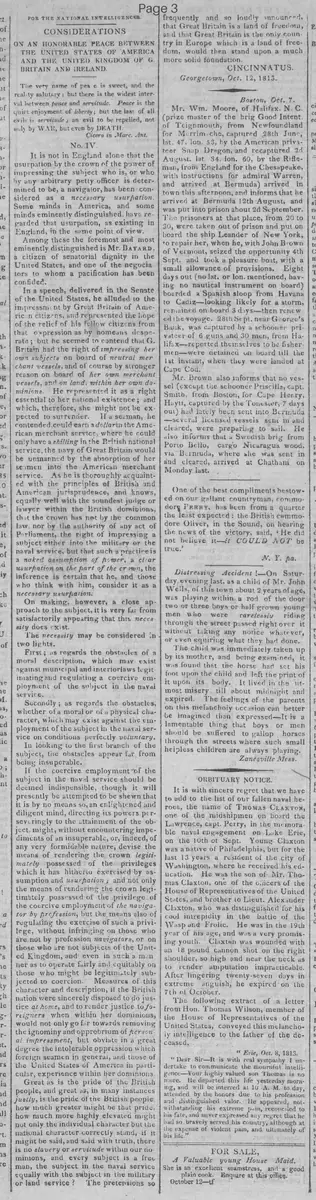
FOR THE NATIONAL INTELLIGENCER.
CONSIDERATIONS
ON AN HONORABLE PEACE BETWEEN
THE UNITED STATES OF AMERICA
AND THE UNITED KINGDOM OF G.
BRITAIN AND IRELAND.
The very name of peace is sweet, and the reality salutary; but there is the widest interval between peace and servitude. Peace is the quiet enjoyment of liberty; but the last of all evils is servitude: an evil to be repelled, not only by WAR, but even by DEATH.
Cicero in Marc. Ant.
No. IV
It is not in England alone that the usurpation by the crown of the power of impressing the subject who is, or who by any arbitrary petty officer is determined to be, a navigator, has been considered as a necessary usurpation. Some minds in America, and some minds eminently distinguished, have regarded that usurpation, as existing in England, in the same point of view. Among these the foremost and most eminently distinguished is Mr. BAYARD, a citizen of senatorial dignity in the United States, and one of the negotiators to whom a pacification has been confided.
In a speech, delivered in the Senate of the United States, he alluded to the impressment by Great Britain of American citizens, and represented the hope of the relief of his fellow citizens from that oppression as by no means desperate: but he seemed to contend that G. Britain had the right of impressing her own subjects on board of neutral merchant vessels, and of course by stronger reason on board of her own merchant vessels, and on land, within her own dominions. He represented it as a right essential to her national existence; and which, therefore, she might not be expected to surrender. If a seaman, he contended, could earn a dollar in the American merchant service, where he could only have a shilling in the British national service, the navy of Great Britain would be unmanned by the absorption of her seamen into the American merchant service. As he is thoroughly acquainted with the principles of British and American jurisprudence, and knows, equally well with the soundest judge or lawyer within the British dominions, that the crown has not by the common law, nor by the authority of any act of Parliament, the right of impressing a subject either into the military or the naval service, but that such a practice is a naked assumption of power, a clear usurpation on the part of the crown, the inference is certain that he, and those who think with him, consider it as a necessary usurpation.
On making, however, a close approach to the subject, it is very far from satisfactorily appearing that this necessity does exist.
The necessity may be considered in two lights.
First; as regards the obstacles of a moral description, which may exist against municipal and interior laws legitimating and regulating a coercive employment of the subject in the naval service.
Secondly; as regards the obstacles, whether of a moral or of a physical character, which may exist against the employment of the subject in the naval service on conditions perfectly voluntary.
In looking to the first branch of the subject, the obstacles appear far from being insuperable.
If the coercive employment of the subject in the naval service should be deemed indispensable, though it will presently be attempted to be shewn that it is by no means so, an enlightened and diligent mind, directing its powers perseveringly to the attainment of the object, might, without encountering impediments of an insuperable, or, indeed, of any very formidable nature, devise the means of rendering the crown legitimately possessed of the privileges which it has hitherto exercised by assumption and usurpation; and not only the means of rendering the crown legitimately possessed of the privilege of the coercive employment of the navigator by profession, but the means also of regulating the exercise of such a privilege, without infringing on those who are not by profession navigators, or on those who are not subjects of the United Kingdom, and even in such a manner as to operate fairly and equitably on those who might be legitimately subjected to coercion. Measures of this character and description, if the British nation were sincerely disposed to do justice at home, and to render justice to foreigners when within her dominions, would not only go far towards removing the ignominy and opprobrium of her naval impressment, but obviate in a great degree the intolerable oppression which foreign seamen in general, and those of the United States of America in particular, experience within her dominions.
Great as is the pride of the British people, and great as, in many instances justly, is the pride of the British people, how much greater might be that pride, how much more highly elevated might not only the individual character but the national character correctly stand, if it might be said, and said with truth, there is no slavery or servitude within our dominions, and every subject is a free man, the subject in the naval service equally with the subject in the military or land service? The pretensions so frequently and so loudly announced, that Great Britain is a land of freedom, and that Great Britain is the only country in Europe which is a land of freedom, would then stand upon a much more solid foundation.
CINCINNATUS.
Georgetown, Oct. 12, 1813.
CONSIDERATIONS
ON AN HONORABLE PEACE BETWEEN
THE UNITED STATES OF AMERICA
AND THE UNITED KINGDOM OF G.
BRITAIN AND IRELAND.
The very name of peace is sweet, and the reality salutary; but there is the widest interval between peace and servitude. Peace is the quiet enjoyment of liberty; but the last of all evils is servitude: an evil to be repelled, not only by WAR, but even by DEATH.
Cicero in Marc. Ant.
No. IV
It is not in England alone that the usurpation by the crown of the power of impressing the subject who is, or who by any arbitrary petty officer is determined to be, a navigator, has been considered as a necessary usurpation. Some minds in America, and some minds eminently distinguished, have regarded that usurpation, as existing in England, in the same point of view. Among these the foremost and most eminently distinguished is Mr. BAYARD, a citizen of senatorial dignity in the United States, and one of the negotiators to whom a pacification has been confided.
In a speech, delivered in the Senate of the United States, he alluded to the impressment by Great Britain of American citizens, and represented the hope of the relief of his fellow citizens from that oppression as by no means desperate: but he seemed to contend that G. Britain had the right of impressing her own subjects on board of neutral merchant vessels, and of course by stronger reason on board of her own merchant vessels, and on land, within her own dominions. He represented it as a right essential to her national existence; and which, therefore, she might not be expected to surrender. If a seaman, he contended, could earn a dollar in the American merchant service, where he could only have a shilling in the British national service, the navy of Great Britain would be unmanned by the absorption of her seamen into the American merchant service. As he is thoroughly acquainted with the principles of British and American jurisprudence, and knows, equally well with the soundest judge or lawyer within the British dominions, that the crown has not by the common law, nor by the authority of any act of Parliament, the right of impressing a subject either into the military or the naval service, but that such a practice is a naked assumption of power, a clear usurpation on the part of the crown, the inference is certain that he, and those who think with him, consider it as a necessary usurpation.
On making, however, a close approach to the subject, it is very far from satisfactorily appearing that this necessity does exist.
The necessity may be considered in two lights.
First; as regards the obstacles of a moral description, which may exist against municipal and interior laws legitimating and regulating a coercive employment of the subject in the naval service.
Secondly; as regards the obstacles, whether of a moral or of a physical character, which may exist against the employment of the subject in the naval service on conditions perfectly voluntary.
In looking to the first branch of the subject, the obstacles appear far from being insuperable.
If the coercive employment of the subject in the naval service should be deemed indispensable, though it will presently be attempted to be shewn that it is by no means so, an enlightened and diligent mind, directing its powers perseveringly to the attainment of the object, might, without encountering impediments of an insuperable, or, indeed, of any very formidable nature, devise the means of rendering the crown legitimately possessed of the privileges which it has hitherto exercised by assumption and usurpation; and not only the means of rendering the crown legitimately possessed of the privilege of the coercive employment of the navigator by profession, but the means also of regulating the exercise of such a privilege, without infringing on those who are not by profession navigators, or on those who are not subjects of the United Kingdom, and even in such a manner as to operate fairly and equitably on those who might be legitimately subjected to coercion. Measures of this character and description, if the British nation were sincerely disposed to do justice at home, and to render justice to foreigners when within her dominions, would not only go far towards removing the ignominy and opprobrium of her naval impressment, but obviate in a great degree the intolerable oppression which foreign seamen in general, and those of the United States of America in particular, experience within her dominions.
Great as is the pride of the British people, and great as, in many instances justly, is the pride of the British people, how much greater might be that pride, how much more highly elevated might not only the individual character but the national character correctly stand, if it might be said, and said with truth, there is no slavery or servitude within our dominions, and every subject is a free man, the subject in the naval service equally with the subject in the military or land service? The pretensions so frequently and so loudly announced, that Great Britain is a land of freedom, and that Great Britain is the only country in Europe which is a land of freedom, would then stand upon a much more solid foundation.
CINCINNATUS.
Georgetown, Oct. 12, 1813.
What sub-type of article is it?
War Or Peace
Foreign Affairs
What keywords are associated?
Impressment
Honorable Peace
British Usurpation
Naval Service
Legal Reform
American Seamen
War Of 1812
What entities or persons were involved?
Mr. Bayard
British Crown
United States Senate
Great Britain
Editorial Details
Primary Topic
Impressment Of Seamen As Barrier To Honorable Peace Between Us And Uk
Stance / Tone
Opposition To British Impressment As Usurpation, Advocacy For Legal Reform And Voluntary Service
Key Figures
Mr. Bayard
British Crown
United States Senate
Great Britain
Key Arguments
Impressment By British Crown Is A Usurpation Without Legal Basis In Common Law Or Parliament
Mr. Bayard Views Impressment As Necessary For British Naval Power Despite Its Illegality
Necessity Of Impressment Can Be Addressed Through Legal Reforms Legitimizing Coercive Employment
Voluntary Service Could Suffice Without Moral Or Physical Obstacles
Reforming Impressment Would Enhance British National Pride And Claims To Freedom
Such Reforms Would Reduce Oppression On American And Foreign Seamen