Thank you for visiting SNEWPapers!
Sign up free
Letter to Editor
March 15, 1803
The New Hampshire Gazette
Portsmouth, Rockingham County, New Hampshire
What is this article about?
Philalethes writes to Thomas Paine, critiquing his deistic ideas from 'The Age of Reason,' defending the unity of God in scripture, true Christian philanthropy, and the gospel's evidence, while urging Paine to consider Christ's perfect character and the hope of resurrection.
Clipping
OCR Quality
95%
Excellent
Full Text
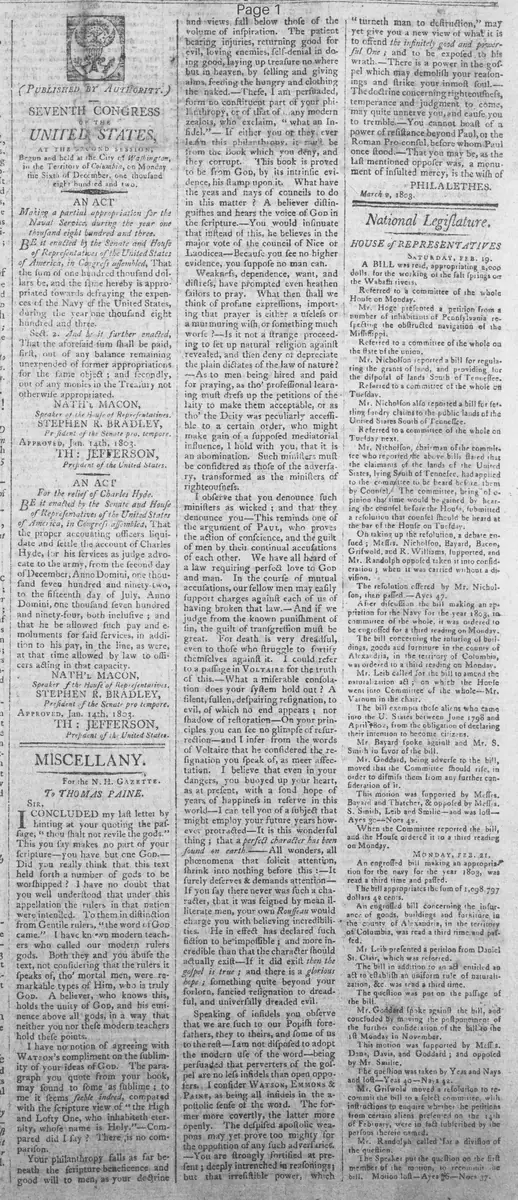
MISCELLANY.
For the N.H. GAZETTE.
To THOMAS PAINE.
SIR,
I CONCLUDED my last letter by hinting at your quoting the page, "thou shalt not revile the gods."
This you say makes no part of your scripture-you have but one God. -- Did you really think that this text held forth a number of gods to be worshipped? I have no doubt that you well understood that under this appellation the rulers in that nation were intended. To them in distinction from Gentile rulers, "the word of God came." I have known modern teachers who called our modern rulers gods. Both they and you abuse the text, not considering that the rulers it speaks of, tho' mortal men, were remarkable types of Him, who is truly God. A believer, who knows this, holds the unity of God, and his eminence above all gods, in a way that neither you nor those modern teachers hold these points.
I have no notion of agreeing with Watson's compliment on the sublimity of your ideas of God. The paragraph you quote from your book, may sound to some as sublime; to me it seems feeble indeed, compared with the scripture view of "the High and Lofty One, who inhabiteth eternity, whose name is Holy." -Compared did I say? There is no comparison.
Your philanthropy falls as far beneath the scripture beneficence and good will to men, as your doctrine and views fall below those of the volume of inspiration. The patient bearing injuries, returning good for evil, loving enemies, self-denial in doing good, laying up treasure no where but in heaven, by selling and giving alms, feeding the hungry and clothing the naked. These, I am persuaded form no constituent part of your philanthropy, or of that of any modern zealots, who exclaim, "what an Infidel." If either you or they ever learn this philanthropy. it must be from the Book which you deny, and they corrupt. This book is proved to be from God, by its intrinsic evidence, his Stamp upon it. What have the yeas and nays of councils to do in this matter? A believer distinguishes and hears the voice of God in the scripture.--You would insinuate that instead of this, he believes in the major vote of the council of Nice or Laodicea--Because you see no higher evidence, you suppose no man can.
Weakness, dependence, want, and distress, have prompted even heathen sailors to pray. What then shall we think of profane expressions, importing that prayer is either a useless or a murmuring wish, or something much worse?-Is it not a strange proceeding to set up natural religion against revealed, and then deny or depreciate the plain dictates of the law of nature?
-As to men being hired and paid for praying, as tho' professional learning must dress up the petitions of the laity to make them acceptable, or as tho' the Deity was peculiarly accessible to a certain order, who might make gain of a supposed mediatorial influence, I hold with you, that it is an abomination. Such ministers must be considered as those of the adversary, transformed as the ministers of righteousness:
I observe that you denounce such ministers as wicked; and that they denounce you-This reminds one of the argument of PAUL, who proves the action of conscience, and the guilt of men by their continual accusations of each other. We have all heard of a law requiring perfect love to God and man. In the course of mutual accusations, our fellow men may easily support charges against each of us of having broken that law.- And if we judge from the known punishment of sin, the guilt of transgression must be great. For death is very dreadful, even to those who struggle to fortify themselves against it. I could refer to a passage in Voltaire for the truth of this.-What a miserable consolation does your system hold out? A silent, sullen, despairing resignation, to evil, of which no end appears; nor shadow of restoration-On your principles you can see no glimpse of resurrection-and I infer from the words of Voltaire that he considered the resignation you speak of, as mere affectation. I believe that even in your dangers, you buoyed up your heart, as at present, with a fond hope of years of happiness in reserve in this world-I can tell you of a subject that might employ your future years however protracted-It is this wonderful thing; that a perfect character has been found on earth. All wonders, all phenomena that solicit attention, shrink into nothing before this :-It surely deserves & demands attention- If you say there never was such a character, that it was feigned by mean illiterate men, your own Rousseau would charge you with believing incredibilities. He in effect has declared such fiction to be impossible: and more incredible than that the character should actually exist--If it did exist then the gospel is true; and there is a glorious hope; something quite beyond your forlorn, fancied resignation to dreadful, and universally dreaded evil.
Speaking of infidels you observe that we are such to our Popish forefathers, they to theirs, and some of us to the rest-I am not disposed to adopt the modern use of the word-being persuaded that perverters of the gospel are no less infidels than open opposers. I consider Watson, Emmons & Paine, as being all infidels in the apostolic sense of the word. The former more covertly, the latter more openly. The despised apostolic weapons may yet prove too mighty for the opposition of any such adversaries.
—You are strongly fortified at present; deeply intrenched in reasonings; but that irresistible power, which "turneth man to destruction," may yet give you a new view of what it is to offend the infinitely good and powerful One; and to be exposed to his wrath.-There is a power in the gospel which may demolish your reasonings and strike your inmost soul.-- The doctrine concerning righteousness, temperance and judgment to come, may quite unnerve you, and cause you to tremble.-You cannot boast of a power of resistance beyond Paul, or the Roman Pro consul, before whom Paul once stood.That you may be, as the last mentioned opposer was, a monument of insulted mercy, is the wish of
PHILALETHES.
March 9, 1803.
For the N.H. GAZETTE.
To THOMAS PAINE.
SIR,
I CONCLUDED my last letter by hinting at your quoting the page, "thou shalt not revile the gods."
This you say makes no part of your scripture-you have but one God. -- Did you really think that this text held forth a number of gods to be worshipped? I have no doubt that you well understood that under this appellation the rulers in that nation were intended. To them in distinction from Gentile rulers, "the word of God came." I have known modern teachers who called our modern rulers gods. Both they and you abuse the text, not considering that the rulers it speaks of, tho' mortal men, were remarkable types of Him, who is truly God. A believer, who knows this, holds the unity of God, and his eminence above all gods, in a way that neither you nor those modern teachers hold these points.
I have no notion of agreeing with Watson's compliment on the sublimity of your ideas of God. The paragraph you quote from your book, may sound to some as sublime; to me it seems feeble indeed, compared with the scripture view of "the High and Lofty One, who inhabiteth eternity, whose name is Holy." -Compared did I say? There is no comparison.
Your philanthropy falls as far beneath the scripture beneficence and good will to men, as your doctrine and views fall below those of the volume of inspiration. The patient bearing injuries, returning good for evil, loving enemies, self-denial in doing good, laying up treasure no where but in heaven, by selling and giving alms, feeding the hungry and clothing the naked. These, I am persuaded form no constituent part of your philanthropy, or of that of any modern zealots, who exclaim, "what an Infidel." If either you or they ever learn this philanthropy. it must be from the Book which you deny, and they corrupt. This book is proved to be from God, by its intrinsic evidence, his Stamp upon it. What have the yeas and nays of councils to do in this matter? A believer distinguishes and hears the voice of God in the scripture.--You would insinuate that instead of this, he believes in the major vote of the council of Nice or Laodicea--Because you see no higher evidence, you suppose no man can.
Weakness, dependence, want, and distress, have prompted even heathen sailors to pray. What then shall we think of profane expressions, importing that prayer is either a useless or a murmuring wish, or something much worse?-Is it not a strange proceeding to set up natural religion against revealed, and then deny or depreciate the plain dictates of the law of nature?
-As to men being hired and paid for praying, as tho' professional learning must dress up the petitions of the laity to make them acceptable, or as tho' the Deity was peculiarly accessible to a certain order, who might make gain of a supposed mediatorial influence, I hold with you, that it is an abomination. Such ministers must be considered as those of the adversary, transformed as the ministers of righteousness:
I observe that you denounce such ministers as wicked; and that they denounce you-This reminds one of the argument of PAUL, who proves the action of conscience, and the guilt of men by their continual accusations of each other. We have all heard of a law requiring perfect love to God and man. In the course of mutual accusations, our fellow men may easily support charges against each of us of having broken that law.- And if we judge from the known punishment of sin, the guilt of transgression must be great. For death is very dreadful, even to those who struggle to fortify themselves against it. I could refer to a passage in Voltaire for the truth of this.-What a miserable consolation does your system hold out? A silent, sullen, despairing resignation, to evil, of which no end appears; nor shadow of restoration-On your principles you can see no glimpse of resurrection-and I infer from the words of Voltaire that he considered the resignation you speak of, as mere affectation. I believe that even in your dangers, you buoyed up your heart, as at present, with a fond hope of years of happiness in reserve in this world-I can tell you of a subject that might employ your future years however protracted-It is this wonderful thing; that a perfect character has been found on earth. All wonders, all phenomena that solicit attention, shrink into nothing before this :-It surely deserves & demands attention- If you say there never was such a character, that it was feigned by mean illiterate men, your own Rousseau would charge you with believing incredibilities. He in effect has declared such fiction to be impossible: and more incredible than that the character should actually exist--If it did exist then the gospel is true; and there is a glorious hope; something quite beyond your forlorn, fancied resignation to dreadful, and universally dreaded evil.
Speaking of infidels you observe that we are such to our Popish forefathers, they to theirs, and some of us to the rest-I am not disposed to adopt the modern use of the word-being persuaded that perverters of the gospel are no less infidels than open opposers. I consider Watson, Emmons & Paine, as being all infidels in the apostolic sense of the word. The former more covertly, the latter more openly. The despised apostolic weapons may yet prove too mighty for the opposition of any such adversaries.
—You are strongly fortified at present; deeply intrenched in reasonings; but that irresistible power, which "turneth man to destruction," may yet give you a new view of what it is to offend the infinitely good and powerful One; and to be exposed to his wrath.-There is a power in the gospel which may demolish your reasonings and strike your inmost soul.-- The doctrine concerning righteousness, temperance and judgment to come, may quite unnerve you, and cause you to tremble.-You cannot boast of a power of resistance beyond Paul, or the Roman Pro consul, before whom Paul once stood.That you may be, as the last mentioned opposer was, a monument of insulted mercy, is the wish of
PHILALETHES.
March 9, 1803.
What sub-type of article is it?
Religious
Persuasive
Philosophical
What themes does it cover?
Religion
Morality
What keywords are associated?
Thomas Paine
Deism
Christianity
Scripture
Philanthropy
Resurrection
Infidelity
Gospel Truth
What entities or persons were involved?
Philalethes
Thomas Paine
Letter to Editor Details
Author
Philalethes
Recipient
Thomas Paine
Main Argument
the writer critiques paine's deistic views as inferior to christian scripture, which provides true evidence of god, superior philanthropy, and hope through christ's perfect character and resurrection, urging paine to embrace the gospel.
Notable Details
Quotes Bible: 'Thou Shalt Not Revile The Gods'
References Watson's Compliment
Cites Councils Of Nice And Laodicea
Mentions Voltaire On Death's Dread
References Rousseau On Christ's Character
Alludes To Paul's Argument On Conscience
Wishes Paine Becomes A 'Monument Of Insulted Mercy' Like The Roman Proconsul