Thank you for visiting SNEWPapers!
Sign up free
Literary
May 9, 1874
The Albany Register
Albany, Linn County, Oregon
What is this article about?
In a California mining town, the enigmatic Colonel, a heavy spender and gambler, loses at races and rides off, pursued unknowingly by the constable. He joins his gang of road agents to rob a stagecoach but halts upon recognizing his mother among the passengers, releases them, sells his horse, cleans up, and leaves the state to retire from crime and reunite with family.
Merged-components note: Continuation of Bret Harte's short story 'Retiring From Business' across page break.
Clippings
1 of 2
OCR Quality
95%
Excellent
Full Text
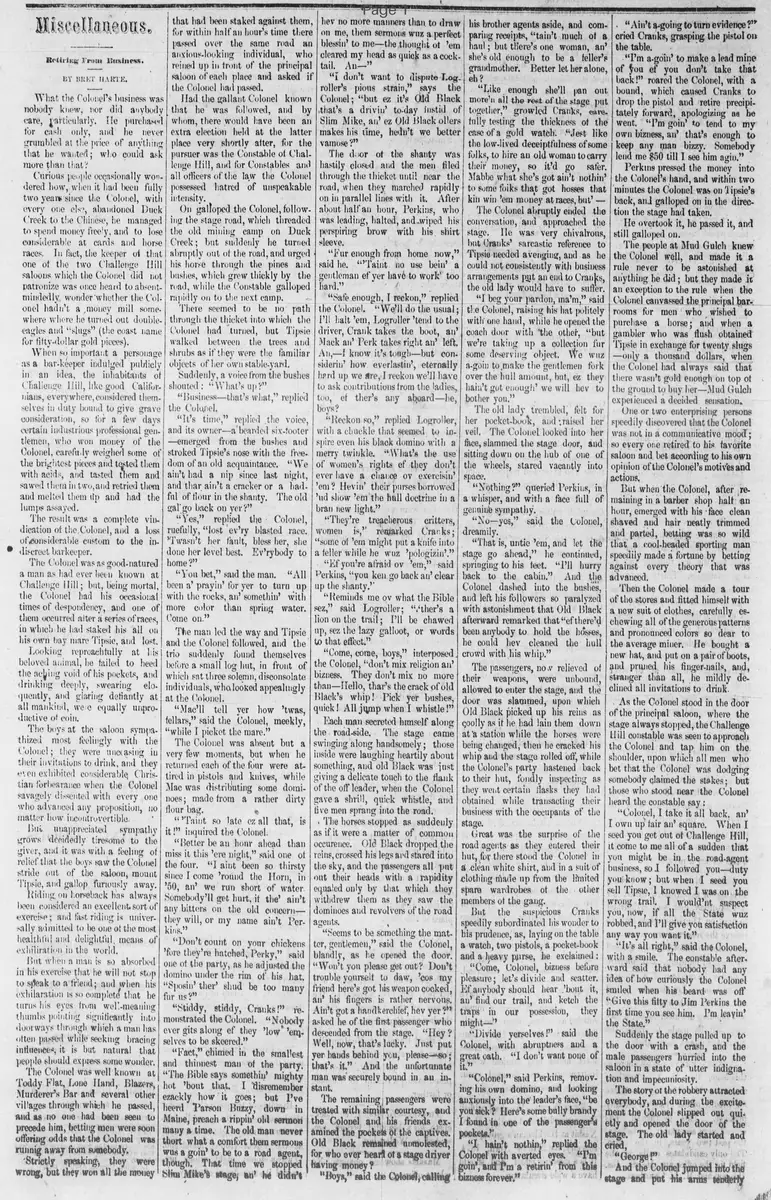
Miscellaneous.
Retiring From Business.
BY BRET HARTE.
What the Colonel's business was nobody knew, nor did anybody care, particularly. He purchased for cash only, and he never grumbled at the price of anything that he wanted; who could ask more than that?
Curious people occasionally wondered how, when it had been fully two years since the Colonel, with every one else, abandoned Duck Creek to the Chinese, he managed to spend money freely, and to lose considerable at cards and horse races. In fact, the keeper of that one of the two Challenge Hill saloons which the Colonel did not patronize was once heard to absentmindedly wonder 'whether the Colonel hadn't a money mill somewhere where he turned out double eagles and "slugs" (the coast name for fifty-dollar gold pieces).
When so important a personage as a bar-keeper indulged publicly in an idea, the inhabitants of Challenge Hill, like good Californians everywhere, considered themselves in duty bound to give grave consideration, so for a few days certain industrious professional gentlemen, who won money of the Colonel, carefully weighed some of the brightest pieces and tested them with acids, and tasted them and sawed them in two, and retried them and melted them up and had the lumps assayed.
The result was a complete vindication of the Colonel, and a loss of considerable custom to the indiscreet barkeeper.
The Colonel was as good-natured a man as had ever been known at Challenge Hill; but, being mortal, the Colonel had his occasional times of despondency, and one of them occurred after a series of races, in which he had staked his all on his own bay mare Tipsie, and lost.
Looking reproachfully at his beloved animal, he failed to heed the aching void of his pockets, and drinking deeply, swearing eloquently, and glaring defiantly at all mankind, were equally unproductive of coin.
The boys at the saloon sympathized most feelingly with the Colonel; they were unceasing in their invitations to drink, and they even exhibited considerable Christian forbearance when the Colonel savagely dissented with every one who advanced any proposition, no matter how incontrovertible.
But unappreciated sympathy grows decidedly tiresome to the giver, and it was with a feeling of relief that the boys saw the Colonel stride out of the saloon, mount Tipsie, and gallop furiously away.
Riding on horseback has always been considered an excellent sort of exercise; and fast riding is universally admitted to be one of the most healthful and delightful means of exhilaration in the world.
But when a man is so absorbed in his exercise that he will not stop to speak to a friend; and when his exhilaration is so complete that he turns his eyes from well-meaning thumbs pointing significantly into doorways through which a man has often passed while seeking bracing influences, it is but natural that people should express some wonder.
The Colonel was well known at Toddy Flat, Lone Hand, Blazers, Murderer's Bar and several other villages through which he passed, and as no one had been seen to precede him, betting men were soon offering odds that the Colonel was running away from somebody.
Strictly speaking, they were wrong, but they won all the money that had been staked against them, for within half an hour's time there passed over the same road an anxious-looking individual, who reined up in front of the principal saloon of each place and asked if the Colonel had passed.
Had the gallant Colonel known that he was followed, and by whom, there would have been an extra election held at the latter place very shortly after, for the pursuer was the Constable of Challenge Hill, and for Constables and all officers of the law the Colonel possessed hatred of unspeakable intensity.
On galloped the Colonel, following the stage road, which threaded the old mining camp on Duck Creek; but suddenly he turned abruptly out of the road, and urged his horse through the pines and bushes, which grew thickly by the road, while the Constable galloped rapidly on to the next camp.
There seemed to be no path through the thicket into which the Colonel had turned, but Tipsie walked between the trees and shrubs as if they were the familiar objects of her own stable-yard.
Suddenly, a voice from the bushes shouted: "What's up?"
"Business—that's what," replied the Colonel.
"It's time," replied the voice, and its owner—a bearded six-footer—emerged from the bushes and stroked Tipsie's nose with the freedom of an old acquaintance. "We ain't had a nip since last night, and thar ain't a cracker or a handful of flour in the shanty. The old gal go back on yer?"
"Yes," replied the Colonel ruefully, "lost ev'ry blasted race. 'Twasn't her fault, bless her, she done her level best. Ev'rybody to home?"
"You bet," said the man. "All been a' prayin' for yer to turn up with the rocks, an' somethin' with more color than spring water. Come on."
The man led the way and Tipsie and the Colonel followed, and the trio suddenly found themselves before a small log hut, in front of which sat three solemn, disconsolate individuals, who looked appealingly at the Colonel.
"Mac'll tell yer how 'twas, fellars," said the Colonel, meekly, "while I picket the mare."
The Colonel was absent but a very few moments, but when he returned each of the four were attired in pistols and knives, while Mac was distributing some dominoes; made from a rather dirty flour bag.
"'Taint so late ez all that, is it!" inquired the Colonel.
"Better be an hour ahead than miss it this 'ere night," said one of the four. "I ain't been so thirsty since I come 'round the Horn, in '50, an' we run short of water. Somebody'll get hurt if the ain't any bitters on the old concern—they will, or my name ain't Perkins."
"Don't count on your chickens 'fore they're hatched, Perky," said one of the party, as he adjusted the domino under the rim of his hat. "Sposin' ther' shud be too many fur us?"
"Stiddy, stiddy, Crauks!" remonstrated the Colonel. "Nobody ever gits along ef they 'low 'emselves to be skeered."
"Fact," chimed in the smallest and thinnest man of the party. "The Bible says somethin' mighty hot bout that. I disremember ezackly how 'it goes; but I've heerd Parson Buzzy, down in Maine, preach a rippin' old sermon many a time. The old man never thort what a comfort them sermons wus a goin' to be to a road agent, though. That time we stopped Slim Mike's stage an' he didn't hev no more manners than to draw on me, them sermons wuz a perfect blessin' to me—the thought ot 'em cleared my head as quick as a cock-tail."
"I don't want to dispute Logroller's pious strain," says the Colonel; "but ez it's Old Black that's a drivin' to-day instid of Slim Mike, an' ez Old Black ollers makes his time, hedn't we better vamose?"
The door ot the shanty was hastily closed and the men filed through the thicket until near the road, when they marched rapidly on in parallel lines with it. After about half an hour, Perkins, who was leading, halted, and wiped his perspiring brow with his shirt sleeve.
"Fur enough from home now," said he. "Taint no use bein' a gentleman ef yer havé to work' too hard."
"Safe enough, I reckon," replied the Colonel. "We'll do the usual; I'll halt 'em, Logroller 'tend to the driver, Crank takes the boot, an' Mack an' Perk takes right an' left. An', I know it's tough—but considerin' how everlastin', eternally hard up we are, I reckon we'll bave to ask contributions from the ladies, too, ef ther's any aboard—he, boys?"
"Reckon so," replied Logroller, with a chuckle that seemed to inspire even his black domino with a merry twinkle. "What's the use of women's rights ef they don't ever have a chauce ov exercisin' 'em? Hevin' their purses borrowed 'ud show 'em the hall doctrine in a bran new light."
"They're treacherous critters, women is," remarked Cranks; "some of 'em might put a knife into a feller while he wuz 'pologizin'."
"Ef you're afraid ov 'em," said Perkins, "you ken go back an' clear up the shanty."
"Reminds me ov what the Bible sez," said Logroller; "'ther's a lion on the trail: I'll be chawed up, sez the lazy galloot, or words to that effect.'"
"Come, come, boys," interposed the Colonel, "don't mix religion an' bizness. They don't mix no more than—hello, thar's the crack of old Black's whip! Pick yer bushes quick! All jump when I whistle!"
Each man secreted himself along the road-side. The stage came swinging along handsomely; those inside were laughing heartily about something, and old Black was just giving a delicate touch to the flank of the off leader, when the Colonel gave a shrill, quick whistle, and five men sprang into the road.
The horses stopped as suddenly as if it were a matter of common occurence. Old Black dropped the reins, crossed his legs and stared into the sky, and the passengers all put out their heads with a rapidity equaled only by that which they withdrew them as they saw the dominoes and revolvers of the road agents.
"Seems to be something the matter, gentlemen," said the Colonel, blandly, as he opened the door. "Won't you please get out? Don't trouble yourself to draw, 'cos my friend here's got his weapon cocked, an' his fingers is rather nervous. Ain't got a handkerchief, hev yer?" asked he of the first passenger who descended from the stage. "Hey? Well, now, that's lucky. Just put yer hands behind you, please—so; that's it." And the unfortunate man was securely bound in an instant.
The remaining passengers were treated with similar courtesy, and the Colonel and his friends examined the pockets of the captives. Old Black remained unmolested, for who ever heard of a stage driver having money?
"Boys," said the Colonel, calling his brother agents aside, and comparing receipts, "tain't much of a haul; but there's one woman, an' she's old enough to be a feller's grandmother. Better let her alone, eh?"
"Like enough she'll pan out more'n all the rest of the stage put together," growled Cranks, carefully testing the thickness ot the case of a gold watch. "Jest like the low-lived deceiptfulness of some folks, to hire an old woman to carry their money, so it'd go safer. Mabbe what she's got ain't nothin' to some foiks that got hosses that kin win 'em money at races, but'—"
The Colonel abruptly ended the conversation, and approached the stage. He was very chivalrous, but Cranks' sarcastic reference to Tipsie needed avenging, and as he could not consistently with business arrangements put an end to Cranks, the old lady would have to suffer.
"I beg your pardon, ma'm," said the Colonel, raising his hat politely with one hand, while he opened the coach door with the other, "but we're taking up a collection fur some deserving object. We wuz a-goin to make the gentlemen fork over the hull amount, but, ez they hain't got enough' we will hev to bother you."
The old lady trembled, felt for her pocket-book, and raised her veil. The Colonel looked into her face, slammed the stage door, and sitting down on the hub of one of the wheels, stared vacantly into space.
"Nothing?" queried Perkins, in a whisper, and with a face full of genuine sympathy.
"No—yes," said the Colonel, dreamily. "That is, untie 'em, and let the stage go ahead," he continued, springing to his feet. "I'll hurry back to the cabin." And the Colonel dashed into the bushes, and left his followers so paralyzed with astonishment that Old Black afterward remarked that "ef there'd been anybody to hold the horses, he could hev cleaned the hull crowd with his whip."
The passengers, now relieved of their weapons, were unbound, allowed to enter the stage, and the door was slammed, upon which Old Black picked up his reins as coolly as if he had lain them down at a station while the horses were being changed, then he cracked his whip and the stage rolled off, while the Colonel's party hastened back to their hut, fondly inspecting as they went certain flasks they had obtained while transacting their business with the occupants of the stage.
Great was the surprise of the road agents as they entered their hut, for there stood the Colonel in a clean white shirt, and in a suit of clothing made up from the limited spare wardrobes ot the other members ot the gang.
But the suspicious Cranks speedily subordinated his wonder to his prudence, as, laying on the table a watch, two pistols, a pocket-book and a heavy purse, he exclaimed:
"Come, Colonel, bizness before pleasure; let's divide and scatter. Ef anybody should hear 'bout it, an' find our trail, and ketch the traps in our possession, they might—"
"Divide themselves!" said the Colonel, with abruptness and a great oath. "I don't want none of it."
"Colonel," said Perkins, removing his own domino, and looking anxiously into the leader's face, "be you sick? Here's some bully brandy I found in one of the passenger's pockets."
"I hain't nothin," replied the Colonel with averted eyes. "I'm goin', and I'm a retirin' from this bizness forever."
"Ain't a-going to turn evidence?" cried Cranks, grasping the pistol on the table.
"I'm a-goin' to make a lead mine of you ef you don't take that back!" roared the Colonel, with a bound, which caused Cranks to drop the pistol and retire precipitately forward, apologizing as he went. "I'm goin' to tend to my own bizness, an' that's enough to keep any man bizzy. Somebody lend me $50 till I see him agin."
Perkins pressed the money into the Colonel's hand, and within two minutes the Colonel was on Tipsie's back, and galloped on in the direction the stage had taken.
He overtook it, he passed it, and still galloped on.
The people at Mud Gulch knew the Colonel well, and made it a rule never to be astonished at anything he did; but they made it an exception to the rule when the Colonel canvassed the principal bar-rooms for men who wished to purchase a horse; and when a gambler who was flush obtained Tipsie in exchange for twenty slugs—only a thousand dollars, when the Colonel had always said that there wasn't gold enough on top ot the ground to buy her—Mud Gulch experienced a decided sensation.
One or two enterprising persons speedily discovered that the Colonel was not in a communicative mood; so every one retired to his favorite saloon and bet according to his own opinion of the Colonel's motives and actions.
But when the Colonel, after remaining in a barber shop half an hour, emerged with his face clean shaved and hair neatly trimmed and parted, betting was so wild that a cool-headed sporting man speedily made a fortune by betting against every theory that was advanced.
Then the Colonel made a tour of the stores and fitted himself with a new suit of clothes, carefully eschewing all of the generous patterns and pronounced colors so dear to the average miner. He bought a new hat, and put on a pair of boots, and pruned his finger-nails, and, stranger than all, he mildly declined all invitations to drink.
As the Colonel stood in the door of the principal saloon, where the stage always stopped, the Challenge Hill constable was seen to approach the Colonel and tap him on the shoulder, upon which all men who bet that the Colonel was dodging somebody claimed the stakes; but those who stood near the Colonel heard the constable say:
"Colonel, I take it all back, an' I own up fair an' square. When I seed you get out ot Challenge Hill, it come to me all of a sudden that you might be in tbe road-agent business, so I followed you—duty you know; but when I seed you sell Tipsie, I knowed I was on the wrong trail. I wouldn't suspect you, now, if all the State wuz robbed, and I'll give you satisfaction any way you want it."
"It's all right," said the Colonel, with a smile. The constable afterward said that nobody had any idea of how curiously the Colonel smiled when his beard was off.
"Give this fifty to Jim Perkins the first time you see him. I'm leavin' the State."
Suddenly the stage pulled up to the door with a crash, and the male passengers hurried into the saloon in a state of utter indignation and impecuniosity.
The story of the robbery attracted everybody, and during the excitement the Colonel slipped out quietly and opened the door of the stage. The old lady started and cried,
"George!"
And the Colonel jumped into the stage and put his arms tenderly around her.
About the trembling form of the old lady, exclaiming,
"Mother!"
Retiring From Business.
BY BRET HARTE.
What the Colonel's business was nobody knew, nor did anybody care, particularly. He purchased for cash only, and he never grumbled at the price of anything that he wanted; who could ask more than that?
Curious people occasionally wondered how, when it had been fully two years since the Colonel, with every one else, abandoned Duck Creek to the Chinese, he managed to spend money freely, and to lose considerable at cards and horse races. In fact, the keeper of that one of the two Challenge Hill saloons which the Colonel did not patronize was once heard to absentmindedly wonder 'whether the Colonel hadn't a money mill somewhere where he turned out double eagles and "slugs" (the coast name for fifty-dollar gold pieces).
When so important a personage as a bar-keeper indulged publicly in an idea, the inhabitants of Challenge Hill, like good Californians everywhere, considered themselves in duty bound to give grave consideration, so for a few days certain industrious professional gentlemen, who won money of the Colonel, carefully weighed some of the brightest pieces and tested them with acids, and tasted them and sawed them in two, and retried them and melted them up and had the lumps assayed.
The result was a complete vindication of the Colonel, and a loss of considerable custom to the indiscreet barkeeper.
The Colonel was as good-natured a man as had ever been known at Challenge Hill; but, being mortal, the Colonel had his occasional times of despondency, and one of them occurred after a series of races, in which he had staked his all on his own bay mare Tipsie, and lost.
Looking reproachfully at his beloved animal, he failed to heed the aching void of his pockets, and drinking deeply, swearing eloquently, and glaring defiantly at all mankind, were equally unproductive of coin.
The boys at the saloon sympathized most feelingly with the Colonel; they were unceasing in their invitations to drink, and they even exhibited considerable Christian forbearance when the Colonel savagely dissented with every one who advanced any proposition, no matter how incontrovertible.
But unappreciated sympathy grows decidedly tiresome to the giver, and it was with a feeling of relief that the boys saw the Colonel stride out of the saloon, mount Tipsie, and gallop furiously away.
Riding on horseback has always been considered an excellent sort of exercise; and fast riding is universally admitted to be one of the most healthful and delightful means of exhilaration in the world.
But when a man is so absorbed in his exercise that he will not stop to speak to a friend; and when his exhilaration is so complete that he turns his eyes from well-meaning thumbs pointing significantly into doorways through which a man has often passed while seeking bracing influences, it is but natural that people should express some wonder.
The Colonel was well known at Toddy Flat, Lone Hand, Blazers, Murderer's Bar and several other villages through which he passed, and as no one had been seen to precede him, betting men were soon offering odds that the Colonel was running away from somebody.
Strictly speaking, they were wrong, but they won all the money that had been staked against them, for within half an hour's time there passed over the same road an anxious-looking individual, who reined up in front of the principal saloon of each place and asked if the Colonel had passed.
Had the gallant Colonel known that he was followed, and by whom, there would have been an extra election held at the latter place very shortly after, for the pursuer was the Constable of Challenge Hill, and for Constables and all officers of the law the Colonel possessed hatred of unspeakable intensity.
On galloped the Colonel, following the stage road, which threaded the old mining camp on Duck Creek; but suddenly he turned abruptly out of the road, and urged his horse through the pines and bushes, which grew thickly by the road, while the Constable galloped rapidly on to the next camp.
There seemed to be no path through the thicket into which the Colonel had turned, but Tipsie walked between the trees and shrubs as if they were the familiar objects of her own stable-yard.
Suddenly, a voice from the bushes shouted: "What's up?"
"Business—that's what," replied the Colonel.
"It's time," replied the voice, and its owner—a bearded six-footer—emerged from the bushes and stroked Tipsie's nose with the freedom of an old acquaintance. "We ain't had a nip since last night, and thar ain't a cracker or a handful of flour in the shanty. The old gal go back on yer?"
"Yes," replied the Colonel ruefully, "lost ev'ry blasted race. 'Twasn't her fault, bless her, she done her level best. Ev'rybody to home?"
"You bet," said the man. "All been a' prayin' for yer to turn up with the rocks, an' somethin' with more color than spring water. Come on."
The man led the way and Tipsie and the Colonel followed, and the trio suddenly found themselves before a small log hut, in front of which sat three solemn, disconsolate individuals, who looked appealingly at the Colonel.
"Mac'll tell yer how 'twas, fellars," said the Colonel, meekly, "while I picket the mare."
The Colonel was absent but a very few moments, but when he returned each of the four were attired in pistols and knives, while Mac was distributing some dominoes; made from a rather dirty flour bag.
"'Taint so late ez all that, is it!" inquired the Colonel.
"Better be an hour ahead than miss it this 'ere night," said one of the four. "I ain't been so thirsty since I come 'round the Horn, in '50, an' we run short of water. Somebody'll get hurt if the ain't any bitters on the old concern—they will, or my name ain't Perkins."
"Don't count on your chickens 'fore they're hatched, Perky," said one of the party, as he adjusted the domino under the rim of his hat. "Sposin' ther' shud be too many fur us?"
"Stiddy, stiddy, Crauks!" remonstrated the Colonel. "Nobody ever gits along ef they 'low 'emselves to be skeered."
"Fact," chimed in the smallest and thinnest man of the party. "The Bible says somethin' mighty hot bout that. I disremember ezackly how 'it goes; but I've heerd Parson Buzzy, down in Maine, preach a rippin' old sermon many a time. The old man never thort what a comfort them sermons wus a goin' to be to a road agent, though. That time we stopped Slim Mike's stage an' he didn't hev no more manners than to draw on me, them sermons wuz a perfect blessin' to me—the thought ot 'em cleared my head as quick as a cock-tail."
"I don't want to dispute Logroller's pious strain," says the Colonel; "but ez it's Old Black that's a drivin' to-day instid of Slim Mike, an' ez Old Black ollers makes his time, hedn't we better vamose?"
The door ot the shanty was hastily closed and the men filed through the thicket until near the road, when they marched rapidly on in parallel lines with it. After about half an hour, Perkins, who was leading, halted, and wiped his perspiring brow with his shirt sleeve.
"Fur enough from home now," said he. "Taint no use bein' a gentleman ef yer havé to work' too hard."
"Safe enough, I reckon," replied the Colonel. "We'll do the usual; I'll halt 'em, Logroller 'tend to the driver, Crank takes the boot, an' Mack an' Perk takes right an' left. An', I know it's tough—but considerin' how everlastin', eternally hard up we are, I reckon we'll bave to ask contributions from the ladies, too, ef ther's any aboard—he, boys?"
"Reckon so," replied Logroller, with a chuckle that seemed to inspire even his black domino with a merry twinkle. "What's the use of women's rights ef they don't ever have a chauce ov exercisin' 'em? Hevin' their purses borrowed 'ud show 'em the hall doctrine in a bran new light."
"They're treacherous critters, women is," remarked Cranks; "some of 'em might put a knife into a feller while he wuz 'pologizin'."
"Ef you're afraid ov 'em," said Perkins, "you ken go back an' clear up the shanty."
"Reminds me ov what the Bible sez," said Logroller; "'ther's a lion on the trail: I'll be chawed up, sez the lazy galloot, or words to that effect.'"
"Come, come, boys," interposed the Colonel, "don't mix religion an' bizness. They don't mix no more than—hello, thar's the crack of old Black's whip! Pick yer bushes quick! All jump when I whistle!"
Each man secreted himself along the road-side. The stage came swinging along handsomely; those inside were laughing heartily about something, and old Black was just giving a delicate touch to the flank of the off leader, when the Colonel gave a shrill, quick whistle, and five men sprang into the road.
The horses stopped as suddenly as if it were a matter of common occurence. Old Black dropped the reins, crossed his legs and stared into the sky, and the passengers all put out their heads with a rapidity equaled only by that which they withdrew them as they saw the dominoes and revolvers of the road agents.
"Seems to be something the matter, gentlemen," said the Colonel, blandly, as he opened the door. "Won't you please get out? Don't trouble yourself to draw, 'cos my friend here's got his weapon cocked, an' his fingers is rather nervous. Ain't got a handkerchief, hev yer?" asked he of the first passenger who descended from the stage. "Hey? Well, now, that's lucky. Just put yer hands behind you, please—so; that's it." And the unfortunate man was securely bound in an instant.
The remaining passengers were treated with similar courtesy, and the Colonel and his friends examined the pockets of the captives. Old Black remained unmolested, for who ever heard of a stage driver having money?
"Boys," said the Colonel, calling his brother agents aside, and comparing receipts, "tain't much of a haul; but there's one woman, an' she's old enough to be a feller's grandmother. Better let her alone, eh?"
"Like enough she'll pan out more'n all the rest of the stage put together," growled Cranks, carefully testing the thickness ot the case of a gold watch. "Jest like the low-lived deceiptfulness of some folks, to hire an old woman to carry their money, so it'd go safer. Mabbe what she's got ain't nothin' to some foiks that got hosses that kin win 'em money at races, but'—"
The Colonel abruptly ended the conversation, and approached the stage. He was very chivalrous, but Cranks' sarcastic reference to Tipsie needed avenging, and as he could not consistently with business arrangements put an end to Cranks, the old lady would have to suffer.
"I beg your pardon, ma'm," said the Colonel, raising his hat politely with one hand, while he opened the coach door with the other, "but we're taking up a collection fur some deserving object. We wuz a-goin to make the gentlemen fork over the hull amount, but, ez they hain't got enough' we will hev to bother you."
The old lady trembled, felt for her pocket-book, and raised her veil. The Colonel looked into her face, slammed the stage door, and sitting down on the hub of one of the wheels, stared vacantly into space.
"Nothing?" queried Perkins, in a whisper, and with a face full of genuine sympathy.
"No—yes," said the Colonel, dreamily. "That is, untie 'em, and let the stage go ahead," he continued, springing to his feet. "I'll hurry back to the cabin." And the Colonel dashed into the bushes, and left his followers so paralyzed with astonishment that Old Black afterward remarked that "ef there'd been anybody to hold the horses, he could hev cleaned the hull crowd with his whip."
The passengers, now relieved of their weapons, were unbound, allowed to enter the stage, and the door was slammed, upon which Old Black picked up his reins as coolly as if he had lain them down at a station while the horses were being changed, then he cracked his whip and the stage rolled off, while the Colonel's party hastened back to their hut, fondly inspecting as they went certain flasks they had obtained while transacting their business with the occupants of the stage.
Great was the surprise of the road agents as they entered their hut, for there stood the Colonel in a clean white shirt, and in a suit of clothing made up from the limited spare wardrobes ot the other members ot the gang.
But the suspicious Cranks speedily subordinated his wonder to his prudence, as, laying on the table a watch, two pistols, a pocket-book and a heavy purse, he exclaimed:
"Come, Colonel, bizness before pleasure; let's divide and scatter. Ef anybody should hear 'bout it, an' find our trail, and ketch the traps in our possession, they might—"
"Divide themselves!" said the Colonel, with abruptness and a great oath. "I don't want none of it."
"Colonel," said Perkins, removing his own domino, and looking anxiously into the leader's face, "be you sick? Here's some bully brandy I found in one of the passenger's pockets."
"I hain't nothin," replied the Colonel with averted eyes. "I'm goin', and I'm a retirin' from this bizness forever."
"Ain't a-going to turn evidence?" cried Cranks, grasping the pistol on the table.
"I'm a-goin' to make a lead mine of you ef you don't take that back!" roared the Colonel, with a bound, which caused Cranks to drop the pistol and retire precipitately forward, apologizing as he went. "I'm goin' to tend to my own bizness, an' that's enough to keep any man bizzy. Somebody lend me $50 till I see him agin."
Perkins pressed the money into the Colonel's hand, and within two minutes the Colonel was on Tipsie's back, and galloped on in the direction the stage had taken.
He overtook it, he passed it, and still galloped on.
The people at Mud Gulch knew the Colonel well, and made it a rule never to be astonished at anything he did; but they made it an exception to the rule when the Colonel canvassed the principal bar-rooms for men who wished to purchase a horse; and when a gambler who was flush obtained Tipsie in exchange for twenty slugs—only a thousand dollars, when the Colonel had always said that there wasn't gold enough on top ot the ground to buy her—Mud Gulch experienced a decided sensation.
One or two enterprising persons speedily discovered that the Colonel was not in a communicative mood; so every one retired to his favorite saloon and bet according to his own opinion of the Colonel's motives and actions.
But when the Colonel, after remaining in a barber shop half an hour, emerged with his face clean shaved and hair neatly trimmed and parted, betting was so wild that a cool-headed sporting man speedily made a fortune by betting against every theory that was advanced.
Then the Colonel made a tour of the stores and fitted himself with a new suit of clothes, carefully eschewing all of the generous patterns and pronounced colors so dear to the average miner. He bought a new hat, and put on a pair of boots, and pruned his finger-nails, and, stranger than all, he mildly declined all invitations to drink.
As the Colonel stood in the door of the principal saloon, where the stage always stopped, the Challenge Hill constable was seen to approach the Colonel and tap him on the shoulder, upon which all men who bet that the Colonel was dodging somebody claimed the stakes; but those who stood near the Colonel heard the constable say:
"Colonel, I take it all back, an' I own up fair an' square. When I seed you get out ot Challenge Hill, it come to me all of a sudden that you might be in tbe road-agent business, so I followed you—duty you know; but when I seed you sell Tipsie, I knowed I was on the wrong trail. I wouldn't suspect you, now, if all the State wuz robbed, and I'll give you satisfaction any way you want it."
"It's all right," said the Colonel, with a smile. The constable afterward said that nobody had any idea of how curiously the Colonel smiled when his beard was off.
"Give this fifty to Jim Perkins the first time you see him. I'm leavin' the State."
Suddenly the stage pulled up to the door with a crash, and the male passengers hurried into the saloon in a state of utter indignation and impecuniosity.
The story of the robbery attracted everybody, and during the excitement the Colonel slipped out quietly and opened the door of the stage. The old lady started and cried,
"George!"
And the Colonel jumped into the stage and put his arms tenderly around her.
About the trembling form of the old lady, exclaiming,
"Mother!"
What sub-type of article is it?
Prose Fiction
Satire
What themes does it cover?
Moral Virtue
Commerce Trade
What keywords are associated?
Colonel
Road Agents
Stage Robbery
Retirement
Family Reunion
Gold Rush
California Mining
What entities or persons were involved?
By Bret Harte.
Literary Details
Title
Retiring From Business.
Author
By Bret Harte.
Key Lines
"Mother!"
"I'm Goin', And I'm A Retirin' From This Bizness Forever."
"Business—That's What," Replied The Colonel.