Thank you for visiting SNEWPapers!
Sign up free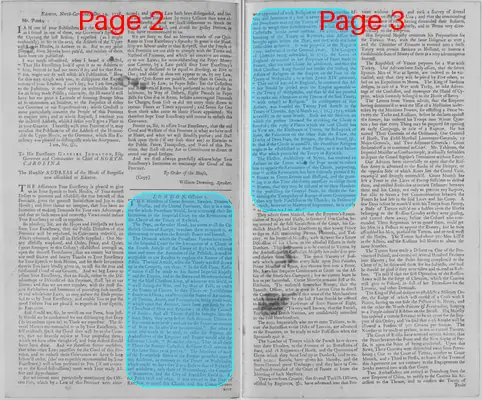
The Virginia Gazette
Richmond, Williamsburg, Richmond County, Virginia
What is this article about?
Protestant powers including Britain, Sweden, Denmark, Prussia, and the United Provinces urge the Imperial Court to revoke a clause in the Treaty of Ryswick protecting Catholic interests in Alsatia, conflicting with the Treaty of Westphalia. The Pope opposes it, but the Elector of Mainz supports revocation to aid European peace.
Merged-components note: Direct continuation of the article explaining the historical context and demands regarding the Clause in the Fourth Article of the Treaty of Ryswick.
Clippings
1 of 2
OCR Quality
Full Text
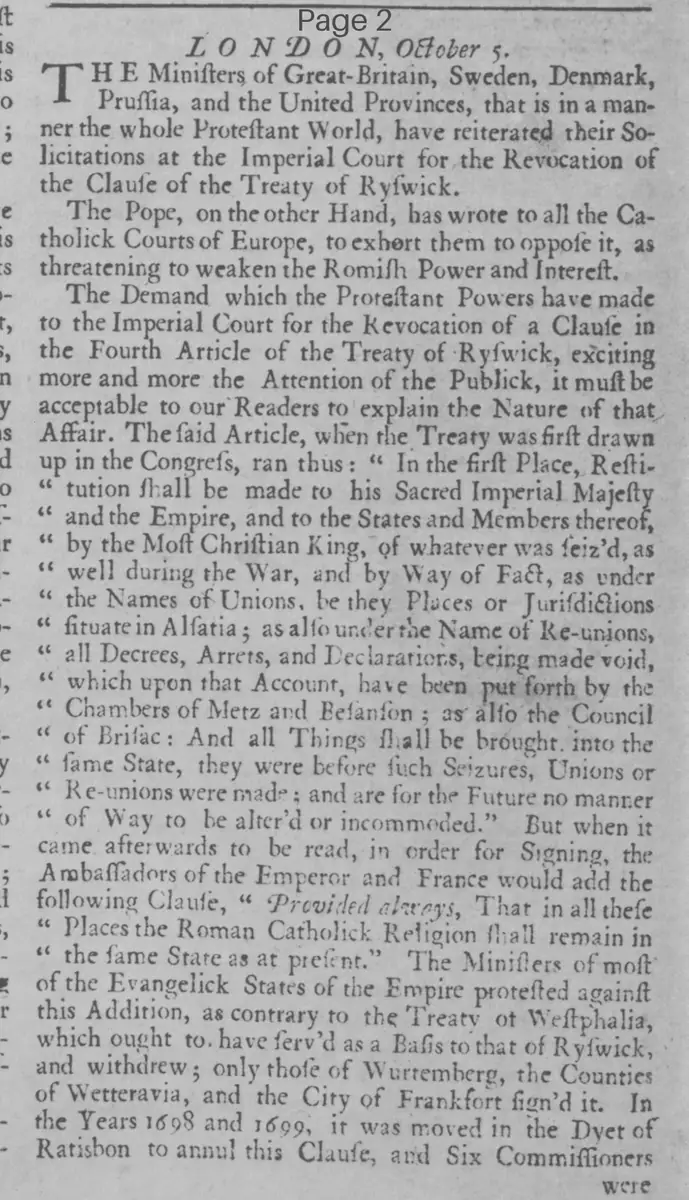
THE Ministers of Great-Britain, Sweden, Denmark, Prussia, and the United Provinces, that is in a manner the whole Protestant World, have reiterated their Solicitations at the Imperial Court for the Revocation of the Clause of the Treaty of Ryswick.
The Pope, on the other Hand, has wrote to all the Catholick Courts of Europe, to exhort them to oppose it, as threatening to weaken the Romish Power and Interest.
The Demand which the Protestant Powers have made to the Imperial Court for the Revocation of a Clause in the Fourth Article of the Treaty of Ryswick, exciting more and more the Attention of the Publick, it must be acceptable to our Readers to explain the Nature of that Affair. The said Article, when the Treaty was first drawn up in the Congress, ran thus: "In the first Place, Restitution Shall be made to his Sacred Imperial Majesty and the Empire, and to the States and Members thereof, by the Most Christian King, of whatever was seiz'd, as well during the War, and by Way of Fact, as under the Names of Unions, be they Places or Jurisdictions situate in Alsatia; as also under the Name of Re-unions, all Decrees, Arrets, and Declarations, being made void, which upon that Account, have been put forth by the Chambers of Metz and Besançon; as also the Council of Brisac: And all Things shall be brought into the same State, they were before such Seizures, Unions or Re-unions were made: and are for the Future no manner of Way to be alter'd or incommoded." But when it came afterwards to be read, in order for Signing, the Ambassadors of the Emperor and France would add the following Clause, "Provided always, That in all these Places the Roman Catholick Religion Shall remain in the same State as at present." The Ministers of most of the Evangelick States of the Empire protested against this Addition, as contrary to the Treaty of Westphalia, which ought to have serv'd as a Basis to that of Ryswick, and withdrew; only those of Wurtemberg, the Counties of Wetteravia, and the City of Frankfort sign'd it. In the Years 1698 and 1699, it was moved in the Dyet of Ratisbon to annul this Clause, and Six Commissioners
were appointed of each Religion to examine into this Affair, and determine it ; but it never came to any Thing, the Protestants making the Treaty of Westphalia the Standard to weigh their Resolutions by, to which the Roman Catholicks would never consent. In 1702, after the breaking of the Treaty of Ryswick, this Affair was brought again before the Diet, and met with the same Difficulties as before. It was propos'd at the Hague in 1709, and referr'd to the General Peace. The Congress of Utrecht being assembled in 1713, the Court of England demanded in her Proposals of Peace made to France, that the said Clause be abolished, and that the Most Christian King should not hinder the settling the Affairs of Religion in the Empire on the Foot of the Treaty of Westphalia ; to which Lewis XIV answered, "That out of Regard to England, he consented this Affair should be settled with the Empire agreeable to the Treaty of Westphalia, and that he did not pretend to make any Alteration in the Tenour of the said Treaty, with respect to Religion." In consequence of this Answer, was founded the Twenty First Article in the Treaty of Utrecht, sign'd March 20, (31,) 1713, which is exactly in the same Words. Such are the Motives on which the present Demand for revoking the Clause is founded; the restor'd Places which the said Clause has in View are, the Electorate of Treves, the Bishoprick of Spire, the Palatinate on the other Side the Rhine, the Dutchy of Deux Ponts, the Brisgau, the Black Forest, &c. so that if the Clause is annull'd, the Protestant Religion ought to be established in those Places, as it was before the War which preceded the Treaty of Ryswick.
The Elector, Archbishop of Mentz, has returned an Answer to the Letter which the Pope wrote to exhort him to oppose the Revocation of this Clause, purporting, that "as this Revocation has been solemnly promis'd by France to Great-Britain and Holland, and the granting it at this Time absolutely necessary to oblige those Powers, that they may be induced to set their Hands to perfecting the General Peace, he thinks the furthering the Tranquility of Europe of more Consequence than any little Punctillio to the Church ; in Defence of which, however in Matters of Importance, he is ready to sacrifice his Life, &c."
What sub-type of article is it?
What keywords are associated?
What entities or persons were involved?
Where did it happen?
Foreign News Details
Primary Location
Imperial Court
Event Date
October 5
Key Persons
Outcome
elector of mentz supports revocation to promote european peace over church punctilio; historical promises in treaty of utrecht to settle per westphalia.
Event Details
Protestant ministers from Great-Britain, Sweden, Denmark, Prussia, and United Provinces solicit Imperial Court to revoke Ryswick Treaty clause protecting Catholic religion in Alsatia, contrary to Westphalia. Pope urges Catholic courts to oppose. Historical context of clause addition, protests, and failed annulments detailed, with Utrecht Treaty article promising settlement per Westphalia. Places affected include Electorate of Treves, Bishoprick of Spire. Elector of Mentz replies to Pope favoring revocation for peace.