Thank you for visiting SNEWPapers!
Sign up free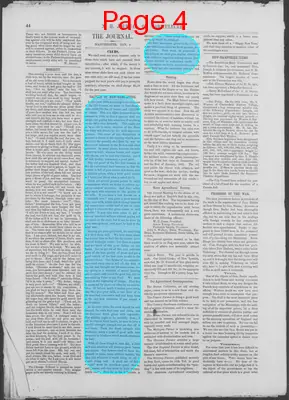
Story
January 5, 1863
New Hampshire Journal Of Agriculture
Manchester, Hillsborough County, New Hampshire
What is this article about?
1860 census shows slight decline in New Hampshire butter and cheese production from 1850 levels, attributed to milk markets and poor management. Article advises farmers on selecting good stock, proper feeding, housing, milking, and equipment for quality dairy products.
Clipping
OCR Quality
98%
Excellent
Full Text
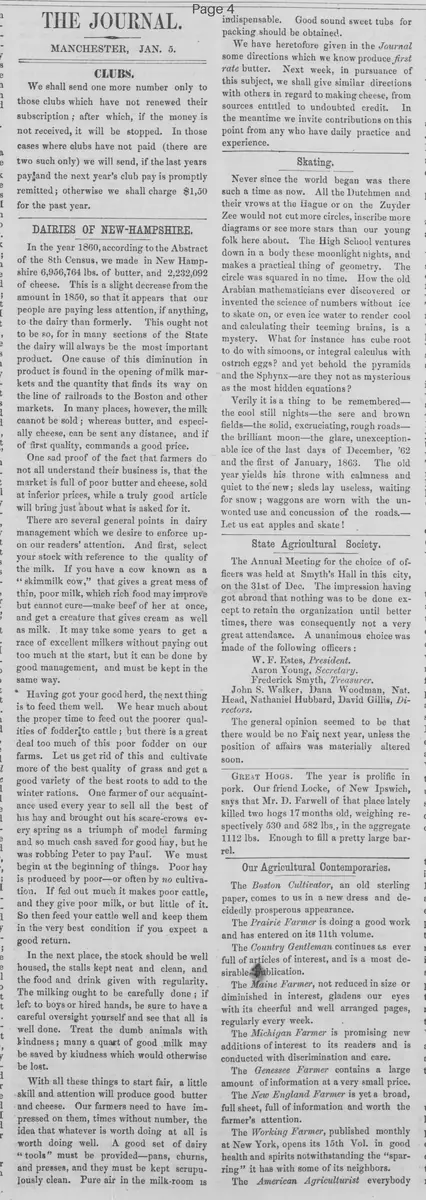
DAIRIES OF NEW-HAMPSHIRE.
In the year 1860, according to the Abstract of the 8th Census, we made in New Hampshire 6,956,764 lbs. of butter, and 2,232,092 of cheese. This is a slight decrease from the amount in 1850, so that it appears that our people are paying less attention, if anything, to the dairy than formerly. This ought not to be so, for in many sections of the State the dairy will always be the most important product. One cause of this diminution in product is found in the opening of milk markets and the quantity that finds its way on the line of railroads to the Boston and other markets. In many places, however, the milk cannot be sold; whereas butter, and especially cheese, can be sent any distance, and if of first quality, commands a good price.
One sad proof of the fact that farmers do not all understand their business is, that the market is full of poor butter and cheese, sold at inferior prices, while a truly good article will bring just about what is asked for it.
There are several general points in dairy management which we desire to enforce upon our readers' attention. And first, select your stock with reference to the quality of the milk. If you have a cow known as a "skimmilk cow," that gives a great mess of thin, poor milk, which rich food may improve but cannot cure—make beef of her at once, and get a creature that gives cream as well as milk. It may take some years to get a race of excellent milkers without paying out too much at the start, but it can be done by good management, and must be kept in the same way.
Having got your good herd, the next thing is to feed them well. We hear much about the proper time to feed out the poorer qualities of fodder to cattle; but there is a great deal too much of this poor fodder on our farms. Let us get rid of this and cultivate more of the best quality of grass and get a good variety of the best roots to add to the winter rations. One farmer of our acquaintance used every year to sell all the best of his hay and brought out his scare-crows every spring as a triumph of model farming and so much cash saved for good hay, but he was robbing Peter to pay Paul. We must begin at the beginning of things. Poor hay is produced by poor—or often by no cultivation. If fed out much it makes poor cattle, and they give poor milk, or but little of it.
So then feed your cattle well and keep them in the very best condition if you expect a good return.
In the next place, the stock should be well housed, the stalls kept neat and clean, and the food and drink given with regularity. The milking ought to be carefully done; if left to boys or hired hands, be sure to have a careful oversight yourself and see that all is well done. Treat the dumb animals with kindness; many a quart of good milk may be saved by kindness which would otherwise be lost.
With all these things to start fair, a little skill and attention will produce good butter and cheese. Our farmers need to have impressed on them, times without number, the idea that whatever is worth doing at all is worth doing well. A good set of dairy "tools" must be provided—pans, churns, and presses, and they must be kept scrupulously clean. Pure air in the milk-room is indispensable. Good sound sweet tubs for packing should be obtained.
We have heretofore given in the Journal some directions which we know produce first rate butter. Next week, in pursuance of this subject, we shall give similar directions with others in regard to making cheese, from sources entitled to undoubted credit. In the meantime we invite contributions on this point from any who have daily practice and experience.
In the year 1860, according to the Abstract of the 8th Census, we made in New Hampshire 6,956,764 lbs. of butter, and 2,232,092 of cheese. This is a slight decrease from the amount in 1850, so that it appears that our people are paying less attention, if anything, to the dairy than formerly. This ought not to be so, for in many sections of the State the dairy will always be the most important product. One cause of this diminution in product is found in the opening of milk markets and the quantity that finds its way on the line of railroads to the Boston and other markets. In many places, however, the milk cannot be sold; whereas butter, and especially cheese, can be sent any distance, and if of first quality, commands a good price.
One sad proof of the fact that farmers do not all understand their business is, that the market is full of poor butter and cheese, sold at inferior prices, while a truly good article will bring just about what is asked for it.
There are several general points in dairy management which we desire to enforce upon our readers' attention. And first, select your stock with reference to the quality of the milk. If you have a cow known as a "skimmilk cow," that gives a great mess of thin, poor milk, which rich food may improve but cannot cure—make beef of her at once, and get a creature that gives cream as well as milk. It may take some years to get a race of excellent milkers without paying out too much at the start, but it can be done by good management, and must be kept in the same way.
Having got your good herd, the next thing is to feed them well. We hear much about the proper time to feed out the poorer qualities of fodder to cattle; but there is a great deal too much of this poor fodder on our farms. Let us get rid of this and cultivate more of the best quality of grass and get a good variety of the best roots to add to the winter rations. One farmer of our acquaintance used every year to sell all the best of his hay and brought out his scare-crows every spring as a triumph of model farming and so much cash saved for good hay, but he was robbing Peter to pay Paul. We must begin at the beginning of things. Poor hay is produced by poor—or often by no cultivation. If fed out much it makes poor cattle, and they give poor milk, or but little of it.
So then feed your cattle well and keep them in the very best condition if you expect a good return.
In the next place, the stock should be well housed, the stalls kept neat and clean, and the food and drink given with regularity. The milking ought to be carefully done; if left to boys or hired hands, be sure to have a careful oversight yourself and see that all is well done. Treat the dumb animals with kindness; many a quart of good milk may be saved by kindness which would otherwise be lost.
With all these things to start fair, a little skill and attention will produce good butter and cheese. Our farmers need to have impressed on them, times without number, the idea that whatever is worth doing at all is worth doing well. A good set of dairy "tools" must be provided—pans, churns, and presses, and they must be kept scrupulously clean. Pure air in the milk-room is indispensable. Good sound sweet tubs for packing should be obtained.
We have heretofore given in the Journal some directions which we know produce first rate butter. Next week, in pursuance of this subject, we shall give similar directions with others in regard to making cheese, from sources entitled to undoubted credit. In the meantime we invite contributions on this point from any who have daily practice and experience.
What sub-type of article is it?
Historical Event
Curiosity
What themes does it cover?
Moral Virtue
Misfortune
What keywords are associated?
Dairy Production
Butter Making
Cheese Production
New Hampshire Farming
Cattle Management
Agricultural Advice
Where did it happen?
New Hampshire
Story Details
Location
New Hampshire
Event Date
1860
Story Details
Decline in dairy production noted in 1860 census compared to 1850; advice on improving output through better stock selection, feeding quality fodder, proper housing, careful milking, kindness to animals, clean equipment, and attention to detail for producing superior butter and cheese.