Thank you for visiting SNEWPapers!
Sign up free
Story
October 7, 1913
The Detroit Times
Detroit, Wayne County, Michigan
What is this article about?
Detroit United Railway (D.U.R.) employs agents to visit workers' homes, assessing lifestyles to argue fair wages in arbitration. Employees report high revenues contradicting company's poverty claims; fare adjustments and legal savings noted. (187 chars)
Clipping
OCR Quality
95%
Excellent
Full Text
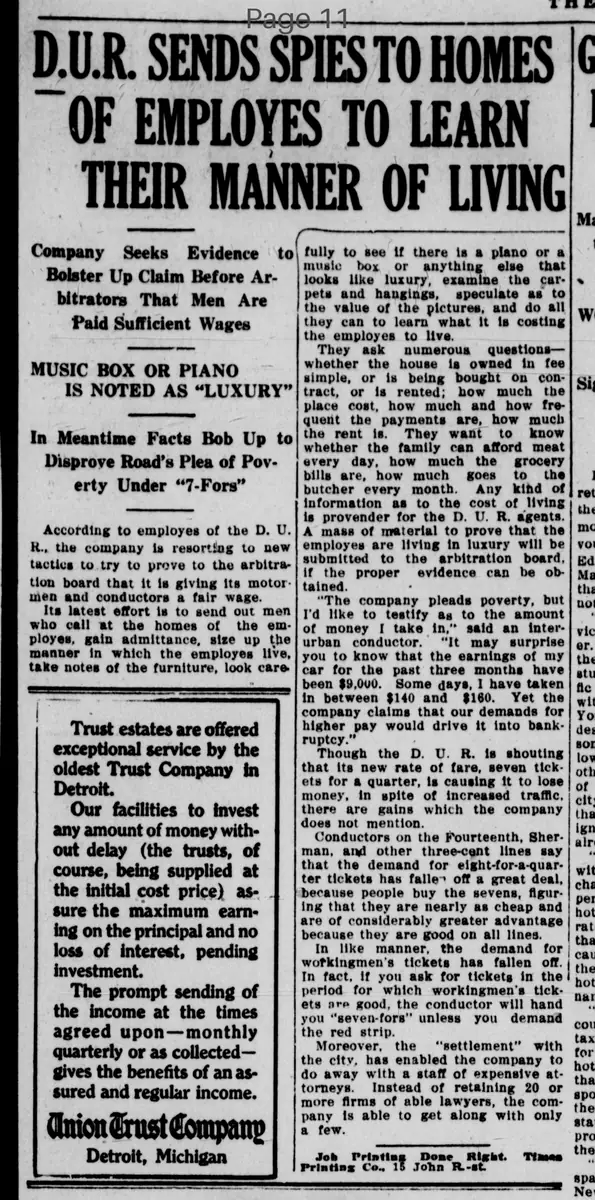
D.U.R. SENDS SPIES TO HOMES OF EMPLOYES TO LEARN THEIR MANNER OF LIVING
Company Seeks Evidence to Bolster Up Claim Before Arbitrators That Men Are Paid Sufficient Wages
MUSIC BOX OR PIANO IS NOTED AS "LUXURY"
In Meantime Facts Bob Up to Disprove Road's Plea of Poverty Under "7-Fors"
According to employes of the D. U. R., the company is resorting to new tactics to try to prove to the arbitration board that it is giving its motormen and conductors a fair wage. Its latest effort is to send out men who call at the homes of the employes, gain admittance, size up the manner in which the employes live, take notes of the furniture, look carefully to see if there is a piano or a music box or anything else that looks like luxury, examine the carpets and hangings, speculate as to the value of the pictures, and do all they can to learn what it is costing the employes to live. They ask numerous questions—whether the house is owned in fee simple, or is being bought on contract, or is rented: how much the place cost, how much and how frequent the payments are, how much the rent is. They want to know whether the family can afford meat every day, how much the grocery bills are, how much goes to the butcher every month. Any kind of information as to the cost of living is provender for the D. U. R. agents. A mass of material to prove that the employes are living in luxury will be submitted to the arbitration board, if the proper evidence can be obtained.
"The company pleads poverty, but I'd like to testify as to the amount of money I take in," said an interurban conductor. "It may surprise you to know that the earnings of my car for the past three months have been $9,000. Some days, I have taken in between $140 and $160. Yet the company claims that our demands for higher pay would drive it into bankruptcy."
Though the D. U. R. is shouting that its new rate of fare, seven tickets for a quarter, is causing it to lose money, in spite of increased traffic, there are gains which the company does not mention. Conductors on the Fourteenth, Sherman, and other three-cent lines say that the demand for eight-for-a-quarter tickets has fallen off a great deal, because people buy the sevens, figuring that they are nearly as cheap and are of considerably greater advantage because they are good on all lines. In like manner, the demand for workingmen's tickets has fallen off. In fact, if you ask for tickets in the period for which workingmen's tickets are good, the conductor will hand you "seven-fors" unless you demand the red strip.
Moreover, the "settlement" with the city, has enabled the company to do away with a staff of expensive attorneys. Instead of retaining 20 or more firms of able lawyers, the company is able to get along with only a few.
Job Printing Done Right. Times Printing Co., 15 John R-st
Company Seeks Evidence to Bolster Up Claim Before Arbitrators That Men Are Paid Sufficient Wages
MUSIC BOX OR PIANO IS NOTED AS "LUXURY"
In Meantime Facts Bob Up to Disprove Road's Plea of Poverty Under "7-Fors"
According to employes of the D. U. R., the company is resorting to new tactics to try to prove to the arbitration board that it is giving its motormen and conductors a fair wage. Its latest effort is to send out men who call at the homes of the employes, gain admittance, size up the manner in which the employes live, take notes of the furniture, look carefully to see if there is a piano or a music box or anything else that looks like luxury, examine the carpets and hangings, speculate as to the value of the pictures, and do all they can to learn what it is costing the employes to live. They ask numerous questions—whether the house is owned in fee simple, or is being bought on contract, or is rented: how much the place cost, how much and how frequent the payments are, how much the rent is. They want to know whether the family can afford meat every day, how much the grocery bills are, how much goes to the butcher every month. Any kind of information as to the cost of living is provender for the D. U. R. agents. A mass of material to prove that the employes are living in luxury will be submitted to the arbitration board, if the proper evidence can be obtained.
"The company pleads poverty, but I'd like to testify as to the amount of money I take in," said an interurban conductor. "It may surprise you to know that the earnings of my car for the past three months have been $9,000. Some days, I have taken in between $140 and $160. Yet the company claims that our demands for higher pay would drive it into bankruptcy."
Though the D. U. R. is shouting that its new rate of fare, seven tickets for a quarter, is causing it to lose money, in spite of increased traffic, there are gains which the company does not mention. Conductors on the Fourteenth, Sherman, and other three-cent lines say that the demand for eight-for-a-quarter tickets has fallen off a great deal, because people buy the sevens, figuring that they are nearly as cheap and are of considerably greater advantage because they are good on all lines. In like manner, the demand for workingmen's tickets has fallen off. In fact, if you ask for tickets in the period for which workingmen's tickets are good, the conductor will hand you "seven-fors" unless you demand the red strip.
Moreover, the "settlement" with the city, has enabled the company to do away with a staff of expensive attorneys. Instead of retaining 20 or more firms of able lawyers, the company is able to get along with only a few.
Job Printing Done Right. Times Printing Co., 15 John R-st
What sub-type of article is it?
Deception Fraud
Historical Event
What themes does it cover?
Deception
Justice
Misfortune
What keywords are associated?
Wage Dispute
Company Spies
Arbitration Board
Living Standards
Fare Rates
Employee Earnings
What entities or persons were involved?
D.U.R.
Motormen
Conductors
Interurban Conductor
Story Details
Key Persons
D.U.R.
Motormen
Conductors
Interurban Conductor
Story Details
The D.U.R. sends agents to employees' homes to assess living standards and gather evidence for arbitration claiming sufficient wages, noting luxuries like pianos. An employee counters with high earnings data. Company benefits from fare changes and reduced legal costs despite poverty claims.