Thank you for visiting SNEWPapers!
Sign up free
Editorial
November 29, 1885
Workmen's Advocate
New Haven, New Haven County, Connecticut
What is this article about?
This editorial endorses the walking delegate system used by New York building trades unions to supervise members, exclude non-union workers, and enforce dues, citing a plumber boss example, and urges its adoption elsewhere for union strength.
Clipping
OCR Quality
90%
Excellent
Full Text
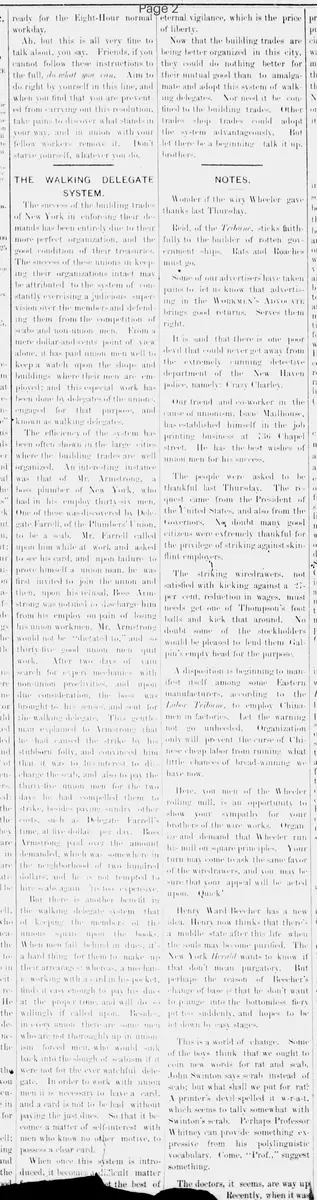
THE WALKING DELEGATE SYSTEM.
The success of the building trades of New York in enforcing their demands has been entirely due to their more perfect organization, and the good condition of their treasuries.
The success of these unions in keeping their organizations intact may be attributed to the system of constantly exercising a judicious supervision over the members and defending them from the competition of scabs and non-union men. From a more dollar-and-cents point of view alone, it has paid union men well to keep a watch upon the shops and buildings where their men are employed: and this especial work has been done by delegates of the unions, engaged for that purpose, and known as walking delegates.
The efficiency of the system has been often shown in the large cities where the building trades are well organized. An interesting instance was that of Mr. Armstrong, a boss plumber of New York, who had in his employ thirty-six men.
One of these was discovered by Delegate Farrell, of the Plumbers' Union, to be a scab. Mr. Farrell called upon him while at work and asked to see his card, and upon failure to prove himself a union man, he was first invited to join the union and then, upon his refusal, Boss Armstrong was notified to discharge him from his employ on pain of losing his union workmen. Mr. Armstrong would not be "dictated to," and so thirty-five good union men quit work. After two days of vain search for expert mechanics with non-union proclivities, and upon due consideration, the boss was brought to his senses, and sent for the walking delegate. This gentleman explained to Armstrong that he had caused the strike by his stubborn folly, convinced him that it was to his interest to discharge the scab, and also to pay the thirty-five union men for the two days he had compelled them to strike, besides paying sundry other costs, such as Delegate Farrell's time, at five dollars per day. Boss Armstrong paid over the amount demanded, which was somewhere in the neighborhood of two hundred dollars; and he is not tempted to hire scabs again as it is too expensive.
But there is another benefit in the walking delegate system that of keeping the members of the unions up to the mark.
When men fall behind in dues, it's a hard thing for them to make up their arrears: whereas, a mechanic working with a card in his pocket, finds it easy enough to pay his dues at the proper time, and will do so willingly if called upon. Besides, in every union there are some men who are not thoroughly unionists at heart, forced men, who would sink back into the slough of scabism if it were not for the ever watchful delegate. In order to work with union men it is necessary to have a card, and a card is not to be had without paying the just dues. So that it becomes a matter of self-interest with men who know no other motive, to possess a clear card.
When once this system is introduced, it becomes a difficult matter for the best of
eternal vigilance, which is the price of liberty.
Now that the building trades are being better organized in this city, they could do nothing better for their mutual good than to amalgamate and adopt this system of walking delegates. Nor need it be confined to the building trades. Other trades shop trades could adopt the system advantageously. But let there be a beginning talk it up, brothers.
The success of the building trades of New York in enforcing their demands has been entirely due to their more perfect organization, and the good condition of their treasuries.
The success of these unions in keeping their organizations intact may be attributed to the system of constantly exercising a judicious supervision over the members and defending them from the competition of scabs and non-union men. From a more dollar-and-cents point of view alone, it has paid union men well to keep a watch upon the shops and buildings where their men are employed: and this especial work has been done by delegates of the unions, engaged for that purpose, and known as walking delegates.
The efficiency of the system has been often shown in the large cities where the building trades are well organized. An interesting instance was that of Mr. Armstrong, a boss plumber of New York, who had in his employ thirty-six men.
One of these was discovered by Delegate Farrell, of the Plumbers' Union, to be a scab. Mr. Farrell called upon him while at work and asked to see his card, and upon failure to prove himself a union man, he was first invited to join the union and then, upon his refusal, Boss Armstrong was notified to discharge him from his employ on pain of losing his union workmen. Mr. Armstrong would not be "dictated to," and so thirty-five good union men quit work. After two days of vain search for expert mechanics with non-union proclivities, and upon due consideration, the boss was brought to his senses, and sent for the walking delegate. This gentleman explained to Armstrong that he had caused the strike by his stubborn folly, convinced him that it was to his interest to discharge the scab, and also to pay the thirty-five union men for the two days he had compelled them to strike, besides paying sundry other costs, such as Delegate Farrell's time, at five dollars per day. Boss Armstrong paid over the amount demanded, which was somewhere in the neighborhood of two hundred dollars; and he is not tempted to hire scabs again as it is too expensive.
But there is another benefit in the walking delegate system that of keeping the members of the unions up to the mark.
When men fall behind in dues, it's a hard thing for them to make up their arrears: whereas, a mechanic working with a card in his pocket, finds it easy enough to pay his dues at the proper time, and will do so willingly if called upon. Besides, in every union there are some men who are not thoroughly unionists at heart, forced men, who would sink back into the slough of scabism if it were not for the ever watchful delegate. In order to work with union men it is necessary to have a card, and a card is not to be had without paying the just dues. So that it becomes a matter of self-interest with men who know no other motive, to possess a clear card.
When once this system is introduced, it becomes a difficult matter for the best of
eternal vigilance, which is the price of liberty.
Now that the building trades are being better organized in this city, they could do nothing better for their mutual good than to amalgamate and adopt this system of walking delegates. Nor need it be confined to the building trades. Other trades shop trades could adopt the system advantageously. But let there be a beginning talk it up, brothers.
What sub-type of article is it?
Labor
What keywords are associated?
Walking Delegates
Labor Unions
Building Trades
Scabs
Union Organization
Dues Payment
Strike Enforcement
What entities or persons were involved?
Mr. Armstrong
Delegate Farrell
Plumbers' Union
Building Trades Unions
Editorial Details
Primary Topic
Advocacy For The Walking Delegate System In Labor Unions
Stance / Tone
Supportive And Exhortatory
Key Figures
Mr. Armstrong
Delegate Farrell
Plumbers' Union
Building Trades Unions
Key Arguments
Success Of Building Trades Unions Due To Organization And Supervision By Walking Delegates
Walking Delegates Prevent Employment Of Scabs And Non Union Men
Example Of Armstrong Discharging A Scab After Union Men Strike
System Ensures Members Pay Dues And Maintain Union Loyalty
Encourages Amalgamation And Adoption Of The System In Other Cities And Trades