Thank you for visiting SNEWPapers!
Sign up free
The Rhode Islander
Newport, Newport County, Rhode Island
What is this article about?
Mrs. Child describes the Delevan Temperance Institute near Jersey City, founded by Mr. G.M. Danforth in a converted military storehouse to aid poor inebriates from Five Points in reforming through sober labor. She shares emotional stories of residents, calls for benevolent support, and advocates broader social reconstruction inspired by association principles.
Clipping
OCR Quality
Full Text
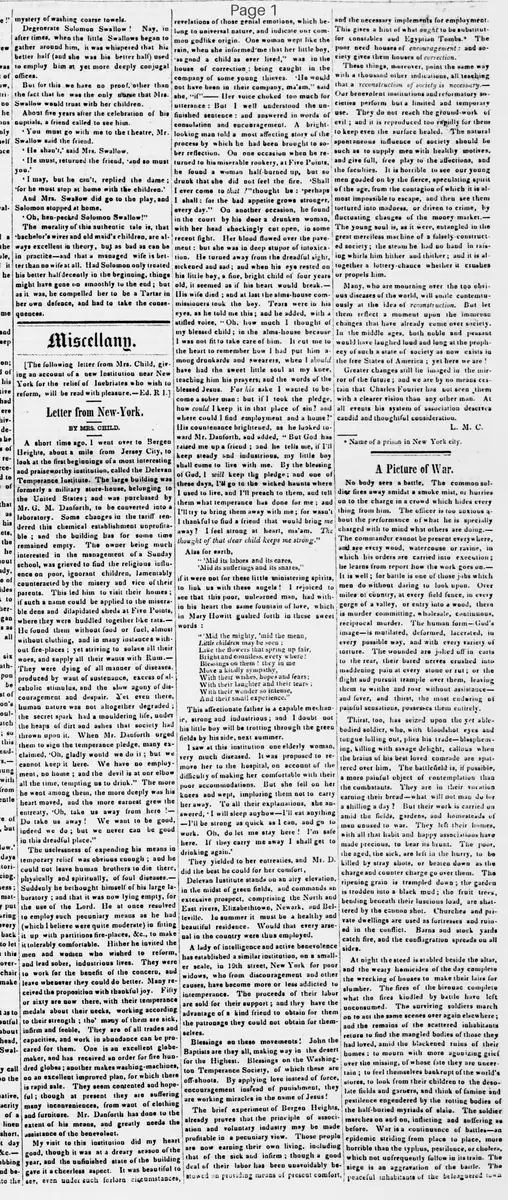
[The following letter from Mrs. Child, giving an account of a new Institution near New York for the relief of Inebriates who wish to reform, will be read with pleasure.—Ed. R. I.]
Letter from New-York.
BY MRS. CHILD.
A short time ago, I went over to Bergen Heights, about a mile from Jersey City, to look at the first beginnings of a most interesting and praiseworthy institution, called the Delevan Temperance Institute. The large building was formerly a military store-house, belonging to the United States; and was purchased by Mr. G. M. Danforth, to be converted into a laboratory. Some changes in the tariff rendered this chemical establishment unprofitable; and the building has for some time remained empty.
The owner being much interested in the management of a Sunday school, was grieved to find the religious influence on poor, ignorant children, lamentably counteracted by the misery and vice of their parents. This led him to visit their homes; if such a name could be applied to the miserable dens and dilapidated sheds at Five Points, where they were huddled together like rats. He found them without food or fuel, almost without clothing, and in many instances without fire-places; yet striving to solace all their woes, and supply all their wants with Rum. They were dying of all manner of diseases, produced by want of sustenance, excess of alcoholic stimulus, and the slow agony of discouragement and despair. Yet even there, human nature was not altogether degraded; the secret spark had a mouldering life, under the heaps of dirt and ashes that society had thrown upon it. When Mr. Danforth urged them to sign the temperance pledge, many exclaimed, "Oh, gladly would we do it; but we cannot keep it here. We have no employment, no home; and the devil is at our elbow all the time, tempting us to drink." The more he went among them, the more deeply was his heart moved, and the more earnest grew the entreaty, "Oh, take us away from here!—Do take us away! We want to be good, indeed we do: but we never can be good in this dreadful place."
The uselessness of expending his means in temporary relief was obvious enough; and he could not leave human brothers to die there, physically and spiritually, of foul diseases. Suddenly he bethought himself of his large laboratory; and that it was now lying empty, for the use of the Lord. He at once resolved to employ such pecuniary means as he had (which I believe were quite moderate) in fitting it up with partitions, fire-places, &c., to make it tolerably comfortable. Hither he invited the men and women who wished to reform, and lead sober, industrious lives. They were to work for the benefit of the concern, and leave whenever they could do better. Many received the proposition with thankful joy. Fifty or sixty are now there, with their temperance medals about their necks, working according to their strength; though many of them are sick, infirm and feeble. They are of all trades and capacities, and work in abundance can be provided for them. One is an excellent globe-maker, and has received an order for five hundred globes; another makes washing-machines, on an excellent improved plan, for which there is rapid sale. They seem contented and hopeful; though at present they are suffering many inconveniences, from want of clothing and furniture. Mr. Danforth has done to the extent of his means, and greatly needs the assistance of the benevolent.
My visit to this institution did my heart good, though it was at a dreary season of the year, and the unfinished state of the building gave it a cheerless aspect. It was beautiful to see, even under such forlorn circumstances, revelations of those genial emotions, which belong to universal nature, and indicate our common godlike origin. One woman wept like the rain, when she informed me that her little boy, "as good a child as ever lived," was in the house of correction: being caught in the company of some young thieves. "He would not have been in their company, ma'am," said she, if—" Her voice choked too much for utterance: But I well understood the unfinished sentence: and answered in words of consolation and encouragement. A bright-looking man told a most affecting story of the process by which he had been brought to sober reflection. On one occasion when he returned to his miserable rookery, at Five Points, he found a woman half-burned up, but so drunk that she did not feel the fire. "Shall I ever come to that?" thought he: "perhaps I shall: for the bad appetite grows stronger, every day." On another occasion, he found in the court by his door a drunken woman, with her head shockingly cut open, in some recent fight. Her blood flowed over the pavement: but she was in deep stupor of intoxication. He turned away from the dreadful sight, sickened and sad; and when his eye rested on his little boy, a fine, bright child of four years old, it seemed as if his heart would break. His wife died; and at last the alms-house commissioners took the boy. Tears were in his eyes, as he told me this; and he added, with a stifled voice, "Oh, how much I thought of my blessed child; in the alms-house because I was not fit to take care of him. It cut me to the heart to remember how I had put him among drunkards and swearers, when I should have had the sweet little soul at my knee, teaching him his prayers; and the words of the blessed Jesus. For his sake I wanted to become a sober man: but if I took the pledge, how could I keep it in that place of sin? and where could I find employment and a home?' His countenance brightened, as he looked toward Mr. Danforth, and added. "But God has raised me up a friend; and he tells me, if I'll keep steady and industrious, my little boy shall come to live with me. By the blessing of God, I will keep the pledge; and one of these days, I'm go to the wicked haunts where I used to live, and I'll preach to them, and tell them what temperance has done for me; and I'll try to bring them away with me; for wasn't I thankful to find a friend that would bring me away? I feel strong at heart, ma'am. The thought of that dear child keeps me strong."
Alas for earth,
'Mid its labors and its cares,
'Mid its sufferings and its snares,
if it were not for these little ministering spirits, to link us with these angels! I rejoiced to see that this poor, unlearned man, had within his heart the same fountain of love, which in Mary Howitt gushed forth in these sweet words:
"'Mid the mighty, 'mid the mean,
Little children may be seen;
Like the flowers that spring up fair,
Bright and countless, every where!
Blessings on them! they in me
Move a kindly sympathy.
With their wishes, hopes and fears:
With their laughter and their tears;
With their wonder so intense,
And their small experience."
This affectionate father is a capable mechanic, strong and industrious; and I doubt not his little boy will be trotting through the green fields by his side, next summer.
I saw at this institution one elderly woman, very much diseased. It was proposed to remove her to the hospital, on account of the difficulty of making her comfortable with their poor accommodations. But she fell on her knees and wept, imploring them not to carry her away. To all their explanations, she answered, "I'll sleep anyhow—I'll eat anything—I'll be strong as quick as I can, and go to work. Oh, do let me stay here! I'm safe here. If they carry me away I shall get to drinking again."
They yielded to her entreaties, and Mr. D. did the best he could for her comfort.
Delevan Institute stands on an airy elevation, in the midst of green fields, and commands an extensive prospect, comprising the North and East rivers, Elizabethtown, Newark, and Belleville. In summer it must be a healthy and beautiful residence.
Would that every arsenal in the country were thus employed.
A lady of intelligence and active benevolence has established a similar institution, on a smaller scale, in 19th street, New York for poor widows, who from discouragement and other causes, have become more or less addicted to intemperance. The proceeds of their labor are sold for their support; and they have the advantage of a kind friend to obtain for them the patronage they could not obtain for themselves.
Blessings on these movements! John the Baptists are they all, making way in the desert for the Highest. Blessings on the Washington Temperance Society, of which these are off-shoots. By applying love instead of force, encouragement instead of punishment, they are working miracles in the name of Jesus!
The brief experiment of Bergen Heights, already proves that the principle of association and voluntary industry may be made profitable in a pecuniary view. Those people are now earning their own living, including that of the sick and infirm; though a good deal of their labor has been unavoidably bestowed on providing means of present comfort, and the necessary implements for employment.
This gives a hint of what ought to be substituted for constables and Egyptian Tombs.* The poor need houses of encouragement: and society gives them houses of correction.
These things, moreover, point the same way with a thousand other indications, all teaching that a reconstruction of society is necessary. Our benevolent institutions and reformatory societies perform but a limited and temporary use. They do not reach the ground-work of evil; and it is reproduced too rapidly for them to keep even the surface healed. The natural spontaneous influence of society should be such as to supply men within healthy motives, and give full, free play to the affections, and the faculties. It is horrible to see our young men goaded on by the fierce, speculating spirit of the age, from the contagion of which it is almost impossible to escape, and then see them tortured into madness, or driven to crime, by fluctuating changes of the money-market. The young soul is, as it were, entangled in the great merciless machine of a falsely-constructed society; the steam he had no hand in raising whirls him hither and thither; and it is altogether a lottery-chance whether it crushes or propels him.
Many, who are mourning over the too obvious diseases of the world, will smile contemptuously at the idea of reconstruction. But let them reflect a moment upon the immense changes that have already come over society. In the middle ages, both noble and peasant would have laughed loud and long at the prophecy of such a state of society as now exists in the free States of America: yet here we are! Greater changes still lie imaged in the mirror of the future; and we are by no means certain that Charles Fourier has not seen them with a clearer vision than any other man. At all events his system of association deserves candid and thoughtful consideration.
L. M. C.
* Name of a prison in New York city.
What sub-type of article is it?
What themes does it cover?
What keywords are associated?
What entities or persons were involved?
Letter to Editor Details
Author
L. M. C.
Recipient
The Printer
Main Argument
the delevan temperance institute provides a vital refuge for poor inebriates seeking reform through removal from temptation and provision of sober employment, demonstrating the effectiveness of voluntary association; society needs broader reconstruction to address root causes of vice and poverty, as inspired by figures like charles fourier.
Notable Details