Thank you for visiting SNEWPapers!
Sign up free
Literary
October 30, 1906
Twice A Week Plain Dealer
Cresco, Howard County, Iowa
What is this article about?
In a western mining camp, Ann and Raymond confess their love amid turmoil. The arrival of U.S. cavalry ends the reign of terror. Munro, wounded in a shootout, dies seeking Ann's forgiveness. Ann ponders returning east while nursing the sick.
Merged-components note: These three components form the complete installment of the serialized story 'Hesper' by Hamlin Garland, with sequential reading order and adjacent spatial positioning.
Clipping
OCR Quality
92%
Excellent
Full Text
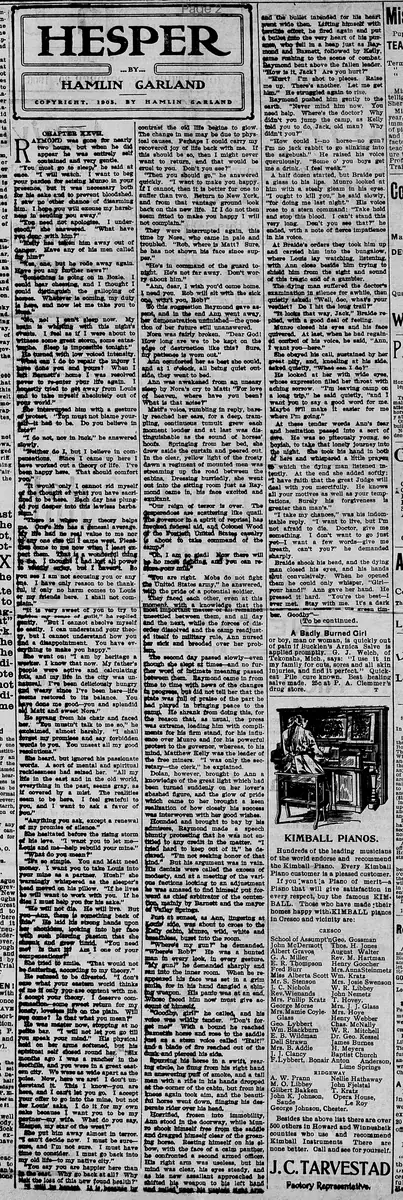
HESPER
BY
HAMLIN GARLAND
COPYRIGHT, 1905. BY
HAMLIN GARLAND
Armond was gone for nearly two hours, but when he did appear he was entirely self contained and very gentle.
"You must go to sleep," he said at once. "I will watch. I want to beg your pardon for seizing Munro in your presence, but it was necessary both for his sake and to prevent bloodshed. I saw no other chance of disarming him. I hope you will excuse my harshness in bending you away?"
"No need to apologize. I understand," she answered.
"What have you done with him?"
"I took him away out of danger. Have any of his men called him?"
"No, but he rode away again before our eyes."
"Is something going on in Boise? I could hear cheering, and I thought I could distinguish the galloping of horses. Whatever is coming, my duty is here, and now let me take you to bed."
"No, no! I can't sleep now. My mind is whirling with this night's events. I feel as if I were about to pass some great storm, some catastrophe. Sleep is impossible tonight."
He turned with low voiced intensity. "Miss, can I do to repair the injury I have done you and yours? When I met Barrett's men I was resolved never to re-enter your life again. I honestly tried to get away from Louis and to take myself absolutely out of your world."
She interrupted him with a gesture of protest. "You must not blame yourself; it had to be. Do you believe in fate?"
"I do not, nor in luck," he answered slowly. "Neither do I, but I believe in compensations. Since I came up here I have worked out a theory of life. I've been happy here. That should comfort you, would it not? Only I cannot rid myself of the thought of what you have sacrificed to be here. Each day has plunged you deeper into this lawless barbarism."
"My theory helps. Life has a general average."
"It had no real value to me nor to any one else till I came west. Pleasant to me now when I least expected them. That wonderful thing love. I thought I knew all about power and place, but Barrett showed me I am not accusing you or any one else. I have only reason to be thankful, if only no harm comes to Louis or my friends here."
"I shall not come again."
"It is very sweet of you to try to ease my sense of guilt," he replied. "But I cannot absolve myself. I can understand your theory, but I cannot understand how you can bear your disappointment. You have everything to make you happy."
She went on: "I am by heritage a worker. I know that now. My father's people were active and calculating folk and my life in the city was unnatural. I've been deliciously hungry and weary since I've been here--life seems restored to its balance. You have done me good--you and splendid Matt and sweet Nora."
He sprang from his chair and faced her. "You mustn't talk to me so," he exclaimed, almost harshly. "I shall forget my promises and say forbidden words to you. You unseat all my good resolutions."
She heard, but ignored his passionate words. A sort of mental and spiritual recklessness had seized her. "All my life in the east and in the old world, everything in the past, seems gray, as if covered by a mist. The realities seem to be here. I feel grateful to you, and I want to ask a favor of you."
"Anything you ask, except a renewal of my promise of silence."
She hesitated before the rising storm of his love. "I want you to let me-- Louis and me help rebuild your mine."
"What do you mean?"
"It is so simple. You and Matt need money. I want you to take Louis into your mine as a partner. Hush!" she hurriedly whispered as the sleeper's head moved on his pillow. "If he lives he will want to work with you. If he dies I must help you for his sake."
"Lou will not die. He will live. But Lou, there is something back of all this."
He laid his strong hands upon her shoulders, looking into her face with such piercing passion that she quivered and grew timid.
"You need have no fear of me. Am I one of your hired toadies?"
"That would not accord with my theory."
He smiled and turned to be diverted. "I don't care what your eastern world thinks of me if only you are content with me. Accept your theory. I deserve compensation--some sweet return for my poverty, loneliness. Life as the plain will come? Is that what you mean?"
He was master now, stopping at no delicate bar. "I will not let you go till I read your mind." His physical hold upon her arms softened, but his spiritual net closed round her.
"Six months ago I was a puncher in the foothills, and you were in a great eastern city. We were as wide apart as the poles. Now, here we are! I don't understand it. This I know--you are here and I can't let you go. I accept your offer to go into the mine, but not as Lou's partner. I do it for my own sake because I want you to be my partner--my wife. What do you say, sweet, my star of the west?"
She put him away almost in terror. "I can't decide now. I must be sure-- sure, and I'm not sure. I must have time to consider. I must go back into my old life--to my native city."
"You say you are happier here than in the east. Why go back at all? Why risk the loss of this new found health?"
In contrast the old life begins to glow. The change in me may be due to physical causes. Perhaps I could carry my recovered joy of life back with me. If this should be so, then I might never want to return, and that would be cruel to you. Don't you see?"
"Then you should go," he answered quickly. "I want to make you happy. If I cannot, then it is better for one to suffer than two. Return to New York and from that vantage ground look back on this new life. If I do not then seem fitted to make you happy I will not complain."
They were interrupted again, this time by Nora, who came in pale and troubled. "Rob, where is Matt? Sure he has not shown his face since supper."
"He's in command of the guard tonight. He's not far away. Don't worry about him."
"Ann, dear, I wish you'd come home. I need you. Rob will sit with the sick one, won't you, Rob?"
At this suggestion Raymond gave assent and in the end Ann went away with demonstration unfinished--the question of her future still unanswered.
Nora was fairly broken. "Dear God! How long are we to be kept on the verge of destruction like this? Sure, my patience is worn out."
Ann comforted her as best she could. and at 1 o'clock, all being quiet outside, they went to bed.
Ann was awakened from an uneasy sleep by Nora's cry to Matt: "For love of heaven, where have you been? What is that noise?"
Matt's voice rumbling in reply, barely reached her ears, for a deep, trampling, continuous tumult grew each moment louder and at last was distinguishable as the sound of horses' hoofs. Springing from her bed, she drew aside the curtain and peered out.
In the clear, yellow light of the frosty dawn a regiment of mounted men was streaming up the road between the cabins. Dressing hurriedly, she went out into the sitting room just as Raymond came in, his face excited and exultant.
"Our reign of terror is over. The desperadoes are scattering like quail. The governor in a spirit of reprisal has invoked federal aid, and Colonel Wood of the Rough Rider United States cavalry is about to take command of the camp."
"Oh, I am so glad! Now they will not come fighting, and you can resume your activities."
"You are right. Mobs do not fight the United States army," he answered, with the pride of a potential soldier.
As they faced each other, even at this moment with a knowledge that the most important matter of all remained unsettled between them, and all day and the next while the forces of disorder dissolved and the camp readjusted itself to military rule, Ann nursed her sick and brooded over her problem.
The second day passed slowly--even though she slept at times and no further word of intimate meaning passed between them. Raymond came in from time to time with news of the changes in progress, but did not tell her that the state was full of praise of the part he had played in bringing peace to the camp. He shrank from doing this, for the reason that as usual, the press was extreme, loading him with compliments for his firm stand, for his influence over Munro and for his powerful protest to the governor, whereas, to his mind, Matthew Kelly was the leader of the free miners. "I was only the secretary--the clerk," he explained.
Dolan, however, brought to Ann a knowledge of the great light which had been turned suddenly on her lover's abashed figure, and the glow of pride which came to her brought a keen realization of how closely his success was interwoven with her good wishes.
Surrounded and brought to bay by his admirers, Raymond made a speech bluntly protesting that he was not entitled to any credit in the matter. "I tried hard to keep out of it," he declared. "I'm not seeking honor of that kind." But his argument was in vain. His denials were called the excess of modesty, and at a meeting of the various factions looking to an adjustment he was amazed to find himself put forward as chief arbitrator of the contention, mainly by Barnett and the mayor of Valley Springs.
Just at sunset as Ann, lingering at her door, was about to cross to the Kelly cabin, Munro, wild, white and ghastly, burst into the room.
"Where's my gun?" he demanded. "Where's Rob?" He was a hunted man in every look, in every gesture.
"My gun," he demanded sharply and ran into the inner room. When he returned his face was set in a grim smile, for in his hand dangled a shining weapon. His panic was at an end. Whoso faced him now must give account of himself.
"Goodby, girl," he called and his voice was wildly tender. "Don't forget me!" with a bound he reached Barnett's horse and rose to the saddle when a stern voice called "Halt!" and a rifle shot reached out of the dusk and pierced his side.
Spurring his horse in a swift rearing circle, he flung from his right hand an answering puff of smoke, and a tall man with a rifle in his hands dropped at the corner of the cabin, but from his knees again took aim, and the beautiful horse went down, flinging his desperate rider over his head.
Horrified, frozen into immobility, Ann stood in the doorway, while Munro shook himself free from the saddle and dragged himself clear of the groaning horse. Resting himself on his elbow, with the face of a calm panther he confronted a second armed officer.
His right arm was useless, but his mind was clear, his eyes steady, and as his new assailant approached he shifted his weapon to his left hand and the bullet intended for his heart went wide then. Lifting himself with terrible effort, he fired again and put bullet into the very heart of his pursuer who fell in a heap just as Raymond and Barnett, followed by Kelly, came rushing to the scene of combat.
Raymond bent above the fallen leader. "How is it, Jack? Are you hurt?"
"Hurt? I'm shot to pieces. Raise me up. There's another. Let me get him." He struggled again to rise.
Raymond pushed him gently to the earth. "Never mind him now. You need help. Where's the doctor? Why didn't you jump the camp, as Kelly told you to do, Jack, old man? Why didn't you?"
"How could I? No horse--no gun? I'm no jack rabbit to go slinking into the sagebrush." He raised his voice querulously. "Some o' you boys get me a drink. I feel weak."
A half dozen started, but Braide put a glass to his lips. Munro looked at him with a steely gleam in his eyes.
"I ought to kill you," he said slowly, "for doing me dirt last night." His voice rose to a stern command: "Take hold and stop this blood. I can't stand this very long. Don't you see that?" he ended, with a note of fierce impatience in his voice.
At Braide's orders they took him up and carried him into the bungalow where Louis lay watching, listening, with Ann close beside him trying to shield him from the sight and sound of this tragic end of a gambler.
The dying man suffered the doctor's examination in silence for awhile, then quietly asked: "Well, Doc, what's your verdict? Do I hit the long trail?"
"It looks that way, Jack," Braide replied, with a good deal of feeling.
Munro closed his eyes and his face quivered. At last, when he had regained control of his voice, he said, "Ann, I want you--here."
She obeyed his call, sustained by her great pity, and, kneeling at his side, asked quietly, "What can I do?"
He looked at her with wide eyes, whose expression filled her throat with aching sorrow. "I'm leaving camp on a long trip," he said quietly, "and I want you to say a good word for me. Maybe it'll make it easier for me where I'm going."
At these tender words Ann's fear and hesitation passed into a sort of divine pity. He was so piteously young, so boyish, to take that lonely journey into the night. She took his hand in both of hers and whispered a little prayer which the dying man listened intently. At the end she added softly: "I have faith that the great Judge will deal with you mercifully. He knows all your motives as well as your temptations. Surely his forgiveness is greater than man's."
"I take my chances," was his indomitable reply. "I want to live, but I'm not afraid to die. Doctor, give me something. I don't want to go just yet. I want a few words--give me breath, can't you?" he demanded sharply.
Braide shook his head, and the dying man closed his eyes, and his hands grew rigid convulsively. When he opened them he could only whisper, "Girl-- your hand!" Ann gave her hand. He pressed it hard. "You're the best--I ever met. Stay with me. It's a dark green timber. Goodby."
(To be continued.)
BY
HAMLIN GARLAND
COPYRIGHT, 1905. BY
HAMLIN GARLAND
Armond was gone for nearly two hours, but when he did appear he was entirely self contained and very gentle.
"You must go to sleep," he said at once. "I will watch. I want to beg your pardon for seizing Munro in your presence, but it was necessary both for his sake and to prevent bloodshed. I saw no other chance of disarming him. I hope you will excuse my harshness in bending you away?"
"No need to apologize. I understand," she answered.
"What have you done with him?"
"I took him away out of danger. Have any of his men called him?"
"No, but he rode away again before our eyes."
"Is something going on in Boise? I could hear cheering, and I thought I could distinguish the galloping of horses. Whatever is coming, my duty is here, and now let me take you to bed."
"No, no! I can't sleep now. My mind is whirling with this night's events. I feel as if I were about to pass some great storm, some catastrophe. Sleep is impossible tonight."
He turned with low voiced intensity. "Miss, can I do to repair the injury I have done you and yours? When I met Barrett's men I was resolved never to re-enter your life again. I honestly tried to get away from Louis and to take myself absolutely out of your world."
She interrupted him with a gesture of protest. "You must not blame yourself; it had to be. Do you believe in fate?"
"I do not, nor in luck," he answered slowly. "Neither do I, but I believe in compensations. Since I came up here I have worked out a theory of life. I've been happy here. That should comfort you, would it not? Only I cannot rid myself of the thought of what you have sacrificed to be here. Each day has plunged you deeper into this lawless barbarism."
"My theory helps. Life has a general average."
"It had no real value to me nor to any one else till I came west. Pleasant to me now when I least expected them. That wonderful thing love. I thought I knew all about power and place, but Barrett showed me I am not accusing you or any one else. I have only reason to be thankful, if only no harm comes to Louis or my friends here."
"I shall not come again."
"It is very sweet of you to try to ease my sense of guilt," he replied. "But I cannot absolve myself. I can understand your theory, but I cannot understand how you can bear your disappointment. You have everything to make you happy."
She went on: "I am by heritage a worker. I know that now. My father's people were active and calculating folk and my life in the city was unnatural. I've been deliciously hungry and weary since I've been here--life seems restored to its balance. You have done me good--you and splendid Matt and sweet Nora."
He sprang from his chair and faced her. "You mustn't talk to me so," he exclaimed, almost harshly. "I shall forget my promises and say forbidden words to you. You unseat all my good resolutions."
She heard, but ignored his passionate words. A sort of mental and spiritual recklessness had seized her. "All my life in the east and in the old world, everything in the past, seems gray, as if covered by a mist. The realities seem to be here. I feel grateful to you, and I want to ask a favor of you."
"Anything you ask, except a renewal of my promise of silence."
She hesitated before the rising storm of his love. "I want you to let me-- Louis and me help rebuild your mine."
"What do you mean?"
"It is so simple. You and Matt need money. I want you to take Louis into your mine as a partner. Hush!" she hurriedly whispered as the sleeper's head moved on his pillow. "If he lives he will want to work with you. If he dies I must help you for his sake."
"Lou will not die. He will live. But Lou, there is something back of all this."
He laid his strong hands upon her shoulders, looking into her face with such piercing passion that she quivered and grew timid.
"You need have no fear of me. Am I one of your hired toadies?"
"That would not accord with my theory."
He smiled and turned to be diverted. "I don't care what your eastern world thinks of me if only you are content with me. Accept your theory. I deserve compensation--some sweet return for my poverty, loneliness. Life as the plain will come? Is that what you mean?"
He was master now, stopping at no delicate bar. "I will not let you go till I read your mind." His physical hold upon her arms softened, but his spiritual net closed round her.
"Six months ago I was a puncher in the foothills, and you were in a great eastern city. We were as wide apart as the poles. Now, here we are! I don't understand it. This I know--you are here and I can't let you go. I accept your offer to go into the mine, but not as Lou's partner. I do it for my own sake because I want you to be my partner--my wife. What do you say, sweet, my star of the west?"
She put him away almost in terror. "I can't decide now. I must be sure-- sure, and I'm not sure. I must have time to consider. I must go back into my old life--to my native city."
"You say you are happier here than in the east. Why go back at all? Why risk the loss of this new found health?"
In contrast the old life begins to glow. The change in me may be due to physical causes. Perhaps I could carry my recovered joy of life back with me. If this should be so, then I might never want to return, and that would be cruel to you. Don't you see?"
"Then you should go," he answered quickly. "I want to make you happy. If I cannot, then it is better for one to suffer than two. Return to New York and from that vantage ground look back on this new life. If I do not then seem fitted to make you happy I will not complain."
They were interrupted again, this time by Nora, who came in pale and troubled. "Rob, where is Matt? Sure he has not shown his face since supper."
"He's in command of the guard tonight. He's not far away. Don't worry about him."
"Ann, dear, I wish you'd come home. I need you. Rob will sit with the sick one, won't you, Rob?"
At this suggestion Raymond gave assent and in the end Ann went away with demonstration unfinished--the question of her future still unanswered.
Nora was fairly broken. "Dear God! How long are we to be kept on the verge of destruction like this? Sure, my patience is worn out."
Ann comforted her as best she could. and at 1 o'clock, all being quiet outside, they went to bed.
Ann was awakened from an uneasy sleep by Nora's cry to Matt: "For love of heaven, where have you been? What is that noise?"
Matt's voice rumbling in reply, barely reached her ears, for a deep, trampling, continuous tumult grew each moment louder and at last was distinguishable as the sound of horses' hoofs. Springing from her bed, she drew aside the curtain and peered out.
In the clear, yellow light of the frosty dawn a regiment of mounted men was streaming up the road between the cabins. Dressing hurriedly, she went out into the sitting room just as Raymond came in, his face excited and exultant.
"Our reign of terror is over. The desperadoes are scattering like quail. The governor in a spirit of reprisal has invoked federal aid, and Colonel Wood of the Rough Rider United States cavalry is about to take command of the camp."
"Oh, I am so glad! Now they will not come fighting, and you can resume your activities."
"You are right. Mobs do not fight the United States army," he answered, with the pride of a potential soldier.
As they faced each other, even at this moment with a knowledge that the most important matter of all remained unsettled between them, and all day and the next while the forces of disorder dissolved and the camp readjusted itself to military rule, Ann nursed her sick and brooded over her problem.
The second day passed slowly--even though she slept at times and no further word of intimate meaning passed between them. Raymond came in from time to time with news of the changes in progress, but did not tell her that the state was full of praise of the part he had played in bringing peace to the camp. He shrank from doing this, for the reason that as usual, the press was extreme, loading him with compliments for his firm stand, for his influence over Munro and for his powerful protest to the governor, whereas, to his mind, Matthew Kelly was the leader of the free miners. "I was only the secretary--the clerk," he explained.
Dolan, however, brought to Ann a knowledge of the great light which had been turned suddenly on her lover's abashed figure, and the glow of pride which came to her brought a keen realization of how closely his success was interwoven with her good wishes.
Surrounded and brought to bay by his admirers, Raymond made a speech bluntly protesting that he was not entitled to any credit in the matter. "I tried hard to keep out of it," he declared. "I'm not seeking honor of that kind." But his argument was in vain. His denials were called the excess of modesty, and at a meeting of the various factions looking to an adjustment he was amazed to find himself put forward as chief arbitrator of the contention, mainly by Barnett and the mayor of Valley Springs.
Just at sunset as Ann, lingering at her door, was about to cross to the Kelly cabin, Munro, wild, white and ghastly, burst into the room.
"Where's my gun?" he demanded. "Where's Rob?" He was a hunted man in every look, in every gesture.
"My gun," he demanded sharply and ran into the inner room. When he returned his face was set in a grim smile, for in his hand dangled a shining weapon. His panic was at an end. Whoso faced him now must give account of himself.
"Goodby, girl," he called and his voice was wildly tender. "Don't forget me!" with a bound he reached Barnett's horse and rose to the saddle when a stern voice called "Halt!" and a rifle shot reached out of the dusk and pierced his side.
Spurring his horse in a swift rearing circle, he flung from his right hand an answering puff of smoke, and a tall man with a rifle in his hands dropped at the corner of the cabin, but from his knees again took aim, and the beautiful horse went down, flinging his desperate rider over his head.
Horrified, frozen into immobility, Ann stood in the doorway, while Munro shook himself free from the saddle and dragged himself clear of the groaning horse. Resting himself on his elbow, with the face of a calm panther he confronted a second armed officer.
His right arm was useless, but his mind was clear, his eyes steady, and as his new assailant approached he shifted his weapon to his left hand and the bullet intended for his heart went wide then. Lifting himself with terrible effort, he fired again and put bullet into the very heart of his pursuer who fell in a heap just as Raymond and Barnett, followed by Kelly, came rushing to the scene of combat.
Raymond bent above the fallen leader. "How is it, Jack? Are you hurt?"
"Hurt? I'm shot to pieces. Raise me up. There's another. Let me get him." He struggled again to rise.
Raymond pushed him gently to the earth. "Never mind him now. You need help. Where's the doctor? Why didn't you jump the camp, as Kelly told you to do, Jack, old man? Why didn't you?"
"How could I? No horse--no gun? I'm no jack rabbit to go slinking into the sagebrush." He raised his voice querulously. "Some o' you boys get me a drink. I feel weak."
A half dozen started, but Braide put a glass to his lips. Munro looked at him with a steely gleam in his eyes.
"I ought to kill you," he said slowly, "for doing me dirt last night." His voice rose to a stern command: "Take hold and stop this blood. I can't stand this very long. Don't you see that?" he ended, with a note of fierce impatience in his voice.
At Braide's orders they took him up and carried him into the bungalow where Louis lay watching, listening, with Ann close beside him trying to shield him from the sight and sound of this tragic end of a gambler.
The dying man suffered the doctor's examination in silence for awhile, then quietly asked: "Well, Doc, what's your verdict? Do I hit the long trail?"
"It looks that way, Jack," Braide replied, with a good deal of feeling.
Munro closed his eyes and his face quivered. At last, when he had regained control of his voice, he said, "Ann, I want you--here."
She obeyed his call, sustained by her great pity, and, kneeling at his side, asked quietly, "What can I do?"
He looked at her with wide eyes, whose expression filled her throat with aching sorrow. "I'm leaving camp on a long trip," he said quietly, "and I want you to say a good word for me. Maybe it'll make it easier for me where I'm going."
At these tender words Ann's fear and hesitation passed into a sort of divine pity. He was so piteously young, so boyish, to take that lonely journey into the night. She took his hand in both of hers and whispered a little prayer which the dying man listened intently. At the end she added softly: "I have faith that the great Judge will deal with you mercifully. He knows all your motives as well as your temptations. Surely his forgiveness is greater than man's."
"I take my chances," was his indomitable reply. "I want to live, but I'm not afraid to die. Doctor, give me something. I don't want to go just yet. I want a few words--give me breath, can't you?" he demanded sharply.
Braide shook his head, and the dying man closed his eyes, and his hands grew rigid convulsively. When he opened them he could only whisper, "Girl-- your hand!" Ann gave her hand. He pressed it hard. "You're the best--I ever met. Stay with me. It's a dark green timber. Goodby."
(To be continued.)
What sub-type of article is it?
Prose Fiction
What themes does it cover?
Love Romance
Political
War Peace
What keywords are associated?
Western Romance
Mining Camp
Lawless Conflict
Federal Intervention
Dying Outlaw
Hamlin Garland
What entities or persons were involved?
Hamlin Garland
Literary Details
Title
Hesper
Author
Hamlin Garland
Key Lines
"I Accept Your Offer To Go Into The Mine, But Not As Lou's Partner. I Do It For My Own Sake Because I Want You To Be My Partner My Wife. What Do You Say, Sweet, My Star Of The West?"
"Our Reign Of Terror Is Over. The Desperadoes Are Scattering Like Quail. The Governor In A Spirit Of Reprisal Has Invoked Federal Aid, And Colonel Wood Of The Rough Rider United States Cavalry Is About To Take Command Of The Camp."
"I'm Leaving Camp On A Long Trip," He Said Quietly, "And I Want You To Say A Good Word For Me. Maybe It'll Make It Easier For Me Where I'm Going."