Thank you for visiting SNEWPapers!
Sign up free
Henderson Daily Dispatch
Henderson, Vance County, North Carolina
What is this article about?
Columnist Charles P. Stewart critiques President Roosevelt's support for an anti-espionage organization proposed by Rep. Martin Dies, arguing that foreign spying threats are overstated, secrets are publicly available, and such a body could lead to abusive secret police, citing past Justice Department scandals.
Merged-components note: Merged continuation of the spy activity editorial from page 1 to page 3; changed label from domestic_news on page 3 part to editorial as it is an opinion piece by Charles P. Stewart.
Clippings
1 of 2
OCR Quality
Full Text
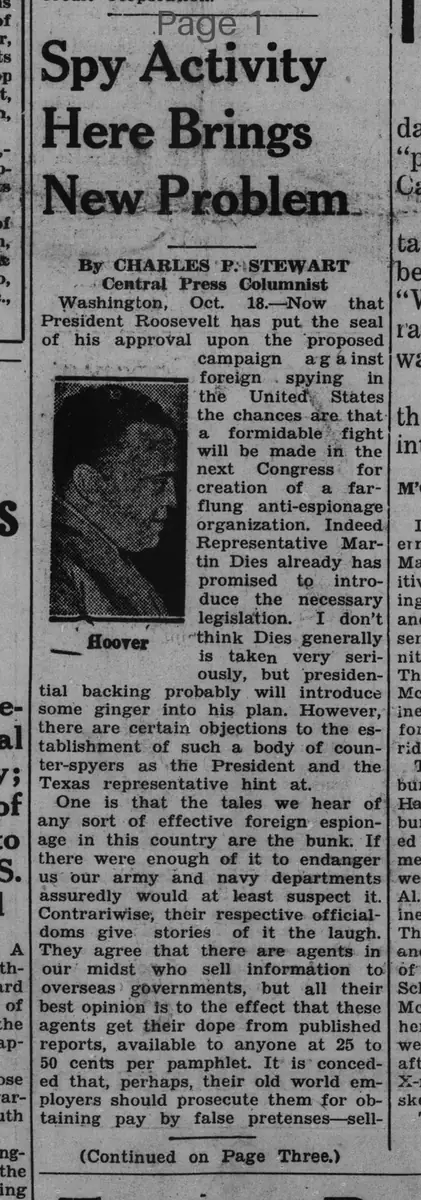
Here Brings
New Problem
By CHARLES P. STEWART
Central Press Columnist
Washington, Oct. 18.-Now that President Roosevelt has put the seal of his approval upon the proposed campaign against foreign spying in the United States the chances are that a formidable fight will be made in the next Congress for creation of a far-flung anti-espionage organization. Indeed Representative Martin Dies already has promised to introduce the necessary legislation. I don't think Dies generally is taken very seriously, but presidential backing probably will introduce some ginger into his plan. However, there are certain objections to the establishment of such a body of counter-spyers as the President and the Texas representative hint at.
One is that the tales we hear of any sort of effective foreign espionage in this country are the bunk. If there were enough of it to endanger us our army and navy departments assuredly would at least suspect it. Contrariwise, their respective officialdoms give stories of it the laugh. They agree that there are agents in our midst who sell information to overseas governments, but all their best opinion is to the effect that these agents get their dope from published reports, available to anyone at 25 to 50 cents per pamphlet. It is conceded that, perhaps, their old world employers should prosecute them for obtaining pay by false pretenses—selling counterfeit "secrets," that is to say. But genuine stuff?—phooey!
(Continued on Page Three.)
Spy Activity Here Brings New Problem
(Continued from Page One.)
Spies' Secret Sources.
There is a rather expensive volume, issued periodically, known as "Jane's Fighting Ships," which describes the world's navies in much detail and pretty reliably. Any spy who gets that book (all well-equipped libraries have it on tap) can frame up a pretty good "secret report."
Some years ago the U. S. Navy perfected a mysterious listening-in "gadget" which, installed, for instance, on the island of Guam, would keep us informed as to Japanese naval movements. Gosh!—but that was a confidential thing! That is, it was confidential until, one day, the congressional Naval Affairs Committee was questioning an old admiral, and the admiral, forgetting that it was a secret, told all about it, and every newspaper in the nation explained it minutely. It was a great occasion for foreign spies.
More recently we were building a new battleship. It was the last word in secrecy. In due course the Navy Department, issuing a report to be broadcast by the government printing office, accidentally included every imaginable blueprint of that ship, which the printing office faithfully reproduced. It's for sale at half a dollar per issue. Again, for international spies, "Score 1."
Aside from the foolishness of the counter-espionage game, the average American doesn't like the idea of an "OGPU" or a "Gestapo" set up here.
There's a sound basis for this objection.
Our army and navy "intelligences" never have interfered in civil life. They may have their military utility.
The treasury's secret service is O. K. at catching counterfeiters and protecting the president. Post office inspectors are all right at defending the sanctity of the mails.
The Justice Department's investigatorial bureau hasn't so clean a record.
Under J. Edgar Hoover it has performed creditably. But in William J. Burns' time, during the period of the oil scandals, it certainly was smeared. It was accused of rifling senators' desks. It was convicted of trying to frame a case against Senator Burton K. Wheeler of Montana. Its chief inquisitor, Gaston Means, still is doing time in prison.
Economy? Efficiency? Maybe.
President Roosevelt suggests that a merger of the secret services could be effected, to the advantage of efficiency, and without increased cost by a combination of State Department, Justice Department, Treasury Department, Army and Navy activities.
He doesn't mention the post office, but that fits in, too.
It's a nice thing that it won't cost any more.
It has other possible disadvantages, however.
What sub-type of article is it?
What keywords are associated?
What entities or persons were involved?
Editorial Details
Primary Topic
Proposed Anti Espionage Organization
Stance / Tone
Skeptical And Critical
Key Figures
Key Arguments