Thank you for visiting SNEWPapers!
Sign up free
Virginia Argus
Richmond, Virginia
What is this article about?
Arthur O'Connor's first-person narrative recounts his persecution by Irish authorities from 1796-1803, including aiding militia during French invasion fears, false arrests, imprisonments, trials, and property destruction, to counter English misconceptions and highlight government tyranny.
Merged-components note: Continuation of Arthur O'Connor's narrative across pages 1 and 2; original label on second component was 'story', changed to 'literary' to match the serialized personal account.
Clippings
1 of 2
OCR Quality
Full Text
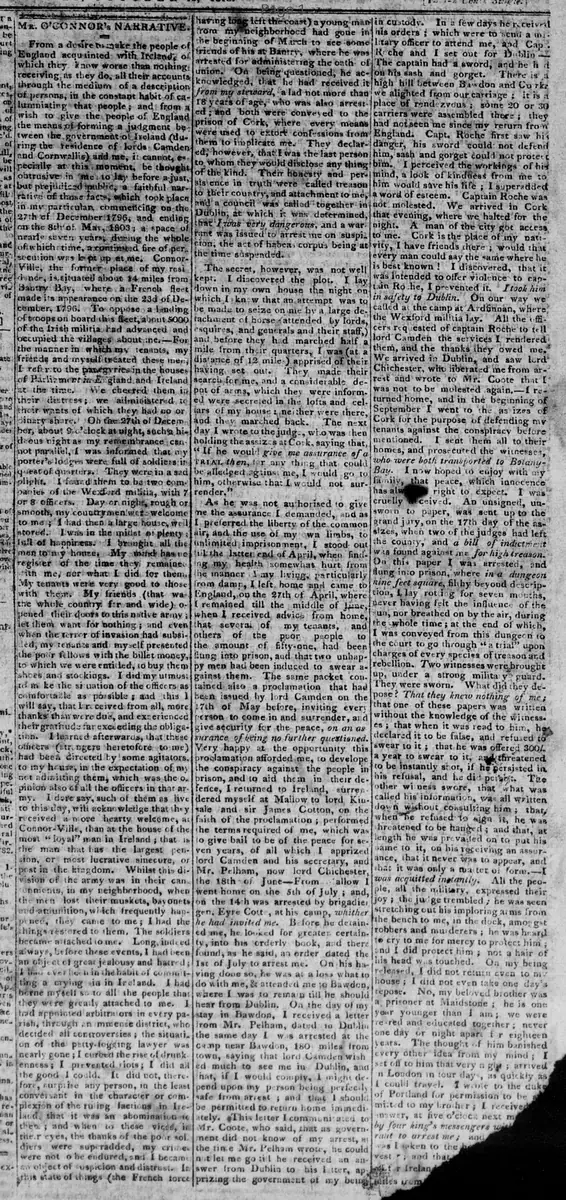
From a desire to make the people of England acquainted with Ireland, of which they know worse than nothing, receiving, as they do, all their accounts through the medium of a description of persons, in the constant habit of calumniating that people; and from a wish to give the people of England the means of forming a judgment between the government of Ireland (during the residence of lords Camden and Cornwallis) and me, it cannot, especially at this moment, be thought obtrusive in me to lay before a just, but prejudiced public, a faithful narrative of those facts, which took place in my particular, commencing on the 27th of December 1796, and ending on the 8th of May, 1803; a space of nearly seven years; during the whole of which time, a continued fire of persecution was kept up at me, O'Connor. Ville, the former place of my residence, is situated about 14 miles from Bantry Bay, where a French fleet made its appearance on the 23d of December, 1796. To oppose a landing of troops on board this fleet, about 8000 of the Irish militia had advanced and occupied the villages about it. For the manner in which my tenants, my friends and myself treated these men I refer to the panegyrics in the houses of Parliament in England and Ireland at the time. We cheered them in their distress; we administered to their wants of which they had no ordinary share. On the 27th of December, about 9 o'clock at night, such a hideous night as my remembrance cannot parallel, was informed that my porter's lodges were full of soldiers in quest of quarters. They were in a sad plight. I found them to be two companies of the Wexford militia, with 7 or 8 officers. Day or night, rough or smooth, my countrymen were welcome to me; I had then a large house, well stored. I was in the midst of plenty; all of happiness. I brought all the men to my house. My mind has no register of the time they remained with me, nor what I did for them. My tenants were very good to those with them. My friends (that was the whole country far and wide) opened their doors to this native army; let them want for nothing; and even when the terror of invasion had subsided, my tenants and myself presented the poor fellows with the billet money, to which we were entitled, to buy them shoes and stockings. I did my utmost to make the situation of the officers as comfortable as possible; and this I will say, that I received from all, more thanks than were due, and experienced their gratitude exceeding the obligation. I learned afterwards, that these officers (strangers heretofore to me) had been directed by some agitators, to my house, in the expectation of my not admitting them, which was the opinion also of all the officers in that army. I dare say, such of them as live to this day, will acknowledge that they received a more hearty welcome, at O'Connor-Ville, than at the house of the most "loyal" man in Ireland; that is the man that has the largest pension, or most lucrative sinecure, or post in the kingdom. Whilst this division of the army was in their quarters, in my neighborhood, when the men lost their muskets, bayonets and ammunition, which frequently happened, they came to me; I had the things restored to them. The soldiers became attached to me. Long, indeed always, before these events, I had been an object of great jealousy and hatred; I travelled over the whole in the habit of committing a crying sin in Ireland. I had borne myself so to all the people that they were greatly attached to me. I had appointed arbitrators in every parish, through an immense district, who decided all controversies; the situation of the petty-fogging lawyer was nearly gone; I curbed the rise of drunkenness; I prevented riots; I did all the good I could. It did not, therefore, surprise any person, in the least conversant in the character or complexion of the ruling factions in Ireland, that it was an abomination to them; and when to these vices, in their eyes, the thanks of the poor soldiers were superadded, my crimes were not to be endured, and I became a object of suspicion and distrust. In this state of things (the French force having long left the coast) a young man from my neighborhood had gone in the beginning of March to see some friends of his at Bantry, where he was arrested for administering the oath of union. On being questioned, he acknowledged, that he had received it from my steward, a lad not more than 18 years of age, who was also arrested: and both were conveyed to the prison of Cork, Where every means were used to extort confessions from them to implicate me. They declared, however, that I was the last person to whom they would disclose any thing of the Kind. Their honesty and perseverance in truth were called treason to their country, and attachment to me, and a council was called together in Dublin, at which it was determined, that I was very dangerous, and a warrant was issued to arrest me on suspicion. the act of habeas corpus being at the time suspended. The secret, however, was not well kept. I discovered the plot. I lay down in my own house the night on which I knew that an attempt was to be made to seize on me by a large detachment of horse (attended by lords, esquires, and generals and their staff,) and before they had marched half a mile from their quarters, I was (at a distance of 12 miles) apprised of their having set out. They made their search for me, and a considerable depot of arms, which they were informed were secreted in the lofts and cellars of my house: neither were there, and they marched back. The next day I wrote to the judge, who was then holding the assizes at Cork, saying that, if he would give me assurance of a TRIAL then, for any thing that could be alledged against me, I would go to him, otherwise that I would not surrender. As he was not authorised to give me the assurance I demanded, and as I preferred the liberty of the common air; and the use of my own limbs, to unlimited imprisonment, I stood out till the latter end of April, when my health being somewhat hurt from the manner of my living, particularly from damp, I left home and came to England, on the 27th of April, where ( remained till the middle of June, when I received advice from home, that several of my tenants, and others of the poor people to the amount of fifty-one, had been flung into prison, and that two unhappy men had been induced to swear against them. The same packet contained also a proclamation that had been issued by lord Camden on the 17th of May before, inviting every person to come in and surrender, and give security for the peace, on an assurance of being no further questioned. Very happy at the opportunity this proclamation afforded me, to develope the conspiracy against the people in prison, and to aid them in their defence, I returned to Ireland, surrendered myself at Mallow to lord Kinsale and sir James Cotton, on the faith of the proclamation; performed the terms required of me, which was to give bail to be of the peace for seven years, of all which I apprised lord Camden and his secretary, and Mr. Pelham, now lord Chichester, the 18th of June--From Mallow I went home on the 5th of July; and, on the 14th was arrested by brigadier gen. Eyre Coote, at his camp, whither he had invited me. Before he detained me, he looked for greater certainty, into his orderly book, and there found, as he said, an order dated the 1st of July to arrest me. On his having done so, he was at a loss what to do with me, & attended me to Bawdon, where I was to remain till he should hear from Dublin. On the day of my stay in Bawdon, I received a letter from Mr. Pelham, dated in Dublin the same day I was arrested at the camp near Bawdon, 180 miles from town, saying that lord Camden wished much to see me in Dublin, and that, if I would comply, I might depend upon my person being perfectly safe from arrest; and that I should be permitted to return home immediately. This letter I communicated to Mr. Coote, who said, that as government did not know of my arrest, at the time Mr. Pelham wrote, he could not let me go til he received an answer from Dublin to his letter, aprizing the government of my being in custody. In a few days he received his orders: which were to send a military officer to attend me, and Capt. Roche and I set out for Dublin. The captain had a sword, and he had on his sash and gorget. There is a high hill between Bawdon and Corke we alighted from our carriage: it is a place of rendezvous; some 20 or 30 carriers were assembled there; they had not seen me since my return from England. Capt. Roche first saw his danger, his sword could not defend him, sash and gorget could not protect him. I perceived the workings of his mind, a look of kindness from me to him would save his life: I superadded a word of esteem. Captain Roche was not molested. We arrived in Cork that evening, where we halted for the night. A man of the city got access to me. Cork is the place of my nativity, I have friends there; would that every man could say the same where he is best known! I discovered, that it was intended to offer violence to captain Roche, I prevented it. I took him in safety to Dublin. On our way we called at the camp at Ardfinnan, where the Wexford militia lay. All the officers requested of captain Roche to tell lord Camden the services I rendered them, and the thanks they owed me. We arrived in Dublin, and saw lord Chichester, who liberated me from arrest and wrote to Mr. Coote that I was not to be molested again. I returned home, and in the beginning of September I went to the assizes of Cork for the purpose of defending my tenants against the conspiracy before mentioned. I sent them all to their homes, and prosecuted the witnesses, who were both transported to Botany Bay. I now hoped to enjoy with my family, that peace, which innocence has always a right to expect. I was cruelly deceived. An unsigned, unsworn to paper, was sent up to the grand jury, on the 17th day of the assizes, when two of the judges had left the county, and a bill of indictment was found against me for high treason. On this paper I was arrested, and flung into prison, where in a dungeon nine feet square, filthy beyond description, I lay rotting for seven months, never having felt the influence of the sun, nor breathed on by the air, during the whole time; at the end of which. I was conveyed from this dungeon to the court to go through "a trial" upon charges of every species of treason and rebellion. Two witnesses were brought up, under a strong military guard. They were sworn. What did they depose? That they knew nothing of me; that one of these papers was written without the knowledge of the witness; that when it was read to him, he declared it to be false, and refused to swear to it; that he was offered 30l. a year to swear to it, and threatened to be instantly shot, if he persisted in his refusal, and he did persist. The other witness swore, that what was called his information, was all written down without consulting him; that, when he refused to sign it, he was threatened to be hanged; and that, at length he was prevailed on to put his name to it, on his receiving an assurance, that it never was to appear, and that it was only a matter of form.--I was acquitted instantly. All the people, all the military, expressed their joy; the judge trembled; he was seen stretching out his imploring arms from the bench to me, in the dock, amongst robbers and murderers; he was heard to cry to me for mercy to protect him; and I did protect him; not a hair of his head was touched. On my being released, I did not return even to my house; I did not even take one day's repose. No, my beloved brother was a prisoner at Maidstone; he is one year younger than I am; we were bred and educated together; never one day or night apart for eighteen years. The thought of him banished every other idea from my mind; I set off to him that very night; arrived in London in four days, as quickly as I could travel. I wrote to the duke of Portland for permission to be admitted to my brother; I received no answer, at five o'clock next morning by four king's messengers with warrant to arrest me; and was taken to the Tower; and that
Mr. Sylvester and the Bondstreet constable, my companion, from a watery grave, and conducted them safe to Dublin, where we arrived at three o'clock in the morning. I now, for the first time since I left London, lay down, and had not been in my bed more than three hours, when Mr. Sylvester awakened me, to tell me, that another king's messenger had, that moment, arrived from the Duke of Portland to take me back instantly to London. This was about seven o'clock in the morning: about twelve, Mr. Sylvester informed me, that Mr. Cooke desired to see me at the castle. Mark the instability of fortune. Behold O'Connor, brought by a constable to have the liberty of being admitted to the presence of Mr. Edward Cooke! I did see him; the interview was not of long duration; the conversation was not made of many words; but it is important. I asked him the meaning of these proceedings; what post haste treason I had committed in the few days that I travelled from Cork to London, about 400 miles. Hear his answer. "We do not pretend to have any charge against you; but we know your power & suspect your inclination; had my advice been taken, you should not have been brought to trial in Cork. My opinion was, that you should have been kept in confinement under the suspension of the habeas corpus act, and it now appears I was right." Well, that afternoon, about two o'clock, I was obliged to set off back again towards London, where we arrived on the fourth morning, having been forced to perform journeys of nearly 1200 miles, and cross the Irish sea three times, in 13 days and nights, during the whole of which time I never permitted to take off my clothes, nor to lay down for more than seven hours. I was kept in custody at the house of Mr. Sylvester till my brother's acquittal at Maidstone, when we were both taken to Dublin, where we were lodged in the same prison room, on the second day of June, 1798. In July a special commission was opened in Dublin, for the trial of all those against whom any charges had been exhibited, amongst whom neither my brother nor I were. There had been no creed. Mr. Byrne a relation of the Marchioness of Buckingham, was condemned, and was to be executed on the 24th of July. On Sunday, the 22d, some negotiation was set on foot, in a way never yet ascertained, between the government and some of the state prisoners in Dublin, of which it appears that neither my brother nor I had any intimation till Tuesday, when Mr. Dobbs the sheriff of Dublin entered our apartment, and shewed us a paper, purporting to be an acquiescence, on the part of seventy-three of the prisoners, to give information of any arms, ammunition and plans of warfare; and to emigrate, on condition of a general amnesty, and of pardon for Mr. Byrne, who was to die that day, and for Mr. Oliver Bond, who was, at that moment, on his trial, if he should be condemned. My brother and I declined entering into any agreement. Mr. Byrne was ordered for instant execution, which instantly took place; Mr. Bond was to die on Friday. We heard no more of the paper till Thursday evening late; when the same Mr. Dobbs, accompanied by Mr. Samuel Nelson, one of the prisoners having another of the prisoners, came to that where my brother and I lay. "All the prisoners were called together; Mr. Dobbs produced a letter he had just received from Mr. Cooke, stating, 'that if my brother & I would enter in a treaty with the government, by which we should engage to give every information in our power of all matters relating to the rebellion, and particularly our relations with foreign states, there should be a general amnesty - Mr. Bond should be pardoned, and we should be permitted to emigrate to any country not at war with England: but that, if we persisted in our refusal, military commissions should be issued in the north for the trial of the prisoners there, the courts should proceed in Dublin, and the yeomanry should remain on active duty!' We both refused. We said, if there are any charges against us, proceed upon them. Why proceed against others because we will not enter into any negotiations? We went to our own room, whither Mr. Dobbs presently came. He represented to us the dreadful scene of slaughter and devastation that would follow upon our declaration. It was that my brother was influenced by considerations, and to save the people, he consented but I heard such with a very dif- ficult. As I set. never: would enter into any agreement with the castle of Dublin during my life. Nothing now was left unattempted to induce me, by every promise, or to intimidate me by the most alarming threats, to sign this agreement. All were unavailing. At length Mr. Marsden came, as if secretly and as a friend, to let me know what, by chance, he had heard at the castle. Thus it was determined to seize my estate if I did not comply. My answer was, that I was prepared against every thing; that I was resolved never to comply. In consequence of which, orders were dispatched to the officers commanding at Bawdon, to send detachments of horse and foot to take possession of my house, which they did to the amount of between 2 and 300 men; they expelled four of my infant children and my servants; the officers broke open my cellars, drank all my wine; they ordered the men to kill my sheep and oxen, on which the whole party subsisted; they converted my iron gates into shoes for their horses; they made firing of windows, doors, & frames of the House and offices; burned all my farming utensils; destroyed all my gardens, and the wall trees, the hot house, green house, and all the plants; turned all their horses out into young plantations which were all ruined; stole every thing moveable; and committed every species of devastation for eight or nine weeks that they remained there; for which I never received one penny as remuneration, from that day to this. After this visitation, it was again demanded of me to sign the paper. My answer was always the same. Still was I kept a prisoner; and when those who had entered into the agreement were sent to Scotland, I was forced by justice Atkinson and a company of Buckinghamshire militia, at the very point of the bayonet, into a coach, conveyed on board a tender, and conducted to Fort George, in which military garrison I was kept for a year and ten months, where by the lenient treatment I received, I lost the use of my limbs, and was reduced to the very verge of life; at the end of which time I was brought to London, and let go on the 24th January, 1801, upon a dreadful recognizance to some immense amount, not to return to Ireland, and to reside in such part of England as the king of England should, from time to time appoint (and Middlesex was named) during the then war. I took a house at Southgate in Middlesex, where I resided for half a year; but having no land there, I looked out for a place with land, to occupy my time. I found one to suit me at Elstree. As I was a stranger and as the rent amounted to 500l a year, I applied to my old friend sir Francis Burdett, who immediately became my security, there I lived for one year, when, the treaty of Amiens taking place, I was desirous of returning to my own country, and applied to sir Richard Ford, the magistrate, before whom I acknowledged the recognizance to get it up. In vain. After many fruitless efforts, he, at length informed me, that it was determined never to give it up, as long as I retained the power of living in the south of Ireland. I judged it better to part with Connor-Ville than be shut out from my country. I got a licence to go to Ireland, & on the 1st of May, 1803, I let a lease forever of the place of my earliest days. Whereupon, I got up my recognizance immediately, I purchased, for forty thousand pounds, from lord Wellesley, the castle and estate of Duncan's, within a few miles of Dublin, where I have resided with my family ever since, coming over occasionally to visit Sir Francis Burdett and a few other friends in England, where, though I have estates; I have never been known, directly or indirectly, to interfere in any concerns of the country. I never attended a public meeting or a public dinner; though I have many friends. I seldom associate with any one but sir Francis Burdett and his family. My fortune is ample; & neither I nor any one of my family ever eat one morsel that was not produced from our own estates. We never received any of the people's money, in the shape of pensions and places, nor was any man's meal or comforts ever diminished by one of us. Surely, then, I must be a most disloyal traitor! In fine, many, very many, of the people of Ireland love me; the militia was attached to me. I surrendered on the solemn faith of a proclamation, which faith, towards me, was broken; I protected Cape Roche; I defended the judge; I saved Mr Sylvester and the Bow street constable. There is no kind of place that has not been my prison; my own house, camps, guard houses, taverns and hotels; castles, wherries, packet boats, messenger's houses, court houses, bridewells, state prisons (as they are called) tenders, garrisons, palaces; and, as a prisoner, have I been travelled about from my own Fortescue in the south to Carrickfergus in the north of Ireland: from the western extremity of Wales, to Maidstone, nearly the eastern extremity of England: from Dublin to fort George in Scotland; within forty miles of John O'Groat's house. to London. In mail coaches, hackney coaches, post carriages, and carts: on foot and on horseback. And all because (for I know of no other cause) that, ten years before the French revolution, I saw the absolute necessity of a reform in the commons in Ireland, which was acknowledged afterwards by the factions of England and Ireland; and because I would not consent to a legislative union, which I regarded as equally ruinous to both parts of the kingdom. On the whole, then, let the people of England, now that they are in possession of their sober senses, decide between my accusers and me; whether the laws were infringed by me who have gone through every ordeal, who have always courted investigation and enquiry; who for years never ceased to demand trial; or by them, who sought the protection of a bill of indemnity, passed by an assembly of which they themselves made a part. Such, reader, is the political history, such are the crimes of Mr. O'Connor: such is the person, to have had whom in his house, at the time when the army stormed it, was, if the public had been still fools enough, to be set down to the account of sir Francis, and as proof presumptive, at least, that he had wicked designs against the peace and safety of the country! Reader, if you be an Englishman, and have neither job, nor contract, nor place, nor unmerited pension, nor defalcation in your accounts with the public; in short, if you profit from no species of public robbery, say, how should you like to be treated as Mr. O'Connor was? How should you like this sort of treatment? How should you like to have your house, your gardens, your fields, your plantations laid waste and destroyed, as his were? How should you like to be hurried from prison to prison: to be thrown into dungeon after dungeon: and when you demanded trial, refused that trial? But, surely, I need not ask these questions. Well, then, is there to be no feeling for him because he is an Irishman? Are we ready to avow this to the Irish people? I trust not; I trust that we shall prove to that unfortunate people, that we feel for them as for ourselves; that we are as ready to resent their wrongs as we are our own; that, in a word, we regard them as our countrymen; and that we are resolved to consider their enemies as our enemies. This is the way to produce an union with Ireland; a real union of the hearts of the people of the whole kingdom: and this sort of union it is that the borough mongers and their hirelings would wish to prevent. Hitherto, indeed, they have prevented it. They have never missed an opportunity of misrepresenting the people of Ireland. They have caused the people of England to believe, that those of Ireland were bent upon a surrender of their country to France, and that all their demands relating to political and civil liberty, were mere pretences. What evils have not sprung from this accursed source! I beseech the reader to consider, that it is not in nature, that the people of Ireland should not hate us, if we persist in our credence to these calumnies. It is, on all hands agreed, that Ireland is our vulnerable part. Does it not, then become us to strengthen that part; to use all means in our power of regaining the good will of the Irish people, and to induce them to make common cause with us against the common enemy? And, what can be more opposite to this than reviving the memory of those cruel times, to which Mr. O's narrative refers; than tearing the skin from the hardly healed and hardly hidden wound? What he has said, he has been compelled to say. He has been calumniated in the most foul and infamous manner. To remain silent might have been construed into a consciousness of guilt. His calumniators, therefore, are answerable for the revival of the memory of that, which he was willing should be forgotten, and which nothing but borough-mongering malignity could have induced any one to attempt to revive.
WM. COBBETT.
Botley, May 9, 1810.
What sub-type of article is it?
What themes does it cover?
What keywords are associated?
What entities or persons were involved?
Literary Details
Title
Mr. O'connor's Narrative.
Author
Mr. O'connor; Published By Wm. Cobbett
Subject
Narrative Of Facts From 27 December 1796 To 8 May 1803, To Inform English Public Of Irish Government Under Lords Camden And Cornwallis
Key Lines