Thank you for visiting SNEWPapers!
Sign up free
Story
November 17, 1843
The Liberator
Boston, Suffolk County, Massachusetts
What is this article about?
In New Orleans, Judge Canonge discharges two free persons of color arrested for returning from a free state, ruling that absences under two years do not forfeit their special residency licenses granted between 1825 and 1838.
Clipping
OCR Quality
98%
Excellent
Full Text
Free Persons of Color in Louisiana.
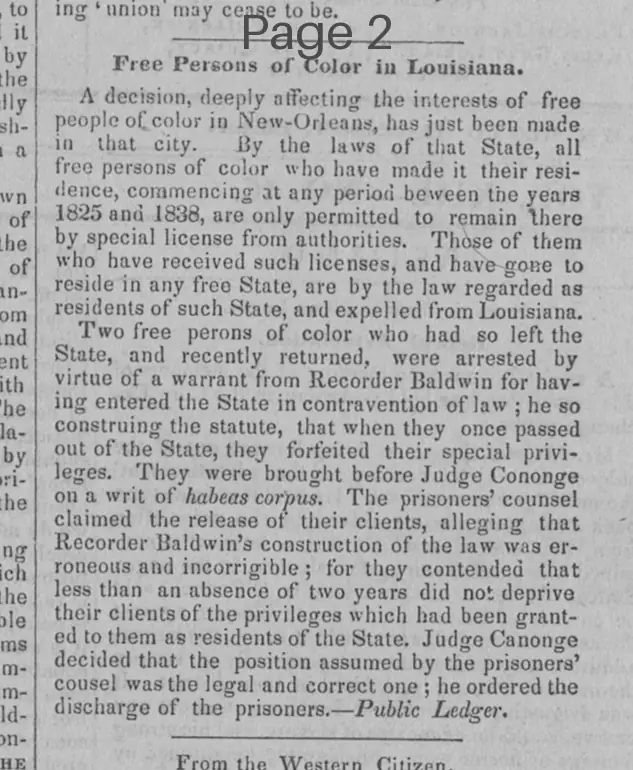
A decision, deeply affecting the interests of free people of color in New-Orleans, has just been made in that city. By the laws of that State, all free persons of color who have made it their residence, commencing at any period between the years 1825 and 1838, are only permitted to remain there by special license from authorities. Those of them who have received such licenses, and have gone to reside in any free State, are by the law regarded as residents of such State, and expelled from Louisiana. Two free persons of color who had so left the State, and recently returned, were arrested by virtue of a warrant from Recorder Baldwin for having entered the State in contravention of law; he so construing the statute, that when they once passed out of the State, they forfeited their special privileges. They were brought before Judge Canonge on a writ of habeas corpus. The prisoners' counsel claimed the release of their clients, alleging that Recorder Baldwin's construction of the law was erroneous and incorrigible; for they contended that less than an absence of two years did not deprive their clients of the privileges which had been granted to them as residents of the State. Judge Canonge decided that the position assumed by the prisoners' counsel was the legal and correct one; he ordered the discharge of the prisoners.—Public Ledger.
A decision, deeply affecting the interests of free people of color in New-Orleans, has just been made in that city. By the laws of that State, all free persons of color who have made it their residence, commencing at any period between the years 1825 and 1838, are only permitted to remain there by special license from authorities. Those of them who have received such licenses, and have gone to reside in any free State, are by the law regarded as residents of such State, and expelled from Louisiana. Two free persons of color who had so left the State, and recently returned, were arrested by virtue of a warrant from Recorder Baldwin for having entered the State in contravention of law; he so construing the statute, that when they once passed out of the State, they forfeited their special privileges. They were brought before Judge Canonge on a writ of habeas corpus. The prisoners' counsel claimed the release of their clients, alleging that Recorder Baldwin's construction of the law was erroneous and incorrigible; for they contended that less than an absence of two years did not deprive their clients of the privileges which had been granted to them as residents of the State. Judge Canonge decided that the position assumed by the prisoners' counsel was the legal and correct one; he ordered the discharge of the prisoners.—Public Ledger.
What sub-type of article is it?
Historical Event
What themes does it cover?
Justice
What keywords are associated?
Free Persons Of Color
Louisiana Laws
New Orleans
Habeas Corpus
Residency License
Legal Discharge
What entities or persons were involved?
Recorder Baldwin
Judge Canonge
Two Free Persons Of Color
Prisoners' Counsel
Where did it happen?
New Orleans, Louisiana
Story Details
Key Persons
Recorder Baldwin
Judge Canonge
Two Free Persons Of Color
Prisoners' Counsel
Location
New Orleans, Louisiana
Story Details
Two free persons of color, who had left Louisiana with special licenses and recently returned from a free state, were arrested by Recorder Baldwin for violating residency laws. On habeas corpus before Judge Canonge, their counsel argued that absences under two years preserved their privileges. The judge agreed and ordered their discharge.