Thank you for visiting SNEWPapers!
Sign up free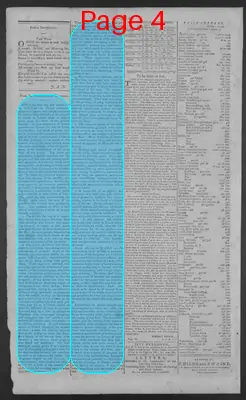
National Gazette
Philadelphia, Philadelphia County, Pennsylvania
What is this article about?
An article from the Connecticut Courant explains the severe despotism under the French monarchy, including taxes, lettres de cachet, and feudal rights, to contextualize the violence of the French Revolution and urge Americans to understand the peasants' desperation.
Clipping
OCR Quality
Full Text
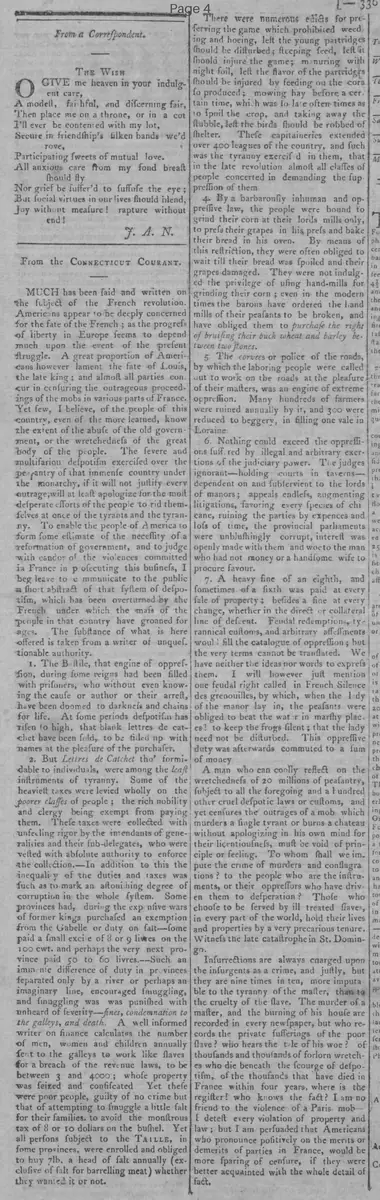
MUCH has been said and written on the subject of the French revolution. Americans appear to be deeply concerned for the fate of the French: as the progress of liberty in Europe seems to depend much upon the event of the present struggle. A great proportion of Americans however lament the fate of Louis, the late king: and almost all parties concur in censuring the outrageous proceedings of the mobs in various parts of France. Yet few, I believe, of the people of this country, even of the more learned, know the extent of the abuse of the old government, or the wretchedness of the great body of the people. The severe and multifarious despotism exercised over the peasantry of that immense country under the monarchy, if it will not justify every outrage, will at least apologize for the most desperate efforts of the people to rid themselves at once of the tyrants and the tyranny. To enable the people of America to form some estimate of the necessity of a reformation of government, and to judge with candor of the violences committed in France in prosecuting this business, I beg leave to communicate to the public a short abstract of that system of despotism, which has been overturned by the French under which the mass of the people in that country have groaned for ages. The substance of what is here offered is taken from a writer of unquestionable authority.
I. The Bastile, that engine of oppression, during some reigns had been filled with prisoners, who without even knowing the cause or author of their arrest, have been doomed to darkness and chains for life. At some periods despotism has risen so high, that blank lettres de cachet have been sold, to be filled up with names at the pleasure of the purchaser.
2. But Lettres de Cachet tho' formidable to individuals, were among the least instruments of tyranny. Some of the heaviest taxes were levied wholly on the poorer classes of people; the rich nobility and clergy being exempt from paying them. These taxes were collected with unfeeling rigor by the intendants of generalities and their sub-delegates, who were vested with absolute authority to enforce the collection. In addition to this the inequality of the duties and taxes was such as to mark an astonishing degree of corruption in the whole system. Some provinces had, during the expensive wars of former kings purchased an exemption from the Gabelle or duty on salt-some paid a small excise of 8 or 9 livres on the 100 cwt. and perhaps the very next province paid 50 to 60 livres. Such an immense difference of duty in provinces separated only by a river or perhaps an imaginary line, encouraged smuggling, and smuggling was punished with unheard of severity-fines, condemnation to the galleys, and death. A well informed writer on finance calculates the number of men, women and children annually sent to the galleys to work like slaves for a breach of the revenue laws, to be between 3 and 4000; whose property was seized and confiscated Yet these were poor people, guilty of no crime but that of attempting to smuggle a little salt for their families. to avoid the monstrous tax of 8 or 10 dollars on the bushel. Yet all persons subject to the TAILLE. in some provinces, were enrolled and obliged to buy 7lb. a head of salt annually (exclusive of salt for barrelling meat) whether they wanted it or not.
There were numerous edicts for preserving the game which prohibited weeding and hoeing, lest the young partridges should be disturbed; keeping seed, lest it should injure the game; manuring with night soil, lest the flavor of the partridges should be injured by feeding on the corn so produced; mowing hay before a certain time, which was so late often times as to spoil the crop, and taking away the stubble, lest the birds should be robbed of shelter. These captaineries extended over 400 leagues of the country, and such was the tyranny exercised in them, that in the late revolution almost all classes of people concerted in demanding the suppression of them
4. By a barbarously inhuman and oppressive law, the people were bound to grind their corn at their lords mills only, to press their grapes in his press and bake their bread in his oven. By means of this restriction, they were often obliged to wait till their bread was spoiled and their grapes damaged. They were not indulged the privilege of using hand-mills for grinding their corn ; even in the modern times the barons have ordered the hand mills of their peasants to be broken, and have obliged them to purchase the right of bruising their buck wheat and barley between two stones.
5 The corvees or police of the roads, by which the laboring people were called just to work on the roads at the pleasure of their masters, was an engine of extreme oppression. Many hundreds of farmers were ruined annually by it, and 300 were reduced to beggary, in filling one vale in Loraine
6. Nothing could exceed the oppressions suffered by illegal and arbitrary exertions of the judiciary power. The judges ignorant-holding courts in taverns-dependent on and subservient to the lords of manors; appeals endless, augmenting litigations, favoring every species of chicane, ruining the parties by expences and loss of time, the provincial parliaments were unblushingly corrupt, interest was openly made with them and woe to the man who had not money or a handsome wife to procure favour.
7. A heavy fine of an eighth, and sometimes of a sixth was paid at every sale of property; besides a fine at every change, whether in the direct or collateral line of descent. Feudal redemptions, tyrannical customs, and arbitrary assessments would fill the catalogue of oppression; but the very terms cannot be translated. We have neither the ideas nor words to express them. I will however just mention one feudal right called in French Silence des grenouilles, by which, when the lady of the manor lay in, the peasants were obliged to beat the water in marshy places! to keep the frogs silent; that the lady need not be disturbed. This oppressive duty was afterwards commuted to a sum of money
A man who can coolly reflect on the wretchedness of 20 millions of peasantry, subject to all the foregoing and a hundred other cruel despotic laws or customs, and yet censures the outrages of a mob which murders a single tyrant or burns a chateau without apologizing in his own mind for their licentiousness, must be void of principle or feeling. To whom shall we impute the crime of murders and conflagrations ? to the people who are the instruments, or their oppressors who have driven them to desperation? Those who choose to be served by ill treated slaves, in every part of the world, hold their lives and properties by a very precarious tenure. Witness the late catastrophe in St. Domingo.
Insurrections are always charged upon the insurgents as a crime, and justly, but they are nine times in ten, more imputable to the tyranny of the master, than to the cruelty of the slave. The murder of a master, and the burning of his house are recorded in every newspaper, but who records the private sufferings of the poor slave? who hears the tale of his woe? of thousands and thousands of forlorn wretches who die beneath the scourge of despotism, of the thousands that have died in France within four years, where is the register! who knows the fact? I am no friend to the violence of a Paris mob-I detest every violation of property and law; but I am persuaded that Americans who pronounce positively on the merits or demerits of parties in France, would be more sparing of censure, if they were better acquainted with the whole detail of fact.
What sub-type of article is it?
What keywords are associated?
What entities or persons were involved?
Where did it happen?
Foreign News Details
Primary Location
France
Key Persons
Outcome
overturn of the despotic system; thousands died within four years; late catastrophe in st. domingo referenced.
Event Details
The article details historical abuses under the French monarchy, including the Bastille, lettres de cachet, heavy taxes on the poor, game preservation edicts, forced use of lords' mills and ovens, corvees, corrupt judiciary, and feudal fines, leading to the revolution's violence against tyrants.