Thank you for visiting SNEWPapers!
Sign up free
Literary
October 25, 1826
Phenix Gazette
Alexandria, Virginia
What is this article about?
In ancient Athens, friends Alcander and Septimus vie for the love of Hypatia. Alcander sacrifices her to save his dying friend, leading to his ruin, enslavement, and flight to Rome. There, unrecognized, he faces false accusation of murder before Septimus, who ultimately recognizes and saves him, restoring their bond.
Clipping
OCR Quality
95%
Excellent
Full Text
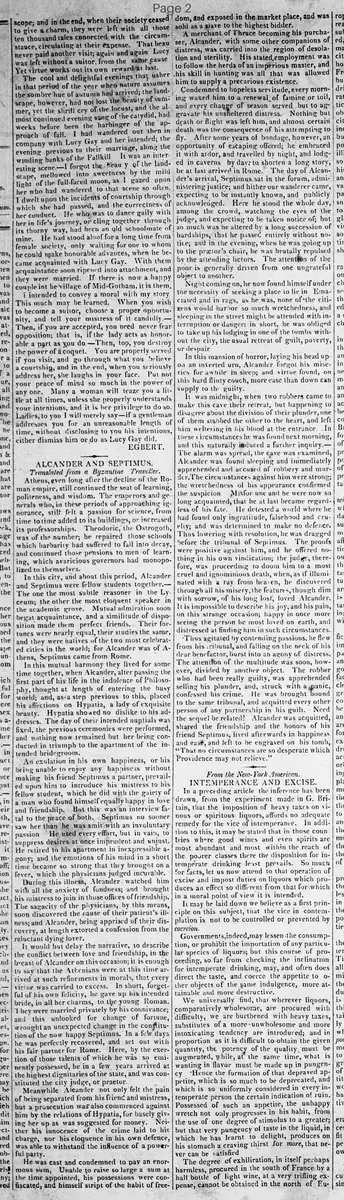
ALCANDER AND SEPTIMUS.
Translated from a Byzantine Traveller.
Athens, even long after the decline of the Roman empire, still continued the seat of learning, politeness, and wisdom. The emperors and generals who, in these periods of approaching ignorance, still felt a passion for science, from time to time added to its buildings, or increased its professorships. Theodoric, the Ostrogoth, was of the number; he repaired those schools which barbarity had suffered to fall into decay, and continued those pensions to men of learning, which avaricious governors had monopolized to themselves.
In this city, and about this period, Alcander and Septimus were fellow students together.— The one the most subtle reasoner in the Lyceum; the other the most eloquent speaker in the academic grove. Mutual admiration soon begat acquaintance, and a similitude of disposition made them perfect friends. Their fortunes were nearly equal, their studies the same, and they were natives of the two most celebrated cities in the world; for Alcander was of Athens, Septimus came from Rome.
In this mutual harmony they lived for some time together, when Alcander, after passing the first part of his life in the indolence of Philosophy, thought at length of entering the busy world; and, as a step previous to this, placed his affections on Hypatia, a lady of exquisite beauty. Hypatia showed no dislike to his addresses. The day of their intended nuptials was fixed, the previous ceremonies were performed, and nothing now remained but her being conducted in triumph to the apartment of the intended bridegroom.
An exultation in his own happiness, or his being unable to enjoy any happiness without making his friend Septimus a partner, prevailed upon him to introduce his mistress to his fellow student, which he did with the gaiety of a man who found himself equally happy in love and friendship. But this was an interview fatal to the peace of both. Septimus no sooner saw her than he was smit with an involuntary passion. He used every effort, but in vain, to suppress desires at once imprudent and unjust. He retired to his apartment in inexpressible agony; and the emotions of his mind in a short time became so strong that they brought on a fever, which the physicians judged incurable.
During this illness, Alcander watched him with all the anxiety of fondness; and brought his mistress to join in those offices of friendship. The sagacity of the physicians, by this means, soon discovered the cause of their patient's illness; and Alcander, being apprised of their discovery, at length extorted a confession from the reluctant dying lover.
It would but delay the narrative, to describe the conflict between love and friendship, in the breast of Alcander on this occasion; it is enough to say that the Athenians were, at this time arrived at such refinements in morals, that every virtue was carried to excess. In short, forgetful of his own felicity, he gave up his intended bride, in all her charms, to the young Roman. They were married privately by his connivance; and this unlooked for change of fortune, wrought an unexpected change in the constitution of the now happy Septimus. In a few days he was perfectly recovered, and set out with his fair partner for Rome. Here, by the exertion of those talents of which he was so eminently possessed, he in a few years arrived at the highest dignitaries of the state, and was constituted the city judge, or praetor.
Meanwhile Alcander not only felt the pain of being separated from his friend and mistress, but a prosecution was also commenced against him by the relations of Hypatia, for basely giving her up as was suggested for money. Neither his innocence of the crime laid to his charge, nor his eloquence in his own defence, was able to withstand the influence of a powerful party.
He was cast and condemned to pay an enormous sum. Unable to raise so large a sum at the time appointed, his possessions were confiscated, and himself stripped of the habit of freedom, and exposed in the market place, and was sold as a slave to the highest bidder.
A merchant of Thrace becoming his purchaser, Alcander, with some other companions of distress, was carried into the region of desolation and sterility. His stated employment was to follow the herds of an imperious master, and his skill in hunting was all that was allowed him to supply a precarious existence.
Condemned to hopeless servitude, every morning waked him to a renewal of famine or toil, and every change of season served but to aggravate his unsheltered distress. Nothing but flight was left him, and almost certain death was the consequence of his attempting to fly. After some years of bondage, however, an opportunity of escaping offered; he embraced it with ardor, and travelled by night, and lodged in caverns by day: to shorten a long story, he at last arrived in Rome. The day of Alcander's arrival, Septimus sat in the forum, administering justice; and hither our wanderer came, expecting to be instantly known, and publicly acknowledged. Here he stood the whole day, among the crowd, watching the eyes of the judge, and expecting to be taken notice of; but so much was he altered by a long succession of hardships, that he passed entirely without notice; and in the evening, when he was going up to the praetor's chair, he was brutally repulsed by the attending lictors. The attention of the poor is generally driven from one ungrateful object to another.
Night coming on, he now found himself under the necessity of seeking a place to lie in. Enclated and in rags, as he was, none of the citizens would harbor so much wretchedness, and sleeping in the street might be attended with interruption or danger: in short, he was obliged to take up his lodging in one of the tombs without the city, the usual retreat of guilt, poverty, or despair.
In this mansion of horror, laying his head upon an inverted urn, Alcander forgot his miseries for a while in sleep; and virtue found, on this hard flinty couch, more ease than down can supply to the guilty.
It was midnight, when two robbers came to make this cave their retreat, but happening to disagree about the division of their plunder, one of them stabbed the other to the heart, and left him weltering in his blood at the entrance. In these circumstances he was found next morning, and this naturally induced a further inquiry. The alarm was spread, the cave was examined, Alcander was found sleeping and immediately apprehended and accused of robbery and murder. The circumstances against him were strong; the wretchedness of his appearance confirmed the suspicion. Misfortune and he were now so long acquainted, that he at last became regardless of his fate. He detested a world where he had found only ingratitude, falsehood and cruelty; and was determined to make no defence.
Thus lowering with resolution, he was dragged before the tribunal of Septimus. The proofs were positive against him, and he offered nothing in his own vindication; the judge, therefore, was proceeding to doom him to a most cruel and ignominious death, when, as if illuminated with a ray from heaven, he discovered through all his misery, the features, though dim with sorrow, of his long lost, loved Alcander.
It is impossible to describe his joy, and his pain on this strange occasion; happy in once more seeing the person he most loved on earth, and distressed at finding him in such circumstances. Thus agitated by contending passions, he flew from his tribunal, and falling on the neck of his dear benefactor, burst into an agony of distress.
The attention of the multitude was soon, however, divided by another object. The robber who had been really guilty, was apprehended selling his plunder, and, struck with a panic, confessed his crime. He was brought bound to the same tribunal, and acquitted every other person of any partnership in his guilt. Need the sequel be related? Alcander was acquitted, shared the friendship and the honors of his friend Septimus, lived afterwards in happiness and ease, and left to be engraved on his tomb, "That no circumstances are so desperate which Providence may not relieve."
Translated from a Byzantine Traveller.
Athens, even long after the decline of the Roman empire, still continued the seat of learning, politeness, and wisdom. The emperors and generals who, in these periods of approaching ignorance, still felt a passion for science, from time to time added to its buildings, or increased its professorships. Theodoric, the Ostrogoth, was of the number; he repaired those schools which barbarity had suffered to fall into decay, and continued those pensions to men of learning, which avaricious governors had monopolized to themselves.
In this city, and about this period, Alcander and Septimus were fellow students together.— The one the most subtle reasoner in the Lyceum; the other the most eloquent speaker in the academic grove. Mutual admiration soon begat acquaintance, and a similitude of disposition made them perfect friends. Their fortunes were nearly equal, their studies the same, and they were natives of the two most celebrated cities in the world; for Alcander was of Athens, Septimus came from Rome.
In this mutual harmony they lived for some time together, when Alcander, after passing the first part of his life in the indolence of Philosophy, thought at length of entering the busy world; and, as a step previous to this, placed his affections on Hypatia, a lady of exquisite beauty. Hypatia showed no dislike to his addresses. The day of their intended nuptials was fixed, the previous ceremonies were performed, and nothing now remained but her being conducted in triumph to the apartment of the intended bridegroom.
An exultation in his own happiness, or his being unable to enjoy any happiness without making his friend Septimus a partner, prevailed upon him to introduce his mistress to his fellow student, which he did with the gaiety of a man who found himself equally happy in love and friendship. But this was an interview fatal to the peace of both. Septimus no sooner saw her than he was smit with an involuntary passion. He used every effort, but in vain, to suppress desires at once imprudent and unjust. He retired to his apartment in inexpressible agony; and the emotions of his mind in a short time became so strong that they brought on a fever, which the physicians judged incurable.
During this illness, Alcander watched him with all the anxiety of fondness; and brought his mistress to join in those offices of friendship. The sagacity of the physicians, by this means, soon discovered the cause of their patient's illness; and Alcander, being apprised of their discovery, at length extorted a confession from the reluctant dying lover.
It would but delay the narrative, to describe the conflict between love and friendship, in the breast of Alcander on this occasion; it is enough to say that the Athenians were, at this time arrived at such refinements in morals, that every virtue was carried to excess. In short, forgetful of his own felicity, he gave up his intended bride, in all her charms, to the young Roman. They were married privately by his connivance; and this unlooked for change of fortune, wrought an unexpected change in the constitution of the now happy Septimus. In a few days he was perfectly recovered, and set out with his fair partner for Rome. Here, by the exertion of those talents of which he was so eminently possessed, he in a few years arrived at the highest dignitaries of the state, and was constituted the city judge, or praetor.
Meanwhile Alcander not only felt the pain of being separated from his friend and mistress, but a prosecution was also commenced against him by the relations of Hypatia, for basely giving her up as was suggested for money. Neither his innocence of the crime laid to his charge, nor his eloquence in his own defence, was able to withstand the influence of a powerful party.
He was cast and condemned to pay an enormous sum. Unable to raise so large a sum at the time appointed, his possessions were confiscated, and himself stripped of the habit of freedom, and exposed in the market place, and was sold as a slave to the highest bidder.
A merchant of Thrace becoming his purchaser, Alcander, with some other companions of distress, was carried into the region of desolation and sterility. His stated employment was to follow the herds of an imperious master, and his skill in hunting was all that was allowed him to supply a precarious existence.
Condemned to hopeless servitude, every morning waked him to a renewal of famine or toil, and every change of season served but to aggravate his unsheltered distress. Nothing but flight was left him, and almost certain death was the consequence of his attempting to fly. After some years of bondage, however, an opportunity of escaping offered; he embraced it with ardor, and travelled by night, and lodged in caverns by day: to shorten a long story, he at last arrived in Rome. The day of Alcander's arrival, Septimus sat in the forum, administering justice; and hither our wanderer came, expecting to be instantly known, and publicly acknowledged. Here he stood the whole day, among the crowd, watching the eyes of the judge, and expecting to be taken notice of; but so much was he altered by a long succession of hardships, that he passed entirely without notice; and in the evening, when he was going up to the praetor's chair, he was brutally repulsed by the attending lictors. The attention of the poor is generally driven from one ungrateful object to another.
Night coming on, he now found himself under the necessity of seeking a place to lie in. Enclated and in rags, as he was, none of the citizens would harbor so much wretchedness, and sleeping in the street might be attended with interruption or danger: in short, he was obliged to take up his lodging in one of the tombs without the city, the usual retreat of guilt, poverty, or despair.
In this mansion of horror, laying his head upon an inverted urn, Alcander forgot his miseries for a while in sleep; and virtue found, on this hard flinty couch, more ease than down can supply to the guilty.
It was midnight, when two robbers came to make this cave their retreat, but happening to disagree about the division of their plunder, one of them stabbed the other to the heart, and left him weltering in his blood at the entrance. In these circumstances he was found next morning, and this naturally induced a further inquiry. The alarm was spread, the cave was examined, Alcander was found sleeping and immediately apprehended and accused of robbery and murder. The circumstances against him were strong; the wretchedness of his appearance confirmed the suspicion. Misfortune and he were now so long acquainted, that he at last became regardless of his fate. He detested a world where he had found only ingratitude, falsehood and cruelty; and was determined to make no defence.
Thus lowering with resolution, he was dragged before the tribunal of Septimus. The proofs were positive against him, and he offered nothing in his own vindication; the judge, therefore, was proceeding to doom him to a most cruel and ignominious death, when, as if illuminated with a ray from heaven, he discovered through all his misery, the features, though dim with sorrow, of his long lost, loved Alcander.
It is impossible to describe his joy, and his pain on this strange occasion; happy in once more seeing the person he most loved on earth, and distressed at finding him in such circumstances. Thus agitated by contending passions, he flew from his tribunal, and falling on the neck of his dear benefactor, burst into an agony of distress.
The attention of the multitude was soon, however, divided by another object. The robber who had been really guilty, was apprehended selling his plunder, and, struck with a panic, confessed his crime. He was brought bound to the same tribunal, and acquitted every other person of any partnership in his guilt. Need the sequel be related? Alcander was acquitted, shared the friendship and the honors of his friend Septimus, lived afterwards in happiness and ease, and left to be engraved on his tomb, "That no circumstances are so desperate which Providence may not relieve."
What sub-type of article is it?
Prose Fiction
What themes does it cover?
Friendship
Love Romance
Moral Virtue
What keywords are associated?
Friendship
Love Triangle
Sacrifice
Slavery
Justice
Providence
Ancient Athens
Rome
What entities or persons were involved?
Translated From A Byzantine Traveller.
Literary Details
Title
Alcander And Septimus.
Author
Translated From A Byzantine Traveller.
Key Lines
It Would But Delay The Narrative, To Describe The Conflict Between Love And Friendship, In The Breast Of Alcander On This Occasion; It Is Enough To Say That The Athenians Were, At This Time Arrived At Such Refinements In Morals, That Every Virtue Was Carried To Excess.
Thus Lowering With Resolution, He Was Dragged Before The Tribunal Of Septimus.
It Is Impossible To Describe His Joy, And His Pain On This Strange Occasion; Happy In Once More Seeing The Person He Most Loved On Earth, And Distressed At Finding Him In Such Circumstances.
Need The Sequel Be Related? Alcander Was Acquitted, Shared The Friendship And The Honors Of His Friend Septimus, Lived Afterwards In Happiness And Ease,