Thank you for visiting SNEWPapers!
Sign up free
Jeffersonian Plaindealer
Philippi, Barbour County, West Virginia
What is this article about?
Young Dorothy Mallard defies suitor Silas Green by independently running her Rhode Island farm to support her five younger siblings. Aided by old Jubal and the children, she profits from tobacco, strawberries, and poultry, attracting and later engaging Mr. Mayhew, a Providence cigar maker.
Clipping
OCR Quality
Full Text
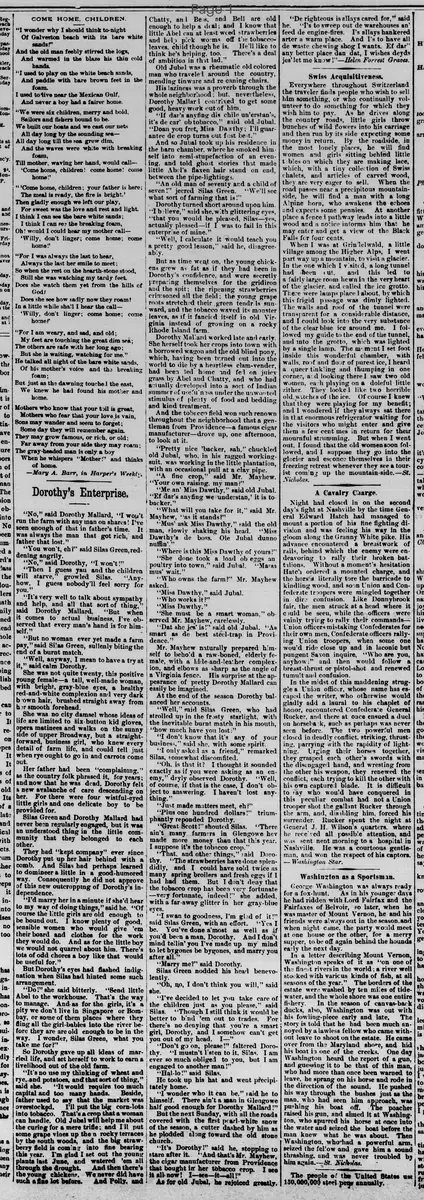
"No," said Dorothy Mallard, "I won't run the farm with any man on shares! I've seen enough of that in father's time. It was always the man that got rich, and father that lost."
"You won't, eh?" said Silas Green, reddening angrily.
"No," said Dorothy, "I won't!"
"Then I guess you and the children will starve," growled Silas.
"Anyway, I guess nobody'll feel sorry for you."
"It's very well to talk about sympathy and help, and all that sort of thing,' said Dorothy Mallard. "But when it comes to actual business, I've observed that every man's hand is for himself."
"But no woman ever yet made a farm pay, " said Silas Green, sullenly biting the end of a burnt match.
"Well, anyway, I mean to have a try at it." said calm Dorothy.
She was not quite twenty, this positive young female--a tall, well-made woman, with bright, gray-blue eyes, a healthy red-and-white complexion and very dark brown hair, brushed straight away from her smooth forehead.
She was no city damsel whose ideas of life are limited to six-button kid gloves, opera matinees and walks on the sunny side of upper Broadway, but a straight-forward, business girl, who knew every detail of farm life, and could tell just when rye ought to go in and carrots come out.
Her father had been "complaining," as the country folk phrased it, for years; and now that he was dead, Dorothy felt a new avalanche of care descending on her. For there were four wistful-eyed little girls and one delicate boy to be provided for.
Silas Green and Dorothy Mallard had never been regularly engaged, but it was an understood thing in the little community that they belonged to each other.
They had "kept company" ever since Dorothy put up her hair behind with a comb, And Silas had perhaps learned to domineer a little in a good-humored way. Consequently he did not approve of this new outcropping of Dorothy's independence.
"I'd marry her in a minute if she'd hear to my way of doing things" said he. "Of course the little girls are old enough to be bound out. I know plenty of good, sensible women who would give 'em their board and clothes for the work they would do. And as for the little boy we would not quarrel about him. There's lots of odd chores a boy like that would be useful for."
But Dorothy's eyes had flashed indignation when Silas had hinted some such arrangement.
"Do!" she said bitterly. "Send little Abel to the workhouse. That's the way to manage. And-as for the girls, it's a pity we don't live in Singapore or Bombay, or some of them places where they ding all the girl-babies into the river before they are old enough to be in the way. I wonder, Silas Green, what you take me for?"
So Dorothy gave up all ideas of married life, and set herself to work to earn a livelihood out of the old farm.
"It's no use my thinking of wheat and rye, and potatoes, and that sort of thing." said she.
"It would require too much capital and too many hands. Beside, father used to say that the market was overstocked.
I'll put the big corn-lots into tobacco. That's a crop that a woman can handle. Old Jubal will help me about the curing for a mere trifle: and I'll put some grape vines up the rocky terraces by the south woods, and the big strawberry field is coming into fine bearing this year. I'm glad I set out the young plants last June, and watered 'em all through the drought.
And then there's the young chickens. We never did have such a fine lot before. And Polly, and Chattv, and Bess, and Bell are old enough to help a deal; and I know that little Abel can at least weed strawberries and help pick worms off the tobacco-leaves, child though he is. He'll like to think he's helping, too. There's a deal of ambition in that lad."
Old Jubal was a rheumatic old colored man who traveled around the country, mending tinware and re-caning chairs.
His laziness was a proverb through the whole neighborhood; but, nevertheless, Dorothy Mallard contrived to get some good, heavy work out of him.
"If dar's anything dis chile understands, it's de curin' ob tobacco," said old Jubal. "Doan you fret, Miss Dorothy: I'll guarantee de crop turns out fus' rate."
And so Jubal took up his residence in the barn chamber, where he smoked himself into semi-stupefaction of an evening, and told ghost stories that made little Abel's flaxen hair stand on end, between the pipe-lightings.
"An old man of seventy and a child of seven!" jeered Silas Green. "We'll see what sort of farming that is!"
Dorothy turned short around upon him.
"I believe." said she, with glittering eyes "that you would be pleased, Silas-yes, actually pleased-if I was to fail in this enterprise of mine."
"Well, I calculate it would teach you a pretty good lesson," said he, disagreeably.
But as time went on, the young chickens grew as fat as if they had been in Dorothy's confidence, and were secretly preparing themselves for the gridiron and the spit; the ripening strawberries crimsoned all the field; the young grape roots stretched their green tendrils sunward, and the tobacco waved its monster leaves, as if it fancied itself in old Virginia instead of growing on a rocky Rhode Island farm.
Dorothy Mallard worked late and early She herself took her crops into town with a borrowed wagon and the old blind pony, which, having been turned out into the world to die by a heartless clam-vender, had been led home and fed on juicy grass by Abel and Chatty, and who had actually developed into a sort of Indian summer of usefulness under the unwonted stimulus of plenty of food and bedding and kind treatment.
And the tobacco field won such renown throughout the neighborhood that a gentleman from Providence-a famous cigar manufacturer-drove up, one afternoon, to look at it.
"Pretty nice 'backer, sah," chuckled old Jubal, who, in his ragged working suit, was working in the little plantation, with an occasional pull at a clay pipe.
"A fine crop," said Mr. Mayhew "Your own raising, my man?"
"Me an' Miss Dorothy," said old Jubal. "Ef dar's anything we understands, it is tobacco."
"What will you take for it," said Mr. Mayhew. "as it stands?"
"Mus' ask Miss Dorothy." said the old man, slowly shaking his head. "Miss Dorothy's de boss. Ole Jubal dunno nuffin'."
"Where is this Miss Dorothy of yours?"
"She done took a load ob eggs an poultry into town." said Jubal. "Massa mus' wait."
"Who owns the farm?" Mr. Mayhew asked.
"Miss Dorothy," said Jubal.
"Who works it?"
"Miss Dorothy."
"She must be a smart woman," observed Mr. Mayhew, carelessly.
"Dat she jes' is!" said old Jubal. "As smart as de best steel-trap in Providence."
Mr. Mayhew naturally prepared himself to behold a raw-boned, elderly female, with a hide-and-leather complexion. and elbows as sharp as the angle of a Virginia fence. His surprise at the appearance of pretty Dorothy Mallard can easily be imagined.
At the end of the season Dorothy balanced her accounts.
"Well," said Silas Green, who had strolled up in the frosty starlight, with the inevitable burnt match in his mouth, "how much have you lost?"
"I don't know that it's any of your business, " said she, with some spirit.
"I only asked as a friend," remarked Silas. somewhat discomfited.
"Oh, is that it? I thought it sounded exactly as if you were asking as an enemy," dryly observed Dorothy. "Well, of course, if that is the case, I don't object to answering. I haven't lost anything."
"Just made matters meet. eh?"
"Plus one hundred dollars!" triumphantly responded Dorothy.
"Great Scott!" shouted Silas. "There ain't many farmers in Glengrove have made more money than that this year. I suppose it's the tobacco crop."
"That, and other things," said Dorothy. "The strawberries have done splendidly. and I could have sold twice as many spring broilers and fresh eggs if I had had them. But I don't deny that the tobacco crop has been very fortunate -very fortunate, indeed!" she added. with a far-away glitter in her gray-blue eyes.
"I swan to goodness, I'm glad of it!" said Silas Green, with an effort. "Yes I be. You've done 'most as well as if you'd been a man, Dorothy. And I don't mind tellin' you I've made up my mind to let bygones be bygones, and marry you after all."
"Marry me?" said Dorothy.
Silas Green nodded his head benevolently.
"Oh, no, I don't think you will," said she.
"I've decided to let you take care of the children just as you please." said Silas. "Though I still think it would be better to bind 'em out to trades. For there's no denying that you're a smart girl, Dorothy, and I somehow can't get you out of my head. I"
"Don't go on. please!" faltered Dorothy. "I mustn't listen to it, Silas. I am ever so much obliged to you, but I am engaged to another man!"
"Hal-lo!" said Silas.
He took up his hat and went precipitately home.
"I wonder who it can be," said he to himself. There ain't a man in Glengrove half good enough for Dorothy Mallard!"
But the next Sunday, with all the roads covered with the first pearl-white snow of the season, a cutter dashed by him as he plodded along toward the old stone church.
"It's Dorothy!" said he, stopping to stare after it. "And that's Mr. Mayhew, the cigar manufacturer from Providence that bought in her tobacco crop. I see it all now! I see-it-all!"
As for old Jubal, he rejoiced greatly
"De righteous is always cared for. " said he. "It's to sweep out de warehouses an feed de engine-fires. I's always hankered arter a warm place. And I's to have all de waste chewin' tobaccer I wants. Ef dar's any better place dan dat, I wishes dey's jes' let me know!"
What sub-type of article is it?
What themes does it cover?
What keywords are associated?
What entities or persons were involved?
Where did it happen?
Story Details
Key Persons
Location
Glengrove, Rhode Island
Story Details
Dorothy Mallard rejects Silas Green's proposal to run the farm on shares and decides to manage it independently to support her younger siblings after their father's death. With assistance from old Jubal and the children, she cultivates tobacco, strawberries, grapes, and raises chickens, achieving a profit of over one hundred dollars. Her success leads to a business deal with Mr. Mayhew, the cigar manufacturer from Providence, and she becomes engaged to him.