Thank you for visiting SNEWPapers!
Sign up free
Story
July 8, 1938
White Bluffs Spokesman
White Bluffs, Benton County, Washington
What is this article about?
W. J. Morse of USDA highlights the need for diverse soybean varieties adapted to local conditions and purposes like forage, milling, or vegetables, as breeding efforts begin despite challenges in crossing the self-fertilized plant.
Clipping
OCR Quality
95%
Excellent
Full Text
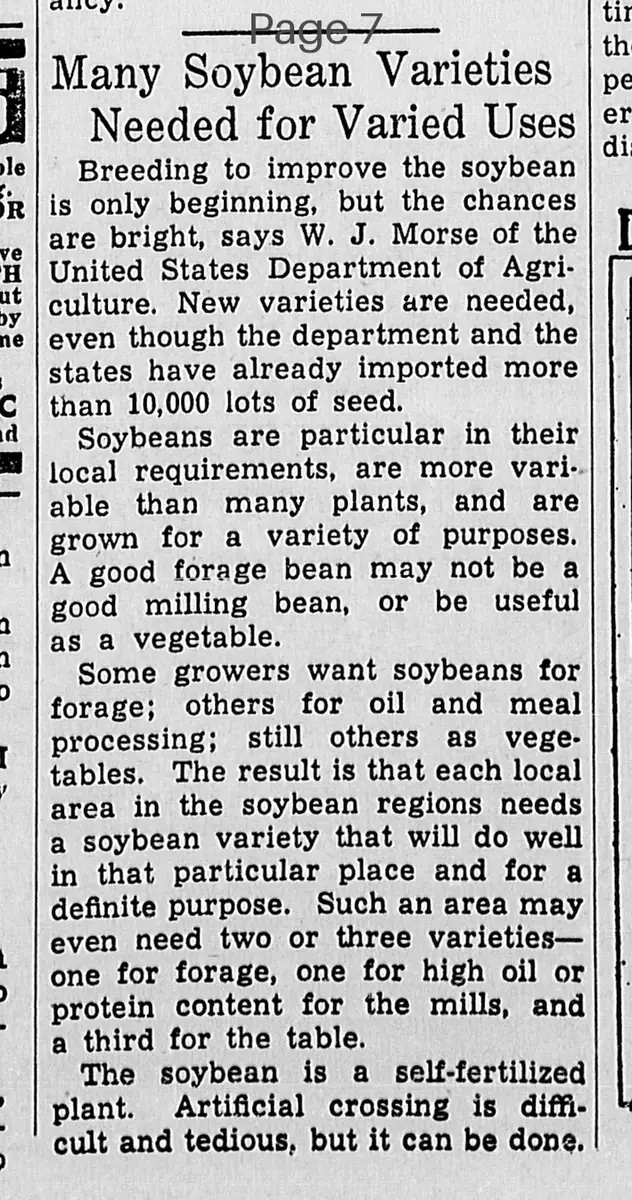
Many Soybean Varieties
Needed for Varied Uses
Breeding to improve the soybean is only beginning, but the chances are bright, says W. J. Morse of the United States Department of Agriculture. New varieties are needed, even though the department and the states have already imported more than 10,000 lots of seed.
Soybeans are particular in their local requirements, are more variable than many plants, and are grown for a variety of purposes.
A good forage bean may not be a good milling bean, or be useful as a vegetable.
Some growers want soybeans for forage; others for oil and meal processing; still others as vegetables. The result is that each local area in the soybean regions needs a soybean variety that will do well in that particular place and for a definite purpose. Such an area may even need two or three varieties- one for forage, one for high oil or protein content for the mills, and a third for the table.
The soybean is a self-fertilized plant. Artificial crossing is difficult and tedious, but it can be done.
Needed for Varied Uses
Breeding to improve the soybean is only beginning, but the chances are bright, says W. J. Morse of the United States Department of Agriculture. New varieties are needed, even though the department and the states have already imported more than 10,000 lots of seed.
Soybeans are particular in their local requirements, are more variable than many plants, and are grown for a variety of purposes.
A good forage bean may not be a good milling bean, or be useful as a vegetable.
Some growers want soybeans for forage; others for oil and meal processing; still others as vegetables. The result is that each local area in the soybean regions needs a soybean variety that will do well in that particular place and for a definite purpose. Such an area may even need two or three varieties- one for forage, one for high oil or protein content for the mills, and a third for the table.
The soybean is a self-fertilized plant. Artificial crossing is difficult and tedious, but it can be done.
What sub-type of article is it?
Agricultural Report
Scientific Article
What keywords are associated?
Soybean Varieties
Breeding
Agriculture
Forage
Oil Processing
Vegetables
What entities or persons were involved?
W. J. Morse
United States Department Of Agriculture
Story Details
Key Persons
W. J. Morse
United States Department Of Agriculture
Story Details
Breeding to improve soybeans is beginning with bright prospects; new varieties needed for local requirements and varied uses like forage, oil and meal processing, or vegetables, despite importing over 10,000 seed lots; self-fertilized plant makes artificial crossing difficult.