Thank you for visiting SNEWPapers!
Sign up free
Story
July 30, 1847
The Lancaster Gazette
Lancaster, Fairfield County, Ohio
What is this article about?
Newspaper excerpts criticize Ohio Volunteers for burning effigy of politician Tom Corwin, led by thief Theodore Gibbons; Whig and Locofoco editors clash over the soldiers' decency and motives amid Mexican War tensions.
Clipping
OCR Quality
98%
Excellent
Full Text
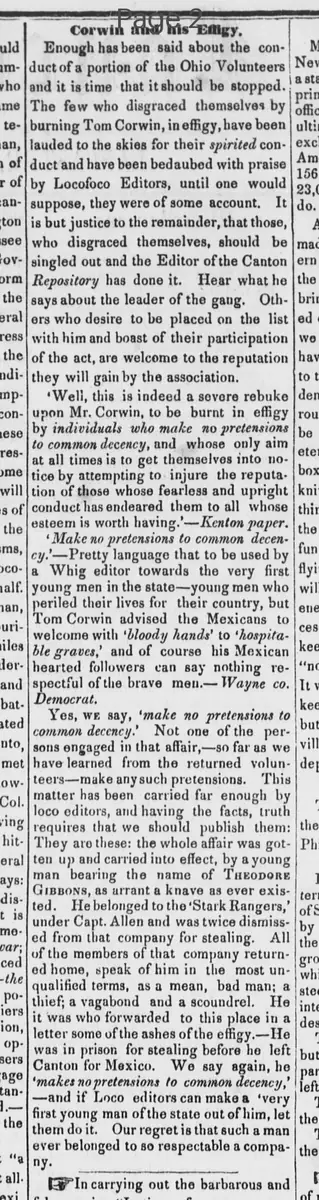
Corwin and His Effigy.
Enough has been said about the conduct of a portion of the Ohio Volunteers and it is time that it should be stopped. The few who disgraced themselves by burning Tom Corwin, in effigy, have been lauded to the skies for their spirited conduct and have been bedaubed with praise by Locofoco Editors, until one would suppose, they were of some account. It is but justice to the remainder, that those, who disgraced themselves, should be singled out and the Editor of the Canton Repository has done it. Hear what he says about the leader of the gang. Others who desire to be placed on the list with him and boast of their participation of the act, are welcome to the reputation they will gain by the association.
Well, this is indeed a severe rebuke upon Mr. Corwin, to be burnt in effigy by individuals who make no pretensions to common decency, and whose only aim at all times is to get themselves into notice by attempting to injure the reputation of those whose fearless and upright conduct has endeared them to all whose esteem is worth having.'—Kenton paper.
'Make no pretensions to common decency.'—Pretty language that to be used by a Whig editor towards the very first young men in the state—young men who periled their lives for their country, but Tom Corwin advised the Mexicans to welcome with 'bloody hands' to 'hospitable graves,' and of course his Mexican hearted followers can say nothing respectful of the brave men.—Wayne co. Democrat.
Yes, we say, 'make no pretensions to common decency.' Not one of the persons engaged in that affair.—so far as we have learned from the returned volunteers—make any such pretensions. This matter has been carried far enough by loco editors, and having the facts, truth requires that we should publish them:
They are these: the whole affair was gotten up and carried into effect, by a young man bearing the name of Theodore Gibbons, as arrant a knave as ever existed. He belonged to the 'Stark Rangers,' under Capt. Allen and was twice dismissed from that company for stealing. All of the members of that company returned home, speak of him in the most unqualified terms, as a mean, bad man; a thief: a vagabond and a scoundrel. He it was who forwarded to this place in a letter some of the ashes of the effigy.—He was in prison for stealing before he left Canton for Mexico. We say again, he 'makes no pretensions to common decency,'—and if Loco editors can make a 'very first young man of the state out of him, let them do it. Our regret is that such a man ever belonged to so respectable a company.
Enough has been said about the conduct of a portion of the Ohio Volunteers and it is time that it should be stopped. The few who disgraced themselves by burning Tom Corwin, in effigy, have been lauded to the skies for their spirited conduct and have been bedaubed with praise by Locofoco Editors, until one would suppose, they were of some account. It is but justice to the remainder, that those, who disgraced themselves, should be singled out and the Editor of the Canton Repository has done it. Hear what he says about the leader of the gang. Others who desire to be placed on the list with him and boast of their participation of the act, are welcome to the reputation they will gain by the association.
Well, this is indeed a severe rebuke upon Mr. Corwin, to be burnt in effigy by individuals who make no pretensions to common decency, and whose only aim at all times is to get themselves into notice by attempting to injure the reputation of those whose fearless and upright conduct has endeared them to all whose esteem is worth having.'—Kenton paper.
'Make no pretensions to common decency.'—Pretty language that to be used by a Whig editor towards the very first young men in the state—young men who periled their lives for their country, but Tom Corwin advised the Mexicans to welcome with 'bloody hands' to 'hospitable graves,' and of course his Mexican hearted followers can say nothing respectful of the brave men.—Wayne co. Democrat.
Yes, we say, 'make no pretensions to common decency.' Not one of the persons engaged in that affair.—so far as we have learned from the returned volunteers—make any such pretensions. This matter has been carried far enough by loco editors, and having the facts, truth requires that we should publish them:
They are these: the whole affair was gotten up and carried into effect, by a young man bearing the name of Theodore Gibbons, as arrant a knave as ever existed. He belonged to the 'Stark Rangers,' under Capt. Allen and was twice dismissed from that company for stealing. All of the members of that company returned home, speak of him in the most unqualified terms, as a mean, bad man; a thief: a vagabond and a scoundrel. He it was who forwarded to this place in a letter some of the ashes of the effigy.—He was in prison for stealing before he left Canton for Mexico. We say again, he 'makes no pretensions to common decency,'—and if Loco editors can make a 'very first young man of the state out of him, let them do it. Our regret is that such a man ever belonged to so respectable a company.
What sub-type of article is it?
Historical Event
What themes does it cover?
Justice
Crime Punishment
Moral Virtue
What keywords are associated?
Effigy Burning
Tom Corwin
Ohio Volunteers
Theodore Gibbons
Stealing
Mexican War
What entities or persons were involved?
Tom Corwin
Theodore Gibbons
Capt. Allen
Where did it happen?
Ohio, Canton
Story Details
Key Persons
Tom Corwin
Theodore Gibbons
Capt. Allen
Location
Ohio, Canton
Story Details
Ohio Volunteers, led by Theodore Gibbons of the Stark Rangers, burned an effigy of Tom Corwin; Gibbons, dismissed twice for stealing and imprisoned before leaving for Mexico, is condemned as a thief and scoundrel by his company; newspaper editors debate the decency of the act and praise or rebuke the participants.