Thank you for visiting SNEWPapers!
Sign up free
Story
May 30, 1826
The National Republican And Ohio Political Register
Cincinnati, Hamilton County, Ohio
What is this article about?
Biographical sketch of Roger Sherman (1721-1793), from shoemaker's apprentice in Massachusetts to eminent Connecticut jurist and signer of the Declaration of Independence, highlighting his rise through industry and intellect.
Clipping
OCR Quality
98%
Excellent
Full Text
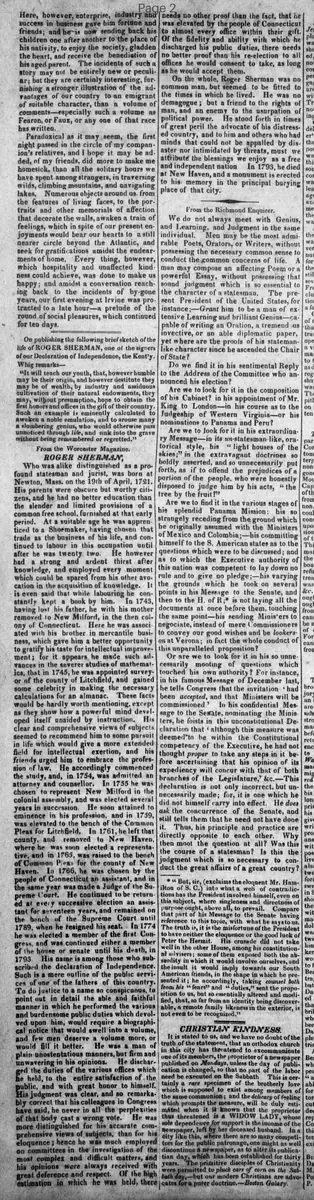
On publishing the following brief sketch of the life of ROGER SHERMAN, one of the signers of our Declaration of Independence, the Kent'y. Whig remarks—
"It will teach our youth, that, however humble may be their origin, and however destitute they may be of wealth, by industry and assiduous cultivation of their natural endowments, they may, without presumption, hope to obtain the first honors and offices in the gift of their country. Such an example is eminently calculated to awaken a noble emulation, and to arouse many a slumbering genius, who would otherwise pass unnoticed through life, and sink into the grave without being remembered or regretted."
From the Worcester Magazine.
ROGER SHERMAN.
Who was alike distinguished as a profound statesman and jurist, was born at Newton, Mass. on the 19th of April, 1721. His parents were obscure but worthy citizens, and he had no better education than the slender and limited provisions of a common free school, furnished at that early period. At a suitable age he was apprenticed to a Shoemaker, having chosen that trade as the business of his life, and continued to labour in this occupation until after he was twenty two. He however had a strong and ardent thirst after knowledge, and employed every moment which could be spared from his other avocation in the acquisition of knowledge. It is even said that while labouring he constantly kept a book by him. In 1743, having lost his father, he with his mother removed to New Milford, in the then colony of Connecticut. Here he was associated with his brother in mercantile business, which gave him a better opportunity to gratify his taste for intellectual improvement; for it appears he made such advances in the severer studies of mathematics, that in 1745, he was appointed surveyor of the county of Litchfield, and gained some celebrity in making the necessary calculations for an almanac. These facts would be hardly worth mentioning, except as they show how a powerful mind developed itself unaided by instruction. His clear and comprehensive views of subjects seemed to recommend him to some pursuit in life which would give a more extended field for intellectual exertion, and his friends urged him to embrace the profession of law. He accordingly commenced the study, and, in 1754, was admitted an attorney and counsellor. In 1755 he was chosen to represent New Milford in the colonial assembly, and was elected several years in succession. He soon attained to eminence in his profession, and in 1759, was elevated to the bench of the Common Pleas for Litchfield. In 1761, he left that county, and removed to New Haven, where he was soon elected a representative, and in 1765, was raised to the bench of Common Pleas for the county of New Haven. In 1766, he was chosen by the people of Connecticut an assistant, and in the same year was made a Judge of the Supreme Court. He continued to be returned at every successive election an assistant for seventeen years, and remained on the bench of the Supreme Court until 1789, when he resigned his seat. In 1774 he was elected a member of the first Congress, and was continued either a member of the house or senate until his death, in 1793. His name is among those who subscribed the declaration of Independence. Such is a mere outline of the public services of one of the fathers of this country. To do justice to a name so conspicuous, to point out in detail the able and faithful manner in which he performed the various and burdensome public duties which devolved upon him, would require a biographical notice that would swell into a volume, and few men deserve a volume more, or would fill it better. He was a man of plain unostentatious manners, but firm and unwavering in his opinions. He discharged the duties of the various offices which he held, to the entire satisfaction of the public, and with great honor to himself. His judgment was clear, and so remarkably correct that his colleagues in Congress have said, he never in all the perplexities of that body cast a wrong vote. He was more distinguished for his accurate comprehensive views of subjects, than for his eloquence; hence he was much employed on committees in the investigation of the most complex and difficult matters, and his opinions were always received with great deference and respect. Of the high estimation in which he was held, there needs no other proof than the fact, that he was elevated by the people of Connecticut to almost every office within their gift. Of the fidelity and ability with which he discharged his public duties, there needs no better proof than his re-election to all offices he would consent to take, as long as he would accept them. On the whole, Roger Sherman was no common man, but seemed to be fitted to the times in which he lived. He was no demagogue; but a friend to the rights of man, and an enemy to the usurpation of political power. He stood forth in times of great peril the advocate of his distressed country, and to him and others who had minds that could not be appalled by disaster nor intimidated by threats, must we attribute the blessings we enjoy as a free and independent nation. In 1793, he died at New Haven, and a monument is erected to his memory in the principal burying place of that city.
"It will teach our youth, that, however humble may be their origin, and however destitute they may be of wealth, by industry and assiduous cultivation of their natural endowments, they may, without presumption, hope to obtain the first honors and offices in the gift of their country. Such an example is eminently calculated to awaken a noble emulation, and to arouse many a slumbering genius, who would otherwise pass unnoticed through life, and sink into the grave without being remembered or regretted."
From the Worcester Magazine.
ROGER SHERMAN.
Who was alike distinguished as a profound statesman and jurist, was born at Newton, Mass. on the 19th of April, 1721. His parents were obscure but worthy citizens, and he had no better education than the slender and limited provisions of a common free school, furnished at that early period. At a suitable age he was apprenticed to a Shoemaker, having chosen that trade as the business of his life, and continued to labour in this occupation until after he was twenty two. He however had a strong and ardent thirst after knowledge, and employed every moment which could be spared from his other avocation in the acquisition of knowledge. It is even said that while labouring he constantly kept a book by him. In 1743, having lost his father, he with his mother removed to New Milford, in the then colony of Connecticut. Here he was associated with his brother in mercantile business, which gave him a better opportunity to gratify his taste for intellectual improvement; for it appears he made such advances in the severer studies of mathematics, that in 1745, he was appointed surveyor of the county of Litchfield, and gained some celebrity in making the necessary calculations for an almanac. These facts would be hardly worth mentioning, except as they show how a powerful mind developed itself unaided by instruction. His clear and comprehensive views of subjects seemed to recommend him to some pursuit in life which would give a more extended field for intellectual exertion, and his friends urged him to embrace the profession of law. He accordingly commenced the study, and, in 1754, was admitted an attorney and counsellor. In 1755 he was chosen to represent New Milford in the colonial assembly, and was elected several years in succession. He soon attained to eminence in his profession, and in 1759, was elevated to the bench of the Common Pleas for Litchfield. In 1761, he left that county, and removed to New Haven, where he was soon elected a representative, and in 1765, was raised to the bench of Common Pleas for the county of New Haven. In 1766, he was chosen by the people of Connecticut an assistant, and in the same year was made a Judge of the Supreme Court. He continued to be returned at every successive election an assistant for seventeen years, and remained on the bench of the Supreme Court until 1789, when he resigned his seat. In 1774 he was elected a member of the first Congress, and was continued either a member of the house or senate until his death, in 1793. His name is among those who subscribed the declaration of Independence. Such is a mere outline of the public services of one of the fathers of this country. To do justice to a name so conspicuous, to point out in detail the able and faithful manner in which he performed the various and burdensome public duties which devolved upon him, would require a biographical notice that would swell into a volume, and few men deserve a volume more, or would fill it better. He was a man of plain unostentatious manners, but firm and unwavering in his opinions. He discharged the duties of the various offices which he held, to the entire satisfaction of the public, and with great honor to himself. His judgment was clear, and so remarkably correct that his colleagues in Congress have said, he never in all the perplexities of that body cast a wrong vote. He was more distinguished for his accurate comprehensive views of subjects, than for his eloquence; hence he was much employed on committees in the investigation of the most complex and difficult matters, and his opinions were always received with great deference and respect. Of the high estimation in which he was held, there needs no other proof than the fact, that he was elevated by the people of Connecticut to almost every office within their gift. Of the fidelity and ability with which he discharged his public duties, there needs no better proof than his re-election to all offices he would consent to take, as long as he would accept them. On the whole, Roger Sherman was no common man, but seemed to be fitted to the times in which he lived. He was no demagogue; but a friend to the rights of man, and an enemy to the usurpation of political power. He stood forth in times of great peril the advocate of his distressed country, and to him and others who had minds that could not be appalled by disaster nor intimidated by threats, must we attribute the blessings we enjoy as a free and independent nation. In 1793, he died at New Haven, and a monument is erected to his memory in the principal burying place of that city.
What sub-type of article is it?
Biography
Personal Triumph
Historical Event
What themes does it cover?
Fortune Reversal
Moral Virtue
Triumph
What keywords are associated?
Roger Sherman
Biography
Declaration Of Independence
Statesman
Shoemaker
Connecticut
Self Education
What entities or persons were involved?
Roger Sherman
Where did it happen?
Newton, Massachusetts; New Milford And New Haven, Connecticut
Story Details
Key Persons
Roger Sherman
Location
Newton, Massachusetts; New Milford And New Haven, Connecticut
Event Date
1721 1793
Story Details
Roger Sherman, born to humble parents in 1721, apprenticed as a shoemaker but pursued self-education, becoming a surveyor, lawyer, judge, and statesman. He served in Connecticut's assembly and courts, signed the Declaration of Independence, and held congressional roles until his death in 1793.