Thank you for visiting SNEWPapers!
Sign up free
Literary
July 13, 1830
Phenix Gazette
Alexandria, Virginia
What is this article about?
Sir Walter Scott recounts his improved health despite lameness, his active pursuits, decision to forgo the bar for literature and sheriff role, and resolutions to avoid literary quarrels, maintain social ties, ignore satire, and secure non-literary income for stability.
Clipping
OCR Quality
95%
Excellent
Full Text
WALTER SCOTT.
The following is an interesting extract from Sir Walter Scott's Auto-Biography:—
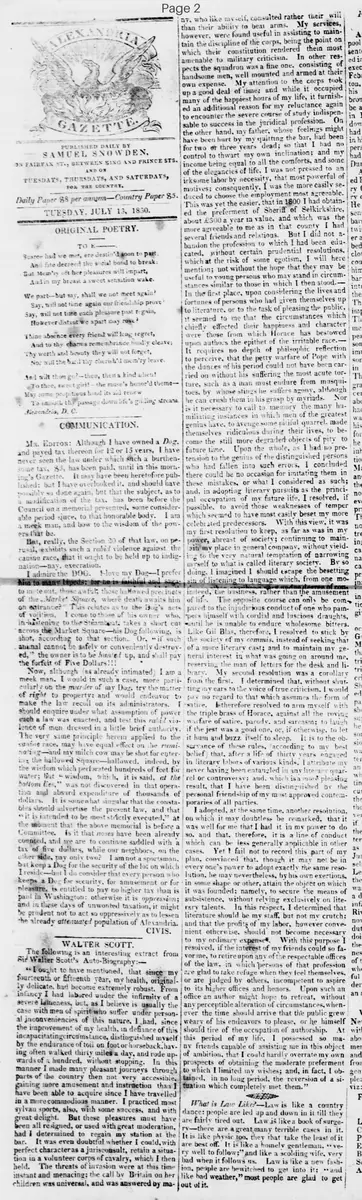
"I ought to have mentioned, that since my fourteenth or fifteenth year, my health, originally delicate, had become extremely robust. From infancy I had labored under the infirmity of a severe lameness, but, as I believe is usually the case with men of spirit who suffer under personal inconveniences of this nature, I had, since the improvement of my health, in defiance of this incapacitating circumstance, distinguished myself by the endurance of toil on foot or horseback, having often walked thirty miles a day, and rode upwards of a hundred, without stopping. In this manner I made many pleasant journeys through parts of the country then not very accessible, gaining more amusement and instruction than I have been able to acquire since I have travelled in a more commodious manner. I practiced most sylvan sports, also, with some success, and with great delight. But these pleasures must have been all resigned, or used with great moderation, had I determined to regain my station at the bar. It was even doubtful whether I could, with perfect character as a jurisconsult, retain a situation in a volunteer corps of cavalry, which I then held. The threats of invasion were at this time instant and menacing; the call by Britain on her children was universal, and was answered by many, who like myself, consulted rather their will than their ability to bear arms. My services, however, were found useful in assisting to maintain the discipline of the corps, being the point on which their constitution rendered them most amenable to military criticism. In other respects the squadron was a fine one, consisting of handsome men, well mounted and armed at their own expense. My attention to the corps took up a good deal of time; and while it occupied many of the happiest hours of my life, it furnished an additional reason for my reluctance again to encounter the severe course of study indispensable to success in the juridical profession. On the other hand, my father, whose feelings might have been hurt by my quitting the bar, had been for two or three years dead; so that I had no control to thwart my own inclination; and my income being equal to all the comforts, and some of the elegancies of life, I was not pressed to an irksome labor by necessity, that most powerful of motives; consequently, I was the more easily seduced to choose the employment most agreeable. This was yet the easier, that in 1799 I had obtained the preferment of Sheriff of Selkirkshire, about £500 a year in value, and which was the more agreeable to me as in that county I had several friends and relations. But I did not abandon the profession to which I had been educated, without certain prudential resolutions, which at the risk of some egotism, I will here mention; not without the hope that they may be useful to young persons who may stand in circumstances similar to those in which I then stood.— In the first place, upon considering the lives and fortunes of persons who had given themselves up to literature, or to the task of pleasing the public, it seemed to me that the circumstances which chiefly affected their happiness and character were those from which Horace has bestowed upon authors the epithet of the irritable race.— It requires no depth of philosophic reflection to perceive, that the petty warfare of Pope with the dunces of his period could not have been carried on without his suffering the most acute torture, such as a man must endure from mosquitoes, by whose stings he suffers agony, although he can crush them in his grasp by myriads. Nor is it necessary to call to memory the many humiliating instances in which men of the greatest genius have, to avenge some pitiful quarrel, made themselves ridiculous during their lives, to become the still more degraded objects of pity to future time. Upon the whole, as I had no pretension to the genius of the distinguished persons who had fallen into such errors, I concluded there could be no occasion for imitating them in these mistakes, or what I considered as such; and, in adopting literary pursuits as the principal occupation of my future life, I resolved, if possible, to avoid those weaknesses of temper which seemed to have most easily beset my more celebrated predecessors. With this view, it was my first resolution to keep, as far as was in my power, abreast of society; continuing to maintain my place in general company, without yielding to the very natural temptation of narrowing myself to what is called literary society. By so doing, I imagined I should escape the besetting sin of listening to language which, indeed, the business, rather than the amusement of life. The opposite course can only be compared to the injudicious conduct of one who pains himself with cordial and luscious draughts, until he is unable to endure wholesome bitters. Like Gil Blas, therefore, I resolved to stick by the society of my commis, instead of seeking that of a more literary cast; and to maintain my general interest in what was going on around me, reserving the man of letters for the desk and library. My second resolution was a corollary from the first. I determined that, without shutting my ears to the voice of true criticism, I would pay no regard to that which assumes the form of satire. I therefore resolved to arm myself with the triple brass of Horace, against all the roving warfare of satire, parody, and sarcasm; to laugh if the jest was a good one, or, if otherwise, to let it hum and buzz itself to sleep. It is to the observance of these rules, according to my best belief that, after a life of thirty years engaged in literary labors of various kinds, I attribute my never having been entangled in any literary quarrel or controversy; and, which is a more pleasing result, that I have been distinguished by the personal friendship of my most approved contemporaries of all parties. I adopted, at the same time, another resolution, on which it may doubtless be remarked, that it was well for me that I had it in my power to do so, and that, therefore, it is a line of conduct which can be less generally applicable in other cases. Yet I fail not to record this part of my plan, convinced that, though it may not be in every one's power to adopt exactly the same resolution, he may nevertheless, by his own exertions, in some shape or other, attain the object on which it was founded: namely, to secure the means of subsistence, without relying exclusively on literary talents. In this respect, I determined that literature should be my staff, but not my crutch: and that the profits of my labor, however convenient otherwise, should not become necessary to my ordinary expense. With this purpose I resolved, if the interest of my friends could so far favor me, to retire upon any of the respectable offices of the law, in which persons of that profession are glad to take refuge when they feel themselves, or are judged by others, incompetent to aspire to its higher offices and honors. Upon such an office an author might hope to retreat, without any perceptible alteration of circumstances, whenever the time should arrive that the public grew weary of his endeavors to please, or he himself should tire of the occupation of authorship. At this period of my life, I possessed so many friends capable of assisting me in this object of ambition, that I could hardly overrate my own prospects of obtaining the moderate preferment to which I limited my wishes; and, in fact, I obtained, in no long period, the reversion of a situation which completely met them."
The following is an interesting extract from Sir Walter Scott's Auto-Biography:—
"I ought to have mentioned, that since my fourteenth or fifteenth year, my health, originally delicate, had become extremely robust. From infancy I had labored under the infirmity of a severe lameness, but, as I believe is usually the case with men of spirit who suffer under personal inconveniences of this nature, I had, since the improvement of my health, in defiance of this incapacitating circumstance, distinguished myself by the endurance of toil on foot or horseback, having often walked thirty miles a day, and rode upwards of a hundred, without stopping. In this manner I made many pleasant journeys through parts of the country then not very accessible, gaining more amusement and instruction than I have been able to acquire since I have travelled in a more commodious manner. I practiced most sylvan sports, also, with some success, and with great delight. But these pleasures must have been all resigned, or used with great moderation, had I determined to regain my station at the bar. It was even doubtful whether I could, with perfect character as a jurisconsult, retain a situation in a volunteer corps of cavalry, which I then held. The threats of invasion were at this time instant and menacing; the call by Britain on her children was universal, and was answered by many, who like myself, consulted rather their will than their ability to bear arms. My services, however, were found useful in assisting to maintain the discipline of the corps, being the point on which their constitution rendered them most amenable to military criticism. In other respects the squadron was a fine one, consisting of handsome men, well mounted and armed at their own expense. My attention to the corps took up a good deal of time; and while it occupied many of the happiest hours of my life, it furnished an additional reason for my reluctance again to encounter the severe course of study indispensable to success in the juridical profession. On the other hand, my father, whose feelings might have been hurt by my quitting the bar, had been for two or three years dead; so that I had no control to thwart my own inclination; and my income being equal to all the comforts, and some of the elegancies of life, I was not pressed to an irksome labor by necessity, that most powerful of motives; consequently, I was the more easily seduced to choose the employment most agreeable. This was yet the easier, that in 1799 I had obtained the preferment of Sheriff of Selkirkshire, about £500 a year in value, and which was the more agreeable to me as in that county I had several friends and relations. But I did not abandon the profession to which I had been educated, without certain prudential resolutions, which at the risk of some egotism, I will here mention; not without the hope that they may be useful to young persons who may stand in circumstances similar to those in which I then stood.— In the first place, upon considering the lives and fortunes of persons who had given themselves up to literature, or to the task of pleasing the public, it seemed to me that the circumstances which chiefly affected their happiness and character were those from which Horace has bestowed upon authors the epithet of the irritable race.— It requires no depth of philosophic reflection to perceive, that the petty warfare of Pope with the dunces of his period could not have been carried on without his suffering the most acute torture, such as a man must endure from mosquitoes, by whose stings he suffers agony, although he can crush them in his grasp by myriads. Nor is it necessary to call to memory the many humiliating instances in which men of the greatest genius have, to avenge some pitiful quarrel, made themselves ridiculous during their lives, to become the still more degraded objects of pity to future time. Upon the whole, as I had no pretension to the genius of the distinguished persons who had fallen into such errors, I concluded there could be no occasion for imitating them in these mistakes, or what I considered as such; and, in adopting literary pursuits as the principal occupation of my future life, I resolved, if possible, to avoid those weaknesses of temper which seemed to have most easily beset my more celebrated predecessors. With this view, it was my first resolution to keep, as far as was in my power, abreast of society; continuing to maintain my place in general company, without yielding to the very natural temptation of narrowing myself to what is called literary society. By so doing, I imagined I should escape the besetting sin of listening to language which, indeed, the business, rather than the amusement of life. The opposite course can only be compared to the injudicious conduct of one who pains himself with cordial and luscious draughts, until he is unable to endure wholesome bitters. Like Gil Blas, therefore, I resolved to stick by the society of my commis, instead of seeking that of a more literary cast; and to maintain my general interest in what was going on around me, reserving the man of letters for the desk and library. My second resolution was a corollary from the first. I determined that, without shutting my ears to the voice of true criticism, I would pay no regard to that which assumes the form of satire. I therefore resolved to arm myself with the triple brass of Horace, against all the roving warfare of satire, parody, and sarcasm; to laugh if the jest was a good one, or, if otherwise, to let it hum and buzz itself to sleep. It is to the observance of these rules, according to my best belief that, after a life of thirty years engaged in literary labors of various kinds, I attribute my never having been entangled in any literary quarrel or controversy; and, which is a more pleasing result, that I have been distinguished by the personal friendship of my most approved contemporaries of all parties. I adopted, at the same time, another resolution, on which it may doubtless be remarked, that it was well for me that I had it in my power to do so, and that, therefore, it is a line of conduct which can be less generally applicable in other cases. Yet I fail not to record this part of my plan, convinced that, though it may not be in every one's power to adopt exactly the same resolution, he may nevertheless, by his own exertions, in some shape or other, attain the object on which it was founded: namely, to secure the means of subsistence, without relying exclusively on literary talents. In this respect, I determined that literature should be my staff, but not my crutch: and that the profits of my labor, however convenient otherwise, should not become necessary to my ordinary expense. With this purpose I resolved, if the interest of my friends could so far favor me, to retire upon any of the respectable offices of the law, in which persons of that profession are glad to take refuge when they feel themselves, or are judged by others, incompetent to aspire to its higher offices and honors. Upon such an office an author might hope to retreat, without any perceptible alteration of circumstances, whenever the time should arrive that the public grew weary of his endeavors to please, or he himself should tire of the occupation of authorship. At this period of my life, I possessed so many friends capable of assisting me in this object of ambition, that I could hardly overrate my own prospects of obtaining the moderate preferment to which I limited my wishes; and, in fact, I obtained, in no long period, the reversion of a situation which completely met them."
What sub-type of article is it?
Essay
What themes does it cover?
Moral Virtue
Social Manners
Political
What keywords are associated?
Autobiography
Literary Career
Sheriff Selkirkshire
Volunteer Corps
Moral Resolutions
Avoiding Quarrels
Social Society
What entities or persons were involved?
Sir Walter Scott
Literary Details
Author
Sir Walter Scott
Subject
Reflections On Career Choices Between Law And Literature Amid Threats Of Invasion
Form / Style
Autobiographical Prose Reflection
Key Lines
I Determined That Literature Should Be My Staff, But Not My Crutch: And That The Profits Of My Labor, However Convenient Otherwise, Should Not Become Necessary To My Ordinary Expense.
I Resolved, If Possible, To Avoid Those Weaknesses Of Temper Which Seemed To Have Most Easily Beset My More Celebrated Predecessors.
I Therefore Resolved To Arm Myself With The Triple Brass Of Horace, Against All The Roving Warfare Of Satire, Parody, And Sarcasm; To Laugh If The Jest Was A Good One, Or, If Otherwise, To Let It Hum And Buzz Itself To Sleep.