Thank you for visiting SNEWPapers!
Sign up free
Poem
August 22, 1860
Cincinnati Daily Press
Cincinnati, Hamilton County, Ohio
What is this article about?
Poem 'The Sea Steamer' by Oliver Wendell Holmes vividly describes a steamship's majestic journey through sea and storm, symbolizing human progress. Followed by excerpt from Thackeray's lecture on George I's life, reign, and historical context in England.
Clipping
OCR Quality
95%
Excellent
Full Text
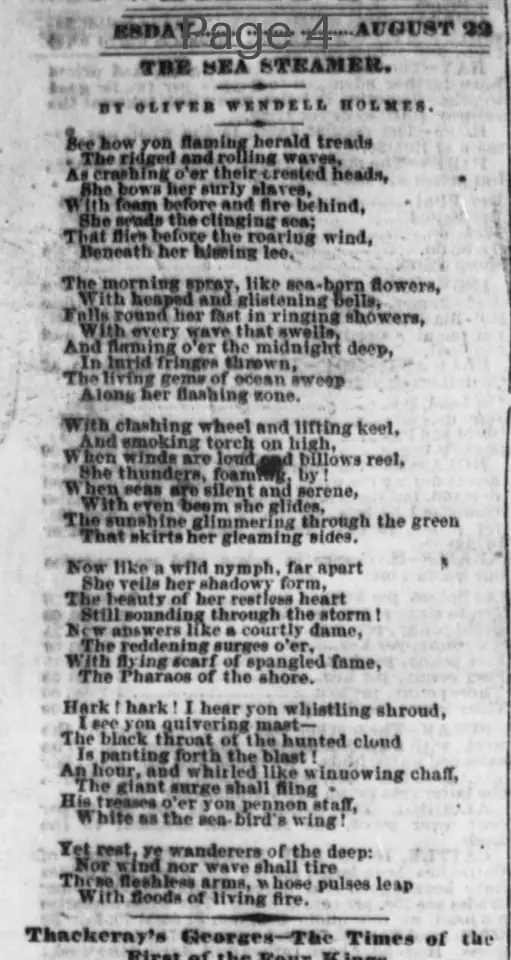
THE SEA STEAMER.
BY OLIVER WENDELL HOLMES.
See how yon flaming herald treads
The ridged and rolling wave,
As, crashing o'er their crested heads,
She bows her surly slave
With foam before and fire behind,
She feeds the clinging sea;
That flies before the roaring wind,
Beneath her hissing lea.
The morning spray, like sea-born flowers,
With heaped and glistening bells,
Falls round her fast in ringing showers,
With every wave that swells
And flashing o'er the midnight deep
In lurid fringes thrown,
The living gems of ocean sweep
Along her flashing zone.
With clashing wheel and lifting keel,
And smoking torch on high,
When winds are loud and billows reel,
She thunders, foaming, by;
When seas are silent and serene,
With even beam she glides,
The sunshine glimmering through the green
That skirts her gleaming sides.
Now like a wild nymph, far apart,
She veils her shadowy form,
The beauty of her restless heart
Still sounding through the storm;
Now answers like a courtly dame,
The reddening surges scan
With flying scarf of spangled flame,
The Pharos of the shore.
Hark! hark! I hear yon whistling shroud,
I see yon quivering mast,
The black throat of the hunted cloud
Panting forth the blast;
An hour, and whirled like winnowing chaff,
The giant surge shall fling
His treasses o'er yon pennon staff,
White as the sea-bird's wing.
Yet rest, ye wanderers of the deep:
Nor wind nor wave shall tire
These fleshless arms, whose pulses leap
With floods of living fire.
Thackeray's Georges—The Times of the First of the Four Kings.
The last Cornhill Magazine has the first of Thackeray's excellent lectures on "The Four Kings of England." The following extract therefrom relates to the life and times of George I:
Delightful as London city was, King George I liked to be out of it as much as ever he could; and when there, passed all of his time with his Germans. It was with them as with Blucher one hundred years afterward, when the bold old reiter looked down from St. Paul's and sighed out, "Was fur plunder?" The German women plundered; the German Secretaries plundered; the German cooks and intendants plundered; even Mustapha and Mahomet, the German negroes, had a share of the booty. Take what you can get, was the old Monarch's maxim. He was not a lofty Monarch, certainly; he was not a patron of the fine arts; but he was not a hypocrite, he was not revengeful, he was not extravagant. Though a despot in Hanover, he was a moderate ruler in England. His aim was to leave it to itself as much as possible, and to live out of it as much as he could. His heart was in Hanover. When taken ill on his last journey, as he was passing through Holland he thrust his livid head out of the coach window and gasped out, "Osnaburg! Osnaburg!"
He was more than fifty years of age when he came among us; we took him because we wanted him, because he served our turn: we laughed at his uncouth German way, and sneered at him. He took our loyalty for what it was worth; laid hands on what money he could; kept us assuredly from Popery and wooden shoes. I, for one, would have been on his side in those days. Cynical and selfish as he was, he was better than a king out of St. Germains, with the French king's orders in his pocket, and a swarm of Jesuits in his train.
The fates are supposed to interest themselves about royal personages; and so this one had omens and prophecies specially regarding him. He was said to be much disturbed at a prophecy that he should die very soon after his wife, and sure enough pallid death, having seized upon the luckless Princess in her castle of Ahlden, presently pounced upon H. M. King George I in his traveling chariot, on the Hanover Road. What postilion can outride that pale horseman? It is said George promised one of his left-handed widows to come to her after death, if leave were granted to him to revisit the glimpses of the moon; and soon after his demise a gray raven actually flying or hopping in at the Duchess of Kendal's window, at Twickenham, she chose to imagine the King's spirit inhabited these plumes and took special care of her sable visitor. Affecting metempsychosis—funereal royal bird! How pathetic is the idea of the Duchess weeping over it! When this chaste addition to our English aristocracy died, all her jewels, her plate, her plunder, went over to her relations in Hanover. I wonder whether her heirs took the bird, and whether it is still flapping its wings over Herrenhausen?
The days are over in England of that strange religion of king-worship, when priests flattered princes in the Temple of God; when servility was held to be ennobling duty; when beauty and youth tried eagerly for royal favor and woman's shame was held to be no dishonor. Mended morals and mended manners in courts and people, are among the priceless consequences of the freedom which George I came to rescue and secure. He kept his compact with his English subjects; and, if he escaped no more than other men and monarchs from the vices of his age, at least we may thank him for preserving and transmitting the liberties of ours. In our free air, royal and humble homes have alike been purified; and truth, the birthright of high and low among us, which quite fearlessly judges our greatest personages, can only speak of them now in words of respect and regard. There are stains in the portrait of the first George, and traits in it which none of us need admire; but among the nobler features are justice, courage, moderation—and these we may recognize ere we turn the picture on the wall.
BY OLIVER WENDELL HOLMES.
See how yon flaming herald treads
The ridged and rolling wave,
As, crashing o'er their crested heads,
She bows her surly slave
With foam before and fire behind,
She feeds the clinging sea;
That flies before the roaring wind,
Beneath her hissing lea.
The morning spray, like sea-born flowers,
With heaped and glistening bells,
Falls round her fast in ringing showers,
With every wave that swells
And flashing o'er the midnight deep
In lurid fringes thrown,
The living gems of ocean sweep
Along her flashing zone.
With clashing wheel and lifting keel,
And smoking torch on high,
When winds are loud and billows reel,
She thunders, foaming, by;
When seas are silent and serene,
With even beam she glides,
The sunshine glimmering through the green
That skirts her gleaming sides.
Now like a wild nymph, far apart,
She veils her shadowy form,
The beauty of her restless heart
Still sounding through the storm;
Now answers like a courtly dame,
The reddening surges scan
With flying scarf of spangled flame,
The Pharos of the shore.
Hark! hark! I hear yon whistling shroud,
I see yon quivering mast,
The black throat of the hunted cloud
Panting forth the blast;
An hour, and whirled like winnowing chaff,
The giant surge shall fling
His treasses o'er yon pennon staff,
White as the sea-bird's wing.
Yet rest, ye wanderers of the deep:
Nor wind nor wave shall tire
These fleshless arms, whose pulses leap
With floods of living fire.
Thackeray's Georges—The Times of the First of the Four Kings.
The last Cornhill Magazine has the first of Thackeray's excellent lectures on "The Four Kings of England." The following extract therefrom relates to the life and times of George I:
Delightful as London city was, King George I liked to be out of it as much as ever he could; and when there, passed all of his time with his Germans. It was with them as with Blucher one hundred years afterward, when the bold old reiter looked down from St. Paul's and sighed out, "Was fur plunder?" The German women plundered; the German Secretaries plundered; the German cooks and intendants plundered; even Mustapha and Mahomet, the German negroes, had a share of the booty. Take what you can get, was the old Monarch's maxim. He was not a lofty Monarch, certainly; he was not a patron of the fine arts; but he was not a hypocrite, he was not revengeful, he was not extravagant. Though a despot in Hanover, he was a moderate ruler in England. His aim was to leave it to itself as much as possible, and to live out of it as much as he could. His heart was in Hanover. When taken ill on his last journey, as he was passing through Holland he thrust his livid head out of the coach window and gasped out, "Osnaburg! Osnaburg!"
He was more than fifty years of age when he came among us; we took him because we wanted him, because he served our turn: we laughed at his uncouth German way, and sneered at him. He took our loyalty for what it was worth; laid hands on what money he could; kept us assuredly from Popery and wooden shoes. I, for one, would have been on his side in those days. Cynical and selfish as he was, he was better than a king out of St. Germains, with the French king's orders in his pocket, and a swarm of Jesuits in his train.
The fates are supposed to interest themselves about royal personages; and so this one had omens and prophecies specially regarding him. He was said to be much disturbed at a prophecy that he should die very soon after his wife, and sure enough pallid death, having seized upon the luckless Princess in her castle of Ahlden, presently pounced upon H. M. King George I in his traveling chariot, on the Hanover Road. What postilion can outride that pale horseman? It is said George promised one of his left-handed widows to come to her after death, if leave were granted to him to revisit the glimpses of the moon; and soon after his demise a gray raven actually flying or hopping in at the Duchess of Kendal's window, at Twickenham, she chose to imagine the King's spirit inhabited these plumes and took special care of her sable visitor. Affecting metempsychosis—funereal royal bird! How pathetic is the idea of the Duchess weeping over it! When this chaste addition to our English aristocracy died, all her jewels, her plate, her plunder, went over to her relations in Hanover. I wonder whether her heirs took the bird, and whether it is still flapping its wings over Herrenhausen?
The days are over in England of that strange religion of king-worship, when priests flattered princes in the Temple of God; when servility was held to be ennobling duty; when beauty and youth tried eagerly for royal favor and woman's shame was held to be no dishonor. Mended morals and mended manners in courts and people, are among the priceless consequences of the freedom which George I came to rescue and secure. He kept his compact with his English subjects; and, if he escaped no more than other men and monarchs from the vices of his age, at least we may thank him for preserving and transmitting the liberties of ours. In our free air, royal and humble homes have alike been purified; and truth, the birthright of high and low among us, which quite fearlessly judges our greatest personages, can only speak of them now in words of respect and regard. There are stains in the portrait of the first George, and traits in it which none of us need admire; but among the nobler features are justice, courage, moderation—and these we may recognize ere we turn the picture on the wall.
What sub-type of article is it?
Ode
What themes does it cover?
Science Progress
Nature Seasons
What keywords are associated?
Sea Steamer
Steamship
Ocean Waves
Stormy Seas
Technological Marvel
What entities or persons were involved?
By Oliver Wendell Holmes.
Poem Details
Title
The Sea Steamer.
Author
By Oliver Wendell Holmes.
Form / Style
Rhymed Quatrains
Key Lines
See How Yon Flaming Herald Treads
The Ridged And Rolling Wave,
As, Crashing O'er Their Crested Heads,
She Bows Her Surly Slave