Thank you for visiting SNEWPapers!
Sign up free
Story
June 17, 1897
The Morning News
Savannah, Chatham County, Georgia
What is this article about?
Article on the history and operations of press clipping bureaus, originating in Paris 17 years ago and New York in 1884, employing thousands globally, serving prominent figures, institutions, and governments with clippings on various topics, including scrapbook compilations for events and individuals.
Clipping
OCR Quality
96%
Excellent
Full Text
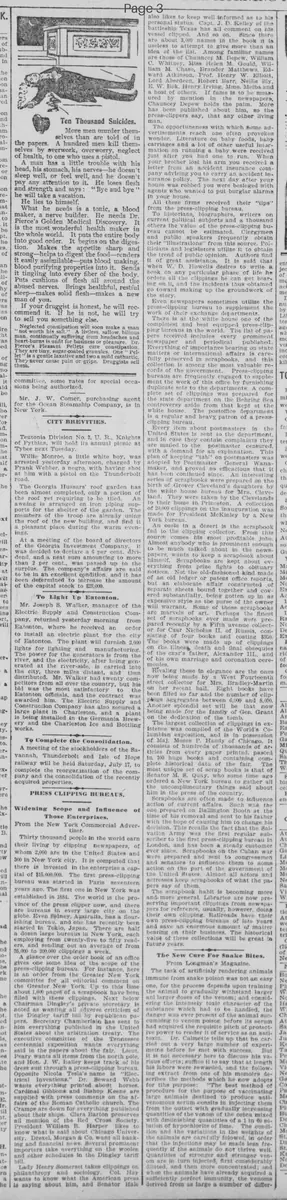
PRESS CLIPPING BUREAUS.
Widening Scope and Influence of Those Enterprises.
From the New York Commercial Advertiser.
Thirty thousand people in the world earn their living by clipping newspapers, of whom 2,000 are in the United States and 300 in New York city. It is computed that there is invested in the enterprise a capital of $15,000,000. The first press-clipping bureau was started in Paris seventeen years ago. The first one in New York was established in 1884. The world is the province of the press clipper now, and there are bureaus in every large city on the globe. Even Sidney, Australia, has a flourishing bureau, and one has recently been started in Tokyo, Japan. There are half a dozen large bureaus in New York, each employing from twenty-five to fifty readers, and sending out an average of from 35,000 to 200,000 clippings a week.
A glance over the order book of an office gives one some idea of the scope of the press-clipping bureau. For instance, here is an order from the Greater New York committee for all editorial comment on the Greater New York. Up to this time about 1,000 pages of a scrapbook have been filled with these clippings. Next below Chairman Dingley's private secretary is noted as wanting all adverse criticism of the Dingley tariff bill by republican papers. Secretary Chamberlain has sent to him everything published in the United States about the arbitration treaty. The executive committee of the Tennessee centennial exposition wants everything said in the papers about the fair. Lieut. Peary wants all items from the north pole, and Hon. J. W. Bailey keeps track of his dress suit through a press-clipping bureau. Opposite Nicola Tesla's name is "Electrical Inventions." Dr. Seward Webb wants everything printed about horses. Cardinal Gibbons and Bishop Keane are supplied with press comments on the affairs of the Roman Catholic church. The Cramps are down for everything published about their ships. Clara Barton preserves all mention of the Red Cross Society. President William R. Harper likes to know what is said about Chicago University. Drexel, Morgan & Co. want all banking and financial news. Several prominent importers take everything on the woolen and other schedules in the Dingley tariff bill.
Lady Henry Somerset takes clippings on philanthropy and sociology. Col. Hay wants to know what the American press is saying about him, and Senator Hale also likes to keep well informed as to his personal status. Capt. J. D. Kelley of the battleship Texas has all comment on his vessel clipped. And so on. Since there are about 3,000 names in the book it is useless to attempt to give more than an idea of the list. Among familiar names are those of Chauncey M. Depew, William C. Whitney, Miss Helen M. Gould, William M. Chase, Brander Matthews, Edward Atkinson, Prof. Henry W. Elliott, Lord Aberdeen, Robert Barr, Nellie Bly, E. W. Bok, Henry Irving, Mme. Melba and a host of others. If fame is to be measured by mention in the newspapers, Chauncey Depew holds the palm. More has been published about him, so the press-clippers say, than any other living man.
The opportuneness with which some advertisements reach one often provokes wonder. Literature on baby foods, baby carriages and a lot of other useful information on running a baby were received just after you had one to run. When your brother lost his arm you received a letter from an accident insurance company advising you to carry an accident insurance policy. The next day after your house was robbed you were besieged with agents who wanted to put burglar alarms in your house.
All these firms received their "tips" from the press-clipping bureau.
To historians, biographers, writers on current political subjects and a thousand others the value of the press-clipping bureau cannot be estimated. Clergymen and public speakers frequently obtain their "illustrations" from this source. Politicians and legislators utilize it to obtain the trend of public opinion. Authors find it of great assistance. It is said that when W. D. Howells desires to write a book on any particular phase of life he orders all the clippings he can get bearing on it, and the incidents thus obtained go toward making up the groundwork of the story.
Even newspapers sometimes utilize the press-clipping bureau to supplement the work of their exchange departments.
There is at the white house one of the completest and best equipped press-clipping bureaus in the world. The list of papers received includes every prominent newspaper and periodical published. Everything of importance bearing on state matters or international affairs is carefully preserved in scrapbooks, and this collection is among the most valuable records of the government. Press-clipping bureaus are frequently engaged to supplement the work of this office by furnishing duplicate sets to the departments. A complete set of clippings was prepared for the state department on the Behring Sea controversy aside from that kept at the white house. The postoffice department is a regular and heavy patron of a press-clipping bureau. Every item about postmasters in the United States is sent to the department, and in case they contain complaints they are mailed to the postmaster censured, with a demand for an explanation. This plan of keeping "tab" on postmasters was adopted by Postmaster General Wanamaker, and proved so efficacious that it has been continued since. An interesting series of scrapbooks were prepared on the birth of Grover Cleveland's daughters by the white house bureau for Mrs. Cleveland. They were taken by the Clevelands to their home in Princeton. A collection of 20,000 clippings on the inauguration was made for President McKinley by a New York bureau.
An oasis in a desert is the scrapbook fad to the clipping collector. From this source comes his most profitable jobs. Almost anybody who is prominent enough to be much talked about in the newspapers, wants to keep a scrapbook about himself. Scrapbooks are kept about everything from prize fights to obituary notices. Not the old-fashioned kind made of an old ledger or patent office reports, but an elaborate affair constructed of separate sheets bound together and covered substantially, being gotten up in as expensive style as the purse of the owner will warrant. Some of these scrapbooks are marvels of art. Perhaps the finest set of scrapbooks ever made were prepared recently by a Fifth avenue collector for Czar Nicholas II. of Russia, consisting of four books and costing $950. The books were made up of clippings on the illness, death and final obsequies of the czar's father, Alexander III., and of his own marriage and coronation ceremonies.
Rivaling these in elegance are the ones now being made by a West Fourteenth street collector for Mrs. Bradley-Martin on her recent ball. Eight books have been filled so far and the number of clippings aggregates between 6,000 and 8,000. Another splendid set will be that now being made for the family of Gen. Grant on the dedication of the tomb.
The largest collection of clippings in existence was compiled of the World's Columbian exposition, and is in possession of Maj. Moses P. Handy of Chicago. It consists of hundreds of thousands of articles from every paper printed, pasted in 100 huge books and containing complete historical data of the fair. The most unique set of scrap books is that of Senator M. S. Quay, who some time ago ordered a New York bureau to gather all the uncomplimentary things said about him in the press of the country.
Scrapbooks are often made to influence action of current affairs. Such was the one prepared on Ballington Booth at the time of his removal and sent to his father with the hope of causing him to change his decision. This recalls the fact that the Salvation Army was the first regular subscriber to the first press-clipping bureau in London, and has been a steady customer ever since. Scrapbooks on the Cuban war were prepared and sent to congressmen and senators to influence them to some action on the part of the government of the United States. Almost all actors and actresses keep scrapbooks of what the papers say of them.
The scrapbook habit is becoming more and more general. Libraries are now preserving important clippings from newspapers for reference, usually, however, doing their own clipping. Railroads have their own press-clipping bureaus of late years and save an enormous amount of matter bearing on their business. The historical value of these collections will be great in future years.
Widening Scope and Influence of Those Enterprises.
From the New York Commercial Advertiser.
Thirty thousand people in the world earn their living by clipping newspapers, of whom 2,000 are in the United States and 300 in New York city. It is computed that there is invested in the enterprise a capital of $15,000,000. The first press-clipping bureau was started in Paris seventeen years ago. The first one in New York was established in 1884. The world is the province of the press clipper now, and there are bureaus in every large city on the globe. Even Sidney, Australia, has a flourishing bureau, and one has recently been started in Tokyo, Japan. There are half a dozen large bureaus in New York, each employing from twenty-five to fifty readers, and sending out an average of from 35,000 to 200,000 clippings a week.
A glance over the order book of an office gives one some idea of the scope of the press-clipping bureau. For instance, here is an order from the Greater New York committee for all editorial comment on the Greater New York. Up to this time about 1,000 pages of a scrapbook have been filled with these clippings. Next below Chairman Dingley's private secretary is noted as wanting all adverse criticism of the Dingley tariff bill by republican papers. Secretary Chamberlain has sent to him everything published in the United States about the arbitration treaty. The executive committee of the Tennessee centennial exposition wants everything said in the papers about the fair. Lieut. Peary wants all items from the north pole, and Hon. J. W. Bailey keeps track of his dress suit through a press-clipping bureau. Opposite Nicola Tesla's name is "Electrical Inventions." Dr. Seward Webb wants everything printed about horses. Cardinal Gibbons and Bishop Keane are supplied with press comments on the affairs of the Roman Catholic church. The Cramps are down for everything published about their ships. Clara Barton preserves all mention of the Red Cross Society. President William R. Harper likes to know what is said about Chicago University. Drexel, Morgan & Co. want all banking and financial news. Several prominent importers take everything on the woolen and other schedules in the Dingley tariff bill.
Lady Henry Somerset takes clippings on philanthropy and sociology. Col. Hay wants to know what the American press is saying about him, and Senator Hale also likes to keep well informed as to his personal status. Capt. J. D. Kelley of the battleship Texas has all comment on his vessel clipped. And so on. Since there are about 3,000 names in the book it is useless to attempt to give more than an idea of the list. Among familiar names are those of Chauncey M. Depew, William C. Whitney, Miss Helen M. Gould, William M. Chase, Brander Matthews, Edward Atkinson, Prof. Henry W. Elliott, Lord Aberdeen, Robert Barr, Nellie Bly, E. W. Bok, Henry Irving, Mme. Melba and a host of others. If fame is to be measured by mention in the newspapers, Chauncey Depew holds the palm. More has been published about him, so the press-clippers say, than any other living man.
The opportuneness with which some advertisements reach one often provokes wonder. Literature on baby foods, baby carriages and a lot of other useful information on running a baby were received just after you had one to run. When your brother lost his arm you received a letter from an accident insurance company advising you to carry an accident insurance policy. The next day after your house was robbed you were besieged with agents who wanted to put burglar alarms in your house.
All these firms received their "tips" from the press-clipping bureau.
To historians, biographers, writers on current political subjects and a thousand others the value of the press-clipping bureau cannot be estimated. Clergymen and public speakers frequently obtain their "illustrations" from this source. Politicians and legislators utilize it to obtain the trend of public opinion. Authors find it of great assistance. It is said that when W. D. Howells desires to write a book on any particular phase of life he orders all the clippings he can get bearing on it, and the incidents thus obtained go toward making up the groundwork of the story.
Even newspapers sometimes utilize the press-clipping bureau to supplement the work of their exchange departments.
There is at the white house one of the completest and best equipped press-clipping bureaus in the world. The list of papers received includes every prominent newspaper and periodical published. Everything of importance bearing on state matters or international affairs is carefully preserved in scrapbooks, and this collection is among the most valuable records of the government. Press-clipping bureaus are frequently engaged to supplement the work of this office by furnishing duplicate sets to the departments. A complete set of clippings was prepared for the state department on the Behring Sea controversy aside from that kept at the white house. The postoffice department is a regular and heavy patron of a press-clipping bureau. Every item about postmasters in the United States is sent to the department, and in case they contain complaints they are mailed to the postmaster censured, with a demand for an explanation. This plan of keeping "tab" on postmasters was adopted by Postmaster General Wanamaker, and proved so efficacious that it has been continued since. An interesting series of scrapbooks were prepared on the birth of Grover Cleveland's daughters by the white house bureau for Mrs. Cleveland. They were taken by the Clevelands to their home in Princeton. A collection of 20,000 clippings on the inauguration was made for President McKinley by a New York bureau.
An oasis in a desert is the scrapbook fad to the clipping collector. From this source comes his most profitable jobs. Almost anybody who is prominent enough to be much talked about in the newspapers, wants to keep a scrapbook about himself. Scrapbooks are kept about everything from prize fights to obituary notices. Not the old-fashioned kind made of an old ledger or patent office reports, but an elaborate affair constructed of separate sheets bound together and covered substantially, being gotten up in as expensive style as the purse of the owner will warrant. Some of these scrapbooks are marvels of art. Perhaps the finest set of scrapbooks ever made were prepared recently by a Fifth avenue collector for Czar Nicholas II. of Russia, consisting of four books and costing $950. The books were made up of clippings on the illness, death and final obsequies of the czar's father, Alexander III., and of his own marriage and coronation ceremonies.
Rivaling these in elegance are the ones now being made by a West Fourteenth street collector for Mrs. Bradley-Martin on her recent ball. Eight books have been filled so far and the number of clippings aggregates between 6,000 and 8,000. Another splendid set will be that now being made for the family of Gen. Grant on the dedication of the tomb.
The largest collection of clippings in existence was compiled of the World's Columbian exposition, and is in possession of Maj. Moses P. Handy of Chicago. It consists of hundreds of thousands of articles from every paper printed, pasted in 100 huge books and containing complete historical data of the fair. The most unique set of scrap books is that of Senator M. S. Quay, who some time ago ordered a New York bureau to gather all the uncomplimentary things said about him in the press of the country.
Scrapbooks are often made to influence action of current affairs. Such was the one prepared on Ballington Booth at the time of his removal and sent to his father with the hope of causing him to change his decision. This recalls the fact that the Salvation Army was the first regular subscriber to the first press-clipping bureau in London, and has been a steady customer ever since. Scrapbooks on the Cuban war were prepared and sent to congressmen and senators to influence them to some action on the part of the government of the United States. Almost all actors and actresses keep scrapbooks of what the papers say of them.
The scrapbook habit is becoming more and more general. Libraries are now preserving important clippings from newspapers for reference, usually, however, doing their own clipping. Railroads have their own press-clipping bureaus of late years and save an enormous amount of matter bearing on their business. The historical value of these collections will be great in future years.
What sub-type of article is it?
Curiosity
Historical Event
What themes does it cover?
Triumph
What keywords are associated?
Press Clipping Bureaus
Newspaper Clippings
Scrapbooks
Famous Clients
Historical Collections
Media Monitoring
Global Reach
What entities or persons were involved?
Chauncey M. Depew
Nicola Tesla
Clara Barton
Czar Nicholas Ii.
Grover Cleveland
Where did it happen?
New York City, United States; Paris, France; Global Cities
Story Details
Key Persons
Chauncey M. Depew
Nicola Tesla
Clara Barton
Czar Nicholas Ii.
Grover Cleveland
Location
New York City, United States; Paris, France; Global Cities
Event Date
1884; Seventeen Years Ago
Story Details
Description of the origins, growth, operations, and diverse clients of press clipping bureaus, including politicians, celebrities, institutions, and governments, with emphasis on scrapbook compilations for personal and historical records.