Thank you for visiting SNEWPapers!
Sign up free
Editorial
April 10, 1903
The Commoner
Lincoln, Lancaster County, Nebraska
What is this article about?
Editorial discusses opposition to Grover Cleveland's potential fourth presidential candidacy from editor Watterson, contrasted with support from a 'Mr. Jones' in the Philadelphia Record. Suggests nominating Cleveland openly if party shifts from people to plutocrats, allowing clear voter choice.
Clipping
OCR Quality
95%
Excellent
Full Text
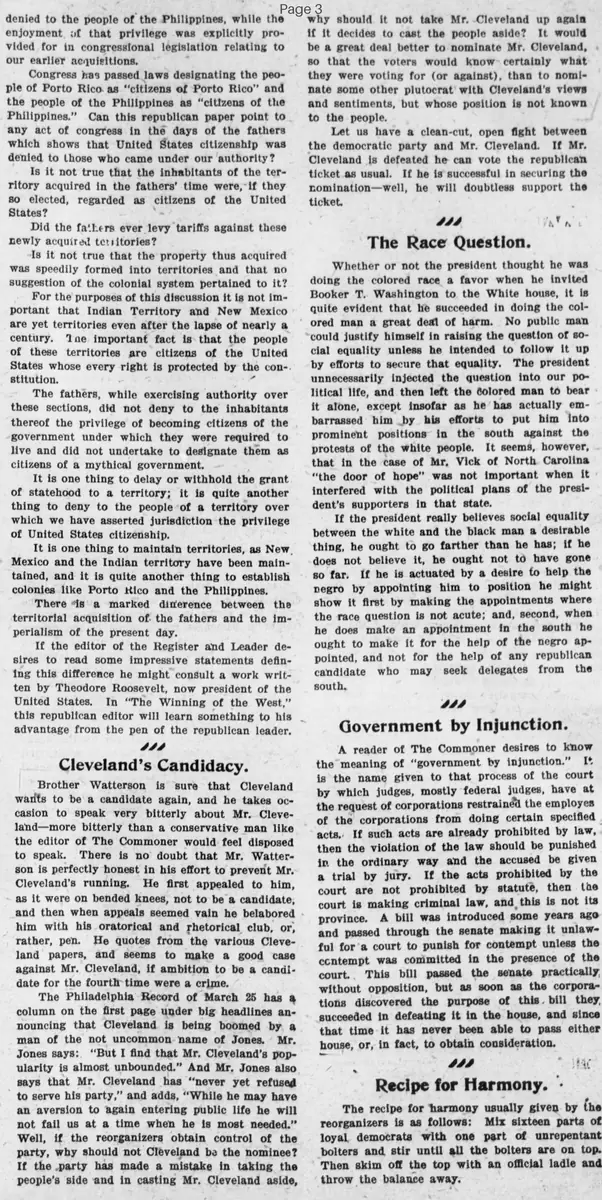
Cleveland's Candidacy.
Brother Watterson is sure that Cleveland wants to be a candidate again, and he takes occasion to speak very bitterly about Mr. Cleveland-more bitterly than a conservative man like the editor of The Commoner would feel disposed to speak. There is no doubt that Mr. Watterson is perfectly honest in his effort to prevent Mr. Cleveland's running. He first appealed to him, as it were on bended knees, not to be a candidate, and then when appeals seemed vain he belabored him with his oratorical and rhetorical club, or, rather, pen. He quotes from the various Cleveland papers, and seems to make a good case against Mr. Cleveland, if ambition to be a candidate for the fourth time were a crime.
The Philadelphia Record of March 25 has a column on the first page under big headlines announcing that Cleveland is being boomed by a man of the not uncommon name of Jones. Mr. Jones says: "But I find that Mr. Cleveland's popularity is almost unbounded." And Mr. Jones also says that Mr. Cleveland has "never yet refused to serve his party," and adds, "While he may have an aversion to again entering public life he will not fail us at a time when he is most needed."
Well, if the reorganizers obtain control of the party, why should not Cleveland be the nominee? If the party has made a mistake in taking the people's side and in casting Mr. Cleveland aside, why should it not take Mr. Cleveland up again if it decides to cast the people aside? It would be a great deal better to nominate Mr. Cleveland, so that the voters would know certainly what they were voting for (or against), than to nominate some other plutocrat with Cleveland's views and sentiments, but whose position is not known to the people.
Let us have a clean-cut, open fight between the democratic party and Mr. Cleveland. If Mr. Cleveland is defeated he can vote the republican ticket as usual. If he is successful in securing the nomination-well, he will doubtless support the ticket.
Brother Watterson is sure that Cleveland wants to be a candidate again, and he takes occasion to speak very bitterly about Mr. Cleveland-more bitterly than a conservative man like the editor of The Commoner would feel disposed to speak. There is no doubt that Mr. Watterson is perfectly honest in his effort to prevent Mr. Cleveland's running. He first appealed to him, as it were on bended knees, not to be a candidate, and then when appeals seemed vain he belabored him with his oratorical and rhetorical club, or, rather, pen. He quotes from the various Cleveland papers, and seems to make a good case against Mr. Cleveland, if ambition to be a candidate for the fourth time were a crime.
The Philadelphia Record of March 25 has a column on the first page under big headlines announcing that Cleveland is being boomed by a man of the not uncommon name of Jones. Mr. Jones says: "But I find that Mr. Cleveland's popularity is almost unbounded." And Mr. Jones also says that Mr. Cleveland has "never yet refused to serve his party," and adds, "While he may have an aversion to again entering public life he will not fail us at a time when he is most needed."
Well, if the reorganizers obtain control of the party, why should not Cleveland be the nominee? If the party has made a mistake in taking the people's side and in casting Mr. Cleveland aside, why should it not take Mr. Cleveland up again if it decides to cast the people aside? It would be a great deal better to nominate Mr. Cleveland, so that the voters would know certainly what they were voting for (or against), than to nominate some other plutocrat with Cleveland's views and sentiments, but whose position is not known to the people.
Let us have a clean-cut, open fight between the democratic party and Mr. Cleveland. If Mr. Cleveland is defeated he can vote the republican ticket as usual. If he is successful in securing the nomination-well, he will doubtless support the ticket.
What sub-type of article is it?
Partisan Politics
What keywords are associated?
Cleveland Candidacy
Democratic Nomination
Watterson Opposition
Party Reorganizers
Plutocrat Nominee
What entities or persons were involved?
Cleveland
Watterson
The Commoner
Philadelphia Record
Mr. Jones
Reorganizers
Democratic Party
Editorial Details
Primary Topic
Grover Cleveland's Potential Democratic Presidential Candidacy
Stance / Tone
Sarcastic Support For Open Nomination To Clarify Party Direction
Key Figures
Cleveland
Watterson
The Commoner
Philadelphia Record
Mr. Jones
Reorganizers
Democratic Party
Key Arguments
Watterson Bitterly Opposes Cleveland's Fourth Candidacy
Mr. Jones Promotes Cleveland's Unbounded Popularity And Party Service
Nominate Cleveland If Party Shifts To Plutocrats For Voter Clarity
Better Open Fight Between Party And Cleveland Than Hidden Similar Nominee