Thank you for visiting SNEWPapers!
Sign up free
Literary
January 14, 1933
The Bismarck Tribune
Bismarck, Mandan, Burleigh County, Morton County, North Dakota
What is this article about?
Thatcher Colt questions a boy and his mother about discovering a bloody scene, consults a locksmith about a key made for a mysterious woman, and interviews an elevator operator about a suspicious visitor to Geraldine's apartment. Leads point to a clever female forger. Colt announces solving the case. (To be continued.)
Clipping
OCR Quality
92%
Excellent
Full Text
THE MYSTERY OF GERALDINE by ANTHONY ABBOT
And it was all covered with blood."
"Warren, was it a man or a woman?"
"It was a lady," answered the boy, beginning to whimper.
"Fine lady,"
said his mother
"even if she was murdered."
"What did you do then?"
"I ran home."
"Did you tell your mother?"
"Not a word." said Mrs. Planzen bitterly. And the ill-favored look she gave Warren boded ill for the presidential namesake's peace after our departure.
"Is that all you know about the case?" persisted Thatcher Colt.
"Did you see anything else up there?"
"No. sir. I went back the next day. but I didn't see anything. I was afraid to go in any more. But I liked to hang around-that is why you found me the day you came up there."
When we emerged from the house, Thatcher Colt was very thoughtful. At the corner, he stopped and chatted with the patrolman stationed there-a youthful policeman. almost inarticulate on finding himself face to face with the Commissioner,
"Is there a locksmith near here?" Thatcher Colt asked him.
"Yes-right there," the patrolman replied, pointing to a basement shop across the street. A light was still burning in its tiny window.
The Key.
The locksmith was a thin, weazened old man with dark glasses.
"Ever see that before?" asked Thatcher Colt. throwing down the old-fashioned key with the blue ribbon.
"I made it."
"For whom?"
"A lady. I don't know her name."
"Describe her."
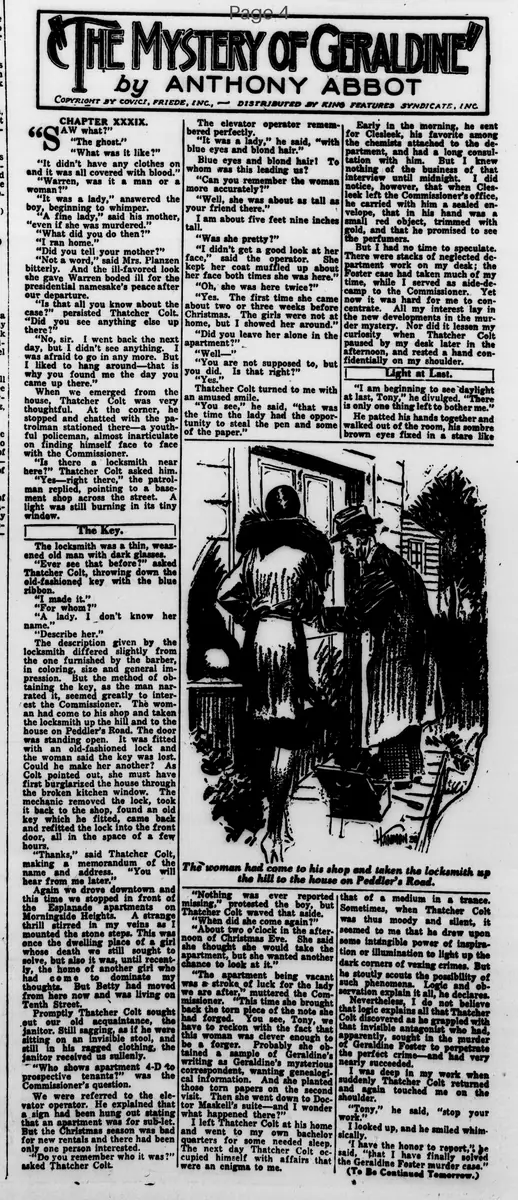
The description given by the locksmith differed slightly from the one furnished by the barber, in coloring, size and general impression. But the method of obtaining the key, as the man narrated it, seemed greatly to interest the Commissioner. The woman had come to his shop and taken the locksmith up the hill and to the house on Peddler's Road. The door was standing open. It was fitted with an old-fashioned lock and the woman said the key was lost. Could he make her another? As Colt pointed out, she must have first burglarized the house through the broken kitchen window. The mechanic removed the lock, took it back to the shop, found an old key which he fitted, came back and refitted the lock into the front door, all in the space of a few hours.
"Thanks," said Thatcher Colt, making memorandum of the name and address.
"You will hear from me later."
Again we drove downtown and this time we stopped in front of the Esplanade apartments on Morningside Heights. A strange thrill stirred in my veins as I mounted the stone steps. This was once the dwelling place of a girl whose death we still sought to solve, but also it was, until recently, the home of another girl who had come to dominate my thoughts. But Betty had moved from here now and was living on Tenth Street.
Promptly Thatcher Colt sought out our old acquaintance, the janitor. Still sagging, as if he were sitting on an invisible stool, and still in his ragged clothing, the janitor received us sullenly.
"Who shows apartment 4-D to prospective tenants?" was the Commissioner's question.
We were referred to the elevator operator. He explained that a sign had been hung out stating that an apartment was for sub-let. But the Christmas season was bad for new rentals and there had been only one person interested
"Do you remember who it was?" asked Thatcher Colt
The elevator operator remembered perfectly.
"It was a lady." he said, "with blue eyes and blond hair."
Blue eyes and blond hair! To whom was this leading us?
"Can you remember the woman more accurately?"
"Well. she was about as tall as your friend there."
I am about five feet nine inches tall.
"Was she pretty?"
"I didn't get a good look at her face," said the operator. She kept her coat muffled up about her face both times she was here."
"Oh.'she was here twice?"
"Yes. The first time she came about two or three weeks before Christmas. The girls were not at home, but I showed her around."
"Did you leave her alone in the apartment?"
"Well"
"You are not supposed to, but you did. Is that right?"
"Yes."
Thatcher Colt turned to me with an amused smile.
"You see." he said, "that was the time the lady had the opportunity to steal the pen and some of the paper."
"Nothing was ever reported missing," protested the boy, but Thatcher Colt waved that aside.
"when did she come again?"
"About two o'clock in the afternoon of Christmas Eve. She said she thought she would take the apartment, but she wanted another chance to look at it."
"The apartment being vacant was a stroke of luck for the lady we are after," muttered the Commissioner. "This time she brought back the torn piece of the note she had forged. You see, Tony, we have to reckon with the fact that this woman was clever enough to be a forger. Probably she obtained a sample of Geraldine's writing as Geraldine's mysterious correspondent, wanting genealogical information. And she planted those torn papers on the second visit. Then she went down to Doctor Maskell's suite-and I wonder what happened there?"
Early in the morning, he sent for Clesheek, his favorite among the chemists attached to the department. and had a long consultation with him. But I knew nothing of the business of that interview until midnight. I did notice, however, that when Clesheek left the Commissioner's office. he carried with him a sealed envelope, that in his hand was a small red object. trimmed with gold, and that he promised to see the perfumers.
But I had no time to speculate. There were stacks of neglected department work on my desk: the Foster case had taken much of my time, while I served as aide-de-camp to the Commissioner. Yet now it was hard for me to concentrate. All my interest lay in the new developments in the murder mystery. Nor did it lessen my curiosity when Thatcher Colt paused by my desk later in the afternoon, and rested a hand confidentially on my shoulder.
Light at Last.
"I am beginning to see daylight at last, Tony," he divulged. "There is only one thing left to bother me."
He patted his hands together and walked out of the room, his sombre brown eyes fixed in a stare like that of a medium in a trance.
Sometimes, when Thatcher Colt was thus moody and silent, it seemed to me that he drew upon some intangible power of inspiration or illumination to light up the dark corners of vexing crimes. But he stoutly scoffs the possibility of such phenomena. Logic and observation explain it all, he declares.
Nevertheless, I do not believe that logic explains all that Thatcher Colt discovered as he grappled with that invisible antagonist who had, apparently, sought in the murder of Geraldine Foster to perpetrate the perfect crime-and had very nearly succeeded.
I was deep in my work when suddenly Thatcher Colt returned and again touched me on the shoulder.
"Tony." he said, "stop your work."
I looked up, and he smiled whimsically.
'I have the honor to report," he said, "that I have finally solved the Geraldine Foster murder case."
(To Be Continued Tomorrow.)
I left Thatcher Colt at his home and went to my own bachelor quarters for some needed sleep.
The next day Thatcher Colt occupied himself with affairs that were an enigma to me.
And it was all covered with blood."
"Warren, was it a man or a woman?"
"It was a lady," answered the boy, beginning to whimper.
"Fine lady,"
said his mother
"even if she was murdered."
"What did you do then?"
"I ran home."
"Did you tell your mother?"
"Not a word." said Mrs. Planzen bitterly. And the ill-favored look she gave Warren boded ill for the presidential namesake's peace after our departure.
"Is that all you know about the case?" persisted Thatcher Colt.
"Did you see anything else up there?"
"No. sir. I went back the next day. but I didn't see anything. I was afraid to go in any more. But I liked to hang around-that is why you found me the day you came up there."
When we emerged from the house, Thatcher Colt was very thoughtful. At the corner, he stopped and chatted with the patrolman stationed there-a youthful policeman. almost inarticulate on finding himself face to face with the Commissioner,
"Is there a locksmith near here?" Thatcher Colt asked him.
"Yes-right there," the patrolman replied, pointing to a basement shop across the street. A light was still burning in its tiny window.
The Key.
The locksmith was a thin, weazened old man with dark glasses.
"Ever see that before?" asked Thatcher Colt. throwing down the old-fashioned key with the blue ribbon.
"I made it."
"For whom?"
"A lady. I don't know her name."
"Describe her."
The description given by the locksmith differed slightly from the one furnished by the barber, in coloring, size and general impression. But the method of obtaining the key, as the man narrated it, seemed greatly to interest the Commissioner. The woman had come to his shop and taken the locksmith up the hill and to the house on Peddler's Road. The door was standing open. It was fitted with an old-fashioned lock and the woman said the key was lost. Could he make her another? As Colt pointed out, she must have first burglarized the house through the broken kitchen window. The mechanic removed the lock, took it back to the shop, found an old key which he fitted, came back and refitted the lock into the front door, all in the space of a few hours.
"Thanks," said Thatcher Colt, making memorandum of the name and address.
"You will hear from me later."
Again we drove downtown and this time we stopped in front of the Esplanade apartments on Morningside Heights. A strange thrill stirred in my veins as I mounted the stone steps. This was once the dwelling place of a girl whose death we still sought to solve, but also it was, until recently, the home of another girl who had come to dominate my thoughts. But Betty had moved from here now and was living on Tenth Street.
Promptly Thatcher Colt sought out our old acquaintance, the janitor. Still sagging, as if he were sitting on an invisible stool, and still in his ragged clothing, the janitor received us sullenly.
"Who shows apartment 4-D to prospective tenants?" was the Commissioner's question.
We were referred to the elevator operator. He explained that a sign had been hung out stating that an apartment was for sub-let. But the Christmas season was bad for new rentals and there had been only one person interested
"Do you remember who it was?" asked Thatcher Colt
The elevator operator remembered perfectly.
"It was a lady." he said, "with blue eyes and blond hair."
Blue eyes and blond hair! To whom was this leading us?
"Can you remember the woman more accurately?"
"Well. she was about as tall as your friend there."
I am about five feet nine inches tall.
"Was she pretty?"
"I didn't get a good look at her face," said the operator. She kept her coat muffled up about her face both times she was here."
"Oh.'she was here twice?"
"Yes. The first time she came about two or three weeks before Christmas. The girls were not at home, but I showed her around."
"Did you leave her alone in the apartment?"
"Well"
"You are not supposed to, but you did. Is that right?"
"Yes."
Thatcher Colt turned to me with an amused smile.
"You see." he said, "that was the time the lady had the opportunity to steal the pen and some of the paper."
"Nothing was ever reported missing," protested the boy, but Thatcher Colt waved that aside.
"when did she come again?"
"About two o'clock in the afternoon of Christmas Eve. She said she thought she would take the apartment, but she wanted another chance to look at it."
"The apartment being vacant was a stroke of luck for the lady we are after," muttered the Commissioner. "This time she brought back the torn piece of the note she had forged. You see, Tony, we have to reckon with the fact that this woman was clever enough to be a forger. Probably she obtained a sample of Geraldine's writing as Geraldine's mysterious correspondent, wanting genealogical information. And she planted those torn papers on the second visit. Then she went down to Doctor Maskell's suite-and I wonder what happened there?"
Early in the morning, he sent for Clesheek, his favorite among the chemists attached to the department. and had a long consultation with him. But I knew nothing of the business of that interview until midnight. I did notice, however, that when Clesheek left the Commissioner's office. he carried with him a sealed envelope, that in his hand was a small red object. trimmed with gold, and that he promised to see the perfumers.
But I had no time to speculate. There were stacks of neglected department work on my desk: the Foster case had taken much of my time, while I served as aide-de-camp to the Commissioner. Yet now it was hard for me to concentrate. All my interest lay in the new developments in the murder mystery. Nor did it lessen my curiosity when Thatcher Colt paused by my desk later in the afternoon, and rested a hand confidentially on my shoulder.
Light at Last.
"I am beginning to see daylight at last, Tony," he divulged. "There is only one thing left to bother me."
He patted his hands together and walked out of the room, his sombre brown eyes fixed in a stare like that of a medium in a trance.
Sometimes, when Thatcher Colt was thus moody and silent, it seemed to me that he drew upon some intangible power of inspiration or illumination to light up the dark corners of vexing crimes. But he stoutly scoffs the possibility of such phenomena. Logic and observation explain it all, he declares.
Nevertheless, I do not believe that logic explains all that Thatcher Colt discovered as he grappled with that invisible antagonist who had, apparently, sought in the murder of Geraldine Foster to perpetrate the perfect crime-and had very nearly succeeded.
I was deep in my work when suddenly Thatcher Colt returned and again touched me on the shoulder.
"Tony." he said, "stop your work."
I looked up, and he smiled whimsically.
'I have the honor to report," he said, "that I have finally solved the Geraldine Foster murder case."
(To Be Continued Tomorrow.)
I left Thatcher Colt at his home and went to my own bachelor quarters for some needed sleep.
The next day Thatcher Colt occupied himself with affairs that were an enigma to me.
What sub-type of article is it?
Prose Fiction
What keywords are associated?
Murder Investigation
Thatcher Colt
Geraldine Foster
Forged Note
Mystery Case
What entities or persons were involved?
By Anthony Abbot
Literary Details
Title
The Mystery Of Geraldine
Author
By Anthony Abbot
Subject
The Murder Of Geraldine Foster
Key Lines
"It Was A Lady," Answered The Boy, Beginning To Whimper.
Blue Eyes And Blond Hair! To Whom Was This Leading Us?
'I Have The Honor To Report," He Said, "That I Have Finally Solved The Geraldine Foster Murder Case."
(To Be Continued Tomorrow.)