Thank you for visiting SNEWPapers!
Sign up free
Letter to Editor
March 12, 1858
Oxford Democrat
Paris, South Paris, Oxford County, Maine
What is this article about?
A letter from a settler in Kansas Territory compares the arduous pioneer experiences in Vermont, Maine, and Ohio—marked by years of hard labor to clear timbered land—with the quicker, less toil-intensive settlement process on the Kansas prairies, where farms can be established rapidly with abundant natural resources.
Clipping
OCR Quality
75%
Good
Full Text
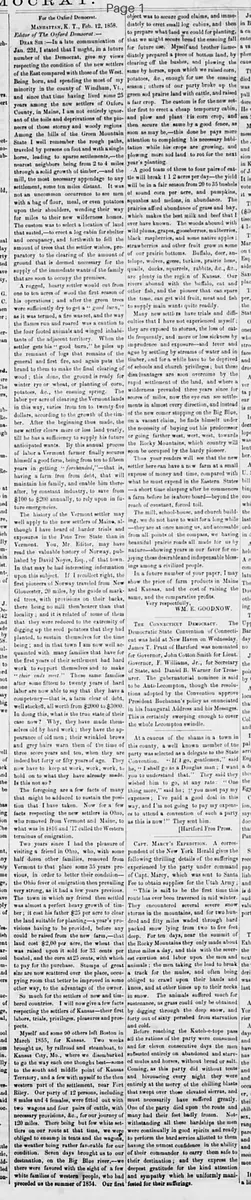
For the Oxford Democrat.
Manhattan, K. T., Feb. 12, 1858.
Editor of The Oxford Democrat:-
Dear Sir:- In a late communication of
Jan. 22nd, I stated that I might, in a future
number of the Democrat, give my views
respecting the condition of the new settlers
of the East compared with those of the West.
Being born, and spending the most of my
minority in the county of Windham, Vt.,
and since that time having lived some 25
years among the new settlers of Oxford
County, in Maine, I am not entirely ignorant
of the toils and deprivations of the pioneers
of those stormy and woody regions. Among
the hills of the Green Mountain State I well
remember the rough paths, traveled by persons
on foot and with a single horse, leading to
sparse settlements, the nearest neighbors being
from 2 to 4 miles through a solid growth of
timber, and the mill, the most necessary
appendage to any settlement, some ten miles
distant. It was not an uncommon occurrence
to see men with a bag of flour, meal, or even
potatoes upon their shoulders, wending their
way for miles to their new wilderness homes.
The custom was to select a location of land
that suited, to erect a log cabin for shelter
and occupancy, and forthwith to fell the
amount of trees that the settler wishes,
preparatory to the clearing of the amount of
ground that is deemed necessary for the
supply of the immediate wants of the family
that are soon to occupy the premises.
A rugged, hearty settler would cut from
one to ten acres of wood the first season of
his operations; and after the green trees
were sufficiently dry to get a "good burn,"
as it was termed, a fire was set, and the way
the flames run and roared was a caution to
the four footed animals and winged inhabitants
of the adjacent territory. When the settler
gets his "good burn," he piles up the remnant
of logs that remains of the general and first
fire, and again puts the brand to them to
make the final clearing of wood; this done,
the ground is ready for winter rye or wheat,
or planting of corn, potatoes, &c., the ensuing
spring. The labor per acre of clearing the
Vermont lands in this way, varies from ten to
twenty-five dollars, according to the growth
of the timber. After the beginning thus made,
the new settler clears more or less land yearly,
till he has a sufficiency to supply his future
anticipated wants. By this annual process
of labor a Vermont farmer finally secures
himself a good farm, being from ten to fifteen
years in getting "forehanded"—that is,
having a farm free from debt, that will
maintain his family, and enable him thereafter,
by constant industry, to save from $100 to
$200 annually, to rely upon in future
emergencies.
The history of the Vermont settler may
well apply to the new settlers of Maine,
although I have heard of harder trials and
exposures in the Pine Tree State than in
Vermont. You, Mr. Editor, may have read
the valuable history of Norway, published by
David Noyes, Esq., of that town. In that
may be had interesting information upon
this subject. If I recollect right, the first
pioneers of Norway traveled from New
Gloucester, 20 miles, by the guide of marked
trees, with provisions on their backs, there
being no mill then nearer than that locality;
and it is related of some of them that they
were reduced to the extremity of digging up
the seed potatoes that they had planted, to
sustain themselves for the time being; and in
that town I am now well acquainted with
many families that have for the first years
of their settlement had hard work to support
themselves and to make "their ends meet."
These same families after some fifteen to
twenty years of hard labor are now able to
say that they have a competency—that is,
a farm clear of debt, well stocked, all worth
from $2000 to $3000. In doing this, what
is the true state of their case now? Why,
they have made themselves old by hard work;
they have the appearance of old men; their
wrinkled brows and grey hairs warn them of
the time of three score years and ten, when
they are indeed but forty or fifty years of age.
They now have to keep at work, work, work,
to hold on to what they have already made.
Is this not so?
The foregoing are a few facts of many
that might be adduced to sustain the position
that I have taken. Now for a few facts
respecting the new settlers in Ohio, who
removed from Vermont and Maine, to what
was in 1816 and '17 called the Western
terminus of emigration.
Two years since I had the pleasure of
visiting a friend in Ohio, who, with some
half dozen other families, removed from
Vermont to that place some 35 years previous,
in order to better their condition—the Ohio
fever of emigration then prevailing very
strong, as it had a few years previous. The
town in which my friend then settled was
almost a perfect heavy growth of timber;
it cost his father $25 per acre to clear the
land suitable for planting—a year's provisions
having to be provided, before any could be
raised from the new farm, that land cost $2.00
per acre, the wheat that was raised upon it
sold for 33 cents per bushel, and the corn at
25 cents, with which to pay for the purchase.
Stumps of great size are now scattered over
the place, occupying room that better be
improved in some other way, to the advantage
of the owner.
So much for the settlers of new and timbered
countries. I will now give a few facts
respecting the settlers of Kansas—their first
labors, trials, privileges, pleasures and prospects.
Myself and some 90 others left Boston in
March 1855, for Kansas. Two weeks brought
us, by railroad and steamboat, to Kansas City,
Mo., where we disembarked to go the way
each one thought best, some to the south and
middle point of Kansas Territory, and a few
with myself to the then western part of the
settlement, near Fort Riley. Our party of 12
persons, including 8 males and 4 females,
were fitted out with two wagons and four
pairs of cattle, with necessary provisions, &c.,
for our journey of 120 miles. There being but
few white settlers on our route at that time,
we were obliged to encamp in tents and the
wagons, the weather being rather favorable
for our condition. Seven days brought us to
our destination, on the Big Blue river—we
there were favored with the sight of a few
white families of western people, who had
preceded us the summer of 1854. Our first
object was to secure good claims, and immediately
to erect small log cabins, and then to prepare
what land we could for planting that we might
secure bread the ensuing fall for future use.
Myself and brother immediately prepared a
piece of bottom land, by clearing off the bushes,
and plowing the same by horses, upon which
we raised corn, potatoes, &c., enough for use
the ensuing season; others of our party broke
up the green sod prairie land with cattle, and
raised a fair crop. The custom is for the new
settler first to erect a cheap temporary cabin,
and plow and plant his corn crop, and then
secure the same by a good fence, as soon as
may be,—this done he pays more attention to
completing his necessary habitation while his
crops are growing, and plowing more sod land
to rot for the next year's planting. A good
team of three to four pairs of cattle will break
1 1/2 acres per day—the yield will be in a fair
season from 20 to 35 bushels of sound corn
per acre, and pumpkins, squashes and melons,
in abundance. The prairies afford abundance
of grass and hay, which makes the best milk
and beef that I ever have known. The woods
abound with wild plums, grapes, gooseberries,
mulberries, black raspberries, and some native
apples; wild strawberries and other fruit grow
in some of our prairie bottoms. Buffalo, deer,
antelope, wolves, game, turkeys, prairie hens,
quails, ducks, squirrels, rabbits, &c., &c., are
plenty in the region of Kansas. Our rivers
abound with the buffalo, cat and other fish,
and the pioneer that can spare the time, can
get wild fruit, meat and fish to supply main
wants quite readily.
Many new settlers have trials and difficulties
that I have not experienced myself; they are
exposed to storms, the loss of cattle frequently,
and more or less sickness by imprudence and
exposure—and fever and ague by settling by
streams of water and in timber, and for a while
have to be deprived of schools and church
privileges; but these disadvantages are soon
overcome by the rapid settlement of the land,
and where a wilderness prevailed three years
since for scores of miles, now the eye can see
settlements in almost every direction, and
instead of the new comer stopping on the Big
Blue, on a vacant claim, he finds himself under
the necessity of buying out his predecessor or
going farther west, west, west, towards the
Rocky Mountains, which country will soon be
occupied by the hardy pioneer.
Thus your readers will see that the new
settler here can have a new farm at a small
expense of money and time, compared with
what he must expend in the Eastern States—a
short time elapsing after he commences a farm
before he is above board—beyond the reach of
constant, forced toil.
The mill, school-house, and church building,
we do not have to wait for a long while—they
are at once among us, and accessible from all
points of the compass, we having beautiful
prairie roads all made for us by nature—showing
years in our favor for enjoying these desirable
and indispensable blessings among a civilized
people.
In a future number of your paper, I may
show the price of farm products in Maine and
Kansas, and the cost of raising the same, and
the comparative profits.
Very respectfully,
WM. E. GOODNOW.
Manhattan, K. T., Feb. 12, 1858.
Editor of The Oxford Democrat:-
Dear Sir:- In a late communication of
Jan. 22nd, I stated that I might, in a future
number of the Democrat, give my views
respecting the condition of the new settlers
of the East compared with those of the West.
Being born, and spending the most of my
minority in the county of Windham, Vt.,
and since that time having lived some 25
years among the new settlers of Oxford
County, in Maine, I am not entirely ignorant
of the toils and deprivations of the pioneers
of those stormy and woody regions. Among
the hills of the Green Mountain State I well
remember the rough paths, traveled by persons
on foot and with a single horse, leading to
sparse settlements, the nearest neighbors being
from 2 to 4 miles through a solid growth of
timber, and the mill, the most necessary
appendage to any settlement, some ten miles
distant. It was not an uncommon occurrence
to see men with a bag of flour, meal, or even
potatoes upon their shoulders, wending their
way for miles to their new wilderness homes.
The custom was to select a location of land
that suited, to erect a log cabin for shelter
and occupancy, and forthwith to fell the
amount of trees that the settler wishes,
preparatory to the clearing of the amount of
ground that is deemed necessary for the
supply of the immediate wants of the family
that are soon to occupy the premises.
A rugged, hearty settler would cut from
one to ten acres of wood the first season of
his operations; and after the green trees
were sufficiently dry to get a "good burn,"
as it was termed, a fire was set, and the way
the flames run and roared was a caution to
the four footed animals and winged inhabitants
of the adjacent territory. When the settler
gets his "good burn," he piles up the remnant
of logs that remains of the general and first
fire, and again puts the brand to them to
make the final clearing of wood; this done,
the ground is ready for winter rye or wheat,
or planting of corn, potatoes, &c., the ensuing
spring. The labor per acre of clearing the
Vermont lands in this way, varies from ten to
twenty-five dollars, according to the growth
of the timber. After the beginning thus made,
the new settler clears more or less land yearly,
till he has a sufficiency to supply his future
anticipated wants. By this annual process
of labor a Vermont farmer finally secures
himself a good farm, being from ten to fifteen
years in getting "forehanded"—that is,
having a farm free from debt, that will
maintain his family, and enable him thereafter,
by constant industry, to save from $100 to
$200 annually, to rely upon in future
emergencies.
The history of the Vermont settler may
well apply to the new settlers of Maine,
although I have heard of harder trials and
exposures in the Pine Tree State than in
Vermont. You, Mr. Editor, may have read
the valuable history of Norway, published by
David Noyes, Esq., of that town. In that
may be had interesting information upon
this subject. If I recollect right, the first
pioneers of Norway traveled from New
Gloucester, 20 miles, by the guide of marked
trees, with provisions on their backs, there
being no mill then nearer than that locality;
and it is related of some of them that they
were reduced to the extremity of digging up
the seed potatoes that they had planted, to
sustain themselves for the time being; and in
that town I am now well acquainted with
many families that have for the first years
of their settlement had hard work to support
themselves and to make "their ends meet."
These same families after some fifteen to
twenty years of hard labor are now able to
say that they have a competency—that is,
a farm clear of debt, well stocked, all worth
from $2000 to $3000. In doing this, what
is the true state of their case now? Why,
they have made themselves old by hard work;
they have the appearance of old men; their
wrinkled brows and grey hairs warn them of
the time of three score years and ten, when
they are indeed but forty or fifty years of age.
They now have to keep at work, work, work,
to hold on to what they have already made.
Is this not so?
The foregoing are a few facts of many
that might be adduced to sustain the position
that I have taken. Now for a few facts
respecting the new settlers in Ohio, who
removed from Vermont and Maine, to what
was in 1816 and '17 called the Western
terminus of emigration.
Two years since I had the pleasure of
visiting a friend in Ohio, who, with some
half dozen other families, removed from
Vermont to that place some 35 years previous,
in order to better their condition—the Ohio
fever of emigration then prevailing very
strong, as it had a few years previous. The
town in which my friend then settled was
almost a perfect heavy growth of timber;
it cost his father $25 per acre to clear the
land suitable for planting—a year's provisions
having to be provided, before any could be
raised from the new farm, that land cost $2.00
per acre, the wheat that was raised upon it
sold for 33 cents per bushel, and the corn at
25 cents, with which to pay for the purchase.
Stumps of great size are now scattered over
the place, occupying room that better be
improved in some other way, to the advantage
of the owner.
So much for the settlers of new and timbered
countries. I will now give a few facts
respecting the settlers of Kansas—their first
labors, trials, privileges, pleasures and prospects.
Myself and some 90 others left Boston in
March 1855, for Kansas. Two weeks brought
us, by railroad and steamboat, to Kansas City,
Mo., where we disembarked to go the way
each one thought best, some to the south and
middle point of Kansas Territory, and a few
with myself to the then western part of the
settlement, near Fort Riley. Our party of 12
persons, including 8 males and 4 females,
were fitted out with two wagons and four
pairs of cattle, with necessary provisions, &c.,
for our journey of 120 miles. There being but
few white settlers on our route at that time,
we were obliged to encamp in tents and the
wagons, the weather being rather favorable
for our condition. Seven days brought us to
our destination, on the Big Blue river—we
there were favored with the sight of a few
white families of western people, who had
preceded us the summer of 1854. Our first
object was to secure good claims, and immediately
to erect small log cabins, and then to prepare
what land we could for planting that we might
secure bread the ensuing fall for future use.
Myself and brother immediately prepared a
piece of bottom land, by clearing off the bushes,
and plowing the same by horses, upon which
we raised corn, potatoes, &c., enough for use
the ensuing season; others of our party broke
up the green sod prairie land with cattle, and
raised a fair crop. The custom is for the new
settler first to erect a cheap temporary cabin,
and plow and plant his corn crop, and then
secure the same by a good fence, as soon as
may be,—this done he pays more attention to
completing his necessary habitation while his
crops are growing, and plowing more sod land
to rot for the next year's planting. A good
team of three to four pairs of cattle will break
1 1/2 acres per day—the yield will be in a fair
season from 20 to 35 bushels of sound corn
per acre, and pumpkins, squashes and melons,
in abundance. The prairies afford abundance
of grass and hay, which makes the best milk
and beef that I ever have known. The woods
abound with wild plums, grapes, gooseberries,
mulberries, black raspberries, and some native
apples; wild strawberries and other fruit grow
in some of our prairie bottoms. Buffalo, deer,
antelope, wolves, game, turkeys, prairie hens,
quails, ducks, squirrels, rabbits, &c., &c., are
plenty in the region of Kansas. Our rivers
abound with the buffalo, cat and other fish,
and the pioneer that can spare the time, can
get wild fruit, meat and fish to supply main
wants quite readily.
Many new settlers have trials and difficulties
that I have not experienced myself; they are
exposed to storms, the loss of cattle frequently,
and more or less sickness by imprudence and
exposure—and fever and ague by settling by
streams of water and in timber, and for a while
have to be deprived of schools and church
privileges; but these disadvantages are soon
overcome by the rapid settlement of the land,
and where a wilderness prevailed three years
since for scores of miles, now the eye can see
settlements in almost every direction, and
instead of the new comer stopping on the Big
Blue, on a vacant claim, he finds himself under
the necessity of buying out his predecessor or
going farther west, west, west, towards the
Rocky Mountains, which country will soon be
occupied by the hardy pioneer.
Thus your readers will see that the new
settler here can have a new farm at a small
expense of money and time, compared with
what he must expend in the Eastern States—a
short time elapsing after he commences a farm
before he is above board—beyond the reach of
constant, forced toil.
The mill, school-house, and church building,
we do not have to wait for a long while—they
are at once among us, and accessible from all
points of the compass, we having beautiful
prairie roads all made for us by nature—showing
years in our favor for enjoying these desirable
and indispensable blessings among a civilized
people.
In a future number of your paper, I may
show the price of farm products in Maine and
Kansas, and the cost of raising the same, and
the comparative profits.
Very respectfully,
WM. E. GOODNOW.
What sub-type of article is it?
Informative
Historical
Reflective
What themes does it cover?
Agriculture
Social Issues
What keywords are associated?
Pioneer Settlers
Land Clearing
Kansas Territory
Vermont Pioneers
Maine Settlements
Ohio Emigration
Agricultural Labor
Prairie Farming
What entities or persons were involved?
Wm. E. Goodnow
Editor Of The Oxford Democrat
Letter to Editor Details
Author
Wm. E. Goodnow
Recipient
Editor Of The Oxford Democrat
Main Argument
new settlers in kansas territory can establish prosperous farms with less time, money, and toil compared to the prolonged hardships faced by pioneers in timbered regions of vermont, maine, and ohio, due to the prairie landscape and abundant resources.
Notable Details
Personal Experiences In Windham County, Vt, And Oxford County, Me
Reference To 'History Of Norway' By David Noyes
Journey From Boston To Kansas In March 1855 With 90 Others
Details On Land Clearing Costs In Vermont ($10 25/Acre) And Ohio ($25/Acre)
Crop Yields In Kansas (20 35 Bushels Corn/Acre)
Abundant Wild Game, Fruits, And Natural Provisions In Kansas