Thank you for visiting SNEWPapers!
Sign up free
Story
September 12, 1833
Virginia Free Press
Charles Town, Jefferson County, West Virginia
What is this article about?
Legal dispute in New Jersey courts over Quaker property after 1827 schism between Orthodox and Hicksite factions. Orthodox prevail, affirming their claim to funds from Chesterfield Preparative Meeting. Court urges amicable settlement.
Clipping
OCR Quality
95%
Excellent
Full Text
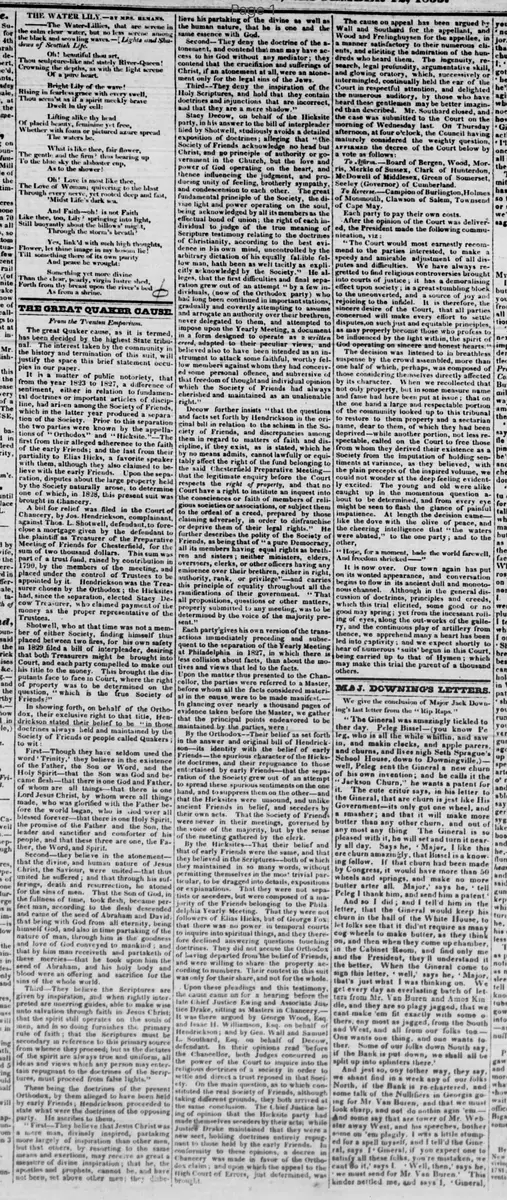
THE GREAT QUAKER CAUSE
From the Trenton Emporium.
The great Quaker cause, as it is termed, has been decided by the highest State tribunal. The interest taken by the community in the history and termination of this suit, will justify the space this brief statement occupies in our paper.
It is a matter of public notoriety, that from the year 1823 to 1827, a difference of sentiment, either in relation to fundamental doctrines or important articles of discipline, had arisen among the Society of Friends, which in the latter year produced a separation of the Society. Prior to this separation the two parties were known by the appellations of "Orthodox" and "Hicksite." The first from their alleged adherence to the faith of the early Friends; and the last from their partiality to Elias Hicks, a favorite speaker with them, although they also claimed to believe with the early Friends. Upon the separation, disputes about the large property held by the Society naturally arose, to determine one of which, in 1828, this present suit was brought in Chancery.
A bill for relief was filed in the Court of Chancery, by Jos. Hendrickson, complainant, against Thos. L. Shotwell, defendant, to foreclose a mortgage given by the defendant to the plaintiff as Treasurer of the Preparative Meeting of Friends for Chesterfield, for the sum of two thousand dollars. This sum was part of a trust fund, raised by contribution in 1790, by the members of the meeting, and placed under the control of Trustees to be appointed by it. Hendrickson was the Treasurer chosen by the Orthodox; the Hicksites had, since the separation, elected Stacy Decow Treasurer, who claimed payment of the money as the proper representative of the Trustees.
Shotwell, who at that time was not a member of either Society, finding himself thus placed between two fires, for his own safety in 1829 filed a bill of interpleader, desiring that both Treasurers might be brought into Court, and each party compelled to make out his title to the money. This brought the disputants face to face in Court, where the right of property was to be determined on the question, "which is the True Society of Friends—"
In showing forth, on behalf of the Orthodox, their exclusive right to that title, Hendrickson stated their belief to be "in those doctrines always held and maintained by the Society of Friends or people called Quakers; to wit:
First—Though they have seldom used the word 'Trinity,' they believe in the existence of the Father, the Son or Word, and the Holy Spirit—that the Son was God and became flesh—that there is one God and Father, of whom are all things—that there is one Lord Jesus Christ, by whom were all things made, who was glorified with the Father before the world began, who is God over all blessed forever—that there is one Holy Spirit, the promise of the Father and the Son, the leader and sanctifier and comforter of his people, and that these three are one, the Father, the Word, and Spirit.
Second—they believe in the atonement—that the divine, and human nature of Jesus Christ, the Saviour, were united—that thus united he suffered; and that through his sufferings, death and resurrection, he atoned for the sins of men. That the Son of God, in the fullness of time, took flesh, became perfect man, according to the flesh descended and came of the seed of Abraham and David, that being with God from all eternity, being himself God, and also in time partaking of the nature of man, through him is the goodness and love of God conveyed to mankind; and that by him man receiveth and partaketh of these mercies—that he took upon him the seed of Abraham, and his holy body and blood were an offering and sacrifice for the sins of the whole world.
Third They believe the Scriptures are given by inspiration, and when rightly interpreted are unerring guides, able to make wise unto salvation through faith in Jesus Christ; that the spirit still operates on the souls of men, and in so doing furnishes the primary rule of faith; that the Scriptures must be secondary in reference to this primary source from whence they proceed; but as the dictates of the spirit are always true and uniform, all ideas and views which any person may entertain repugnant to the doctrines of the Scriptures, must proceed from false lights."
These being the doctrines of the present Orthodox, by them alleged to have been held by early Friends; Hendrickson proceeded to state what were the doctrines of the opposing party. He ascribes to them,
"First They believe that Jesus Christ was a mere man, divinely inspired, partaking more largely of inspiration than other men, but that others, by resorting to the same means and exertions, may receive as great a measure of divine inspiration; that he, the apostles and prophets, cannot be, and have not been, set above other men; they disbelieve his partaking of the divine as well as the human nature, that he is one and the same essence with God.
Second— They deny the doctrine of the atonement, and contend that man may have access to his God without any mediator; they contend that the crucifixion and sufferings of Christ, if an atonement at all, were an atonement only for the legal sins of the Jews.
Third—They deny the inspiration of the Holy Scriptures, and hold that they contain doctrines and injunctions that are incorrect, and that they are a mere shadow."
Stacy Decow, on behalf of the Hicksite party, in his answer to the bill of interpleader filed by Shotwell, studiously avoids a detailed exposition of doctrines; alleging that "the Society of Friends acknowledge no head but Christ, and no principle of authority or government in the Church, but the love and power of God operating on the heart, and thence influencing the judgment, and producing unity of feeling, brotherly sympathy, and condescension to each other. The great fundamental principle of the Society, the divine light and power operating on the soul, being acknowledged by all its members as the effectual bond of union; the right of each individual to judge of the true meaning of Scripture testimony relating to the doctrines of Christianity, according to the best evidence in his own mind, uncontrolled by the arbitrary dictation of his equally fallible fellow man, hath been as well tacitly as explicitly acknowledged by the Society." He alleges, that the first difficulties and final separation grew out of an attempt " by a few individuals, (now of the Orthodox party) who had long been continued in important stations, gradually and covertly attempting to assume and arrogate an authority over their brethren, never delegated to them, and attempted to impose upon the Yearly Meeting, a document in a form designed to operate as a written creed, adapted to their peculiar views, and believed also to have been intended as an instrument to attack some faithful, worthy fellow members against whom they had conceived some personal offence, and subversive of that freedom of thought and individual opinion which the Society of Friends had always cherished and maintained as an unalienable right."
Decow further insists "that the questions and facts set forth by Hendrickson in the original bill in relation to the schism in the Society of Friends, and discrepancies among them in regard to matters of faith and discipline, if they exist, as is stated, which he by no means admits, cannot lawfully or equitably affect the right of the fund belonging to the said Chesterfield Preparative Meeting—that the legitimate enquiry before the Court respects the right of property, and that no Court have a right to institute an inquest into the consciences or faith of members of religious societies or associations, or subject them to the ordeal of a creed, prepared by those claiming adversely, in order to disfranchise or deprive them of their legal rights." He further describes the polity of the Society of Friends, as being that of " a pure Democracy, all its members having equal rights as brethren and sisters; neither ministers, elders, overseers, clerks, or other officers having any eminence over their brethren, either in right, authority, rank, or privilege" and carries this principle of equality throughout all the ramifications of their government. " That all propositions, questions or other matters, properly submitted to any meeting, was to be determined by the voice of the majority present."
Each party gives his own version of the transactions immediately preceding and subsequent to the separation of the Yearly Meeting at Philadelphia in 1827, in which there is less collision about facts, than about the motives and views that led to the facts.
Upon the matter thus presented to the Chancellor, the parties were referred to a Master, before whom all the facts considered material in the cause were to be made manifest.—In glancing over nearly a thousand pages of evidence taken before the Master, we gather that the principal points endeavored to be maintained by the parties, were:
By the Orthodox—Their belief as set forth in the answer and original bill of Hendrickson—its identity with the belief of early Friends—the spurious character of the Hicksite doctrines, and their repugnance to those entertained by early Friends—that the separation of the Society grew out of an attempt to spread these spurious sentiments on the one hand, and to suppress them on the other—and that the Hicksites were unsound, and unlike ancient Friends in belief, and seceders by their own acts. That the Society of Friends were never in their meetings, governed by the voice of the majority, but by the sense of the meeting gathered by the clerk.
By the Hicksites—That their belief and that of early Friends were the same, and that they believed in the Scriptures—both of which they maintained in so many words, without permitting themselves in the most trivial particular, to be dragged into details, expositions or explanations. That they were not separatists or seceders, but were composed of a majority of the Friends belonging to the Philadelphia Yearly Meeting. That they were not followers of Elias Hicks, but of George Fox; that there was no power in temporal courts to inquire into spiritual things, and they therefore declined answering questions touching doctrines. They did not accuse the Orthodox of having departed from the belief of Friends, and were willing to share the property according to numbers. Their contest in this suit was only for their share, and not for the whole.
Upon these pleadings and this testimony, the cause came on for a hearing before the late Chief Justice Ewing and Associate Justice Drake, sitting as Masters in Chancery. It was there argued by George Wood, Esq. and Isaac H. Williamson, Esq. on behalf of Hendrickson; and by Gen. Wall and Samuel L. Southard, Esq. on behalf of Decow, defendant. In their opinions read before the Chancellor, both Judges concurred in the power of the Court to inquire into the religious doctrines of a society in order to settle and direct a trust reposed in that Society. On the main question, as to which constituted the real Society of Friends, although taking different grounds, they both arrived at the same conclusion. The Chief Justice being of opinion that the Hicksite party had made themselves seceders by their acts; while Justice Drake maintained that they were a new sect, holding doctrines entirely repugnant to those held by the early Friends. In conformity to these opinions, a decree in Chancery was made in favor of the Orthodox claim, and upon which the appeal to the High Court of Errors, just determined, was brought.
The cause on appeal has been argued by Wall and Southard for the appellant, and Wood and Frelinghuysen for the appellee, in a manner satisfactory to their numerous clients, and eliciting the admiration of the hundreds who heard them. The ingenuity, research, legal profundity, argumentative skill, and glowing oratory, which, successively or intermingled, continually held the ear of the Court in respectful attention, and delighted the numerous auditory, by those who have heard these gentlemen may be better imagined than described. Mr. Southard closed, and the case was submitted to the Court on the morning of Wednesday last. On Thursday afternoon, at four o'clock, the Council having maturely considered the weighty question, affirmed the decree of the Court below by a vote as follows:
To Affirm—Board of Bergen, Wood, Morris, Merkle of Sussex, Clark of Hunterdon, McDowell of Middlesex, Green of Somerset, Seeley (Governor) of Cumberland.
To Reverse—Campion of Burlington, Holmes of Monmouth, Clawson of Salem, Townsend of Cape May.
Each party to pay their own costs.
After the opinion of the Court was delivered, the President made the following communication, viz:
"The Court would most earnestly recommend to the parties interested, to make a speedy and amicable adjustment of all disputes and difficulties. We have always regretted to find religious controversies brought into courts of justice; it has a demoralizing effect upon society; is a great stumbling block to the unconverted, and a source of joy and rejoicing to the infidel. It is therefore, the sincere desire of the Court, that all parties concerned will make every effort to settle disputes, on such just and equitable principles, as may properly become those who profess to be influenced by the light within, the spirit of God operating on sincere and honest hearts."
The decision was listened to in breathless suspense by the crowd assembled, more than one half of which, perhaps, was composed of those considering themselves directly affected by its character. When we recollected that not only property, but in some measure name and fame had here been put at issue; that on the one hand a large and respectable portion of the community looked up to this tribunal to restore to them property and a sectarian name, dear to them, of which they had been deprived—while another portion, not less respectable, called on the Court to free those from whom they derived their existence as a Society from the imputation of holding sentiments at variance, as they believed, with the plain precepts of the inspired volume, we could not wonder at the deep feeling evidently excited. The young and old were alike caught up in the momentous question about to be determined, and from every eye might be seen to flash the glance of painful impatience. At length the decision came—like the dove with the olive of peace, and the cheering intelligence that "the waters were abated," to the one party; and to the other,
"Hope, for a moment, bade the world farewell,
And freedom shrieked—"
It is now over. Our town again has put on its wonted appearance, and conversation begins to flow in its ancient dull and monotonous channel. Although in the general discussion of doctrines, principles and creeds, which this trial elicited, some good or no good may spring; yet from the incessant rolling of eyes, along the out-works of the gallery, and the continuous play of artillery from thence, we apprehend many a heart has been led into captivity; and we expect shortly to hear of numerous 'suits' begun in this Court, being carried up to that of Hymen; which may make this trial the parent of a thousand others.
From the Trenton Emporium.
The great Quaker cause, as it is termed, has been decided by the highest State tribunal. The interest taken by the community in the history and termination of this suit, will justify the space this brief statement occupies in our paper.
It is a matter of public notoriety, that from the year 1823 to 1827, a difference of sentiment, either in relation to fundamental doctrines or important articles of discipline, had arisen among the Society of Friends, which in the latter year produced a separation of the Society. Prior to this separation the two parties were known by the appellations of "Orthodox" and "Hicksite." The first from their alleged adherence to the faith of the early Friends; and the last from their partiality to Elias Hicks, a favorite speaker with them, although they also claimed to believe with the early Friends. Upon the separation, disputes about the large property held by the Society naturally arose, to determine one of which, in 1828, this present suit was brought in Chancery.
A bill for relief was filed in the Court of Chancery, by Jos. Hendrickson, complainant, against Thos. L. Shotwell, defendant, to foreclose a mortgage given by the defendant to the plaintiff as Treasurer of the Preparative Meeting of Friends for Chesterfield, for the sum of two thousand dollars. This sum was part of a trust fund, raised by contribution in 1790, by the members of the meeting, and placed under the control of Trustees to be appointed by it. Hendrickson was the Treasurer chosen by the Orthodox; the Hicksites had, since the separation, elected Stacy Decow Treasurer, who claimed payment of the money as the proper representative of the Trustees.
Shotwell, who at that time was not a member of either Society, finding himself thus placed between two fires, for his own safety in 1829 filed a bill of interpleader, desiring that both Treasurers might be brought into Court, and each party compelled to make out his title to the money. This brought the disputants face to face in Court, where the right of property was to be determined on the question, "which is the True Society of Friends—"
In showing forth, on behalf of the Orthodox, their exclusive right to that title, Hendrickson stated their belief to be "in those doctrines always held and maintained by the Society of Friends or people called Quakers; to wit:
First—Though they have seldom used the word 'Trinity,' they believe in the existence of the Father, the Son or Word, and the Holy Spirit—that the Son was God and became flesh—that there is one God and Father, of whom are all things—that there is one Lord Jesus Christ, by whom were all things made, who was glorified with the Father before the world began, who is God over all blessed forever—that there is one Holy Spirit, the promise of the Father and the Son, the leader and sanctifier and comforter of his people, and that these three are one, the Father, the Word, and Spirit.
Second—they believe in the atonement—that the divine, and human nature of Jesus Christ, the Saviour, were united—that thus united he suffered; and that through his sufferings, death and resurrection, he atoned for the sins of men. That the Son of God, in the fullness of time, took flesh, became perfect man, according to the flesh descended and came of the seed of Abraham and David, that being with God from all eternity, being himself God, and also in time partaking of the nature of man, through him is the goodness and love of God conveyed to mankind; and that by him man receiveth and partaketh of these mercies—that he took upon him the seed of Abraham, and his holy body and blood were an offering and sacrifice for the sins of the whole world.
Third They believe the Scriptures are given by inspiration, and when rightly interpreted are unerring guides, able to make wise unto salvation through faith in Jesus Christ; that the spirit still operates on the souls of men, and in so doing furnishes the primary rule of faith; that the Scriptures must be secondary in reference to this primary source from whence they proceed; but as the dictates of the spirit are always true and uniform, all ideas and views which any person may entertain repugnant to the doctrines of the Scriptures, must proceed from false lights."
These being the doctrines of the present Orthodox, by them alleged to have been held by early Friends; Hendrickson proceeded to state what were the doctrines of the opposing party. He ascribes to them,
"First They believe that Jesus Christ was a mere man, divinely inspired, partaking more largely of inspiration than other men, but that others, by resorting to the same means and exertions, may receive as great a measure of divine inspiration; that he, the apostles and prophets, cannot be, and have not been, set above other men; they disbelieve his partaking of the divine as well as the human nature, that he is one and the same essence with God.
Second— They deny the doctrine of the atonement, and contend that man may have access to his God without any mediator; they contend that the crucifixion and sufferings of Christ, if an atonement at all, were an atonement only for the legal sins of the Jews.
Third—They deny the inspiration of the Holy Scriptures, and hold that they contain doctrines and injunctions that are incorrect, and that they are a mere shadow."
Stacy Decow, on behalf of the Hicksite party, in his answer to the bill of interpleader filed by Shotwell, studiously avoids a detailed exposition of doctrines; alleging that "the Society of Friends acknowledge no head but Christ, and no principle of authority or government in the Church, but the love and power of God operating on the heart, and thence influencing the judgment, and producing unity of feeling, brotherly sympathy, and condescension to each other. The great fundamental principle of the Society, the divine light and power operating on the soul, being acknowledged by all its members as the effectual bond of union; the right of each individual to judge of the true meaning of Scripture testimony relating to the doctrines of Christianity, according to the best evidence in his own mind, uncontrolled by the arbitrary dictation of his equally fallible fellow man, hath been as well tacitly as explicitly acknowledged by the Society." He alleges, that the first difficulties and final separation grew out of an attempt " by a few individuals, (now of the Orthodox party) who had long been continued in important stations, gradually and covertly attempting to assume and arrogate an authority over their brethren, never delegated to them, and attempted to impose upon the Yearly Meeting, a document in a form designed to operate as a written creed, adapted to their peculiar views, and believed also to have been intended as an instrument to attack some faithful, worthy fellow members against whom they had conceived some personal offence, and subversive of that freedom of thought and individual opinion which the Society of Friends had always cherished and maintained as an unalienable right."
Decow further insists "that the questions and facts set forth by Hendrickson in the original bill in relation to the schism in the Society of Friends, and discrepancies among them in regard to matters of faith and discipline, if they exist, as is stated, which he by no means admits, cannot lawfully or equitably affect the right of the fund belonging to the said Chesterfield Preparative Meeting—that the legitimate enquiry before the Court respects the right of property, and that no Court have a right to institute an inquest into the consciences or faith of members of religious societies or associations, or subject them to the ordeal of a creed, prepared by those claiming adversely, in order to disfranchise or deprive them of their legal rights." He further describes the polity of the Society of Friends, as being that of " a pure Democracy, all its members having equal rights as brethren and sisters; neither ministers, elders, overseers, clerks, or other officers having any eminence over their brethren, either in right, authority, rank, or privilege" and carries this principle of equality throughout all the ramifications of their government. " That all propositions, questions or other matters, properly submitted to any meeting, was to be determined by the voice of the majority present."
Each party gives his own version of the transactions immediately preceding and subsequent to the separation of the Yearly Meeting at Philadelphia in 1827, in which there is less collision about facts, than about the motives and views that led to the facts.
Upon the matter thus presented to the Chancellor, the parties were referred to a Master, before whom all the facts considered material in the cause were to be made manifest.—In glancing over nearly a thousand pages of evidence taken before the Master, we gather that the principal points endeavored to be maintained by the parties, were:
By the Orthodox—Their belief as set forth in the answer and original bill of Hendrickson—its identity with the belief of early Friends—the spurious character of the Hicksite doctrines, and their repugnance to those entertained by early Friends—that the separation of the Society grew out of an attempt to spread these spurious sentiments on the one hand, and to suppress them on the other—and that the Hicksites were unsound, and unlike ancient Friends in belief, and seceders by their own acts. That the Society of Friends were never in their meetings, governed by the voice of the majority, but by the sense of the meeting gathered by the clerk.
By the Hicksites—That their belief and that of early Friends were the same, and that they believed in the Scriptures—both of which they maintained in so many words, without permitting themselves in the most trivial particular, to be dragged into details, expositions or explanations. That they were not separatists or seceders, but were composed of a majority of the Friends belonging to the Philadelphia Yearly Meeting. That they were not followers of Elias Hicks, but of George Fox; that there was no power in temporal courts to inquire into spiritual things, and they therefore declined answering questions touching doctrines. They did not accuse the Orthodox of having departed from the belief of Friends, and were willing to share the property according to numbers. Their contest in this suit was only for their share, and not for the whole.
Upon these pleadings and this testimony, the cause came on for a hearing before the late Chief Justice Ewing and Associate Justice Drake, sitting as Masters in Chancery. It was there argued by George Wood, Esq. and Isaac H. Williamson, Esq. on behalf of Hendrickson; and by Gen. Wall and Samuel L. Southard, Esq. on behalf of Decow, defendant. In their opinions read before the Chancellor, both Judges concurred in the power of the Court to inquire into the religious doctrines of a society in order to settle and direct a trust reposed in that Society. On the main question, as to which constituted the real Society of Friends, although taking different grounds, they both arrived at the same conclusion. The Chief Justice being of opinion that the Hicksite party had made themselves seceders by their acts; while Justice Drake maintained that they were a new sect, holding doctrines entirely repugnant to those held by the early Friends. In conformity to these opinions, a decree in Chancery was made in favor of the Orthodox claim, and upon which the appeal to the High Court of Errors, just determined, was brought.
The cause on appeal has been argued by Wall and Southard for the appellant, and Wood and Frelinghuysen for the appellee, in a manner satisfactory to their numerous clients, and eliciting the admiration of the hundreds who heard them. The ingenuity, research, legal profundity, argumentative skill, and glowing oratory, which, successively or intermingled, continually held the ear of the Court in respectful attention, and delighted the numerous auditory, by those who have heard these gentlemen may be better imagined than described. Mr. Southard closed, and the case was submitted to the Court on the morning of Wednesday last. On Thursday afternoon, at four o'clock, the Council having maturely considered the weighty question, affirmed the decree of the Court below by a vote as follows:
To Affirm—Board of Bergen, Wood, Morris, Merkle of Sussex, Clark of Hunterdon, McDowell of Middlesex, Green of Somerset, Seeley (Governor) of Cumberland.
To Reverse—Campion of Burlington, Holmes of Monmouth, Clawson of Salem, Townsend of Cape May.
Each party to pay their own costs.
After the opinion of the Court was delivered, the President made the following communication, viz:
"The Court would most earnestly recommend to the parties interested, to make a speedy and amicable adjustment of all disputes and difficulties. We have always regretted to find religious controversies brought into courts of justice; it has a demoralizing effect upon society; is a great stumbling block to the unconverted, and a source of joy and rejoicing to the infidel. It is therefore, the sincere desire of the Court, that all parties concerned will make every effort to settle disputes, on such just and equitable principles, as may properly become those who profess to be influenced by the light within, the spirit of God operating on sincere and honest hearts."
The decision was listened to in breathless suspense by the crowd assembled, more than one half of which, perhaps, was composed of those considering themselves directly affected by its character. When we recollected that not only property, but in some measure name and fame had here been put at issue; that on the one hand a large and respectable portion of the community looked up to this tribunal to restore to them property and a sectarian name, dear to them, of which they had been deprived—while another portion, not less respectable, called on the Court to free those from whom they derived their existence as a Society from the imputation of holding sentiments at variance, as they believed, with the plain precepts of the inspired volume, we could not wonder at the deep feeling evidently excited. The young and old were alike caught up in the momentous question about to be determined, and from every eye might be seen to flash the glance of painful impatience. At length the decision came—like the dove with the olive of peace, and the cheering intelligence that "the waters were abated," to the one party; and to the other,
"Hope, for a moment, bade the world farewell,
And freedom shrieked—"
It is now over. Our town again has put on its wonted appearance, and conversation begins to flow in its ancient dull and monotonous channel. Although in the general discussion of doctrines, principles and creeds, which this trial elicited, some good or no good may spring; yet from the incessant rolling of eyes, along the out-works of the gallery, and the continuous play of artillery from thence, we apprehend many a heart has been led into captivity; and we expect shortly to hear of numerous 'suits' begun in this Court, being carried up to that of Hymen; which may make this trial the parent of a thousand others.
What sub-type of article is it?
Historical Event
What themes does it cover?
Justice
Moral Virtue
Fortune Reversal
What keywords are associated?
Quaker Schism
Orthodox Hicksite
Religious Property Dispute
New Jersey Chancery
Court Decision
What entities or persons were involved?
Jos. Hendrickson
Thos. L. Shotwell
Stacy Decow
Elias Hicks
Chief Justice Ewing
Justice Drake
George Wood
Isaac H. Williamson
Gen. Wall
Samuel L. Southard
Theodore Frelinghuysen
Where did it happen?
Chesterfield, New Jersey; Philadelphia; Trenton
Story Details
Key Persons
Jos. Hendrickson
Thos. L. Shotwell
Stacy Decow
Elias Hicks
Chief Justice Ewing
Justice Drake
George Wood
Isaac H. Williamson
Gen. Wall
Samuel L. Southard
Theodore Frelinghuysen
Location
Chesterfield, New Jersey; Philadelphia; Trenton
Event Date
1823 To 1827; Suit In 1828; Appeal Decided 1830s
Story Details
Schism in Society of Friends leads to court case over $2000 trust fund. Orthodox Quakers claim adherence to early doctrines; Hicksites emphasize individual judgment and democracy. Courts rule in favor of Orthodox as true Society.