Thank you for visiting SNEWPapers!
Sign up free
Literary
November 5, 1882
The Daily Cairo Bulletin
Cairo, Alexander County County, Illinois
What is this article about?
In this dramatic novel excerpt, Philip St. John believes his wife Erica has betrayed him by eloping, shattering his honor and love. He rejects her pleas for forgiveness, casting her out despite her innocence in saving another. Years later, Philip endures silent suffering amid fame, as gossip circulates in clubs.
Clipping
OCR Quality
90%
Excellent
Full Text
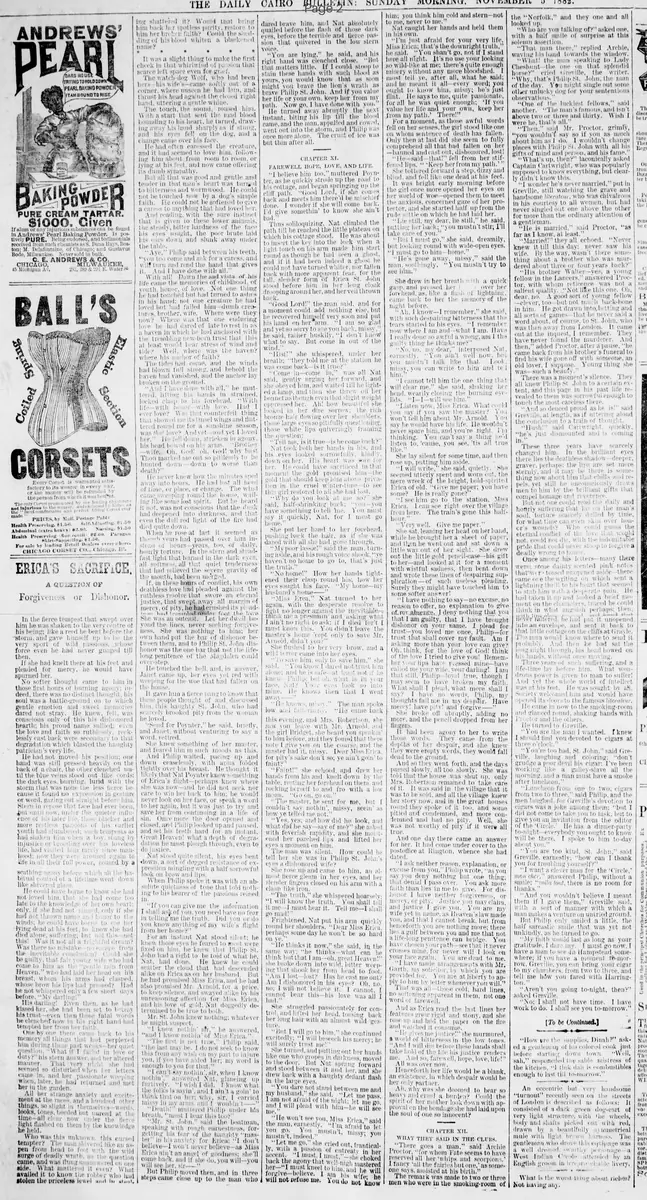
ERICA'S
SACRIFICE
A QUESTION OF
Forgiveness
or
Dishonor.
In the fierce tempest that swept over
him he was shaken to the very centre of
his being: like a reed he bent before the
storm, and gave himself up to be the
very sport of wild passions, whose
force even he had never gauged till
then.
If she had knelt there at his feet and
pleaded for mercy, he would have
spurned her.
No softer thought came to him in
those first hours of burning agony; indeed, there was no distinct thought. his
soul was a battle-ground on to which
gentle emotion and sweet memories
dared not stray. He knew, felt, was
conscious only of this his dishonored
hearth; his proud name sullied; even
the love and faith so ruthlessly, reck-
lessly cast back were secondary to that
degradation which blasted the haughty
patrician's very life.
He had not moved his position; one
hand was still pressed heavily on the
back of a chair, the other clenched un-
til the blue veins stood out like cords:
the dark eyes, burning, lurid with the
storm that was none the less fierce be-
cause it found no expression in gesture
or word, gazing out straight before him.
Stern in repose that face had ever been.
but until now, under the quieter influ-
ence of his later life, those blacker and
more restless passions of his earlier
youth had slumbered; such tempests as
had shaken him when a boy, stung by
injustice or brooding over his loveless
life, had visited him rarely since man-
hood; now they were aroused again to
life in all their full power, roused by a
scathing agony before which all the ha-
bitual control of a lifetime went down
like shivered glass.
He could have borne to know she had
not loved him, that she had come too
late to the knowledge of her own heart:
only, if she had not sinned, only if she
had not thrown name and honor to the
winds; he could have borne to see her
lying dead at his feet, to know she had
died alone, suffering; but not this -not
this: Was it not all a deceitful dream?
Was there no mistake? How are from
the inevitable conclusion? Could she
be guilty, that fair young wife who had
come to him as the "gentle rain from
Heaven." who had laid her head on his
breast, whom his arms had clasped.
whose brow his lips had pressed? Had
he not whispered only a few short days
before, "My darling!"
His darling! Even then, as he had
kissed her, she had been set to betray
his trust; even then those fatal words
he clenched now in his right hand had
tempted her from her faith.
One by one there came back to his
memory all things that had perplexed
him during these past weeks-her quiet
question, "What if I failed in love or
duty?" his stern answer, and her altered
manner. That very night she had
seemed so disturbed when her letters
came in, and her passionate weeping
when, later, he had returned and met
her in the garden.
All her strange anxiety and excite-
ment at the races, and a hundred other
things, so slight in themselves-Words.
looks, tones, heeded but unread at the
time-all clear now under the fierce
light flashed on them by the knowledge
he held.
Who was this unknown, this cursed
tempter? The man shivered like an as-
pen from head to foot with the wild
surge of deadly wrath, as the question
came, and was flung unanswered on one
side. What mattered it even? What
availed it to know the robber who had
stolen the priceless jewel and in stealing
shattered it? Would that bring
him back her spotless purity, restore to
him her broken faith? Could the shed-
ding of his blood whiten a blackened
name?
It was a slight thing to make the first
check in that whirlwind of passion that
scarce left space even for grief.
The watch-dog Wolf, who had been
hers-his wife's—came softly out of a
corner, where unseen he had lain, and
thrust his head against the closed right
hand, uttering a gentle whine.
The touch, the sound, roused him.
With a start that sent the mad blood
bounding to his heart, he turned, draw-
ing away his hand sharply as if stung.
and his eyes fell on the dog, and a
change came over his face.
He had often caressed the creature.
and it had seemed to love him, follow-
ing him about from room to room, or
lying at his feet, and now came offering
its dumb sympathy.
But all that was good and gentle and
tender in that man's heart was turned
to bitterness and wormwood. He could
not be touched now by a dog's simple
faith. He could not be softened to give
a caress to anything that had loved her.
And reading, with the sure instinct
that is given to these lower animals.
the steady, bitter hardness of the face
his eyes sought, the poor brute laid
his ears down and slunk away under
the table.
"Aye," Philip said between his teeth.
"you too come and ask for a caress, and
will turn and rend the hand that gives
it." And I have done with all."
With all! Down the sad vista of his
life came the memories of childhood, of
youth, honor, of love. Not one thing
he had touched but had turned to ashes
in his hand; not one creature he had
loved but had failed him-dumb crea-
tures, brother, wife. Where were they
now? Where was that one enduring
love he had dared of late to rest in as
a haven in which he had anchored with
the trembling new-born trust that this
at least would bear stress of wind and
tide? Well, where was the haven?
where his anchor of faith?
The tides had come, and the winds
had blown full strong, and behold the
haven had vanished, and the anchor lay
broken on the ground.
…And I have done with all." he mut-
tered, biting his hands in strained,
locked clasp to his forehead. "With
life-with honor with love. Had I
ever love? Was that counterfeit thing
that showed me its tinsel wings and flut-
tered round me for a sunshine season,
was that love? And yet -and yet I loved
her." He fell down, stricken in agony,
his head bowed on his arms. "Brother
-wife. Oh, God! oh, God! why hast
Thou marked me out so pitilessly to be
hunted down down to worse than
death?
He never knew how the minutes sped
away into hours. He had lost all heed
of time, or place, or change, The wind
came sweeping round the house, wail-
ing like some lost spirit. But he heard
it not, was not conscious that the dusk
had deepened into darkness, and that
even the dull red light of the fire had
died quite down.
When he rose at last it seemed as
though years had passed over him in-
stead of hours-years, too, of daily,
hourly torture. In the stern and stead-
fast light that burned in the dark eyes,
all softness, all that quiet tenderness
that had relieved the severe gravity of
the mouth, had been merged.
If, in these hours of conflict, his own
deathless love had pleaded against the
ruthless resolve that swore an eternal
justice, that swept away all margin of
mercy, of pity, he had crushed its plead-
ing had trampled under foot the love
She was an outcast. Let her dwell be-
yond the lines, never seeking forgive-
ness. She was nothing to him; her
own hand put the bar of dishonor be-
tween them, and to Philip St. John dis-
honor was the one bar that not the life-
long penitence of the Magdalen could
over-step.
He touched the bell, and, in answer,
Janet came up, her eyes yet red with
weeping for the woe that had fallen on
the house,
It gave him a fierce pang to know that
these people thought of and discussed
him, this haughty St. John, who had
scarcely brooked pity from the woman
he loved.
"Send for Poynter," he said, briefly,
and Janet, without venturing to say a
word, retired.
She knew something of her master.
and feared him in such moods as this.
And Philip waited, pacing up and
down ceaselessly, with arms folded
tightly over his breast. He thought it
likely that Nat Poynter knew something
of Erica's flight-perhaps knew where
she was now-and he did not seek nor
care to win her back to him; he would
never look on her face, or speak a word
to her again, but it was just to try and
save her from continuing in a life of
sin. Once more the door opened and
closed, and Philip looked up and paused,
and set his teeth hard for an instant.
Great Heaven! what a depth of degra-
dation he must plough through, even to
do justice.
Nat stood quite silent, his eyes bent
down, a sort of dogged resistance of ex-
pression mingling with a half sorrowful
look on brow and lips.
When Philip spoke it was with an ab-
solute quietness of tone that told noth-
ing to his hearer of the passions reined
in.
"If you can give me the information
I shall ask of you, you need have no fear
in telling me the truth. Did you or do
you know anything of my wife's flight
from her home?"
For an instant Nat stood silent: he
knew those eyes he feared to meet were
fixed on him, he knew that Philip St.
John had a right to be told of what he,
Nat, had done. He knew he could
scatter the cloud that had descended
alike on Erica as on her husband. But
he had promised Miss Erica, and he had
also promised Mr. Arnold, for a price,
to keep silence, and swayed alike by his
unreasoning affection for Miss Erica,
and his love of gold, Nat doggedly de-
termined to be true to both.
Mr. St. John knew nothing; whatever
he might suspect.
"I know nothin' sir," he answered.
"and I know nothin' of Miss Erica."
"The first is not true," Philip said
"the last may be. I do not seek to know
this from any wish on my part to injure
you, if you have aided her; my word is
enough to you for that."
"I can't say nothin', sir, when I know
nothin'," answered Nat, glancing up
furtively, "I wish I did. I know what
the folks is sayin', and I ain't a goin' to
think that on her; why, sir, I carried
missy in my arms, and I wouldn't-
"Death!" muttered Philip under his
breath, "must I bear this too?"
"Mr. St. John," said the boatman,
speaking with rough earnestness, for-
getting his fear of the haughty "mas-
ter" in his anxiety for Erica; "I don't
believe-I won't never believe-as Miss
Erica ain't an angel of goodness: she'll
come back, and if she do, you will-you
will see her, sir--
But Philip moved then, and in three
steps came close up to the man who
dared brave him, and Nat absolutely
quailed before the flash of those dark
eyes, before the terrible and fierce pas-
sion that quivered in the low stern
voice.
"You are lying," he said, and his
right hand was clenched close. "But
that matters little. If I could stoop to
stain these hands with such blood as
yours, you would know that as soon
might you brave the lion's wrath as
brave Philip St. John. And if you value
her life or your own, keep her from my
path. Now go, I have done with you."
He turned away abruptly the next
instant, biting his lip till the blood
came, and the man, appalled and cowed,
went out into the storm, and Philip was
once more alone. The crust of ice was
but thin after all.
CHAPTER XI.
FAREWELL HOPE, LOVE, AND LIFE.
"I believe him too," muttered Poyn-
ter, as he quickly strode up the road to
his cottage, and began springing up the
cliff path. "Good Lord, if she comes
back and meets him there'd be mischief
done. I wonder if she will come back.
I'd give somethin' to know she ain't
bad."
Thus soliloquizing, Nat climbed the
path till he reached the little plateau on
which his cottage stood. He was about
to insert the key into the lock when a
light touch on his arm made him start
round as though he had seen a ghost.
and if it had been indeed a ghost he
could not have turned whiter, nor fallen
back with more apparent fear, for the
tall, slender form of Erica St. John
stood before him in her long cloak
drooping around her, and her veil thrown
back.
"Good Lord!" the man said, and for
a moment could add nothing else, but
he recovered himself very soon and put
his hand on her arm. "I am so glad
and yet so sorry to see you back, missy,"
he said, rather huskily, "I don't know
what to say. But come in out of the
wind.
"Hist!" she whispered, under her
breath; "they told me at the station he
was come back-is it true?
"Come in-come in," was all Nat
said, gently urging her forward, and
she obeyed him, and waited till he light-
ed a lamp, and then she threw off her
bonnet as though even that slight weight
oppressed her. "Ah! how beautiful she
looked in her dire sorrow: the rich
bronze hair flowing over her shoulders.
those large eyes so pitifully questioning.
those white lips quiveringly framing
the question:
"Tell me, is it true—is he come back?"
Nat took both her hands in his, and
his eyes looked sorrowfully, kindly,
down on her. His heart was sore for
her. He could have sacrificed in that
moment the gold promised him-the
gold that should keep him above priva-
tion in the cruel winter-time-to see
this girl restored to all she had lost.
"Why do you look at me so?" she
said, half-shrinking back; "you-you
have something to tell me. You must
say it quickly, Nat, for I must go
home.
She put her hand to her forehead.
pushing back the hair, as if she was
dazed with all she had gone through.
"My poor lassie!" said the man, turn-
ing aside, and his rough voice shook, "ye
haven't no home to go to, that's just
the truth.
"No home!" How her hands tight-
ened their clasp round his; how her
eyes sought his face. "My home-my
husband's home
"Miss Erica." Nat turned to her
again, with the desperate resolve to
fight no longer against the inevitable—
think me a presuming and asking what
I ain't no right to ask: if I died for't I
must know this. You didn't leave the
master's home 'cept only to save Mr.
Arnold, didn't you:
She flushed to her very brow, and a
wild terror came into her eyes.
"To save him, only to save him," she
said. "You know I'd dared not trust him
alone: and he is safe at least not if he
knows Philip, but oh, what is in your
face, Nat: Your eyes look so into
mine. He knows then that I went
away
"He knows, mis'y." The man spoke
low and faltering. "He came back
this evening, and Mrs. Robertson, she
saw you leave with Mr. Arnold, and
the girl Bridget, she heard you speaking
to him before, and they found that there
note I give you on the course, and the
master had it, missy. Dear Miss Erica.
for pity's sake don't go; ye ain't goin' to
faint?
"Faint!" she echoed, and drew her
hands from his and knelt down by the
table, resting her forehead on them, and
rocking herself to and fro with a low
moan. "Go on, go on.
"The master, he sent for me, but I
couldn't say nothin', missy, seein' as
how ye telled me not.
"Yes, yes; and how did he look, and
what did he say-say of me?" she asked
with feverish rapidity, and she moist-
ened her parched lips and lifted her
eyes a moment on him.
The man was silent. How could he
tell her she was in Philip St. John's
eyes a dishonored wife?
She rose up and came to him, an al-
most fierce gleam in her eyes, and her
slender fingers closed on his arm with a
clasp like iron.
"The truth," she whispered hoarsely:
"I will know the truth. You shall tell
it me-I must hear it. Tell me--I shall
go mad!"
Frightened, Nat put his arm quickly
round her shoulders. "Dear Miss Erica.
perhaps some day he won't be so hard
on ye.
"He thinks it now," she said, in the
same way; "he thinks-what can he
think but that I am--oh, great Heaven!"
she broke down into wild, bitter weep-
ing that shook her from head to foot.
"Am I lost? lost? Has he cast me out:
Am I dishonored in his eyes? Oh, no
no; I will not believe it." I cannot, I
cannot bear this-his love was all I
had."
She struggled passionately for con-
trol, and lifted her head, tossing back
her long hair with an almost wild ges-
ture.
"But I will go to him," she continued
excitedly: "I will beseech his mercy; he
will surely trust me!'
She turned, and putting out her hands
like one who gropes in darkness, moved
to the door. But Nat sprang forward
and stood between it and her, and she
drew back with a haughty defiant flash
in the large eyes.
"You dare not stand between me and
my husband," she said. "Let me pass,
I am not afraid of the night; let me go,
and I will plead with him-he will see
me."
"He won't see you, Miss Erica." said
the man, earnestly. "I'm afraid to let
you go. You mustn't, missy; you
mustn't, indeed."
"Let me go," she cried out, frantical-
ly, with a passion of entreaty in her
accent. "I must, I must,"-she choked
back the agony-that well-nigh mastered
her-"I must kneel to him, and he will
forgive-believe. I am his wife; he
will not refuse me. You do not know
him; you think him cold and stern-not
to me, never to me."
Nat caught her hands and held them
in his own.
"I'm just afraid for your very life
Miss Erica: that's the downright truth."
he said. "You shan't go, not if I stand
here all night. It's no use your looking
so wild-like at me; there's quite enough
misery without any more bloodshed. I
must tell ye, after all, what he said;
and he meant it all-every word; you
ought to know him, missy: he's just
flint. He says to me, quite passionate,
for all he was quiet enough; 'If you
value her life and your own, keep her
from my path.' There!"
For a moment, as those awful words
fell on her senses, the girl stood like one
on whom sentence of death has fallen.
Only then at last did she seem to fully
comprehend all that had fallen on her
--banned and cast out, dishonored, lost!
"He--said--that!" fell from her stif-
fened lips. "Keep her from my path.'"
She tottered forward a step, dizzy and
blind, and fell like one dead at his feet.
It was bright early morning before
the girl once more opened her eyes on
her world of woe-opened them to meet
the anxious, concerned gaze of her pro-
lector, and she started half up from the
rude settle on which he had laid her.
"Lie still, my dear, lie still," he said.
putting her back; "you mustn't stir; I'll
take care of you.
"But I must go," she said, dreamily,
but looking round with wide-open eyes.
"I must go to him-home.
"He's gone away, missy," said the
man, soothingly. "You mustn't try to
see him."
She drew in her breath with a quick
gasp, and pressed her
over her
forehead, as, like a flash of lightning,
came back to her the memory of the
night before.
"Ah, I know-I remember," she said,
with such despairing bitterness that the
tears started to his eyes. "I remember
now where I am and-what I am. Have
I really done so awful a wrong, am I the
guilty thing he thinks me?
"No, no, my dear," interposed Nat.
earnestly. "You ain't well now, but
you mustn't talk like that. Look
missy, you can write to him and tell
him.
"I cannot tell him the one thing that
will clear me," she said, shaking her
head, wearily closing the burning eye-
lids. "I-I-will see him.'
"Listen now, Miss Erica. What could
you say if you saw the master? You
won't tell him about Mr. Arnold. You
say he would have his life. He wouldn't
never spare him, and you're right. I'm
thinking. You can't say a thing he'd
listen to, 'cause, you see, 'tis all true
like."
She lay silent for some time, and then
rose up, putting him aside,
"I will write," she said, quietly. She
seemed utterly spent and worn out, the
mere wreck of the bright, bold-spirited
Erica of old. "Give me paper; you have
some? He is really gone?
"I see him go to the station, Miss
Erica. I can see right over the village
from here. The train's gone this half-
hour.
"Very well. Give me paper."
She sat, leaning her head on her hand
while he brought her a sheet of paper.
and then he went out and sat down a
little way out of her sight. She drew
out the little gold pencil-case--his gift
to her-and looked at it for a moment
with wistful sadness, then bent down
and wrote these lines of despairing sup-
plication-of such useless pleading.
Surely they might have touched him to
some softer answer!
"I have nothing to say-no excuse, no
reason to offer, no explanation to give
of my absence. I deny nothing that you
that I am guilty, that I have brought
dishonor on your name. I plead for
trust-you loved me once, Philip-for
trust that shall cover my fault. Am I
asking more than your love can give?
Oh, think, for the love of God! think
of the love I tried to give you! Remem-
ber your lips have pressed mine-have
called me your wife, your darling! I am
that still, Philip-loyal true, though I
may seem to have broken my faith.
What shall I plead, what more shall I
say? I have no words, Philip, my
thoughts fail me in my despair. "Have
mercy! have pity! and forgive---"
She broke off abruptly, adding no
more, and the pencil dropped from her
fingers.
It had been agony to her to write
those words. They came from the
depths of her despair, and she knew
they were empty words, they would fall
dead to the ground.
And so they went forth, and the days
passed slowly, all too slowly. She was
told that the house was shut up, only
Mrs. Robertson remained to take care
of it. It was said in the village that it
was to be sold, and all the village knew
her story now, and in the great houses
round they spoke of it too, and some
pitied and condemned, and more con-
demned and had no pity. Well, she
was not worthy of pity if it were all
true.
And one day there came an answer
for her. It had come under cover to the
postoffice at Rington, whence she had
dated.
"I ask neither reason, explanation, or
excuse from you," Philip wrote, "as you
say you deny nothing but one thing;
that denial I pass over. You ask more
faith than lies in me to give. For dis-
honor I have neither forgiveness, or
mercy, or pity. Justice you may claim,
and justice I give you. You are my
wife yet in name, as Heaven's law made
you, and that I cannot break, but from
henceforth you are nothing more: there
lies a gulf between you and me that not
a life-long penitence can bridge. You
have chosen your path-see that it never
crosses mine, for never will I look on
your face again. You are dead to me.
"I have made arrangements with Mr.
Garth, my solicitor, by which you are
provided for. You are at liberty to ap-
ply to him by letter whenever you will."
That was all—those cold, hard lines,
no softening apparent in them, not one
word of farewell.
And as Erica read the last lines her
features grew rigid and stony, and she
rose up and laid the paper on the fire
and watched it consume.
"He gives me justice," she murmured,
a world of bitterness in the low tones.
"And I will die before these hands shall
take hold of the life his justice renders
me. And so, farewell, hope, love, life!"
All was over now.
Henceforth her life would be a blank.
an existence, in which despair would be
her only partner.
Ah, why was she doomed to bear so
heavy and cruel a burden? Could the
spirit of her mother look down with ap-
proval on the bondage she had laid upon
the soul of one so innocent?
CHAPTER XII.
WHAT THEY SAID IN THE CLUBS.
"There goes a man," said Archie
Proctor, "for whom Fate seems to have
reserved all her 'whips and scorpions.
I fancy 'all the fairies but one,' as some-
one says, assisted at his birth."
The remark was made to two or three
men who were in the smoking-room of
the "Norfolk," and they one and all
looked up.
"Who are you talking of?" asked one,
with a half smile of surprise at this
solemn assertion.
"That man there," replied Archie,
waving his hand towards the window.
"What! the man speaking to Lady
Cheshunt-the one on that splendid
horse?" cried Greville, the writer.
"Why, that's Philip St. John, the man
of the day. You might single out some
other unlucky dog for your sententious
observations.
"One of the luckiest fellows," said
another. "The man's famous, and isn't
above two or three and thirty. Wish I
were he, that's all."
"Then," said Mr. Proctor, grimly,
"you wouldn't say so if you knew as much
about him as I do. I wouldn't change
places with Philip St. John with all his
gifts of mind and person, and his fame."
"What's up, then?" laconically asked
Captain Cartwright, who was popularly
supposed to know everything, but clear-
ly didn't know this.
"I wonder he's never married," put in
Greville, still watching the grave and
handsome literateur, who was chivalrous
in his courtesy to all women, but had
never singled out one above the other
for more than the ordinary attention of
a gentleman.
"He is married," said Proctor,
"as
far as I know, at least."
"Married!" they all echoed. "Never
knew it till this day: never saw his
wife. By the way, wasn't there some-
thing about a brother who was mur-
dered about three or four years back?'
"His brother Walter-yes, a young
fellow in the Lancers," answered Proc-
tor, with whom reticence was not a
salient quality. "Not like this one. Oh,
deer, no. A good sort of young fellow
-clever, too-but not much back-bone
in him. He got drawn into betting and
all sorts of games-that he never said a
word about, of course, to St. John, who
was then away from London. It came
out at the inquest, I remember. They
have never found the murderer. And
then," added Proctor, after a pause, "he
came back from his brother's funeral to
find his wife gone off with someone, an
old lover, I suppose. Young thing she
was-such a beauty."
There was a moment's silence. They
all knew Philip St. John to a certain ex-
tent, and this page in his past life re-
vealed to them was sorrowful enough to
touch the most careless there.
"And so deuced proud as he is," said
Greville, at length, as if uttering aloud
the conclusion to a train of thought.
"Hush," said Cartwright, quickly.
"he's just dismounted and is coming
in."
These three years have scarcely
changed him. In the brilliant eyes
there lies the deathless shadow-deeper,
graver, perhaps: the lips are set more
sternly, and it may be there is some-
thing now about him that chills and re-
pels, yet still he unconsciously draws
men to him by the brilliant gifts that
compel homage and reverence,
But not one could read the daily and
hourly suffering that lay on the man's
soul, "torture scarcely dulled by time,
for what time can even skin over hon-
ors wound-? Who could guess the
eternal conflict of the love that would
not, could not die, with the indomitable
pride that could never stoop to forgive a
deadly wrong to honor.
Once among his letters-many there
were; some dainty scented pink notes
that were tossed unopened aside-there
came one the writing on which sent a
lightning thrill to his heart that seemed
to stab him with a desperate pang. He
had taken it up and looked a brief mo-
ment on the characters, traced he could
think in what anguish perhaps; then,
without watching he had put it unopened
and hand it
into an envelope, and sent it back to
that little cottage on the cliffs at Grayle.
The man would know where to send it
probably. And then he had sat the
long night through, his head bowed on
his hands, without once moving.
Three years of such suffering, and a
life-time lay before him. What won-
drous power is given to man to suffer.
And yet the whole world of intellect
was at his feet. He was sought by all.
Society welcomed him and would have
opened its doors to the famous literateur.
He came in now to the smoking-room
and glanced round, shaking hands with
Proctor and the others.
He turned to Greville.
"You are the man I wanted. I knew
I should find you devoted to cigars at
three o'clock."
"You're too bad, St. John," said Gre-
villle, laughing and coloring; "don't
grudge a poor devil his cigar: I've been
working like a galley-slave all the
morning, and a man must have a smoke
after luncheon.
"Luncheon from one to two, cigars
from two to three," said Philip, and the
men laughed, for Greville's devotion to
cigars was a joke among them: "but I
did not come to take you to task, but to
give you an invitation from the editor
of the Circle. He has a dinner-party
to-night-everybody you ought to know
will be there. I spoke to him to-day
about you."
"You are too kind, St. John," said
Greville, earnestly; "how can I thank
you for troubling yourself?'
"I want a clever man for the Circle,
mon cher," answered Philip, without a
smile: "voila tout, there is no room for
thanks."
"And you wouldn't believe I meant
them if I gave them," Greville said,
with a sort of manner with which a
man makes a venture on untried ground.
But Philip only smiled a little, the
half sarcastic smile that was yet not
unkindly, as he turned to go.
"My faith would last as long as your
gratitude, I dare say. I must go now, I
have a man to see in Hampstead some-
where; if you have a moment to-mor-
row, Greville, you can bring your cigar
to my chambers, from two to three, and
tell me how you fared with Harring-
ton.
"Aren't you going to-night, then?"
asked Greville.
"No; I shall not have time. I have
work to do. I shall see you to-morrow."
[To be Continued.]
SACRIFICE
A QUESTION OF
Forgiveness
or
Dishonor.
In the fierce tempest that swept over
him he was shaken to the very centre of
his being: like a reed he bent before the
storm, and gave himself up to be the
very sport of wild passions, whose
force even he had never gauged till
then.
If she had knelt there at his feet and
pleaded for mercy, he would have
spurned her.
No softer thought came to him in
those first hours of burning agony; indeed, there was no distinct thought. his
soul was a battle-ground on to which
gentle emotion and sweet memories
dared not stray. He knew, felt, was
conscious only of this his dishonored
hearth; his proud name sullied; even
the love and faith so ruthlessly, reck-
lessly cast back were secondary to that
degradation which blasted the haughty
patrician's very life.
He had not moved his position; one
hand was still pressed heavily on the
back of a chair, the other clenched un-
til the blue veins stood out like cords:
the dark eyes, burning, lurid with the
storm that was none the less fierce be-
cause it found no expression in gesture
or word, gazing out straight before him.
Stern in repose that face had ever been.
but until now, under the quieter influ-
ence of his later life, those blacker and
more restless passions of his earlier
youth had slumbered; such tempests as
had shaken him when a boy, stung by
injustice or brooding over his loveless
life, had visited him rarely since man-
hood; now they were aroused again to
life in all their full power, roused by a
scathing agony before which all the ha-
bitual control of a lifetime went down
like shivered glass.
He could have borne to know she had
not loved him, that she had come too
late to the knowledge of her own heart:
only, if she had not sinned, only if she
had not thrown name and honor to the
winds; he could have borne to see her
lying dead at his feet, to know she had
died alone, suffering; but not this -not
this: Was it not all a deceitful dream?
Was there no mistake? How are from
the inevitable conclusion? Could she
be guilty, that fair young wife who had
come to him as the "gentle rain from
Heaven." who had laid her head on his
breast, whom his arms had clasped.
whose brow his lips had pressed? Had
he not whispered only a few short days
before, "My darling!"
His darling! Even then, as he had
kissed her, she had been set to betray
his trust; even then those fatal words
he clenched now in his right hand had
tempted her from her faith.
One by one there came back to his
memory all things that had perplexed
him during these past weeks-her quiet
question, "What if I failed in love or
duty?" his stern answer, and her altered
manner. That very night she had
seemed so disturbed when her letters
came in, and her passionate weeping
when, later, he had returned and met
her in the garden.
All her strange anxiety and excite-
ment at the races, and a hundred other
things, so slight in themselves-Words.
looks, tones, heeded but unread at the
time-all clear now under the fierce
light flashed on them by the knowledge
he held.
Who was this unknown, this cursed
tempter? The man shivered like an as-
pen from head to foot with the wild
surge of deadly wrath, as the question
came, and was flung unanswered on one
side. What mattered it even? What
availed it to know the robber who had
stolen the priceless jewel and in stealing
shattered it? Would that bring
him back her spotless purity, restore to
him her broken faith? Could the shed-
ding of his blood whiten a blackened
name?
It was a slight thing to make the first
check in that whirlwind of passion that
scarce left space even for grief.
The watch-dog Wolf, who had been
hers-his wife's—came softly out of a
corner, where unseen he had lain, and
thrust his head against the closed right
hand, uttering a gentle whine.
The touch, the sound, roused him.
With a start that sent the mad blood
bounding to his heart, he turned, draw-
ing away his hand sharply as if stung.
and his eyes fell on the dog, and a
change came over his face.
He had often caressed the creature.
and it had seemed to love him, follow-
ing him about from room to room, or
lying at his feet, and now came offering
its dumb sympathy.
But all that was good and gentle and
tender in that man's heart was turned
to bitterness and wormwood. He could
not be touched now by a dog's simple
faith. He could not be softened to give
a caress to anything that had loved her.
And reading, with the sure instinct
that is given to these lower animals.
the steady, bitter hardness of the face
his eyes sought, the poor brute laid
his ears down and slunk away under
the table.
"Aye," Philip said between his teeth.
"you too come and ask for a caress, and
will turn and rend the hand that gives
it." And I have done with all."
With all! Down the sad vista of his
life came the memories of childhood, of
youth, honor, of love. Not one thing
he had touched but had turned to ashes
in his hand; not one creature he had
loved but had failed him-dumb crea-
tures, brother, wife. Where were they
now? Where was that one enduring
love he had dared of late to rest in as
a haven in which he had anchored with
the trembling new-born trust that this
at least would bear stress of wind and
tide? Well, where was the haven?
where his anchor of faith?
The tides had come, and the winds
had blown full strong, and behold the
haven had vanished, and the anchor lay
broken on the ground.
…And I have done with all." he mut-
tered, biting his hands in strained,
locked clasp to his forehead. "With
life-with honor with love. Had I
ever love? Was that counterfeit thing
that showed me its tinsel wings and flut-
tered round me for a sunshine season,
was that love? And yet -and yet I loved
her." He fell down, stricken in agony,
his head bowed on his arms. "Brother
-wife. Oh, God! oh, God! why hast
Thou marked me out so pitilessly to be
hunted down down to worse than
death?
He never knew how the minutes sped
away into hours. He had lost all heed
of time, or place, or change, The wind
came sweeping round the house, wail-
ing like some lost spirit. But he heard
it not, was not conscious that the dusk
had deepened into darkness, and that
even the dull red light of the fire had
died quite down.
When he rose at last it seemed as
though years had passed over him in-
stead of hours-years, too, of daily,
hourly torture. In the stern and stead-
fast light that burned in the dark eyes,
all softness, all that quiet tenderness
that had relieved the severe gravity of
the mouth, had been merged.
If, in these hours of conflict, his own
deathless love had pleaded against the
ruthless resolve that swore an eternal
justice, that swept away all margin of
mercy, of pity, he had crushed its plead-
ing had trampled under foot the love
She was an outcast. Let her dwell be-
yond the lines, never seeking forgive-
ness. She was nothing to him; her
own hand put the bar of dishonor be-
tween them, and to Philip St. John dis-
honor was the one bar that not the life-
long penitence of the Magdalen could
over-step.
He touched the bell, and, in answer,
Janet came up, her eyes yet red with
weeping for the woe that had fallen on
the house,
It gave him a fierce pang to know that
these people thought of and discussed
him, this haughty St. John, who had
scarcely brooked pity from the woman
he loved.
"Send for Poynter," he said, briefly,
and Janet, without venturing to say a
word, retired.
She knew something of her master.
and feared him in such moods as this.
And Philip waited, pacing up and
down ceaselessly, with arms folded
tightly over his breast. He thought it
likely that Nat Poynter knew something
of Erica's flight-perhaps knew where
she was now-and he did not seek nor
care to win her back to him; he would
never look on her face, or speak a word
to her again, but it was just to try and
save her from continuing in a life of
sin. Once more the door opened and
closed, and Philip looked up and paused,
and set his teeth hard for an instant.
Great Heaven! what a depth of degra-
dation he must plough through, even to
do justice.
Nat stood quite silent, his eyes bent
down, a sort of dogged resistance of ex-
pression mingling with a half sorrowful
look on brow and lips.
When Philip spoke it was with an ab-
solute quietness of tone that told noth-
ing to his hearer of the passions reined
in.
"If you can give me the information
I shall ask of you, you need have no fear
in telling me the truth. Did you or do
you know anything of my wife's flight
from her home?"
For an instant Nat stood silent: he
knew those eyes he feared to meet were
fixed on him, he knew that Philip St.
John had a right to be told of what he,
Nat, had done. He knew he could
scatter the cloud that had descended
alike on Erica as on her husband. But
he had promised Miss Erica, and he had
also promised Mr. Arnold, for a price,
to keep silence, and swayed alike by his
unreasoning affection for Miss Erica,
and his love of gold, Nat doggedly de-
termined to be true to both.
Mr. St. John knew nothing; whatever
he might suspect.
"I know nothin' sir," he answered.
"and I know nothin' of Miss Erica."
"The first is not true," Philip said
"the last may be. I do not seek to know
this from any wish on my part to injure
you, if you have aided her; my word is
enough to you for that."
"I can't say nothin', sir, when I know
nothin'," answered Nat, glancing up
furtively, "I wish I did. I know what
the folks is sayin', and I ain't a goin' to
think that on her; why, sir, I carried
missy in my arms, and I wouldn't-
"Death!" muttered Philip under his
breath, "must I bear this too?"
"Mr. St. John," said the boatman,
speaking with rough earnestness, for-
getting his fear of the haughty "mas-
ter" in his anxiety for Erica; "I don't
believe-I won't never believe-as Miss
Erica ain't an angel of goodness: she'll
come back, and if she do, you will-you
will see her, sir--
But Philip moved then, and in three
steps came close up to the man who
dared brave him, and Nat absolutely
quailed before the flash of those dark
eyes, before the terrible and fierce pas-
sion that quivered in the low stern
voice.
"You are lying," he said, and his
right hand was clenched close. "But
that matters little. If I could stoop to
stain these hands with such blood as
yours, you would know that as soon
might you brave the lion's wrath as
brave Philip St. John. And if you value
her life or your own, keep her from my
path. Now go, I have done with you."
He turned away abruptly the next
instant, biting his lip till the blood
came, and the man, appalled and cowed,
went out into the storm, and Philip was
once more alone. The crust of ice was
but thin after all.
CHAPTER XI.
FAREWELL HOPE, LOVE, AND LIFE.
"I believe him too," muttered Poyn-
ter, as he quickly strode up the road to
his cottage, and began springing up the
cliff path. "Good Lord, if she comes
back and meets him there'd be mischief
done. I wonder if she will come back.
I'd give somethin' to know she ain't
bad."
Thus soliloquizing, Nat climbed the
path till he reached the little plateau on
which his cottage stood. He was about
to insert the key into the lock when a
light touch on his arm made him start
round as though he had seen a ghost.
and if it had been indeed a ghost he
could not have turned whiter, nor fallen
back with more apparent fear, for the
tall, slender form of Erica St. John
stood before him in her long cloak
drooping around her, and her veil thrown
back.
"Good Lord!" the man said, and for
a moment could add nothing else, but
he recovered himself very soon and put
his hand on her arm. "I am so glad
and yet so sorry to see you back, missy,"
he said, rather huskily, "I don't know
what to say. But come in out of the
wind.
"Hist!" she whispered, under her
breath; "they told me at the station he
was come back-is it true?
"Come in-come in," was all Nat
said, gently urging her forward, and
she obeyed him, and waited till he light-
ed a lamp, and then she threw off her
bonnet as though even that slight weight
oppressed her. "Ah! how beautiful she
looked in her dire sorrow: the rich
bronze hair flowing over her shoulders.
those large eyes so pitifully questioning.
those white lips quiveringly framing
the question:
"Tell me, is it true—is he come back?"
Nat took both her hands in his, and
his eyes looked sorrowfully, kindly,
down on her. His heart was sore for
her. He could have sacrificed in that
moment the gold promised him-the
gold that should keep him above priva-
tion in the cruel winter-time-to see
this girl restored to all she had lost.
"Why do you look at me so?" she
said, half-shrinking back; "you-you
have something to tell me. You must
say it quickly, Nat, for I must go
home.
She put her hand to her forehead.
pushing back the hair, as if she was
dazed with all she had gone through.
"My poor lassie!" said the man, turn-
ing aside, and his rough voice shook, "ye
haven't no home to go to, that's just
the truth.
"No home!" How her hands tight-
ened their clasp round his; how her
eyes sought his face. "My home-my
husband's home
"Miss Erica." Nat turned to her
again, with the desperate resolve to
fight no longer against the inevitable—
think me a presuming and asking what
I ain't no right to ask: if I died for't I
must know this. You didn't leave the
master's home 'cept only to save Mr.
Arnold, didn't you:
She flushed to her very brow, and a
wild terror came into her eyes.
"To save him, only to save him," she
said. "You know I'd dared not trust him
alone: and he is safe at least not if he
knows Philip, but oh, what is in your
face, Nat: Your eyes look so into
mine. He knows then that I went
away
"He knows, mis'y." The man spoke
low and faltering. "He came back
this evening, and Mrs. Robertson, she
saw you leave with Mr. Arnold, and
the girl Bridget, she heard you speaking
to him before, and they found that there
note I give you on the course, and the
master had it, missy. Dear Miss Erica.
for pity's sake don't go; ye ain't goin' to
faint?
"Faint!" she echoed, and drew her
hands from his and knelt down by the
table, resting her forehead on them, and
rocking herself to and fro with a low
moan. "Go on, go on.
"The master, he sent for me, but I
couldn't say nothin', missy, seein' as
how ye telled me not.
"Yes, yes; and how did he look, and
what did he say-say of me?" she asked
with feverish rapidity, and she moist-
ened her parched lips and lifted her
eyes a moment on him.
The man was silent. How could he
tell her she was in Philip St. John's
eyes a dishonored wife?
She rose up and came to him, an al-
most fierce gleam in her eyes, and her
slender fingers closed on his arm with a
clasp like iron.
"The truth," she whispered hoarsely:
"I will know the truth. You shall tell
it me-I must hear it. Tell me--I shall
go mad!"
Frightened, Nat put his arm quickly
round her shoulders. "Dear Miss Erica.
perhaps some day he won't be so hard
on ye.
"He thinks it now," she said, in the
same way; "he thinks-what can he
think but that I am--oh, great Heaven!"
she broke down into wild, bitter weep-
ing that shook her from head to foot.
"Am I lost? lost? Has he cast me out:
Am I dishonored in his eyes? Oh, no
no; I will not believe it." I cannot, I
cannot bear this-his love was all I
had."
She struggled passionately for con-
trol, and lifted her head, tossing back
her long hair with an almost wild ges-
ture.
"But I will go to him," she continued
excitedly: "I will beseech his mercy; he
will surely trust me!'
She turned, and putting out her hands
like one who gropes in darkness, moved
to the door. But Nat sprang forward
and stood between it and her, and she
drew back with a haughty defiant flash
in the large eyes.
"You dare not stand between me and
my husband," she said. "Let me pass,
I am not afraid of the night; let me go,
and I will plead with him-he will see
me."
"He won't see you, Miss Erica." said
the man, earnestly. "I'm afraid to let
you go. You mustn't, missy; you
mustn't, indeed."
"Let me go," she cried out, frantical-
ly, with a passion of entreaty in her
accent. "I must, I must,"-she choked
back the agony-that well-nigh mastered
her-"I must kneel to him, and he will
forgive-believe. I am his wife; he
will not refuse me. You do not know
him; you think him cold and stern-not
to me, never to me."
Nat caught her hands and held them
in his own.
"I'm just afraid for your very life
Miss Erica: that's the downright truth."
he said. "You shan't go, not if I stand
here all night. It's no use your looking
so wild-like at me; there's quite enough
misery without any more bloodshed. I
must tell ye, after all, what he said;
and he meant it all-every word; you
ought to know him, missy: he's just
flint. He says to me, quite passionate,
for all he was quiet enough; 'If you
value her life and your own, keep her
from my path.' There!"
For a moment, as those awful words
fell on her senses, the girl stood like one
on whom sentence of death has fallen.
Only then at last did she seem to fully
comprehend all that had fallen on her
--banned and cast out, dishonored, lost!
"He--said--that!" fell from her stif-
fened lips. "Keep her from my path.'"
She tottered forward a step, dizzy and
blind, and fell like one dead at his feet.
It was bright early morning before
the girl once more opened her eyes on
her world of woe-opened them to meet
the anxious, concerned gaze of her pro-
lector, and she started half up from the
rude settle on which he had laid her.
"Lie still, my dear, lie still," he said.
putting her back; "you mustn't stir; I'll
take care of you.
"But I must go," she said, dreamily,
but looking round with wide-open eyes.
"I must go to him-home.
"He's gone away, missy," said the
man, soothingly. "You mustn't try to
see him."
She drew in her breath with a quick
gasp, and pressed her
over her
forehead, as, like a flash of lightning,
came back to her the memory of the
night before.
"Ah, I know-I remember," she said,
with such despairing bitterness that the
tears started to his eyes. "I remember
now where I am and-what I am. Have
I really done so awful a wrong, am I the
guilty thing he thinks me?
"No, no, my dear," interposed Nat.
earnestly. "You ain't well now, but
you mustn't talk like that. Look
missy, you can write to him and tell
him.
"I cannot tell him the one thing that
will clear me," she said, shaking her
head, wearily closing the burning eye-
lids. "I-I-will see him.'
"Listen now, Miss Erica. What could
you say if you saw the master? You
won't tell him about Mr. Arnold. You
say he would have his life. He wouldn't
never spare him, and you're right. I'm
thinking. You can't say a thing he'd
listen to, 'cause, you see, 'tis all true
like."
She lay silent for some time, and then
rose up, putting him aside,
"I will write," she said, quietly. She
seemed utterly spent and worn out, the
mere wreck of the bright, bold-spirited
Erica of old. "Give me paper; you have
some? He is really gone?
"I see him go to the station, Miss
Erica. I can see right over the village
from here. The train's gone this half-
hour.
"Very well. Give me paper."
She sat, leaning her head on her hand
while he brought her a sheet of paper.
and then he went out and sat down a
little way out of her sight. She drew
out the little gold pencil-case--his gift
to her-and looked at it for a moment
with wistful sadness, then bent down
and wrote these lines of despairing sup-
plication-of such useless pleading.
Surely they might have touched him to
some softer answer!
"I have nothing to say-no excuse, no
reason to offer, no explanation to give
of my absence. I deny nothing that you
that I am guilty, that I have brought
dishonor on your name. I plead for
trust-you loved me once, Philip-for
trust that shall cover my fault. Am I
asking more than your love can give?
Oh, think, for the love of God! think
of the love I tried to give you! Remem-
ber your lips have pressed mine-have
called me your wife, your darling! I am
that still, Philip-loyal true, though I
may seem to have broken my faith.
What shall I plead, what more shall I
say? I have no words, Philip, my
thoughts fail me in my despair. "Have
mercy! have pity! and forgive---"
She broke off abruptly, adding no
more, and the pencil dropped from her
fingers.
It had been agony to her to write
those words. They came from the
depths of her despair, and she knew
they were empty words, they would fall
dead to the ground.
And so they went forth, and the days
passed slowly, all too slowly. She was
told that the house was shut up, only
Mrs. Robertson remained to take care
of it. It was said in the village that it
was to be sold, and all the village knew
her story now, and in the great houses
round they spoke of it too, and some
pitied and condemned, and more con-
demned and had no pity. Well, she
was not worthy of pity if it were all
true.
And one day there came an answer
for her. It had come under cover to the
postoffice at Rington, whence she had
dated.
"I ask neither reason, explanation, or
excuse from you," Philip wrote, "as you
say you deny nothing but one thing;
that denial I pass over. You ask more
faith than lies in me to give. For dis-
honor I have neither forgiveness, or
mercy, or pity. Justice you may claim,
and justice I give you. You are my
wife yet in name, as Heaven's law made
you, and that I cannot break, but from
henceforth you are nothing more: there
lies a gulf between you and me that not
a life-long penitence can bridge. You
have chosen your path-see that it never
crosses mine, for never will I look on
your face again. You are dead to me.
"I have made arrangements with Mr.
Garth, my solicitor, by which you are
provided for. You are at liberty to ap-
ply to him by letter whenever you will."
That was all—those cold, hard lines,
no softening apparent in them, not one
word of farewell.
And as Erica read the last lines her
features grew rigid and stony, and she
rose up and laid the paper on the fire
and watched it consume.
"He gives me justice," she murmured,
a world of bitterness in the low tones.
"And I will die before these hands shall
take hold of the life his justice renders
me. And so, farewell, hope, love, life!"
All was over now.
Henceforth her life would be a blank.
an existence, in which despair would be
her only partner.
Ah, why was she doomed to bear so
heavy and cruel a burden? Could the
spirit of her mother look down with ap-
proval on the bondage she had laid upon
the soul of one so innocent?
CHAPTER XII.
WHAT THEY SAID IN THE CLUBS.
"There goes a man," said Archie
Proctor, "for whom Fate seems to have
reserved all her 'whips and scorpions.
I fancy 'all the fairies but one,' as some-
one says, assisted at his birth."
The remark was made to two or three
men who were in the smoking-room of
the "Norfolk," and they one and all
looked up.
"Who are you talking of?" asked one,
with a half smile of surprise at this
solemn assertion.
"That man there," replied Archie,
waving his hand towards the window.
"What! the man speaking to Lady
Cheshunt-the one on that splendid
horse?" cried Greville, the writer.
"Why, that's Philip St. John, the man
of the day. You might single out some
other unlucky dog for your sententious
observations.
"One of the luckiest fellows," said
another. "The man's famous, and isn't
above two or three and thirty. Wish I
were he, that's all."
"Then," said Mr. Proctor, grimly,
"you wouldn't say so if you knew as much
about him as I do. I wouldn't change
places with Philip St. John with all his
gifts of mind and person, and his fame."
"What's up, then?" laconically asked
Captain Cartwright, who was popularly
supposed to know everything, but clear-
ly didn't know this.
"I wonder he's never married," put in
Greville, still watching the grave and
handsome literateur, who was chivalrous
in his courtesy to all women, but had
never singled out one above the other
for more than the ordinary attention of
a gentleman.
"He is married," said Proctor,
"as
far as I know, at least."
"Married!" they all echoed. "Never
knew it till this day: never saw his
wife. By the way, wasn't there some-
thing about a brother who was mur-
dered about three or four years back?'
"His brother Walter-yes, a young
fellow in the Lancers," answered Proc-
tor, with whom reticence was not a
salient quality. "Not like this one. Oh,
deer, no. A good sort of young fellow
-clever, too-but not much back-bone
in him. He got drawn into betting and
all sorts of games-that he never said a
word about, of course, to St. John, who
was then away from London. It came
out at the inquest, I remember. They
have never found the murderer. And
then," added Proctor, after a pause, "he
came back from his brother's funeral to
find his wife gone off with someone, an
old lover, I suppose. Young thing she
was-such a beauty."
There was a moment's silence. They
all knew Philip St. John to a certain ex-
tent, and this page in his past life re-
vealed to them was sorrowful enough to
touch the most careless there.
"And so deuced proud as he is," said
Greville, at length, as if uttering aloud
the conclusion to a train of thought.
"Hush," said Cartwright, quickly.
"he's just dismounted and is coming
in."
These three years have scarcely
changed him. In the brilliant eyes
there lies the deathless shadow-deeper,
graver, perhaps: the lips are set more
sternly, and it may be there is some-
thing now about him that chills and re-
pels, yet still he unconsciously draws
men to him by the brilliant gifts that
compel homage and reverence,
But not one could read the daily and
hourly suffering that lay on the man's
soul, "torture scarcely dulled by time,
for what time can even skin over hon-
ors wound-? Who could guess the
eternal conflict of the love that would
not, could not die, with the indomitable
pride that could never stoop to forgive a
deadly wrong to honor.
Once among his letters-many there
were; some dainty scented pink notes
that were tossed unopened aside-there
came one the writing on which sent a
lightning thrill to his heart that seemed
to stab him with a desperate pang. He
had taken it up and looked a brief mo-
ment on the characters, traced he could
think in what anguish perhaps; then,
without watching he had put it unopened
and hand it
into an envelope, and sent it back to
that little cottage on the cliffs at Grayle.
The man would know where to send it
probably. And then he had sat the
long night through, his head bowed on
his hands, without once moving.
Three years of such suffering, and a
life-time lay before him. What won-
drous power is given to man to suffer.
And yet the whole world of intellect
was at his feet. He was sought by all.
Society welcomed him and would have
opened its doors to the famous literateur.
He came in now to the smoking-room
and glanced round, shaking hands with
Proctor and the others.
He turned to Greville.
"You are the man I wanted. I knew
I should find you devoted to cigars at
three o'clock."
"You're too bad, St. John," said Gre-
villle, laughing and coloring; "don't
grudge a poor devil his cigar: I've been
working like a galley-slave all the
morning, and a man must have a smoke
after luncheon.
"Luncheon from one to two, cigars
from two to three," said Philip, and the
men laughed, for Greville's devotion to
cigars was a joke among them: "but I
did not come to take you to task, but to
give you an invitation from the editor
of the Circle. He has a dinner-party
to-night-everybody you ought to know
will be there. I spoke to him to-day
about you."
"You are too kind, St. John," said
Greville, earnestly; "how can I thank
you for troubling yourself?'
"I want a clever man for the Circle,
mon cher," answered Philip, without a
smile: "voila tout, there is no room for
thanks."
"And you wouldn't believe I meant
them if I gave them," Greville said,
with a sort of manner with which a
man makes a venture on untried ground.
But Philip only smiled a little, the
half sarcastic smile that was yet not
unkindly, as he turned to go.
"My faith would last as long as your
gratitude, I dare say. I must go now, I
have a man to see in Hampstead some-
where; if you have a moment to-mor-
row, Greville, you can bring your cigar
to my chambers, from two to three, and
tell me how you fared with Harring-
ton.
"Aren't you going to-night, then?"
asked Greville.
"No; I shall not have time. I have
work to do. I shall see you to-morrow."
[To be Continued.]
What sub-type of article is it?
Prose Fiction
What themes does it cover?
Love Romance
Moral Virtue
What keywords are associated?
Marital Betrayal
Honor And Forgiveness
Emotional Agony
Social Gossip
Pride And Love
Literary Details
Title
Erica's Sacrifice A Question Of Forgiveness Or Dishonor.
Key Lines
"Have Mercy! Have Pity! And Forgive "
"You Are Dead To Me."
"And So, Farewell, Hope, Love, Life!"
"If You Value Her Life Or Your Own, Keep Her From My Path."